

Copy paste Memes

Posts tagged with Copy paste
Everyone Is A Dev Until The Tutorial Stops

Everyone Is A Dev Until The Tutorial Stops
You know what's hilarious? Watching someone copy-paste their way through a React tutorial, feeling like they just invented the internet, only to completely freeze when the instructor says "now try implementing this feature on your own." Following along with tutorials is like riding a bike with training wheels while someone holds the seat. Sure, you're moving forward and it feels great, but the second they let go? Face, meet pavement. The real learning starts when the video ends and you're staring at a blank IDE wondering why your code doesn't work when you changed literally one variable name. Pro tip: If you can't build something without the tutorial playing in the background, you didn't learn it—you just watched someone else do it. Close the video, break things, Google your errors, and suffer a little. That's how you actually become a developer instead of a professional code transcriber.

I Stole Your Code

I Stole Your Code
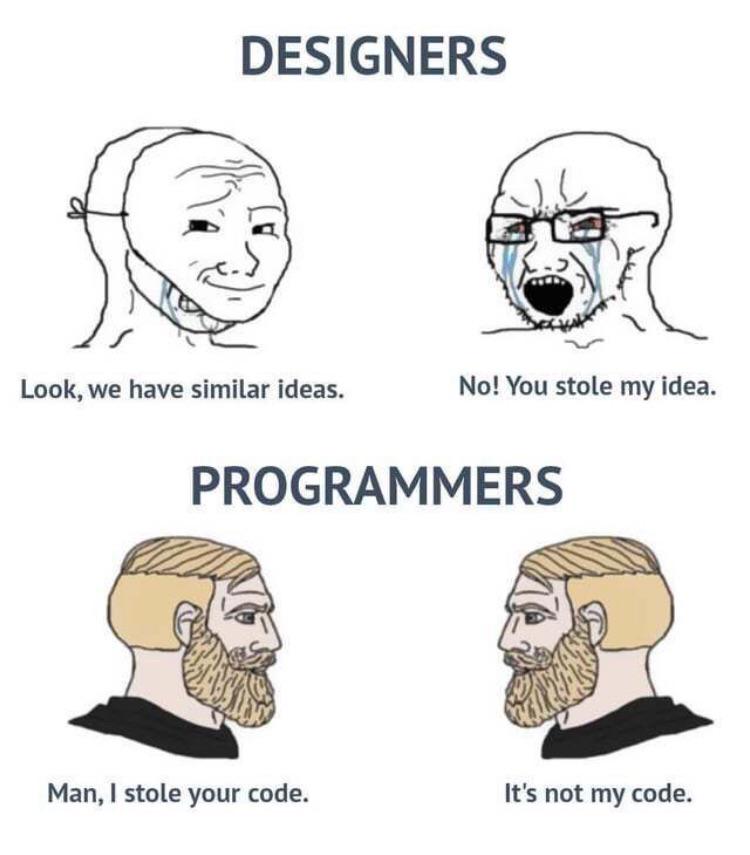
Designers fight over intellectual property like it's their firstborn child, while programmers casually admit to code theft with zero shame because... well, nobody actually owns that code anyway. It came from Stack Overflow, which came from someone's GitHub, which was adapted from a 2009 blog post, which was inspired by a Java tutorial from 2003. The chain of custody is so convoluted that claiming ownership is like trying to copyright air. We're all just remixing the same solutions to FizzBuzz at this point.

I Know It's Not As Easy As Using Claude But I Like It

I Know It's Not As Easy As Using Claude But I Like It
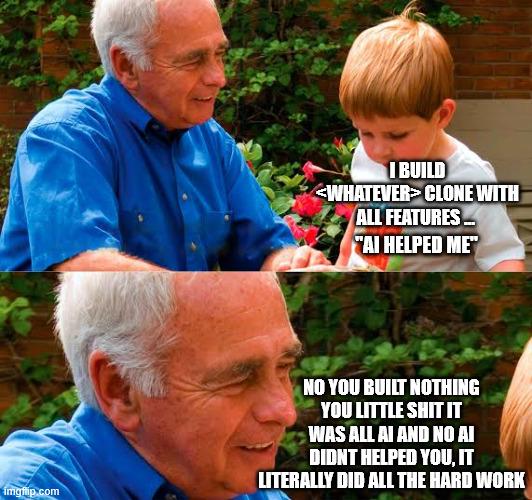
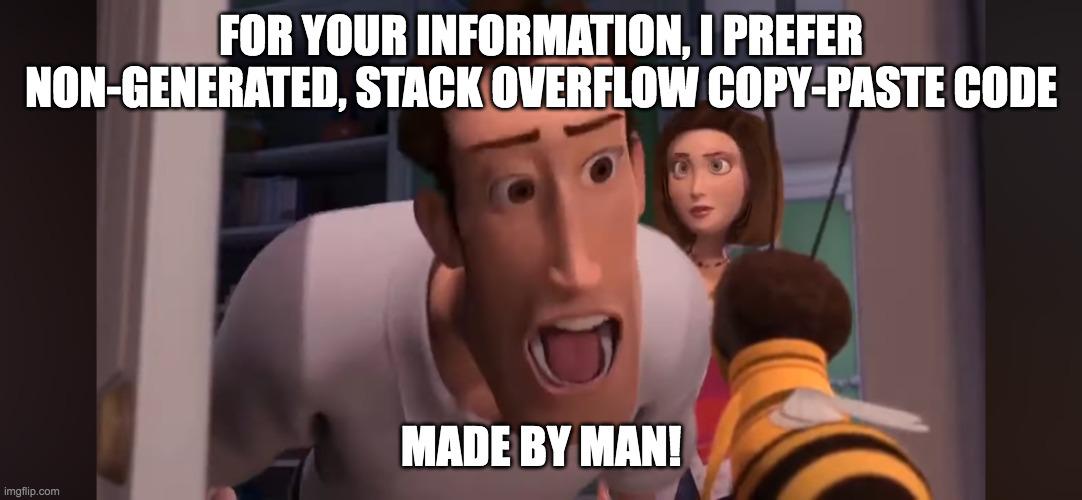
There's something oddly noble about defending your artisanal copy-paste workflow from Stack Overflow while everyone else is letting AI write their entire codebase. It's like insisting on hand-grinding your coffee beans while your coworker just bought a fully automated espresso machine that also does their taxes. Sure, Claude can generate an entire React component in 3 seconds, but where's the adventure in that? The thrill of the hunt through 47 Stack Overflow tabs, the careful selection of which answer from 2014 still works in 2024, the delicate art of renaming variables so it doesn't look too copy-pasted during code review—that's craftsmanship, baby. The dad's unhinged enthusiasm perfectly captures that defensive energy when someone questions your deliberately inefficient workflow. "MADE BY MAN!" he screams, as if manually Ctrl+C-ing code from a 10-year-old forum post is somehow more authentic than prompting an LLM. Both are technically copying someone else's work, but one makes you feel like a real developer™.

We Have All Done This

We Have All Done This
You're desperately trying to hide that beautiful, perfectly working code snippet you just yoinked from StackOverflow while your project manager casually strolls by. The plunger in hand really sells the "I'm just doing some totally original maintenance work here" vibe. The genius part? That code probably solves a problem that would've taken you 4 hours to figure out yourself, but now you're acting like you just committed a felony. Meanwhile, the PM has no idea that 80% of the codebase is held together by StackOverflow answers, prayer, and that one guy who answered a question in 2014. Pro tip: Just make sure you understand what you're pasting before the inevitable bug report comes in and you have to explain why your authentication system is using a regex from a thread about parsing HTML.

Seems Pretty Straightforward To Me...

Seems Pretty Straightforward To Me...
The mental gymnastics developers perform when they copy-paste code from Stack Overflow without attribution. If you're not technically claiming you wrote it yourself, then you're just... redistributing open-source knowledge, right? Right?! The logic is flawless: that npm package you "borrowed" for your production app? Not stolen—just indefinitely borrowed. That entire authentication system you ctrl+C'd from GitHub? You're honoring the developer by using their work. It's basically a compliment. Bonus points if you've ever justified using unlicensed software with "I'm just testing it" for the past 3 years. The cognitive dissonance is strong with this one, and honestly? It's the foundation of half the internet.

100Pcs Programming Stickers for Laptop, Water Bottles - Coding, Developer, Geeky Stickers Vinyl - Gifts for Computer Programmers, for Coders - Programming Party Supplies

100Pcs Programming Stickers for Laptop, Water Bottles - Coding, Developer, Geeky Stickers Vinyl - Gifts for Computer Programmers, for Coders - Programming Party Supplies
Sticks Well on Multiple Surfaces – Our premium vinyl stickers are made to stick securely to laptops, water bottles, phone cases, journals, skateboards, and even car windows. Each sticker uses durable…

Who Is He Anyway

Who Is He Anyway
You know you're dealing with a true "vibe coder" when they can make things work but have absolutely zero clue what's happening under the hood. They're out here calling JSON methods like they're summoning ancient spirits, completely unaware that JSON is just a data format specification, not some guy named Jason who writes their code. The beautiful irony here is that they're confidently using JSON.stringify() in production while having zero understanding of what JSON actually stands for (JavaScript Object Notation, in case you're wondering). They've probably copy-pasted it from Stack Overflow so many times it's become muscle memory, but ask them to explain the difference between JSON and a JavaScript object? Suddenly they need to "check Slack real quick." Honestly though, we've all been there. Sometimes code just works and you don't ask questions. Ignorance is bliss until the code review.

It's All Relative

It's All Relative
The grass is always greener on the other side, isn't it? PHP devs are drowning in spaghetti code, copy-pasting the same helper functions across 12,000 lines because nobody bothered to create a proper module system. Meanwhile, Java devs are over here with their enterprise-grade architecture—you know, the kind where you need to traverse 47 abstract factory singleton builders just to instantiate a simple object. One side dreams of structure and organization, the other side is begging for simplicity and less boilerplate. Classic case of "you don't know what you have until you're stuck in the opposite nightmare." Both are miserable, just in different flavors.

Uhmmmm Azing

Uhmmmm Azing
Picture this: You just copy-pasted some Stack Overflow magic, slapped together a solution that somehow works, and now your team wants you to explain your "genius" during code review. The room is literally on fire with questions, everyone's staring at you expectantly, and you're sitting there like "THIS IS FINE" because you have ZERO idea what half of those functions actually do. You just vibed your way through it, threw in some methods you saw in a tutorial once, and prayed to the coding gods it would compile. Now you're supposed to explain your architectural decisions? Bestie, the only architecture here is a house of cards held together by hopes and dreams. The sheer AUDACITY of thinking you could just wing it and not face consequences in the form of senior developers asking "but why did you use this pattern?" Ma'am/Sir, there was no pattern. There was only panic and caffeine.

The Last One Is So Me

The Last One Is So Me
The hierarchy of sophistication in programmer copy-paste etiquette. We start with the peasant who right-clicks like it's 1995, evolve to the keyboard shortcut user who discovered productivity, and finally ascend to the paranoid developer who spam-presses Ctrl+C five times because trust issues with your clipboard are totally justified. That moment of doubt—"Did it actually copy?"—hits different when you're about to paste into production. The multiple C's are basically insurance against the universe's tendency to screw with developers at the worst possible moment.

Lenovo ThinkPad P14s Gen 6 Copilot+ Mobile Workstation 14.0" IPS WUXGA

Lenovo ThinkPad P14s Gen 6 Copilot+ Mobile Workstation 14.0" IPS WUXGA
[Powerful Performance] Zen 5 Gen Ryzen AI 7 350 2.00GHz Processor (upto 5 GHz, 16MB Cache, 8-Cores, 16-Threads, ); AMD Radeon 860M shared Integrated Graphics · [High Speed and Multitasking] 64GB DDR5…

Be Careful

Be Careful
Copying code from Stack Overflow is like handling a wild animal—you gotta be gentle and careful, or it'll bite you. One wrong move and suddenly your entire codebase is riddled with deprecated methods, mysterious global variables, and that one answer from 2012 that definitely doesn't work anymore but has 500 upvotes. The delicate paste operation shown here perfectly captures the anxiety of transplanting someone else's solution into your Python project. Will it work? Will it break everything? Did they even test this? Why are there three different imports for the same thing? These are questions you'll ask yourself while nervously hitting Ctrl+V. Pro tip: Always read the comments below the answer. That's where the real wisdom lives—usually someone pointing out why this solution will destroy your production environment.

Hard Carried

Hard Carried
Stack Overflow is basically the MVP carrying your entire programming career on its back while you're down there flailing around like a dehydrated sponge. You're "learning to code" but let's be real—you're just getting really good at copying and pasting solutions from that one guy who answered a question in 2013. Without Stack Overflow, half of us would still be stuck trying to figure out why our for-loop runs one extra time. It's not education, it's dependency with extra steps.

You Always Hit It 3 Times

You Always Hit It 3 Times
Trust issues manifest differently in developers. CTRL+V? Sure, paste once and move on like a well-adjusted human being. CTRL+C though? That's where the paranoia kicks in. Everyone knows you gotta hit that copy shortcut at least three times because what if the first one didn't register? What if the second one was a fluke? Better make it three to be absolutely certain your clipboard actually has the content. It's basically the programmer's version of checking if you locked the door. The bar chart perfectly captures this neurosis—sky-high confidence in paste, microscopic faith in copy. Because nothing haunts you quite like pasting the wrong thing into production and realizing you never actually copied what you thought you did.