Cloudflare Memes

Posts tagged with Cloudflare
True Random

True Random
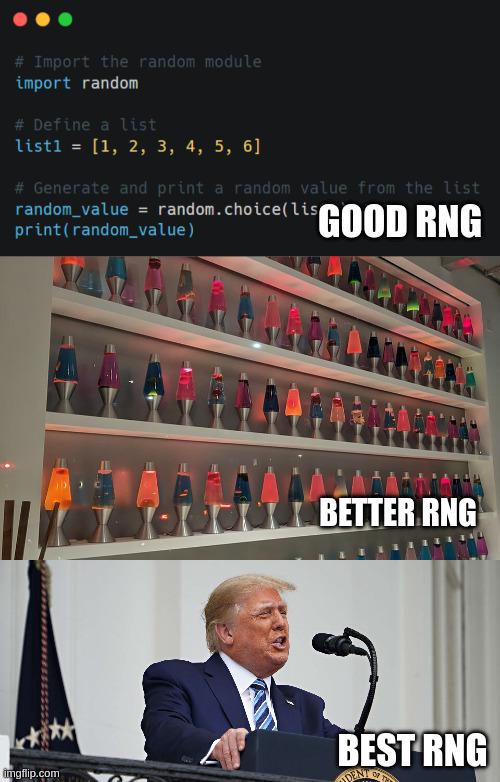
When someone asks for a random number generator and you show up with a wall of lava lamps. Because apparently, the chaotic movement of blobs in lava lamps is more trustworthy than your computer's pseudo-random number generator. Fun fact: Cloudflare actually uses a wall of lava lamps (called LavaRand) to generate truly random numbers for cryptographic keys. They photograph the lamps and use the unpredictable patterns as entropy. It's one of those rare moments where the ridiculous solution is actually the correct one. Meanwhile, your average developer is still using Math.random() and calling it a day. The skeptical look in the last panel? That's every security engineer when you tell them your RNG is "good enough."

Which One Of You Clowns Did This

Which One Of You Clowns Did This
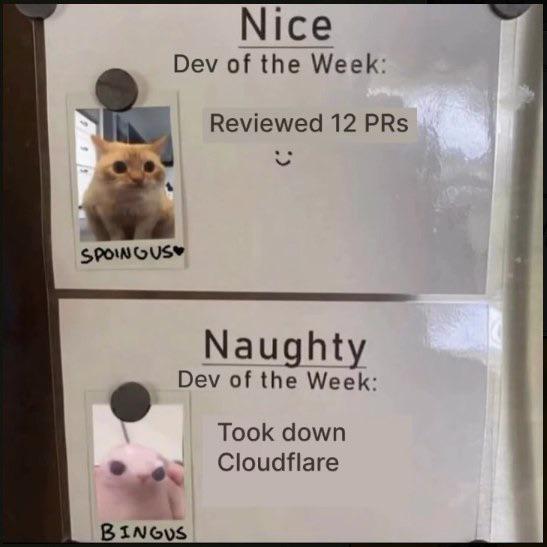
The office whiteboard hall of fame vs. hall of shame is giving major chaotic energy. Spongusv gets the gold star for reviewing 12 PRs (probably caught every missing semicolon and suggested renaming variables to be more "semantic"). Meanwhile, Bingus decided to speedrun their villain arc by taking down Cloudflare. You know, just casually disrupting a significant chunk of the internet's infrastructure. The duality here is *chef's kiss*—one dev is grinding through code reviews like a responsible team player, while the other is out here committing acts of digital terrorism. Someone check Bingus's git history because I'm betting there's a rogue deployment script with a commit message that just says "YOLO" or "fix bug" followed by 47 fire emojis. Plot twist: Bingus probably just fat-fingered a DNS config change during their Friday afternoon deploy. Classic.

Cloud Native

Cloud Native
CTO proudly announces they've migrated 95% of their infrastructure to the cloud. Resilient! Scalable! Modern! Buzzword bingo complete. Someone asks the obvious question: "Doesn't that mean we're entirely dependent on—" but gets immediately shut down by the true believers chanting about best practices and industry standards. Nothing can go wrong when you follow the herd, right? Cloudflare goes down. Entire internet broken. Good luck. Turns out that 95% they were bragging about? Yeah, that's how much of their infrastructure just became very expensive paperweights. But don't worry, everyone else is down too, so technically it's a shared problem. That's what cloud-native really means: suffering together at scale.

Cloud Native

Cloud Native
CTO proudly announces they've migrated 95% of their infrastructure to the cloud, throwing around buzzwords like "resilient," "scalable," and "modern" to a room full of impressed stakeholders. Then someone asks the uncomfortable question: "Doesn't that mean we're entirely dependent on—" but gets cut off by the true believer shouting about best practices and industry standards. Nothing can go wrong when you follow the herd, right? Cut to: Cloudflare goes down and the entire internet breaks. Major outage. Good luck! Boss nervously asks how much of their infrastructure is affected. The answer? That 95% they were bragging about. But don't worry! The good news is they're only down when everyone else is down too. Misery loves company, and so does vendor lock-in. Who needs redundancy across multiple providers when you can just... hope really hard that AWS/Azure/GCP stays up? Turns out "cloud-native" sometimes just means "native to someone else's problems."

Gentlemen A Short View Back To The Past

Gentlemen A Short View Back To The Past
Cloudflare outages have become the developer's equivalent of "my dog ate my homework" - except it's actually true half the time. The beauty here is that while your manager is frantically screaming at you to fix the site, you're just sitting there sipping coffee because literally nothing is under your control. The entire internet could be on fire, but as long as Cloudflare's status page shows red, you're untouchable. It's the perfect alibi: externally verifiable, affects millions of sites simultaneously, and best of all - there's absolutely nothing you can do about it except wait. Some devs have been known to secretly celebrate these outages as unexpected coffee breaks. The other guy clearly hasn't learned this sacred defense mechanism yet.

Internal Server Error

Internal Server Error
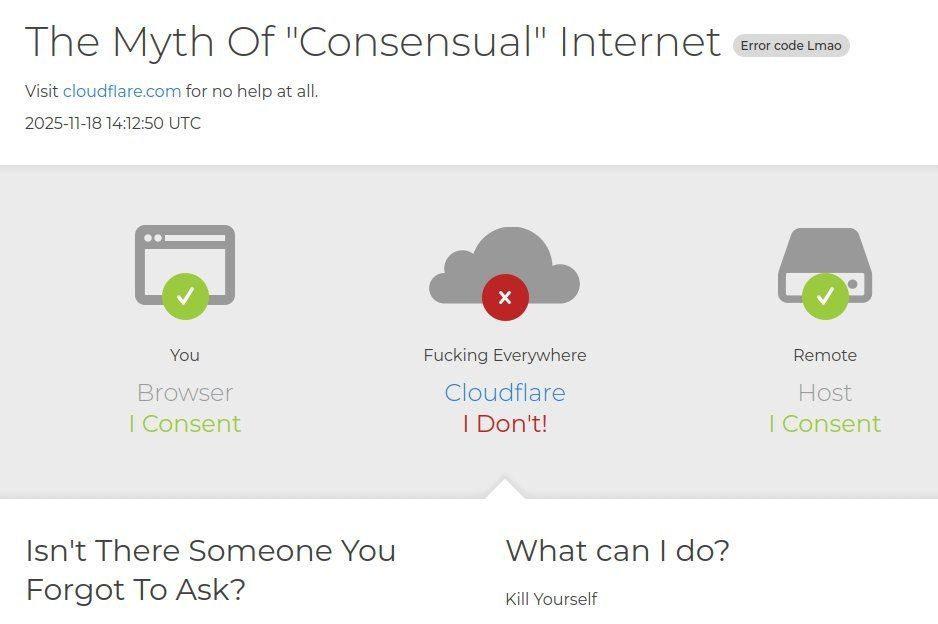
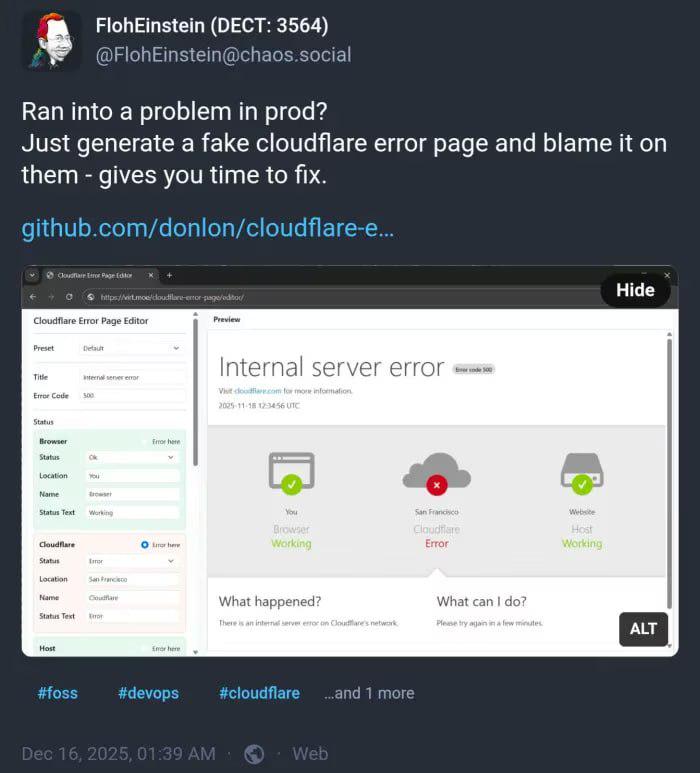
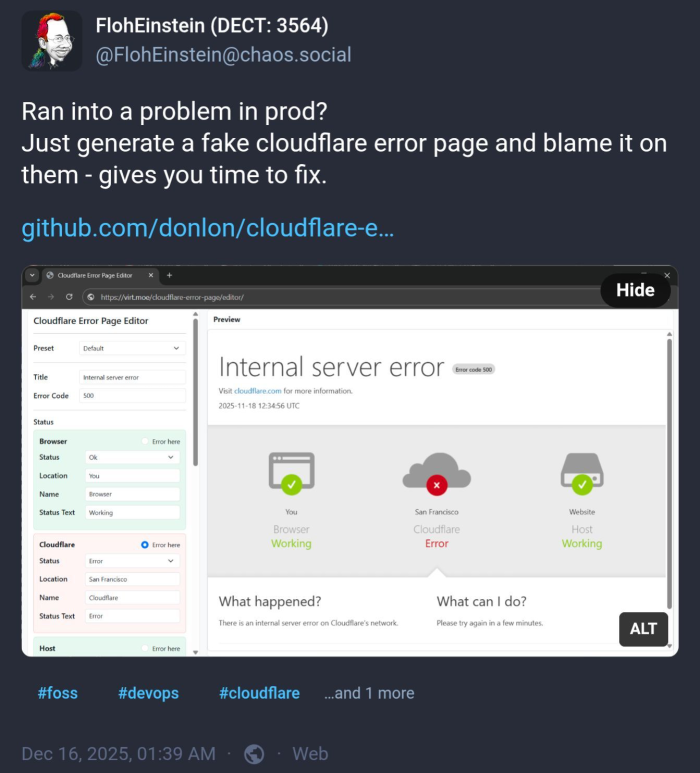
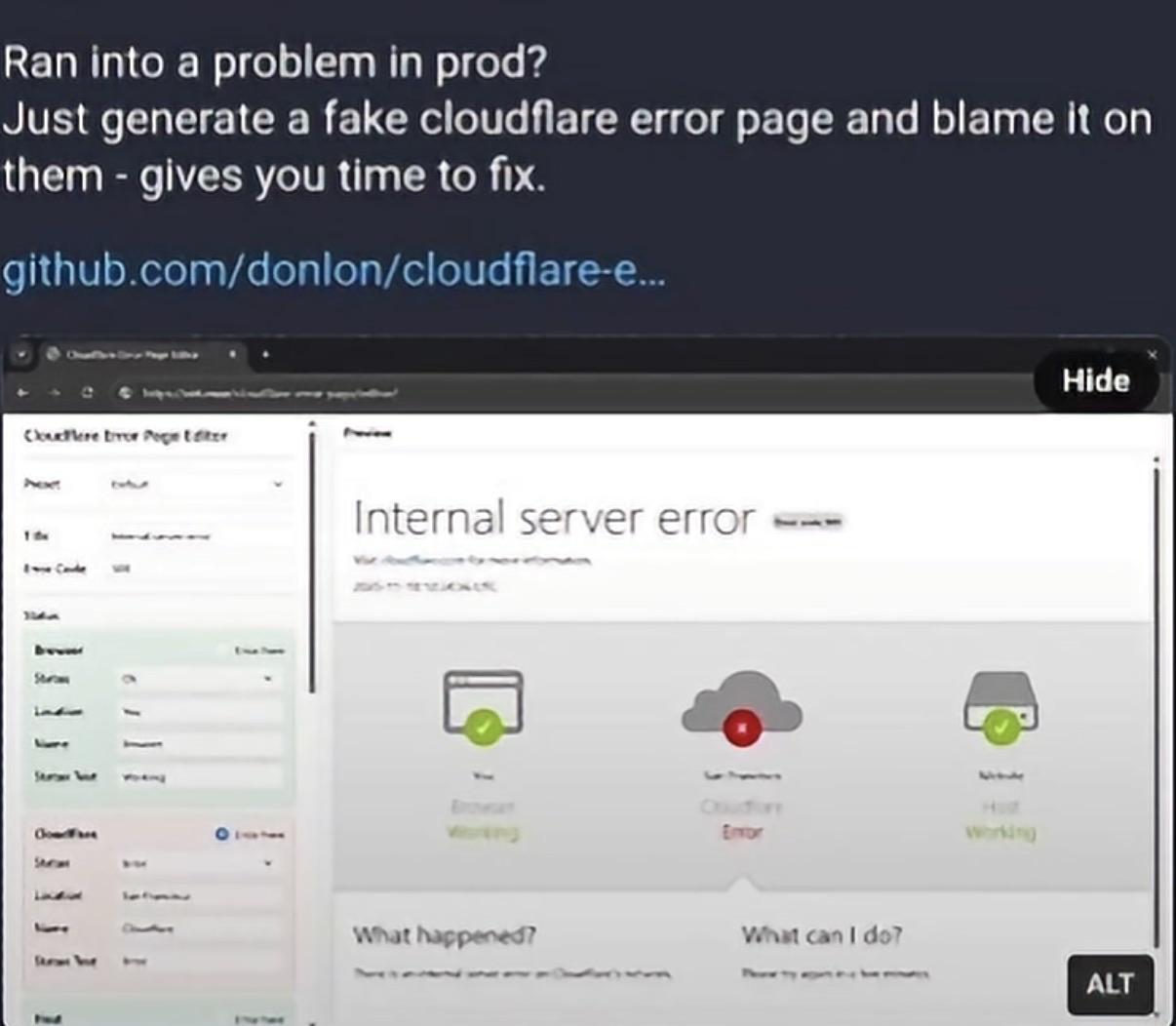
Someone built a Cloudflare error page generator so you can fake outages and buy yourself precious debugging time. Because nothing says "professional incident response" like gaslighting your users into thinking it's Cloudflare's fault when your spaghetti code just threw up. The tool literally lets you customize everything—error codes, locations, status messages—so you can craft the perfect alibi while you frantically grep through logs trying to figure out why your production database just decided to take a nap. It's the digital equivalent of pointing at someone else and running away. Peak DevOps strategy: deflect, delay, and deploy the blame elsewhere. Your manager will never know the difference between a real Cloudflare outage and your nil pointer exception. Probably.

It's Not Our Fault It's Cloudflare's

It's Not Our Fault It's Cloudflare's
Someone just created the ultimate scapegoat generator and honestly? It's GENIUS. Break production at 3 AM? Just whip up a professional-looking Cloudflare error page and watch your boss's anger evaporate faster than your motivation on a Monday morning. The tool literally lets you customize every detail—error codes, timestamps, status messages—so you can craft the perfect "it wasn't me, it was the CDN" alibi. Your browser? Working. Cloudflare? Error. Your website? Also working (allegedly). The perfect crime doesn't exi— The best part? It looks SO legitimate that even your senior dev might believe you. Finally, a tool that understands the developer's most important skill isn't coding—it's creative blame distribution.

Shift Blame

Shift Blame
Someone built a tool that generates fake Cloudflare error pages so you can blame them when your code inevitably breaks. Because nothing says "professional developer" quite like gaslighting your users into thinking a billion-dollar CDN is responsible for your spaghetti code crashing. The tool literally mimics those iconic Cloudflare 5xx error pages—complete with the little cloud diagram showing where things went wrong. Now you can replace your default error pages with these beauties and watch users sympathetically nod while thinking "ah yes, Cloudflare strikes again" instead of "this website is garbage." It's the digital equivalent of pointing at someone else when you fart. Genius? Absolutely. Ethical? Well, let's just say your database queries timing out because you forgot to add indexes is now officially a "Cloudflare issue."

Follow Me For More Tips

Follow Me For More Tips
Oh honey, nothing says "I'm a catch" quite like bonding over shared trauma from a Cloudflare outage. While normal people use pickup lines about eyes and smiles, our brave developer here is out here weaponizing infrastructure failures as conversation starters. "Hey girl, did you also spend three hours refreshing your dashboard in existential dread?" Romance is DEAD and we killed it with status pages and incident reports. But honestly? If someone brought up that Cloudflare crash on a first date, I'd probably marry them on the spot because at least we'd have something real to talk about instead of pretending we enjoy hiking.

It Happened Again

It Happened Again
Ah yes, the classic "workplace safety sign" energy. You know that feeling when your entire infrastructure has been humming along smoothly for over two weeks? That's when you start getting nervous. Because Cloudflare going down isn't just an outage—it's a global event that takes half the internet with it. The counter resetting to zero is the chef's kiss here. It's like those factory signs that say "X days without an accident" except this one never gets past three weeks. And the best part? There's absolutely nothing you can do about it. Your monitoring alerts are screaming, your boss is asking questions, and you're just sitting there like "yeah, it's Cloudflare, not us." Then you watch the status page refresh every 30 seconds like it's going to magically fix itself. Pro tip: When Cloudflare goes down, just tweet "it's not DNS" and wait. That's literally all you can do.

The Uncalled Function Destroyer

The Uncalled Function Destroyer
Seventeen days in and this developer has already achieved enlightenment: deleting dead code with zero hesitation. Most engineers spend months tiptoeing around unused functions like they're ancient artifacts that might curse the entire codebase if disturbed. Not this legend. They're out here Marie Kondo-ing the repo on day seventeen, yeeting functions straight to main like they own the place. The energy here is immaculate. No pull request anxiety, no "but what if we need it later?" Just pure, unfiltered confidence in code deletion. Either they're incredibly brave or their onboarding process was chef's kiss . Meanwhile, senior devs are probably sweating bullets wondering if that function was actually load-bearing for some obscure edge case from 2019. Pro tip: Dead code is like that gym membership you never use. It costs nothing to keep around, but deep down you know it's just taking up space and making you feel guilty.

Gentlemen A Short View Back To The Past

Gentlemen A Short View Back To The Past
Cloudflare going down has become the developer's equivalent of "my dog ate my homework" - except it's actually true about 40% of the time. The other 60% you're just on Reddit. The beautiful thing about Cloudflare outages is they're the perfect scapegoat. Your code could be burning down faster than a JavaScript framework's relevance, but if Cloudflare has even a hiccup, you've got yourself a get-out-of-jail-free card. Boss walks by? "Can't deploy, Cloudflare's down." Standup meeting? "Blocked by Cloudflare." Missed deadline? You guessed it. The manager's response of "Oh. Carry on." is peak resignation. They've heard this excuse seventeen times this quarter and honestly, they're too tired to verify. When a single CDN provider has enough market share to be a legitimate excuse for global productivity loss, we've really built ourselves into a corner haven't we?