Bug hunting Memes

Posts tagged with Bug hunting

Just Got To Double Check

Just Got To Double Check
You know that moment when you're debugging and stumble across an error message so absurd, so utterly bizarre, that you have to lean back in your chair and really process what you're seeing? Like "Error: Potato is not a valid database" or "Cannot read property 'undefined' of undefined of undefined." Your brain goes into full detective mode because surely, SURELY, this can't be what's actually breaking your code. The shrimp sitting in the chair represents you, the developer, carefully examining this comedic masterpiece of an error message. You're convinced it's a rabbit hole that'll send you spiraling through 47 Stack Overflow tabs, your entire codebase, and possibly questioning your career choices. But nope—sometimes a shrimp is just a shrimp. Sometimes the error is exactly what it says, no matter how ridiculous it sounds. The paranoia is real though. We've all been burned by that one time the "simple" error turned into a 6-hour debugging session involving race conditions, memory leaks, and existential dread.

This Little Maneuver Gonna Cost Us Fifty One Years

This Little Maneuver Gonna Cost Us Fifty One Years
Writing code is pure bliss. You're in the zone, fingers flying across the keyboard, creating beautiful abstractions, feeling like a god. Then you hit run and something breaks. Now you're stepping through line 247 for the 18th time, questioning every life decision that led you to this moment, wondering if that business degree your parents suggested wasn't such a bad idea after all. The debugging phase is where dreams go to die and Stack Overflow tabs multiply like rabbits. You'll spend 4 hours hunting down a bug only to discover you misspelled a variable name or forgot a semicolon in a language that actually needs them. The ratio of coding time to debugging time is basically a lie we tell ourselves to get through the day.

Disappointed Yet Again

Disappointed Yet Again
Oh, the eternal cycle of hope and despair! You Google your bug, find a GitHub issue from 2017, and think "FINALLY! Someone else suffered through this nightmare and surely the devs have blessed us with a fix by now!" But NOPE. You scroll through four entire pages of people begging for a solution, only to find h4t0n dropped a comment last week asking "any progress on this?" and the silence is DEAFENING. The "GODDAMMIT" at the end? That's the sound of your soul leaving your body as you realize you're about to become comment number 247 asking the same question. Spoiler alert: there will be no progress. There never is. Welcome to open source, where issues from the Obama administration still haunt us. 💀

Average Workday Of A Game Developer, Right?

Average Workday Of A Game Developer, Right?
Oh, you thought game development was about creating cool mechanics and designing epic levels? THINK AGAIN, SWEETIE. It's actually 95% archaeological excavation trying to understand why that ONE feature that's been working flawlessly since February suddenly decided to throw a tantrum and die for absolutely NO REASON. The tiny sliver for "working on new features" is honestly generous. That's probably just the 15 minutes between your morning coffee and the moment you discover that the jump mechanic now makes characters teleport into the void. The rest? Pure detective work, except the murder victim is your sanity and the killer is your own code from three months ago. Welcome to game dev, where "it works on my machine" becomes "it worked for six months and now it doesn't" and nobody knows why. The mystery deepens, the deadline approaches, and that new feature you wanted to build? Yeah, maybe next quarter.

Interesting Problems Bring Management Headaches

Interesting Problems Bring Management Headaches
The moment you utter the word "interesting" about a bug or technical challenge, your manager's fight-or-flight response kicks in. To you, it means you found something intellectually stimulating that might require some creative problem-solving. To them, it translates to: delayed timelines, scope creep, potential system meltdowns, and having to explain to stakeholders why the "simple feature" is now a three-week research project. Developers live for these moments—the weird edge cases, the bizarre race conditions, the "wait, that shouldn't even be possible" scenarios. Management lives in fear of them. It's the eternal conflict between curiosity and deadlines, between engineering elegance and shipping code that just works™.

Wait What...

Wait What...
You know that mini heart attack when the compiler says "Error on line 42" and you frantically scroll to line 42, only to find it's a completely innocent closing brace? Then you look at line 43 and see the actual problem starting there. The error message is technically correct but also absolutely useless because the real issue is never where it claims to be. Compilers have this delightful habit of detecting errors at the point where they finally give up trying to make sense of your code, not where you actually messed up. That missing semicolon on line 38? The compiler won't notice until line 42 when it's like "wait, what is happening here?" It's the developer equivalent of your GPS saying "you missed your turn" three blocks after you actually missed it. Thanks, I hate it.

Forgot The Base Case

Forgot The Base Case
Picture this: You've tested your datepicker with negative numbers, special characters, null values, edge cases from the ninth circle of hell itself. You're basically a QA god at this point. But then someone asks what you actually put IN the datepicker and—plot twist—it was A DATE. You know, the ONE thing a datepicker is literally designed to handle? The base case? The most OBVIOUS input imaginable? That's right, folks. Our hero tested everything EXCEPT the actual happy path. It's like stress-testing a bridge with tanks and earthquakes but forgetting to check if a regular car can drive across it. The awkward silence says it all. Sometimes the most catastrophic bugs hide in plain sight, wearing a sign that says "I'm literally the primary use case." Chef's kiss of irony right there.

I Hate How Accurate This Is

I Hate How Accurate This Is
You know you've reached peak programmer when a missing semicolon causes more emotional damage than a breakup. While normal people lose sleep over relationships, we're here at 3 AM staring at our screen like a detective, hunting down that one tiny punctuation mark that's been sabotaging our entire application. The worst part? Your IDE probably highlighted it 47 times, but your brain was too busy being a genius to notice. Four days of debugging, Stack Overflow deep dives, rubber duck conversations, and questioning your career choices... all because of a character that's literally smaller than an ant. Pro tip: The bug is always in the last place you look, which coincidentally is always the first line you wrote.

Always The Ones You Suspect The Most

Always The Ones You Suspect The Most
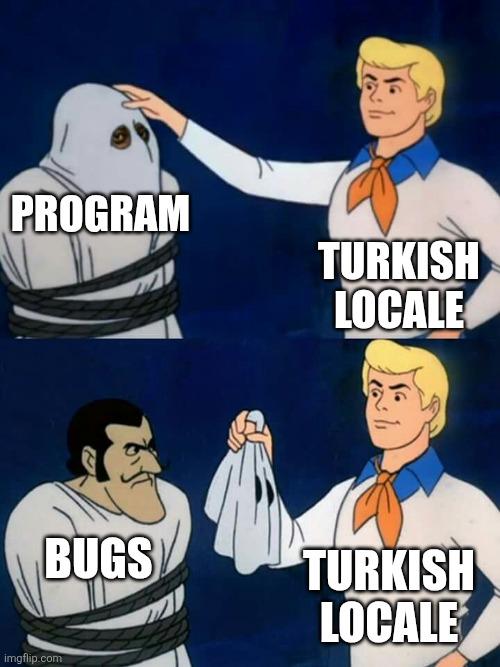
The Scooby-Doo unmasking format strikes again, but instead of revealing the villain, we're exposing the real culprit behind production bugs: ourselves. You spend hours blaming the framework, the compiler, legacy code, that one intern from 2019, maybe even cosmic radiation flipping bits in RAM. But when you finally trace through the git blame and check the commit history, surprise! It was your own code from 3 AM last Tuesday when you thought you were being clever with that "quick fix." The real horror isn't finding bugs—it's discovering you're the villain in your own debugging story. At least when it's someone else's code, you can feel morally superior while fixing it. When it's yours? Just pure existential dread and a strong desire to delete your commit history.

Full Drama

Full Drama
Nothing quite like the adrenaline rush of a critical bug discovered at 4:57 PM on the last day of the testing phase. Your QA engineer suddenly transforms into a theatrical villain, orchestrating chaos with surgical precision. The project manager is already mentally drafting the delay email. The developers are experiencing the five stages of grief simultaneously. And somewhere, a product owner is blissfully unaware that their launch date just became a suggestion rather than a reality. The timing is always immaculate—never day one, never mid-sprint. Always when everyone's already mentally checked out and the deployment scripts are warming up.

Situation, That Is Happened To Me Rn

Situation, That Is Happened To Me Rn
You're out here debugging your game's collision detection, zooming in with your metaphorical telescope trying to figure out why bullets are phasing through enemies like they're ghosts. Is it the hitbox? The timing? The physics engine being moody? Meanwhile, the actual problem is sitting right under your nose: enemy collision on a second layer. Classic game dev moment where you're investigating quantum mechanics when the issue is just that your enemies are literally on a different Z-layer and can't interact with anything. It's like trying to figure out why your keys are missing when they're in your other pocket the whole time.

Heroes And Villains

Heroes And Villains
This comic brilliantly captures how different dev roles handle bugs with wildly different energy levels. JavaScript devs panic-flee from bugs like they're on fire (accurate), then copy-paste Stack Overflow solutions while literally burning, and convince themselves the weight of technical debt is totally fine. Classic. Backend devs go full Batman mode—methodically tracking down bugs with detective skills, then hunting down whichever dev committed the cursed code. The cape is metaphorical but the intimidation is real. Web devs are Spider-Man releasing bugs into production, then trying to "organize" them (read: make it worse), until someone yells "SUDO" and they have no choice but to comply. The power of root commands compels you! Technical Support are the Jedi mind-tricking users that obvious bugs are "features." Three times. With a straight face. It's not a crash, it's an unexpected exit feature! QA is literally Godzilla destroying everything in sight, then casually leaving. Their job is chaos, and they're excellent at it. C++ devs can't find bugs because they're too busy dealing with segfaults, memory leaks, and undefined behavior. Solution? Rage quit with rm -rf and the Infinity Gauntlet. If you can't fix it, delete everything.