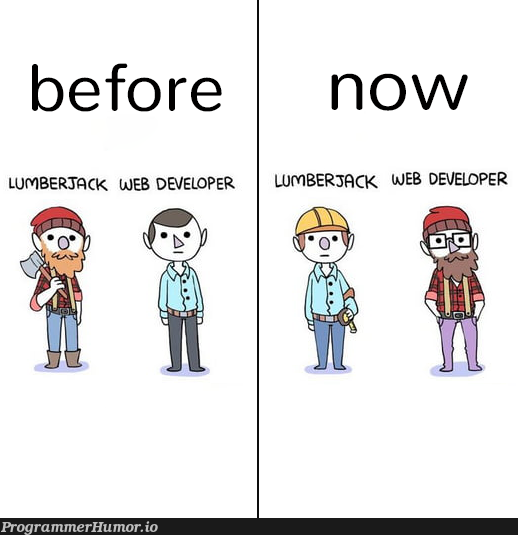
Bro I Literally Told You This Is Not Good Idea

Bro I Literally Told You This Is Not Good Idea
You know that moment when your client insists on adding seventeen different features that completely contradict each other, and you're sitting there like "bestie, I promise you don't want this," but they're ADAMANT? And then you build exactly what they asked for because they're paying the bills, and suddenly the entire application is stuck in a tree, unable to move forward OR backward, just... existing in a state of pure architectural chaos? Yeah. That's what happens when you let users dictate technical decisions without any pushback. The developer tried to warn them, probably sent a whole essay in Slack about scalability concerns and user experience nightmares, but noooo—they wanted it THEIR way. Now look at this beautiful disaster, dangling precariously between branches of bad decisions and "but the user wanted it!" The app works, technically, but at what cost? AT WHAT COST?!

Vibecoder Asked For Last Minute Interview Tips

Vibecoder Asked For Last Minute Interview Tips
Someone's out here applying for machine learning positions with "vibecoding" as their primary qualification. You know, that cutting-edge ML technique where you just kinda feel what the model should do instead of actually understanding the math. The OP's response? "Yesssirr" – the sound of someone who's about to walk into an interview and confidently explain how gradient descent is when you slowly walk down a hill. The brutal "Best of luck with the interview!" at the end is chef's kiss. That's not encouragement, that's a eulogy. Somewhere, a hiring manager is about to ask about backpropagation and get an answer about good vibes propagating through the neural network.

Watching Me Lose 5 Games In A Row

Watching Me Lose 5 Games In A Row
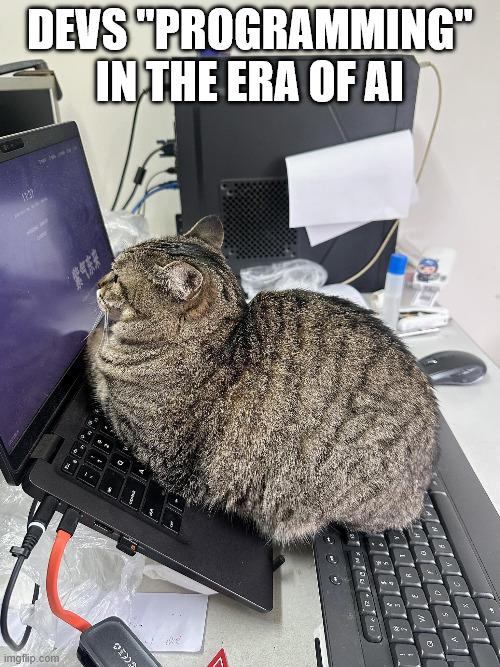
Your gaming PC sitting there with its RGB lights and high-end specs, watching you blame everything except your own skill. "It's the lag," you say. "The matchmaking is broken," you insist. Meanwhile, your rig is internally screaming "I have 32GB of RAM and a 4090, maybe it's not the hardware, chief." That cat's expression is exactly what your $3000 machine looks like when you rage quit for the fifth time and start Googling "how to improve aim" instead of just practicing. The PC isn't judging you... it's just concerned about its life choices and wondering if it could've been used for something more productive like training ML models or rendering Blender scenes. At least when your code fails five times in a row, you can blame the compiler.

Reason Behind Premature Exhaustion Of Tokens

Reason Behind Premature Exhaustion Of Tokens
Asking Claude Opus to center a div is like using a flamethrower to light a birthday candle. Sure, it'll work, but you just burned through your entire monthly token budget to learn that display: flex; justify-content: center; align-items: center; exists. Nothing says "I have more money than sense" quite like consuming 200K tokens for what amounts to a two-line CSS solution that's been copy-pasted since 2015. Your API bill just screamed in agony while Claude generated a 47-paragraph essay on the philosophical implications of horizontal alignment before finally giving you the answer. Meanwhile, your coworker just Googled it in 3 seconds. But hey, at least you got to feel like you're living in the future while bankrupting yourself over basic frontend tasks.

The Ultimate Terminal Trap

The Ultimate Terminal Trap
Valve really played 4D chess here. They marketed the Steam Deck as this revolutionary handheld gaming device for Windows gamers who just want to play their Steam library on the go. Innocent enough, right? Wrong. The thing runs Linux under the hood, and before you know it, you're googling "how to install custom proton versions" and reading Arch Wiki at 2 AM. It's the perfect gateway drug. You start by just playing Elden Ring in bed, then you're SSH-ing into your Deck, tweaking performance settings via command line, and suddenly you're dual-booting your main rig because "maybe Windows really IS bloat." Valve didn't just make a handheld console—they made a sleeper agent that converts gamers into Linux enthusiasts one frame-time optimization at a time.

Adopting Claude Speak In Regular Life

Adopting Claude Speak In Regular Life
When you spend too much time with Claude AI, you start adopting its signature move: being technically correct while completely useless. "You're right to push back" is Claude's diplomatic way of saying "I was wrong but let me make it sound like a collaborative decision." The partner asks a simple yes/no question, gets a confident affirmative, only to discover reality disagrees. Instead of just admitting the dishes are still dirty, our protagonist channels their inner AI and validates the pushback like they're in some kind of pair programming session gone domestic. The beauty here is how AI assistants have trained us to communicate in this overly-polite, responsibility-dodging corporate speak even when we're just trying to explain why we lied about chores.

How Confident

How Confident
You know that junior dev who just discovered VS Code extensions and now suddenly thinks they're Linus Torvalds? That's the vibe here. The "Vibe Coder" is out here demanding respect from the Senior Developer with the energy of someone who just learned what a for-loop does yesterday. The sheer audacity of "Look at me. I am the programmer now" after probably copy-pasting three Stack Overflow answers is chef's kiss. Meanwhile, the senior dev is just standing there, probably contemplating their life choices and wondering if it's too late to switch to farming. The confidence-to-competence ratio is absolutely off the charts, and we've all either been that person or worked with them. Spoiler alert: writing `console.log("Hello World")` doesn't make you the captain now.

AstroAI Digital Multimeter Tester 2000 Counts with DC AC Voltmeter and Ohm Volt Amp Meter; Measures Voltage, Current, Resistance, Continuity and Diode, Black

AstroAI Digital Multimeter Tester 2000 Counts with DC AC Voltmeter and Ohm Volt Amp Meter; Measures Voltage, Current, Resistance, Continuity and Diode, Black
Versatile Digital Multimeter - Accurately measures AC/DC Voltage, DC Current, Resistance, and Diode. This Multimeter is a really useful tool for solving industrial and household electrical issues. Su…

Keep Competitors On Toes

Keep Competitors On Toes
Ah yes, the ancient art of psychological warfare through Internet Explorer 6. Nothing says "I'm a professional threat analyst" quite like firing up a browser from 2001 to casually terrorize your competition's analytics dashboard. Imagine their poor DevOps team frantically Slacking each other: "WHO IS STILL RUNNING IE6?! IS THIS A TIME TRAVELER?!" The comments take it to absolutely UNHINGED levels of chaos. Random resolutions like 5000x100? *Chef's kiss*. Their product manager is probably having an existential crisis trying to justify supporting a screen shaped like a bookmark. And the abandoned checkout strategy with spoofed Netscape Navigator headers? That's not just keeping them on their toes—that's making them question reality itself. "We have high-paying customers stuck on Netscape 1.0" is the kind of sentence that makes CTOs weep into their coffee. Chaotic neutral energy at its finest. Absolutely diabolical, completely harmless, and guaranteed to make some poor analyst's weekly report look like a fever dream.

The Software Development Lifecycle In One Image

The Software Development Lifecycle In One Image
So you've got programmers writing perfect code like they're crafting a masterpiece. Then testers show up and immediately break everything because that's literally their job description. Developers rush in to fix all the bugs the testers found, creating a nice little circular workflow. But wait—here comes the client with a chainsaw, cutting down the entire tree of work you've been carefully building. Requirements? Changed. Architecture? Obsolete. That feature you spent three sprints perfecting? Yeah, they don't want it anymore. They want something completely different now. The real SDLC isn't a cycle at all. It's a tree that gets chopped down every few weeks, and you're left standing there with your test suite wondering why you even bothered with that comprehensive documentation.

My Currently Non Technical Mom Is Learning Robotics

My Currently Non Technical Mom Is Learning Robotics
Mom's learning robotics and has already discovered the most sacred developer ritual: paranoid version control before version control even existed. She's backing up her YAML file by... copying the folder to another location and printing physical copies. 25 lines. Printed. On paper. The kid finds this hilarious and calls it "old school," but honestly? Mom's implementing the grandfather-father-son backup strategy without even knowing it. She's got digital copies AND physical disaster recovery. Meanwhile, half of us have lost production code because we forgot to commit before force-pushing. The real kicker is that she's treating a 45-line YAML config file like it's the Declaration of Independence. But you know what? She'll never experience that cold sweat moment when you realize you just overwrote your only copy. Mom's playing 4D chess while we're all living one "git push --force" away from a mental breakdown.

What Do You Mean

What Do You Mean
You know you've reached peak software engineering when you need to write unit tests to verify that your unit tests are working correctly. The recursive nature of testing your own code is like that inception moment where you question reality itself. Why trust your new code when you can't even trust the code you wrote five minutes ago? The circular logic here is chef's kiss – if the verification code has bugs, how would you even know? You'd need tests for your tests for your tests. It's turtles all the way down, except the turtles are all potentially buggy and none of them have been properly peer reviewed.

When The Devs Actually Care

When The Devs Actually Care
"Apple's got bugs in their networking stack that compromise security? No problem, we'll just work around it." This is the energy of a dev team that's seen some things. Instead of waiting for Apple to fix their mess (spoiler: they won't), they just said "fine, we'll do it ourselves" and secured their app anyway. It's the developer equivalent of duct-taping a leaky pipe because the landlord won't answer your calls. Sure, the underlying infrastructure is still broken, but at least your users are safe. That's what separates teams that ship from teams that just file Radars into the void and pray. The Chad energy here is real—taking ownership when the platform vendor drops the ball. A year later and Apple still hasn't fixed it, but who's surprised? Meanwhile, these devs are out here doing actual security work instead of pointing fingers.