Rust Developer

Rust Developer
When management decides it's time to rewrite that ancient C++ codebase in Rust for "memory safety" and "fearless concurrency," the Rust developer is up top having an existential crisis while the C++ legacy code just sleeps peacefully below, unbothered and battle-tested. The Rust dev is probably dealing with the borrow checker screaming about lifetimes, trying to figure out why Box<dyn Trait> won't compile, and questioning every life decision that led to this moment. Meanwhile, the C++ code has been running in production for 15 years with only minor segfaults on Tuesdays. The positioning is perfect: Rust developer literally above the problem, overthinking everything, while the legacy code is just vibing in blissful ignorance with its raw pointers and undefined behavior.

The Truth

The Truth
Four brutal truths that hit harder than a production outage at 3 AM. That beautiful, elegant code you crafted with tears and caffeine? Deleted in the next refactor. Meanwhile, that hacky mess you wrote in 20 minutes while hungover is somehow still powering critical systems three years later. And let's talk about that feature you spent weeks polishing to perfection—complete with edge cases, error handling, and beautiful architecture. Usage stats: 0. Literally nobody asked for it, nobody uses it, but hey, at least your code is clean. The cherry on top? That bug you've been chasing for days that only exists in your local environment? It'll magically appear during the client demo with 100% reproducibility. Murphy's Law isn't just a theory—it's a lifestyle in software development.

Rust Developer Vs C++ Legacy To Rewrite

Rust Developer Vs C++ Legacy To Rewrite
The Rust developer sits on top, hands clasped in prayer, absolutely terrified of what lies beneath. Meanwhile, the C++ legacy codebase is just chilling on the bottom bunk, completely unbothered, living its best life like the ancient eldritch horror it truly is. The absolute DREAD of being tasked to rewrite decades of C++ spaghetti into Rust is captured perfectly here. Sure, Rust promises memory safety and fearless concurrency, but have you SEEN what lurks in those old C++ codebases? Macros nested seven layers deep, manual memory management that defies the laws of physics, and comments from 1997 that just say "TODO: fix this later." The Rust dev knows they're about to spend the next six months deciphering what `void* ptr = (void*)((int)ptr + 0x42);` actually does while the borrow checker screams at them for crimes they didn't even commit. Sweet dreams are made of unsafe blocks, apparently.

Thanks For Asking...

Thanks For Asking...
You know that one person who treats their OS choice like a personality trait? Yeah, they found the perfect moment to announce it. At a funeral. Because nothing says "respectful mourning" quite like declaring your distro allegiance when literally nobody asked. The Linux user's ability to interject "I use Linux btw" into any conversation is truly legendary. Wedding? Linux. Funeral? Linux. Someone asking about the weather? Somehow... Linux. It's like they're running a cron job that triggers every 5 minutes to remind everyone of their superior operating system choice. The beauty here is the priest's innocent "Anybody want to say anything?" which was clearly meant for eulogies and fond memories, not a tech stack announcement. But hey, at least they didn't specify which distro. That would've started a fight right there at the gravesite.

The Daily Face Off

The Daily Face Off
Nothing quite like sitting there with your morning coffee, watching an AI assistant cheerfully rename 47 variables, move functions across 12 files, and somehow turn your working codebase into a compilation error symphony. The confidence is truly inspiring—zero hesitation, just pure algorithmic chaos. Sure, it looks cleaner. Sure, the function names are now "more semantic." But did it need to touch the authentication middleware? Did it really need to refactor the database connection pool? No one asked for that. No one ever asks for that. The worst part? You can't even get mad because you literally asked it to "improve the code." Next time, maybe be more specific. Or just accept your fate as a code reviewer for our robot overlords.

Yes That Includes Me

Yes That Includes Me
When you share that bell curve meme showing how "smart" people are just as clueless as "dumb" people while the midwits overthink everything, you're secretly hoping everyone sees you as the genius on the right. Reality check: you're probably somewhere around IQ 100 frantically Googling "Dunning-Kruger effect" to make sure you're using it correctly. The beautiful irony here is that posting this meme is itself a midwit move. True galaxy brains don't need to tell you they're galaxy brains, and true simpletons don't know what a bell curve is. You're stuck in the middle, self-aware enough to recognize the pattern but not self-aware enough to realize you just outed yourself. It's like when developers argue about tabs vs spaces while both the beginner and the senior just hit "format on save" and move on with their lives.

Salary Vs Responsibilities In Corporate

Salary Vs Responsibilities In Corporate
You know what's funny? They tell you "we're promoting you to Senior Engineer" and you're thinking stock options and fat raises. Instead, you get a 3% bump that barely covers inflation, but suddenly you're responsible for the entire microservices architecture, mentoring three juniors, on-call rotations, and somehow accountable when Dave from DevOps breaks production again. The corporate playbook is simple: maximize output, minimize cost. They've got spreadsheets that prove giving you more work is cheaper than hiring another person. And the best part? They'll call it "career growth" and "leadership opportunities" while your salary crawls up like it's stuck in O(n²) time complexity. Pro tip: responsibilities scale exponentially, salary scales logarithmically. That's just math they don't teach you in CS degree programs.

Status 418

Status 418
Someone decided HTTP needed more personality, so they created status code 200 OK. You know, for when things actually work. The sheer audacity of letting users send a simple "I'm fine" response when we've got a perfectly good arsenal of error codes sitting unused. Meanwhile, we're out here with 418 I'm a teapot—an actual RFC standard from an April Fools' joke that refuses to die. It was supposed to be a gag about coffee-pot protocols, but it's still in the spec 25 years later because the internet has commitment issues with its jokes. The real kicker? We have status codes for "I'm a teapot" and "payment required" (which nobody uses), but apparently we needed to formalize "yeah everything's cool" too. Standards committees work in mysterious ways.

Looking For Vibe Coder With Vibe Management Skills

Looking For Vibe Coder With Vibe Management Skills
Job postings have officially transcended reality. They're now looking for "AI-Native Senior Software Engineers" who don't write code—they "orchestrate" it. Your primary skill isn't coding proficiency, but rather your ability to sweet-talk LLMs into doing your job at "10x the speed of a traditional developer." The best part? You need "Vibe Management" skills, which is literally prompt engineering dressed up in corporate buzzword couture. You're expected to "craft precise, context-heavy prompts" while managing the LLM's context window like you're negotiating with a goldfish that forgets everything every 5 seconds. And get this—you must be able to read AI-generated code faster than you can write it, spotting "hallucinations, security vulnerabilities, and logic errors instantly." So basically, you're a glorified code reviewer for a robot that may or may not be making things up. The tech stack? "LLM Fluency" where you need to know the "vibes" of different models. Claude 3.5 for logic, GPT-4o for reasoning—like choosing between different flavors of autocomplete chaos. Welcome to 2024, where natural language is the new programming language and your job is to be a therapist for AI tools.

Literally

Literally
Oh look, the entire tech industry collectively toasting GitHub Copilot like it's the second coming of coding salvation, while Microsoft sits there in the corner like a proud parent who just bought their kid's popularity. Everyone's out here clinking glasses and celebrating their new AI overlord that autocompletes their code, meanwhile Microsoft is literally eating the entire meal because they OWN GitHub AND OpenAI's tech. They're not just at the party—they ARE the party, the venue, AND the catering service. The rest of us are just vibing with our fancy AI assistant while daddy Microsoft collects all the data, all the subscriptions, and all the glory. Cheers to being blissfully unaware of who's really winning here! 🥂

Just Math Round All The Things It'll Be Fine

Just Math Round All The Things It'll Be Fine
When your F1 display shows a car at 1.0 seconds when it's actually 0.950 seconds away, and suddenly your "overtake mode" thinks the coast is clear when there's literally a car right there. Nothing screams "production ready" like rounding errors that could cost you a race—or make you look like your EV has phantom range. The dev who decided Math.round() was good enough for thousandth-of-a-second precision probably also thinks floating-point arithmetic is "close enough" for financial calculations. Sure, the data exists with full precision in the backend, but why bother displaying it accurately when you can just... vibe with integers? The best part? The follow-up tweet is basically "we have the data, just use it lol." Classic case of having the solution but shipping the problem anyway. Someone's product manager definitely said "users won't notice" in a meeting.

But What About The Tokens

But What About The Tokens
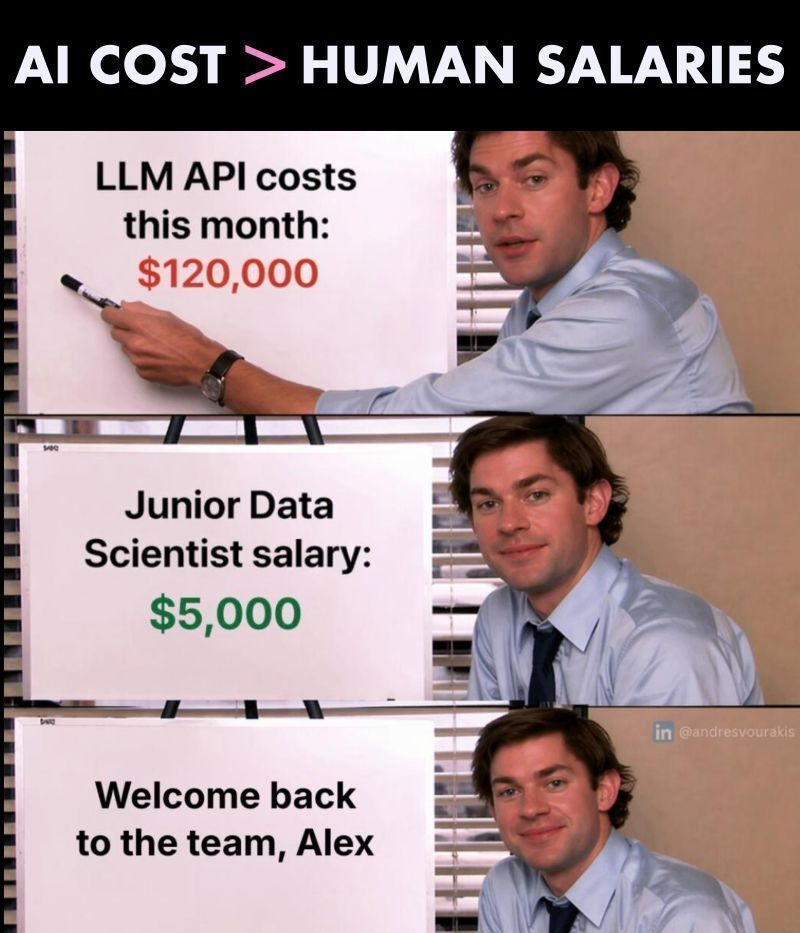
You know what really gets a developer out of bed in the morning? Not their team's mental health—nope, it's the API token budget . When your system architecture is so convoluted that your engineers are drowning in technical debt and crying into their keyboards, you can sleep peacefully. But the SECOND you realize your poorly designed microservices mesh is burning through tokens like a crypto bro in 2021? That's when the existential dread kicks in. Because nothing says "priorities" like ignoring the human cost of spaghetti code while obsessing over your OpenAI bill. Your workers are stressed? That's just character development. Your token consumption is inefficient? Now THAT'S a P0 incident. Time to refactor everything at 2 AM because those LLM calls aren't going to optimize themselves. Fun fact: The average developer spends more time justifying their token usage to finance than actually fixing the architectural disasters that caused the problem in the first place.