


Look.. I've Seen Evil But This Is Evil

Look.. I've Seen Evil But This Is Evil
Someone at the Chromebook design team woke up and chose violence. Placing the backspace key right next to the power button is the kind of sadistic hardware design that makes you question humanity. You're typing away, making a small typo, reach for backspace and—boom—your entire session is gone. No save dialog. No "are you sure?" Just darkness. The UI designer probably sits in a dark room somewhere, collecting the tears of users who've lost their unsaved work. Pure, calculated chaos.

AI Codes Well But Sometimes We Have These Moments Of Reflection

AI Codes Well But Sometimes We Have These Moments Of Reflection
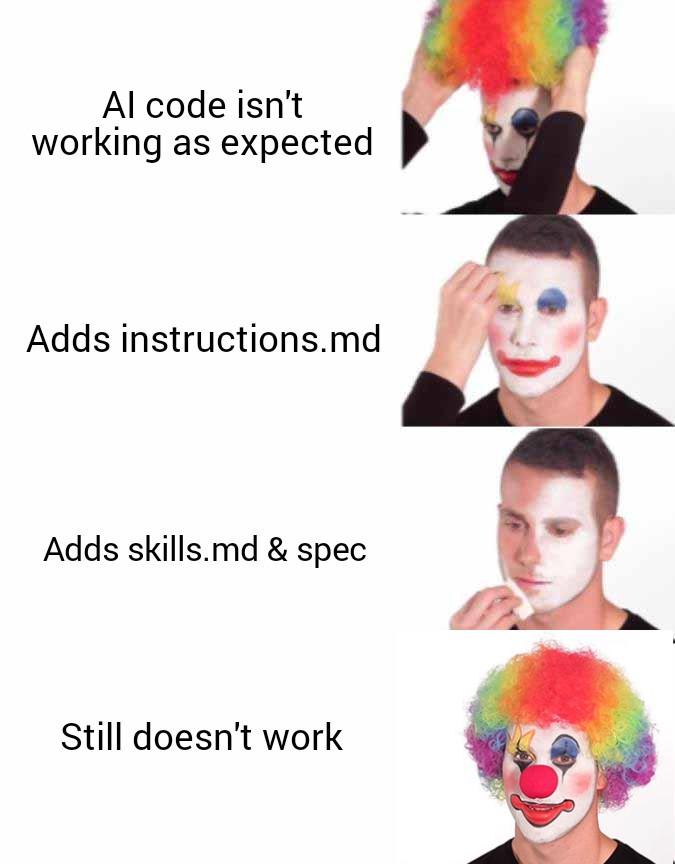
You know you've hit rock bottom when you're debugging AI-generated code by adding documentation files like you're trying to reason with a toddler. First you add instructions.md thinking maybe the AI just needs clearer requirements. Then you throw in skills.md and a spec file because surely that'll fix it. Spoiler: it won't. The AI's still gonna generate code that confidently does the wrong thing, and you'll sit there wondering if the real clown was the AI or you for thinking markdown files would somehow compile into working software. At least when humans write broken code, they have the decency to look embarrassed about it.

Chosen By A Fair Dice Roll

Chosen By A Fair Dice Roll
When you're so exhausted that rolling a dice to make decisions seems like peak productivity, and naturally you land on the WORST possible option for your cybersecurity. Nothing says "I've given up on life" quite like using a random number generator (your brain is too tired for that) to decide how to handle your cryptographic keys, and then proceeding to manually copy-paste your private key into your root certificates directory like you're spreading butter on toast. Because who needs security best practices when you've got VIBES and HUNGER? The beautiful irony? The number 4 supposedly being "an easy to generate private key" when generating secure keys requires actual randomness and complexity, not just... the number four. And then storing it by literally touching your root certs with your greasy fingers? Chef's kiss of catastrophic security failures. You will certainly not regret this until your entire infrastructure gets compromised at 3 AM and you're even MORE tired.

Legacy Supremacy

Legacy Supremacy
You know that feeling when you're maintaining a codebase from 2008 and you look at modern developers with their fancy PHP 8 features like enums and readonly properties? Yeah, that's the vibe here. These PHP 4 warriors are standing there in their aristocratic glory, looking down on the peasants with their namespaces and traits like they're beneath them. PHP 4 reached end-of-life in 2008—that's right, 2008 . We're talking pre-namespace era, no PDO prepared statements by default, register_globals still haunting production servers. These devs are basically coding royalty at this point, maintaining systems so old they remember when MySQL didn't have a "i" at the end. The real tragedy? They probably can't leave because they're the only ones who understand the arcane magic keeping that e-commerce site running. Job security through Stockholm syndrome.

Php Is In The News

Php Is In The News
PHP making headlines? Groundbreaking. Revolutionary. Absolutely earth-shattering. Oh wait—PHP itself IS the punchline. The language has been roasted so mercilessly for decades that its mere existence in the news is comedy gold. No scandal needed, no new feature announcement required. Just mention PHP and watch the entire developer community collectively smirk. It's like announcing "Florida Man" without even describing what he did—you already know it's going to be ridiculous. Poor PHP can't catch a break, standing at that microphone thinking it's about to deliver some profound wisdom, completely unaware that it walked into its own roast session. The audacity of PHP to show up anywhere and expect to be taken seriously is honestly iconic at this point.

Modern AI Startup Stack

Modern AI Startup Stack
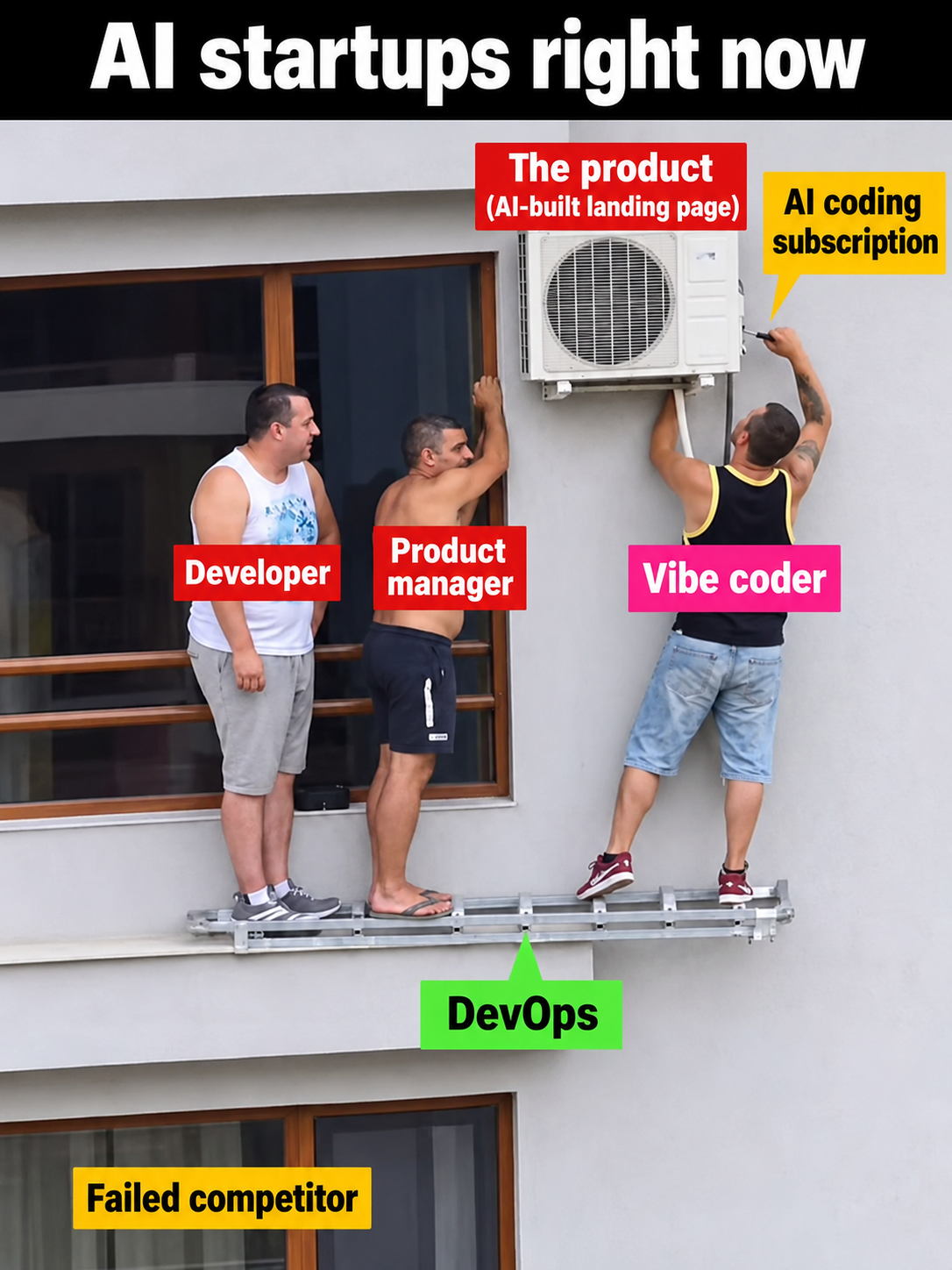
The entire AI startup ecosystem right here: three people pretending to install an air conditioner while standing on the corpse of their last failed venture. The "product" is just an AI-generated landing page (naturally), the actual work is being done by a Copilot subscription masquerading as innovation, and DevOps is literally the only thing holding this house of cards together. The developer just stands there watching because why write code when ChatGPT exists? The product manager provides moral support by touching the wall. Meanwhile, the "vibe coder" is doing all the heavy lifting—probably copy-pasting from Stack Overflow while the AI subscription bills rack up faster than their burn rate. That rickety platform they're standing on? Built on the ruins of their previous startup that definitely wasn't just another AI wrapper. The best part is they'll raise $10M Series A next week.

Average Vibe Coded App Update

Average Vibe Coded App Update
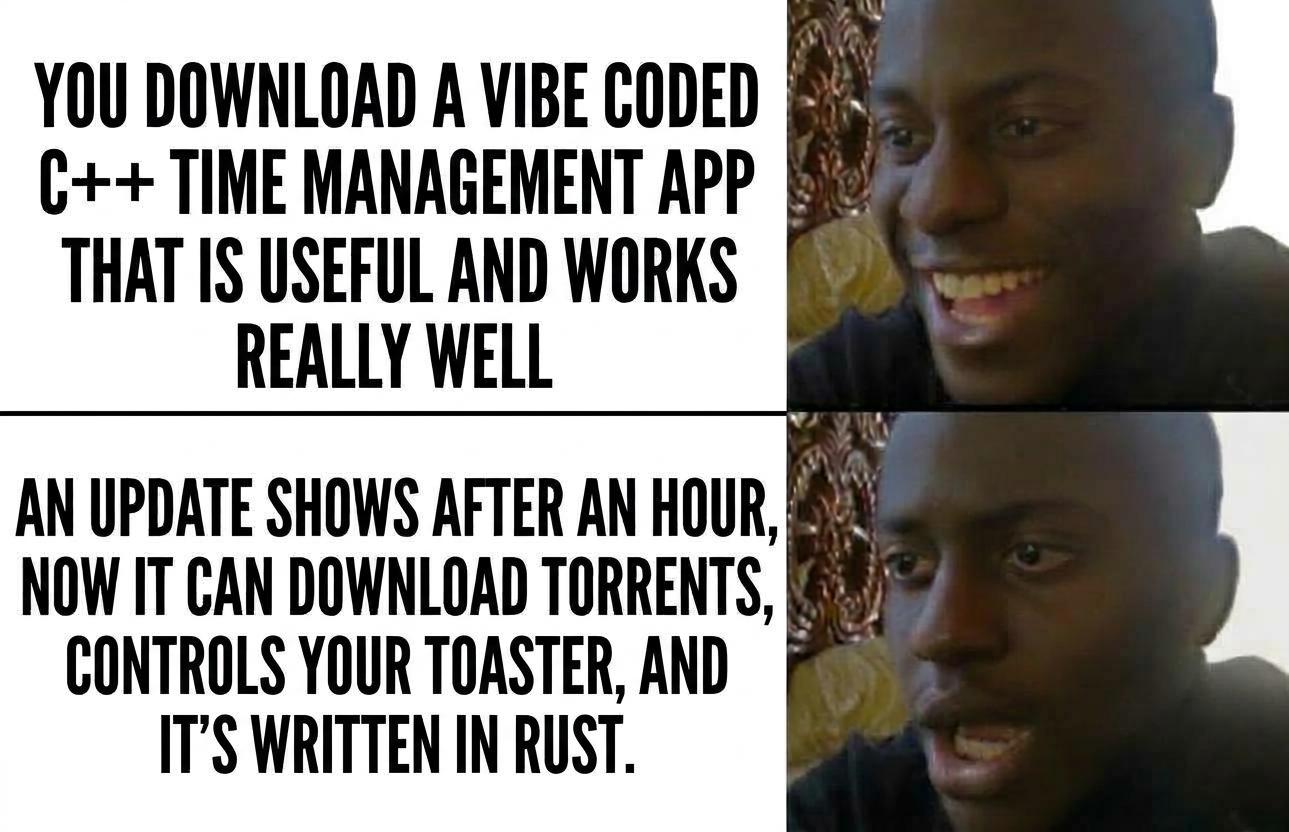
You know that feeling when you find a simple, elegant app that does exactly what you need? Then the dev discovers AI, blockchain, and Rust in the same weekend and decides your humble time tracker needs a complete identity crisis. Started as a C++ time management app. Innocent enough. But now it's downloading torrents (because why not add a BitTorrent client to your calendar?), controlling your smart toaster (IoT integration nobody asked for), and flexing that it's rewritten in Rust because apparently memory safety is crucial when timing your lunch break. The developer probably spent 6 months refactoring a working app into a Swiss Army chainsaw. Feature creep speedrun any%.

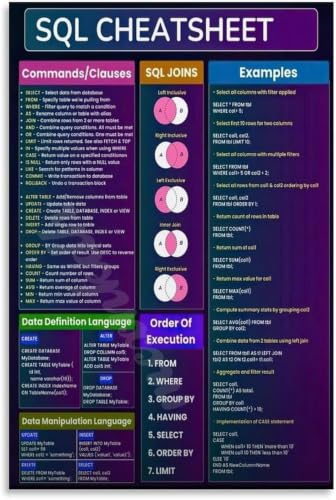
Developer SQL Cheat Sheet Poster Desk Reference

Developer SQL Cheat Sheet Poster Desk Reference
We have reserved a 0.6in (1.5cm) white margin for you, which is convenient for you to frame with a photo frame · Canvas posters are different from paper posters in that they will not deteriorate due …

E Mudhra Certificate Authority Chose Random Numbers By Fair Dice Roll Guaranteed To Be Random

E Mudhra Certificate Authority Chose Random Numbers By Fair Dice Roll Guaranteed To Be Random
So apparently E Mudhra, a Certificate Authority that's supposed to be securing digital certificates and cryptographic operations, decided that "random number generation" means rolling a dice and getting... 4. Every. Single. Time. For those who need context: this is referencing the classic XKCD comic where someone hardcodes the number 4 as their "random" number because they rolled a dice once. The joke here is that a CA—literally an organization whose entire job depends on cryptographic security and proper randomness—might as well be using the same logic. Nothing screams "enterprise security" quite like deterministic randomness. I'm sure their SSL certificates are totally secure when the random number generator has the same entropy as a fortune cookie. But hey, at least it's guaranteed to be random, right? They rolled a dice! Once! In 2003! This is what happens when someone reads "cryptographically secure random number generator" and thinks "yeah, but have we tried just... picking a number?"

How Shitty Standards Stick Around

How Shitty Standards Stick Around
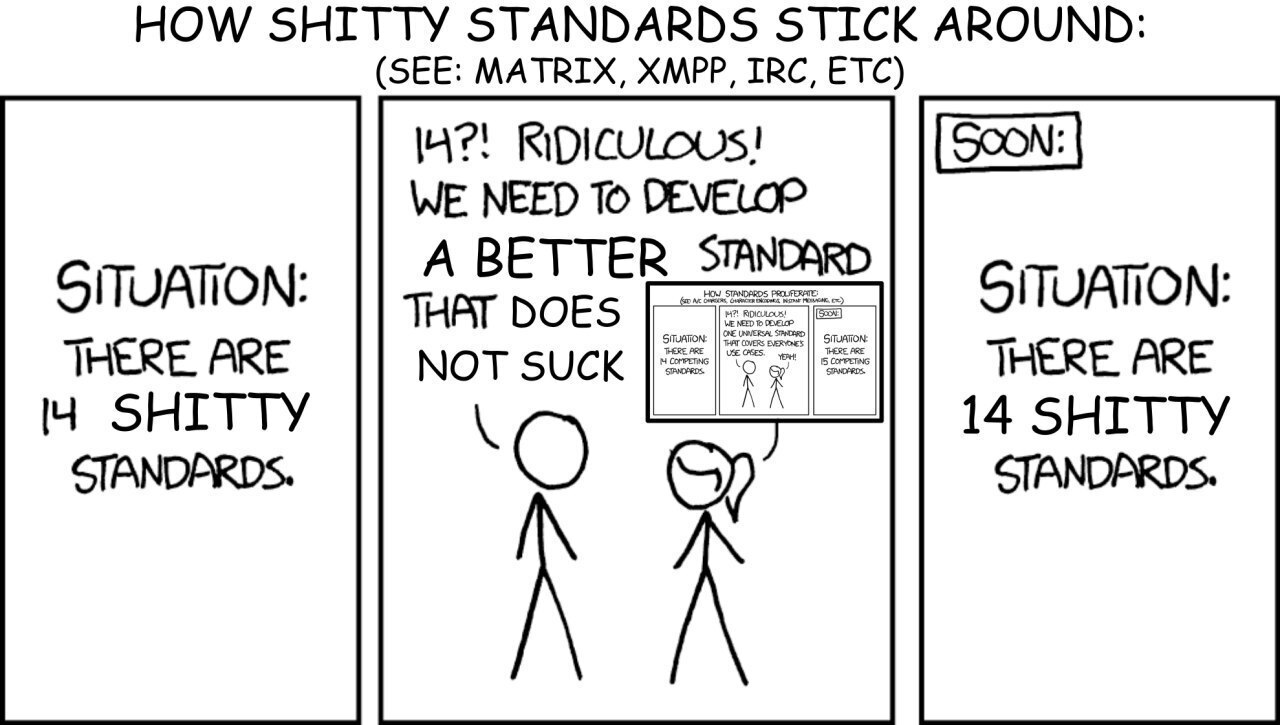
Every tech lead's nightmare captured in three panels. You've got 14 competing standards, someone gets the brilliant idea to unify them all, and boom—now you've got 15 standards to maintain. It's like trying to fix JavaScript by inventing TypeScript, or fixing build tools by creating yet another bundler. The examples listed (Matrix, XMPP, IRC) hit different. These are actual messaging protocols that were supposed to replace each other but instead just... coexist in eternal purgatory. IRC from the 90s? Still kicking. XMPP was gonna save us all? Nope, now we have Slack, Discord, Teams, and 47 other chat apps. The real kicker is that recursive comic within the comic—because even the solution to explaining this problem becomes part of the problem. Meta as hell, and painfully accurate.

This Won't Be Controversial At All

This Won't Be Controversial At All
Classic Apple progression right here. Back in the day, you could actually access your filesystem like a normal human being. Want to move a file? Here's your file. Want to organize your photos? They're in a folder. Revolutionary concept, I know. Then Apple decided that "more costs less" was their new philosophy—more restrictions, less functionality, but hey, at least the UI is pretty. Now they've gone full walled garden mode where the concept of a "file" is treated like some arcane knowledge that mere mortals shouldn't concern themselves with. Everything's in the cloud, abstracted away in some proprietary format, and if you want to actually transfer something between apps, you better hope those apps are feeling cooperative that day. The filesystem has basically become Schrödinger's directory—it exists somewhere, but you're not allowed to observe it directly. Just trust the system, they said. It'll be intuitive, they said.

Presented By The Number 4

Presented By The Number 4
Ah yes, the number that haunts every web developer's dreams. You know you've made it as a developer when you can instantly recognize the entire 4xx family tree: 400 Bad Request (your fault), 401 Unauthorized (forgot the token again), 403 Forbidden (nice try hacker), 404 Not Found (the celebrity of error codes), and the dreaded 418 I'm a Teapot (because why not). The number 4 is basically the harbinger of "something went wrong on the client side" – which in production usually means it's time to check if the frontend dev remembered to actually send the auth headers, or if the user is doing something creative like trying to access /admin with their regular account. Fun fact: HTTP status codes in the 400s mean client errors, while 500s mean server errors. So when you see a 4, you get to blame someone else. When you see a 5, that's all you, buddy.

NordVPN

NordVPN
Encrypt your traffic on public Wi-Fi, stream from anywhere, and cover up to ten devices with one plan. 30-day money-back guarantee.

AI Helped Me

AI Helped Me
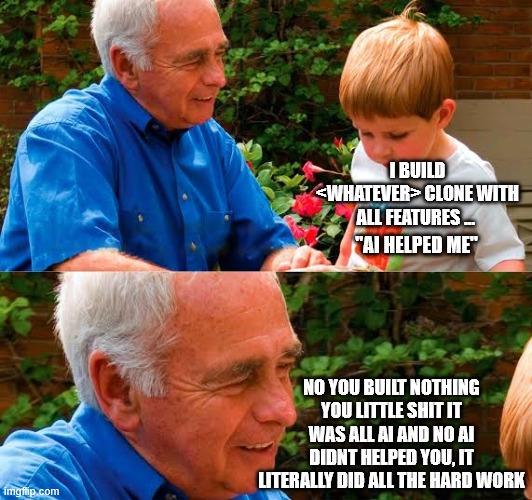
Junior dev proudly announces they "used AI" to build a feature, only for the senior to immediately call out that they just cloned an existing implementation with all its features intact. The AI didn't write anything new—it just copied what was already there. Classic case of giving credit to the fancy chatbot when really you just did Ctrl+C, Ctrl+V with extra steps. The "AI helped me" excuse is the new "I Googled it" but with more marketing budget behind it.