

Do You Like My Fizz Buzz Implementation

Do You Like My Fizz Buzz Implementation
Someone really woke up and chose VIOLENCE with this FizzBuzz solution. Instead of doing the normal if-else chain like a reasonable human being, they went full galaxy brain and used pattern matching on a tuple of booleans. They're literally checking if the number is divisible by 3 AND 5 at the same time, then matching (True, True) , (True, False) , (False, True) like they're playing some twisted game of boolean bingo. Is it elegant? Debatable. Is it unnecessarily complicated for a problem that's literally used to filter out candidates in interviews? ABSOLUTELY. This is the programming equivalent of using a flamethrower to light a birthday candle. Technically correct, but also... why though? 😭

My Duo

My Duo
You've got a beast of a gaming rig with RGB everything and liquid cooling, but your internet is choking on a 5 Mbps connection from 2009. Meanwhile, your buddy's running a potato PC held together with duct tape and prayers, but somehow has gigabit fiber. The result? You're both lagging for completely opposite reasons, creating the most balanced yet utterly dysfunctional gaming duo known to mankind. It's like having a Ferrari with no gas paired with a tricycle on rocket fuel - somehow you both cross the finish line at the same pathetic speed.

Hottest LLM In Town

Hottest LLM In Town
So the top downloaded free app right now is Claude, followed by ChatGPT and Google Gemini. Sandwiched between them at #3? DICK'S Sporting Goods. Because apparently when people aren't asking AI to debug their code or write their emails, they're shopping for sneakers and camping gear. The AI arms race has gotten so intense that three different LLMs are dominating the app store charts, but somehow a sporting goods retailer managed to wedge itself right in the middle. Maybe people need athletic equipment to physically run away from their AI-generated code suggestions. Or maybe they're just buying gear to touch grass after spending 12 hours arguing with Claude about TypeScript types. The real winner here is DICK'S marketing team, who somehow convinced people that shopping for workout clothes is more urgent than downloading Google's AI assistant.

Holy C Compiler

Holy C Compiler
HolyC is the actual programming language created by Terry A. Davis for TempleOS, an entire operating system he built from scratch. The language was literally designed to "talk to God" through divine computing. So when you compile HolyC code, it's not just a build process—it's basically a religious experience. The "Assembly of God" church sign is chef's kiss perfect because HolyC actually compiles down to assembly code, just like C. It's a triple pun: the religious Assembly of God church, the low-level assembly language, and the fact that you're assembling (compiling) code written in a language literally called HolyC. The compiler is essentially performing a sacred ritual, transforming divine source code into executable gospel. Terry Davis was a genuinely brilliant programmer who created an entire OS with its own compiler, kernel, and graphics system—all while battling schizophrenia. TempleOS and HolyC are both fascinating and tragic pieces of computing history.

Vibe Reviewers

Vibe Reviewers
When you're too lazy to actually review the code so you just tag every AI assistant in existence and let them fight it out. Cursor, Claude, CodeRabbitAI, Codex - basically assembling the Avengers of code review except none of them have opposable thumbs or can actually merge the PR. The best part? They'll all probably approve it with different reasoning. Claude will write you a 3-paragraph essay about code quality, Cursor will suggest 47 autocomplete options, CodeRabbitAI will find that one missing semicolon from 2019, and Codex will just hallucinate a completely different codebase. Meanwhile, the actual human reviewers are nowhere to be found because they're busy... also asking AI to review their code. Welcome to 2024 where code review has become a group chat for bots. At least they respond faster than Dave from the backend team who's been "looking at it" for 3 weeks.

Pray For Me

Pray For Me
So your PC just bricked itself and refuses to boot. Cool. Nothing says "professional workday" quite like announcing to your entire team that you're basically unemployed until IT can resurrect your machine from the dead. Hope you weren't working on anything important that you definitely saved and backed up regularly. You did back it up, right? Right? Time to dust off that personal laptop from 2015 that takes 10 minutes to boot and runs slower than a turtle on sedatives. Or maybe you'll just sit there contemplating your life choices while your colleagues carry on without you. Either way, you're about to experience what developers call "forced vacation" but management calls "unacceptable downtime."

More Like The "If" And "When" But Never "Is" Guy

More Like The "If" And "When" But Never "Is" Guy
The "Idea Guy" strikes again with his legendary 007 stats: zero planning, zero contributions, but somehow 7 million "revolutionary" ideas that will "totally disrupt the industry." You know this person. They show up to every sprint planning meeting with grandiose visions of building the next Facebook-meets-Uber-but-for-cats, yet mysteriously vanish when it's time to write actual code or, heaven forbid, document anything. Their ideas exist in a perpetual state of quantum superposition—simultaneously brilliant and completely unimplemented. The real kicker? While you're grinding through merge conflicts at 2 PM on a Tuesday, they're already brainstorming idea number 7,000,001: "What if we rebuilt the entire backend in Rust?" Sure, buddy. You go ahead and open that JIRA ticket.

For The Glory Of The God

For The Glory Of The God
God really said "let there be suffering" and gave us bodies perfectly optimized for debugging hell. Eyes bloodshot from marathon coding sessions? That's not a bug, that's a feature. Mouth for rubber duck debugging instead of actually talking to your teammates? Divine intervention. Ears tuned to hear screen readers test accessibility (because we all know nobody actually does manual a11y testing until the lawsuit arrives)? Blessed. And hands—those precious carpal tunnel factories—designed specifically to translate caffeine into semicolons at 2 AM. The whole package is basically a developer starter kit from the heavens. The real kicker is "everything has its purpose"—yeah, the purpose is pain. But hey, at least we're suffering with intention now. Glory to the LORD of merge conflicts and production bugs.

This Is A Very Good Idea

This Is A Very Good Idea
Nothing says "I've learned nothing from security training" quite like this masterpiece. Dude's planning to spoof AWS billing alerts via SMS and even wants to include a link to the "official AWS dashboard" to make it look legit. Because obviously, the best way to prank your friends is by potentially getting arrested for phishing and identity theft. The real comedy here is thinking your friends won't immediately panic and call their bank, or worse, actually click that link. Then you'll be explaining to HR why half the company reported a security incident that traces back to your phone number. Pro tip: if your prank requires you to clarify "it's not phishing," it's definitely phishing. Also, $50k? That's rookie numbers. If you're gonna fake an AWS bill, at least make it realistic—like $127,483.29 from accidentally leaving a NAT Gateway running in 47 regions.

Accurate Estimates

Accurate Estimates
The classic tale of AI-powered estimation tools versus developer hubris. An AI tool analyzes the feature and conservatively estimates 4-6 weeks. The developer, filled with caffeine-fueled confidence, scoffs and declares they'll knock it out in an afternoon. Fast forward 6 weeks, and surprise—it's finally working. Plot twist: both the overconfident dev AND the AI were wrong, because the real timeline was exactly 6 weeks regardless of who predicted what. The meme brilliantly captures how whether you're using fancy AI estimation tools or just winging it with blind optimism, software projects have a mysterious way of taking exactly as long as they're going to take. Edge cases, scope creep, and that one bug that makes you question your entire career don't care about your predictions.

Wallet Left Chat

Wallet Left Chat
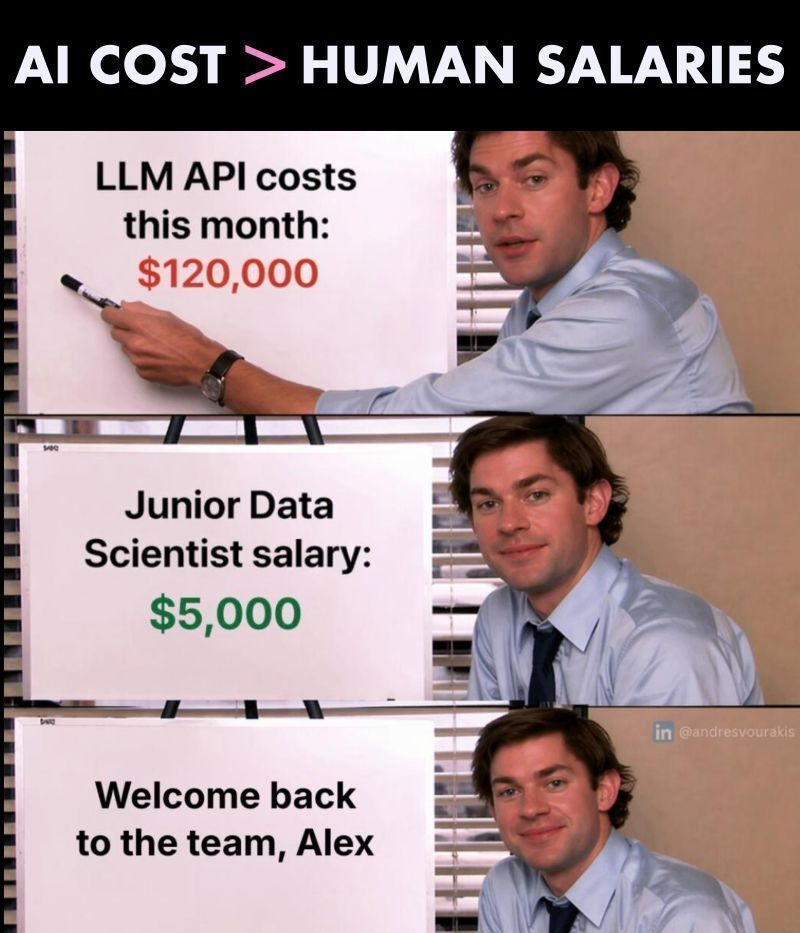
Someone just discovered that "AI-powered" tools come with a side of financial ruin. They ditched their SaaS subscriptions thinking they'd save money, went all-in on OpenClaw (presumably OpenAI's API), and watched their monthly bill skyrocket from $480 to $1,245. The cherry on top? They're now spending 15 hours a week wrestling with YAML configuration files like it's 2015 Kubernetes all over again. The real kicker is the cost breakdown: they're paying more AND working harder. Those convenient SaaS tools with their fancy UIs were actually... worth it? Who would've thought that abstracting away complexity has value? The "adapt or be left behind" line is chef's kiss irony—they adapted right into a worse situation. Sometimes the old way of throwing money at a problem to make it go away is actually the optimal solution. Pro tip: API costs scale with usage, and if you're not careful with prompt engineering and caching strategies, GPT-4 will drain your bank account faster than you can say "token limit exceeded."

Ultimate Source Protection

Ultimate Source Protection
Oh honey, someone really said "I'm gonna protect my JavaScript code" and then wrote it entirely in CLASSICAL CHINESE. Like, forget minification and obfuscation—just throw in some ancient dynasty poetry and call it a day! 😭 This is literally the nuclear option of code protection. You've got arrays, sorting algorithms, and what appears to be a quicksort implementation, but it's all written using traditional Chinese characters with classical grammar. It's like someone took their CS homework and decided to cosplay as a Tang Dynasty scholar. The best part? This would ACTUALLY work as protection because even Chinese-speaking developers would need a degree in ancient literature to decode this masterpiece. Good luck to the junior dev who has to maintain this code. They'll need a dictionary, a history textbook, and possibly a time machine.