

Is There Even Any Safe Browser?

Is There Even Any Safe Browser?
When you work at Google and realize that cookie consent banners are just UX theater. The code literally says "if user accepts cookies, collect their data. else... also collect their data." It's the illusion of choice wrapped in GDPR compliance paperwork. The autocomplete suggestion "abc data" is the cherry on top—like the IDE is trying to help you remember all the different data collection endpoints you've built. "Was it abc data? Or xyz data? Oh wait, it's ALL the data." Spoiler alert: There is no safe browser. They're all just different flavors of data collection with varying levels of honesty about it. At least Google's upfront about monetizing your existence.

Party Hard

Party Hard
When someone asks what you're doing on a Saturday night and you're literally hardcoding a massive array of random numbers like some kind of digital masochist. Nothing screams "living your best life" quite like manually typing out 7,62,2,46,79,83,26,82 and continuing for what looks like an eternity. The timestamp showing 17:54 is just *chef's kiss* – because who needs happy hour when you can have array initialization hour? This is the programming equivalent of counting grains of sand on a beach, except somehow less fun and more carpal tunnel inducing. 241K views because apparently we all love watching someone's descent into madness in real-time.

Will Be Fun 2 Months Later

Will Be Fun 2 Months Later
Imagine raising TWO HUNDRED MILLION DOLLARS to build your SaaS empire, only to discover your internal team slapped together the same tool in 14 days using duct tape and caffeine. The sheer AUDACITY of that excited developer on the left, proudly announcing they "vibe coded" a solution while the VC-funded founder sits there contemplating every life choice that led to this moment. Plot twist: that internal tool is probably held together by a single SQL query, three bash scripts, and pure spite—but hey, it works! Meanwhile, the $200M version is still in its third sprint planning meeting discussing whether to use microservices or a monolith. The real tragedy? The internal tool will become production because "it's just temporary" (narrator: it was never temporary). Fast forward 2 months and that vibe-coded masterpiece is now the company's core infrastructure with zero documentation, no tests, and the original developer just gave their two weeks notice. Godspeed! 🫡

This Is Actually Wild

This Is Actually Wild
So someone discovered that Monster Hunter Wilds was doing aggressive DLC ownership checks that tanked performance. A modder tricked the game into thinking they owned all DLC and boom—instant FPS boost. The unintentional part? Capcom wasn't trying to punish pirates or non-buyers. They just wrote such inefficient code that checking your DLC status every frame became a performance bottleneck. The punchline writes itself: Capcom's management seeing this bug report and realizing they can now market DLC as a "performance enhancement feature." Why optimize your game engine when you can monetize the fix? It's like charging people to remove the memory leak you accidentally shipped. That Homelander smile at the end perfectly captures corporate executives discovering they can turn their own incompetence into a revenue stream. Chef's kiss.

Modern Full Stack Developer

Modern Full Stack Developer
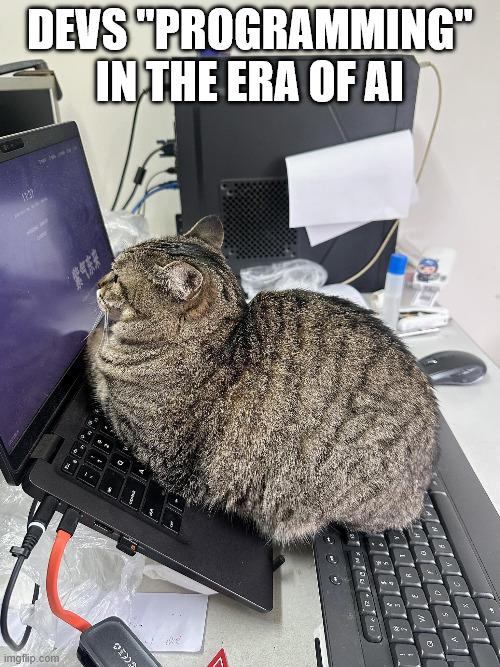
Oh honey, you thought "full-stack" meant knowing React AND Node.js? How adorably 2019 of you! Now it means having three AI assistants open in browser tabs like some kind of digital puppet master. Claude for the elegant code, ChatGPT for when you need something explained like you're five, and Perplexity for... honestly, just vibes at this point. The real tech stack is now: 40% prompting skills, 30% knowing which AI hallucinates less, 20% copy-pasting with confidence, and 10% pretending you totally knew that solution all along during code reviews. Frontend? Backend? Database optimization? Nah bestie, the only stack that matters is your AI subscription stack. Welcome to 2024, where "full-stack developer" just means you're full of tabs running LLMs who actually do the work while you sip coffee and feel like Tony Stark.

Sad Unemployment Tears

Sad Unemployment Tears
Bootcamps out here watching the tech job market burn like a dystopian hellscape while desperately trying to sell their $25k JavaScript courses. Nothing says "great investment" quite like spending the price of a decent used car to learn React hooks while senior devs with 10 years of experience are getting ghosted by recruiters. The timing couldn't be worse—it's like selling swimming lessons on the Titanic. These bootcamps promised you'd be making six figures in 3 months, but forgot to mention that "junior developer" positions now require 5 years of experience, a CS degree, and the ability to single-handedly architect a distributed system. But hey, at least you'll know how to center a div... for only 25 grand.

No Tests, Just Vibes

No Tests, Just Vibes
You know those developers who deploy straight to production with zero unit tests, no integration tests, and definitely no code coverage reports? They're out here doing elaborate mental gymnastics, contorting their entire thought process, and performing Olympic-level cognitive backflips just to convince themselves they can "Make no mistakes." The sheer confidence required to skip the entire testing pipeline and rely purely on intuition and good vibes is honestly impressive. It's like walking a tightrope without a safety net while telling yourself "I simply won't fall." Spoiler alert: production users become your QA team, and they're not getting paid for it.

Clean Compile Maximum Trust Issues

Clean Compile Maximum Trust Issues
You know you've been in the trenches too long when a clean compile feels less like success and more like a trap. That code that compiles first try? Yeah, it's gorgeous on the surface, but your battle-scarred instincts are screaming that runtime errors are lurking somewhere in there like landmines. The compiler's silence isn't reassuring—it's suspicious. Where are the warnings? The type mismatches? The missing semicolons? When everything works immediately, experienced devs don't celebrate, they start writing test cases with the paranoia of someone who's been burned too many times. Because we all know the truth: the compiler only checks syntax. Logic errors, race conditions, off-by-one mistakes, null pointer nightmares—those are all waiting patiently in production to ruin your weekend.

How Can We Actually Prevent This From Happening

How Can We Actually Prevent This From Happening
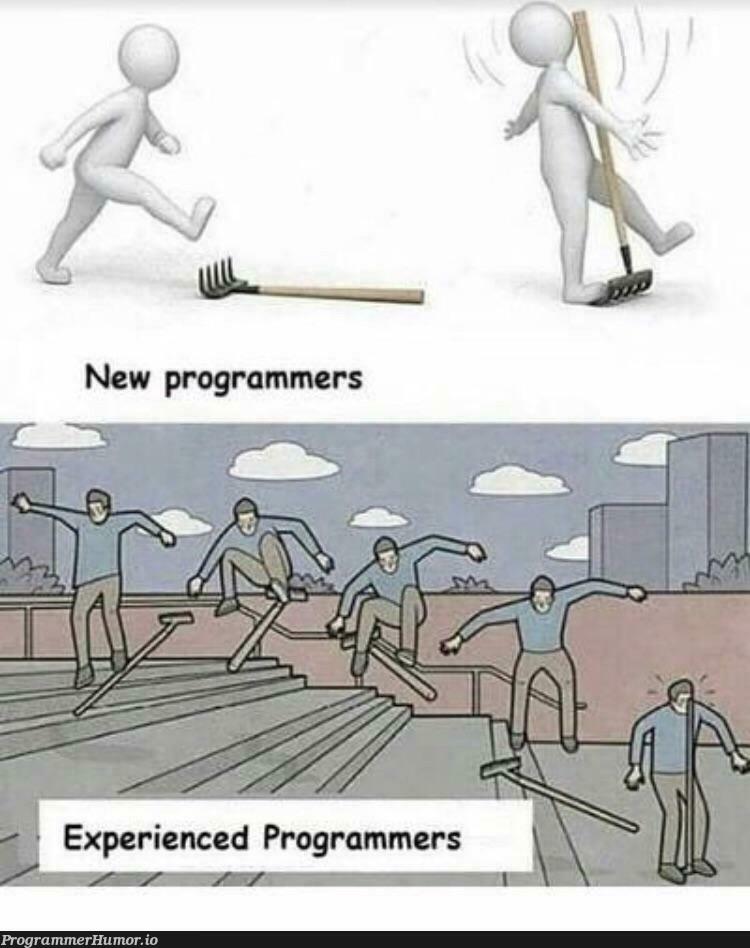
Learning a new language or framework is that satisfying climb up the stairs—steady progress, dopamine hits with each concept mastered, Stack Overflow bookmarks multiplying. Then you take a two-week vacation, switch projects, or just look at production fires for a month straight. Suddenly you're staring at your own code like it's written in ancient Sumerian. The forgetting curve is real and it's exponential. The only prevention? Build useless side projects you'll never finish. It's not procrastination, it's spaced repetition.

Yes That Is True

Yes That Is True
Dark fact #23 hits different because it's painfully accurate. You know that sweet spot between "I should start working" and "OH GOD THE DEADLINE IS IN 2 HOURS"? That's where the magic happens. Suddenly your brain becomes a supercomputer, your fingers move at 200 WPM, and you're shipping features like there's no tomorrow (because there literally isn't). The adrenaline rush from impending doom somehow unlocks productivity levels that no amount of coffee, standing desks, or Pomodoro timers could ever achieve. It's like your body's fight-or-flight response but instead of running from a bear, you're frantically committing code at 3 AM with commit messages like "fix stuff" and "PLEASE WORK". The real question is: are we procrastinators, or are we just adrenaline-driven performance artists who need that cortisol spike to function? Either way, the production server doesn't care about your feelings.

He Needs To Debug Your Connection

He Needs To Debug Your Connection
When you're working from home and spot an unauthorized device on your network, only to realize it's just a spider chilling on your ceiling-mounted WiFi access point. The little guy's literally web developing in the most literal sense possible. Nothing says "security vulnerability" quite like an eight-legged freelancer who didn't sign the NDA. At least he's working on the frontend—specifically, the front end of your Ubiquiti device. Hope he's not packet sniffing or worse, building his own mesh network.

Win Rar Paid Version Perks Go Hard

Win Rar Paid Version Perks Go Hard
Someone actually designed and manufactured a bag that looks like a WinRAR archive file, complete with the iconic multicolored compressed file bars and the little lock icon. The dedication here is unmatched. WinRAR has been living rent-free in our computers for decades with its "40-day trial" that never actually expires, making it the most successful nagware in history. Nobody pays for WinRAR, yet somehow the company is still around, probably sustained by that one corporate IT department that actually bought a license in 2003. Now someone's out here flexing with WinRAR merch like it's Supreme. The bag literally represents the software that everyone uses but nobody pays for. It's like wearing a shirt that says "I pirate software" but making it fashion. The compression ratio on this drip is absolutely unbeatable – you're carrying around the physical manifestation of a 25-year-old inside joke. If you show up with this bag, you're either the coolest nerd at the function or you need to touch grass. Possibly both.