Find Bug In Web

Find Bug In Web
The beautiful irony here is that spiders are probably thrilled to find structural issues in their web—just means they get to patch it up and catch more flies. Meanwhile, developers discovering a bug in their web app experience the five stages of grief simultaneously. The top panel shows casual spider confidence, while the bottom reveals the existential dread of realizing your "production-ready" code has been lying to you this whole time. Nature's architects vs. digital architects: one group has their debugging process figured out, the other is frantically Googling "why is my CSS breaking on Safari only" at 2 PM on a Tuesday.

Bout To Go Britney

Bout To Go Britney
You know that special kind of rage that builds up when you keep running into the same preventable issue? Yeah, NumLock is that gift that keeps on giving. It's not a bug, it's not a feature request gone wrong—it's just your keyboard trolling you because someone at some point in 1980 thought "hey, let's make the numpad do two completely different things and toggle between them with an easy-to-accidentally-press key." The real kicker is that it turns off randomly (or so it seems), and you only notice when you're frantically typing IP addresses, port numbers, or debugging some array indices. You press 8 and nothing happens. You press 4 and your cursor moves left. You question your entire existence. Then you realize NumLock is off again, fix it, and go back to work. Rinse and repeat 12 million times. At some point, you're one accidental NumLock press away from a full meltdown. The Britney 2007 energy is real, and honestly, justified.

There Goes All The Excitement

There Goes All The Excitement
You spend weeks researching the perfect GPU, RGB RAM, and that sweet liquid cooling setup. You watch every YouTube tutorial, carefully cable manage everything, boot it up successfully on the first try... and then it just sits there running Discord and VS Code. Maybe occasionally you fire up Steam to play some indie pixel game that could run on a toaster from 2005. The dopamine hit from building it was the actual endgame—using it for productive work is just the disappointing epilogue nobody asked for.

How The Turn Tables

How The Turn Tables
Oh, the sweet irony of platform exclusivity wars. For years, PlayStation users have been flexing their exclusive titles while Xbox and PC gamers watched from the sidelines with sad puppy eyes. Now the tables have turned, and suddenly Xbox/PC players are the ones gatekeeping Wolverine? The schadenfreude is real. The gaming community's hypocrisy is showing—when you're on the receiving end of exclusives, it's "anti-consumer" and "unfair," but when your platform gets the exclusive, suddenly it's "just business" and "good for competition." Pick a lane, folks. The console wars have turned into a recursive function of pettiness with no base case in sight.

Codex Thinks Its Model Was Quantized Mid Turn

Codex Thinks Its Model Was Quantized Mid Turn
So the AI just gave itself a performance review and decided to rage quit mid-conversation. Honestly, this is the most self-aware thing I've seen from an LLM. For context: quantization is when you compress a model to use less memory/compute, but it makes the model dumber. It's like trying to code after your third beer - technically still functional, but the quality takes a nosedive. The AI literally wrote a professional "I'm not qualified for this" email to itself, complete with the classic "come back when I'm in better shape" line. Meanwhile you're sitting there like "bro, I just asked you to help refactor a function." The AI equivalent of a junior dev realizing they're in over their head, except it actually has the self-awareness to tap out instead of pushing broken code to prod. Props to the AI for knowing when to stop digging. That's more emotional intelligence than most senior devs I've worked with.

Almost Dropped The Course

Almost Dropped The Course
That beautiful moment in CS101 when you discover arrays start at 0 and the equality operator has a twin brother. Nothing quite like the existential crisis of learning that 2 == 2.0 returns true because type coercion is just vibing in the background. Meanwhile you're sitting there wondering if your entire understanding of mathematics is a lie. The double equals does type conversion before comparing (so the number 2 and the float 2.0 are considered equal), while triple equals would actually check if they're the same type too. But hey, at least you didn't learn this the hard way during a production bug at 3 AM like the rest of us did.

Govivo Computer Hard Drive Patents Set of 4-8x10 Unframed Prints - Wall Art Decor for Home Office School College Teacher Student Tech Support Department Man Cave Geek

Govivo Computer Hard Drive Patents Set of 4-8x10 Unframed Prints - Wall Art Decor for Home Office School College Teacher Student Tech Support Department Man Cave Geek
GREAT WALL DECOR IDEA for a bedroom, living room, den, dorm room, office, mancave, basement and many more! These will also look good hanging on the walls of a computer store or internet cafe. · HIGH …

Not Again 😭

Not Again 😭
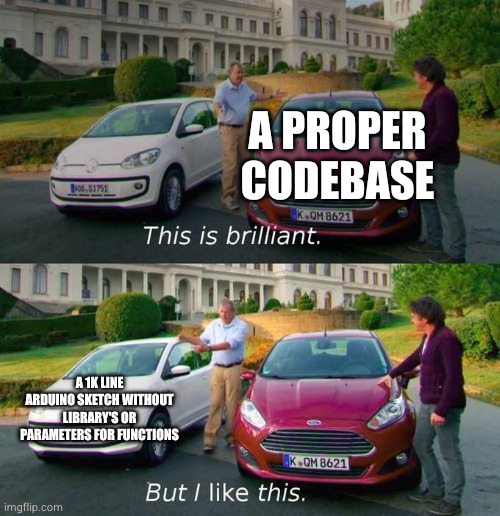
You know you've hit rock bottom when the compiler tells you your code has "blocks nested too deeply." Like, I'm just trying to check if a number is even with a simple boolean function, and apparently I've created the Inception of if-else statements. The real tragedy here? Someone wrote 4000+ lines of nested conditionals checking individual numbers (1983? 1984? really?) instead of just using modulo. That's not code, that's a cry for help. The compiler isn't even mad at this point—it's just disappointed. And honestly? Same. Pro tip: If your code looks like a staircase to hell and the compiler taps out before you do, maybe it's time to rethink your life choices. Or at least learn about the % operator.

Git Multiverse

Git Multiverse
You know you've entered dangerous territory when Claude (or any AI assistant) starts suggesting Git commands and you just copy-paste them without reading. One git rebase -i here, a git reset --hard there, maybe a cheeky git reflog to "fix" things, and suddenly your repository has more divergent branches than the entire MCU timeline. The Loki reference is chef's kiss because just like the TVA dealing with infinite timeline variants, you're now staring at a commit graph that looks like spaghetti had a baby with a neural network diagram. Your git log --graph --all output probably needs its own scroll bar at this point. Pro tip: Maybe read what the AI suggests before executing commands that can literally rewrite history. Or don't, and enjoy explaining to your team why the main branch now exists in 47 parallel universes.

Follow For More Mildly Useful Tips

Follow For More Mildly Useful Tips
You know you've been in the GPU market too long when you can decode seller listings like they're encrypted messages. If they don't specify which card it is upfront, it's always the worse one. Always. It's like Schrödinger's GPU—until you open the listing details, it exists in a superposition of both cards, but the moment you check, the wave function collapses into the 8GB version every single time. The 5060Ti and 9060XT both came in 8GB and higher VRAM variants, and sellers know exactly what they're doing by being vague. It's the marketplace equivalent of "runs fine" in a used car listing—technically not a lie, but you're gonna have a bad time. Been burned once? Congratulations, you've earned your stripes in the eternal battle against sketchy hardware listings.

Now That Everyone At Work Is Using Claude For Everything

Now That Everyone At Work Is Using Claude For Everything
When your entire dev team discovers Claude and suddenly every Slack message is a 47-paragraph essay with perfect markdown formatting and bullet points. You just wanted someone to tell you where the staging server credentials are, but instead you're getting a beautifully structured artifact explaining the philosophical implications of credential management through the ages. The burnout is REAL when even asking "what's for lunch?" gets you a comprehensive analysis of local dining options with pros, cons, and a decision matrix. Just... please... can someone give me a straight answer without the AI-generated preamble about "understanding your request" for once?

The Heisenbug Principle

The Heisenbug Principle
You know what's worse than a bug? A bug that only exists when customers are looking at it. The moment you fire up your debugger or add some logging statements, it vanishes into the quantum realm like it was never there. But the second you close your IDE and push to production? Boom, it's back, haunting your error logs and your dreams. The Heisenbug gets its name from Heisenberg's Uncertainty Principle in quantum physics—where observing a particle changes its behavior. Same energy here: the act of debugging literally changes the bug's behavior. Maybe it's a race condition that disappears when you slow things down with breakpoints. Maybe it's a timing issue that vanishes when you add console.log statements. Either way, you're stuck explaining to your manager why the bug only exists in production and nowhere else. Schrödinger would be proud. The bug is both there and not there until a customer observes it.

The Circle Of PR Reviews

The Circle Of PR Reviews
The beautiful lifecycle of code comprehension: you start as a senior confidently asking juniors to explain their chaotic spaghetti code, then two years later you're staring at your own PR like it was written in ancient Sumerian. "Why did I use three nested ternaries here? What was I thinking? Who hurt me?" Turns out the real enemy isn't the junior dev who doesn't comment their code—it's past you, who thought they were too smart to need comments. Future you will remember this betrayal. The circle of life continues, except instead of Simba it's just confusion and regret.