

I Guess The Minimum Is 500

I Guess The Minimum Is 500
When a game has 250 concurrent players, you wonder how it's still breathing. But once it hits 501? Suddenly it's thriving beyond comprehension. That magical threshold where "dead game" transforms into "actually has a playerbase" is apparently somewhere between these two numbers. The Steam player count is basically Schrödinger's matchmaking queue—below 500 and you're staring at the lobby for 45 minutes hoping that one guy in Australia will queue up. Above 500? You might actually find a match before your coffee gets cold. Fun fact: Many multiplayer games need a critical mass of players to function properly. Below that threshold, matchmaking becomes a dystopian waiting simulator. It's like trying to start a party when only three people showed up—technically possible, but nobody's having fun.

This Car's Boot Is Worth More Than My Apartment

This Car's Boot Is Worth More Than My Apartment
Someone's casually transporting what looks like multiple RTX 5090s and high-end ASUS ROG hardware in their trunk like it's a grocery run. Meanwhile, the rest of us are out here checking our bank account three times before buying a single stick of RAM. The sheer value of GPUs sitting in that boot could probably fund a small country's IT infrastructure. Between the semiconductor shortage trauma and GPU prices that make you question your life choices, seeing this much hardware in one place feels like witnessing a heist in reverse. The person driving this car is either a crypto miner, a machine learning researcher with an unlimited budget, or someone who definitely doesn't need to wait for Black Friday sales.

Thoughts On My Pc? Ignore The Cat.

Thoughts On My Pc? Ignore The Cat.
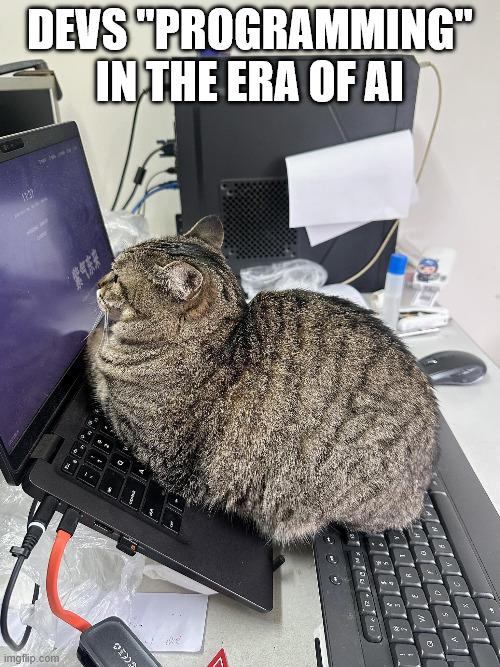
"Ignore the cat" they said, as if anyone could possibly focus on RGB fans when there's a sentient furball perched on top of the setup like a server admin monitoring their production environment. The cat's literally positioned as if it's overseeing the entire operation—probably judging your cable management harder than any code reviewer ever could. That gaming PC with its glowing blue fans is nice and all, but let's be honest: the real hardware upgrade here is the biological heat sensor sitting on top. Cats have this uncanny ability to find the warmest spot in any setup, which means your PC is either running hot or the cat's just claiming dominance over your entire workstation. Either way, that's a feature, not a bug. Also, those cables in the back? Chef's kiss. Nothing says "professional developer setup" like a nest of wires that would make even spaghetti code jealous. But sure, let's pretend we're here to rate the PC and not acknowledge the superior life form supervising your compile times.

Stop Bullshiting We Still Have Just Os Process With Its Way To Communicate With The Rest Of Os

Stop Bullshiting We Still Have Just Os Process With Its Way To Communicate With The Rest Of Os
You know what's wild? We used to have a simple script that listened to GitHub webhooks and shot off an email. Maybe 50 lines of code, ran on a $5/month VPS, never went down. Fast forward to 2024 and that same functionality requires an "autonomous AI agent" with "sensor-based environmental awareness" that triggers "intelligent workflows." It's still just a process listening to HTTP requests and executing some logic. We just wrapped it in enough buzzwords to justify a Series B funding round. The best part? Both are literally doing the same thing: receiving data, processing it, and taking an action. One costs $5/month and you understand it. The other costs $50k/year in cloud bills, requires three microservices, a Kubernetes cluster, and nobody knows how it actually works anymore. But hey, at least the new version has a dashboard with real-time analytics that nobody looks at.

Git Can See That

Git Can See That
That mini heart attack when you're updating your .env file with production credentials and VSCode slaps that big fat "M" next to it. Git's watching, and it knows you just modified something you definitely shouldn't be committing. You frantically double-check your .gitignore for the hundredth time, praying to whatever deity watches over careless developers that you didn't accidentally expose your AWS keys to the entire internet. We've all been there, sweating bullets over a file that should've been ignored from day one.

I Don't Like Where This Is Going...

I Don't Like Where This Is Going...
2009: You had a tower with some GPUs and CPUs. Simple times. Maybe a little warm, but manageable. 2024: Now you need multiple monitors because one screen isn't enough to contain your suffering. The GPU is doing overtime with that rainbow glow—probably mining crypto or training some model that tells you your code is "suboptimal." 2029: Your entire setup has been replaced by a single capsule labeled "AI DATA CENTER" while you're literally in a jar on life support. Your cat's dead. You've been downsized into a container. The AI doesn't even need you anymore—it just keeps you around for nostalgia, like a deprecated dependency that somehow still works. The progression from "I own hardware" to "I am hardware" hits different when you realize we're all just becoming biological peripherals to our AI overlords.

Status 403 Forbidden

Status 403 Forbidden
The brutal honesty here is that LinkedIn has become a recruiter spam factory where IT professionals get bombarded with messages about "exciting opportunities" that are either wildly mismatched to their skills or suspiciously vague contract positions in the middle of nowhere. So naturally, we've all mastered the art of the read-and-ignore. The dating site comparison is painfully accurate—except instead of potential romantic partners, it's recruiters sliding into your DMs with "Hi, I saw your profile and think you'd be a great fit for this Java position!" when your entire profile screams Python developer. The reversal? On actual dating sites, IT folks are usually the ones getting ignored. On LinkedIn, we're the ones doing the ignoring. Finally, some power dynamics in our favor. Status 403: You don't have permission to access my attention span.

What Is An Index

What Is An Index
Nothing says "I work on products nobody uses" quite like being the lead developer on Windows Search. You know, that feature that's been broken since Vista and somehow gets worse with every update. The dad's reaction is perfectly justified—his daughter just told him her son-in-law works on the digital equivalent of a dumpster fire. Windows Search is so notoriously terrible that even Microsoft employees probably use Everything or grep to find their files. Being proud of leading that team is like bragging about being the captain of the Titanic's maintenance crew.

Purely Theoretical

Purely Theoretical
Junior dev asking "purely theoretically" is the biggest red flag since that time someone pushed directly to main on a Friday at 4:55 PM. The senior knows exactly what happened—that API key is already swimming in the commit history, probably in a public repo, and some bot in Russia has already spun up 47 crypto miners on your AWS account. The senior's stare says it all: "I've seen this movie before, and it doesn't end with git revert ." You can't just delete the commit and call it a day—that key is burned. Time to rotate credentials, check the audit logs, explain to the security team why the monthly bill just went from $200 to $12,000, and have a very uncomfortable Slack conversation with your manager. Pro tip: git filter-branch and BFG Repo-Cleaner can scrub history, but if it's already pushed to a public repo, that secret is out there forever. Just rotate it and add .env to your .gitignore like you should've done in the first place.

Many Years Experience With Friendship

Many Years Experience With Friendship
You can have the perfect resume, killer portfolio, a Master's degree from MIT, and ace every technical question like you invented the language itself. But none of that matters if your buddy from college works at the company. Nepotism beats merit every single time in the hiring game. Your friend probably got hired because his roommate's cousin knew the CTO, and now he's your golden ticket past the ATS black hole and the 47 rounds of interviews. The tech industry loves to preach meritocracy while running on a network of "I know a guy who knows a guy." Your LinkedIn connections are worth more than your LeetCode streak.

Vibe Debugging Be Like

Vibe Debugging Be Like
You know that special kind of pain when your AI IDE assistant has been absolutely useless for the past 15 attempts? You're sitting there, cigarette dangling from your mouth like some noir detective, hands on your head in existential crisis mode, wondering if you should just abandon ship and become a farmer. The AI keeps cheerfully suggesting the same garbage solutions while your code remains gloriously broken. "Have you tried turning it off and on again?" Yeah, thanks Copilot, real helpful. Meanwhile you're out here doing vibe-based debugging—no breakpoints, no console logs, just pure suffering and intuition. The real kicker? The AI is probably hallucinating solutions with the confidence of a senior dev who hasn't actually read the error message. But here you are, still asking it for help like a glutton for punishment.

Alright, Here's The Plan

Alright, Here's The Plan
Step 1: Coffee. Step 2: The mysterious squiggly line that represents "???". Step 3: Somehow you've gone to production. Step 4: Everything's on fire and the graphs only go up. We've all been there. You start the day with optimism and caffeine, skip all the boring parts like planning, testing, and common sense, deploy straight to prod because YOLO, and then watch in horror as your monitoring dashboard lights up like a Christmas tree. The "GOTO" label on step 3 is chef's kiss - because nothing says "professional software development" quite like goto statements and skipping directly to deployment. The real accuracy here is that step 2 isn't even defined. It's just vibes and prayers. That's basically every sprint planning meeting I've ever attended.