

But What About The Tokens

But What About The Tokens
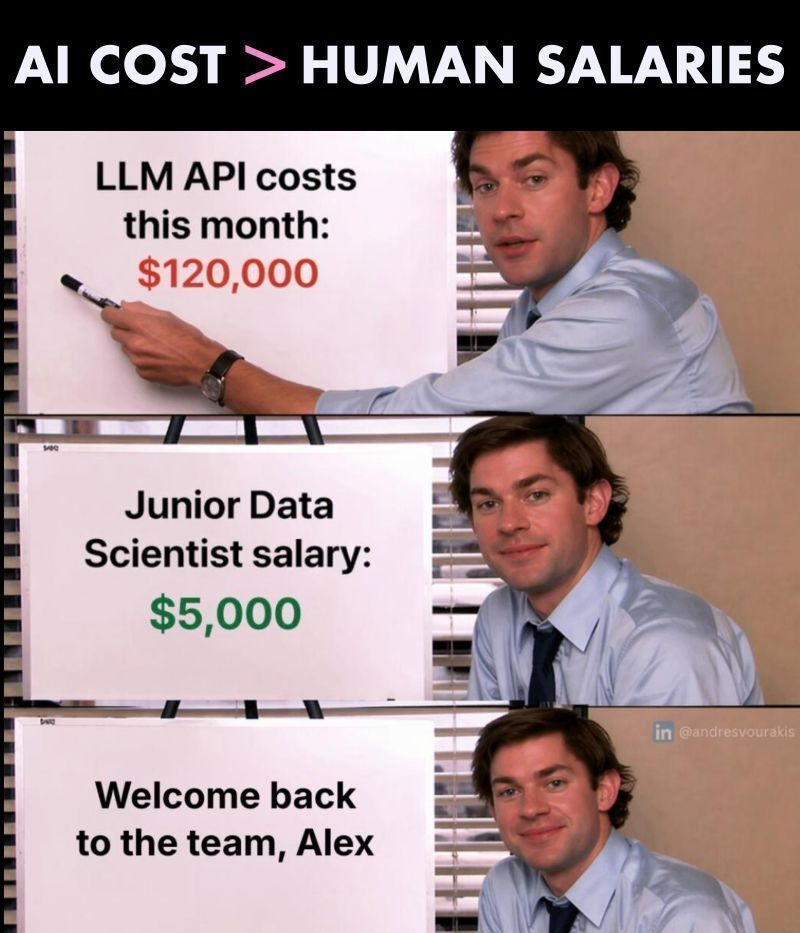
You know what really gets a developer out of bed in the morning? Not their team's mental health—nope, it's the API token budget . When your system architecture is so convoluted that your engineers are drowning in technical debt and crying into their keyboards, you can sleep peacefully. But the SECOND you realize your poorly designed microservices mesh is burning through tokens like a crypto bro in 2021? That's when the existential dread kicks in. Because nothing says "priorities" like ignoring the human cost of spaghetti code while obsessing over your OpenAI bill. Your workers are stressed? That's just character development. Your token consumption is inefficient? Now THAT'S a P0 incident. Time to refactor everything at 2 AM because those LLM calls aren't going to optimize themselves. Fun fact: The average developer spends more time justifying their token usage to finance than actually fixing the architectural disasters that caused the problem in the first place.

That Hurts A Lot

That Hurts A Lot
Oh, the absolute HORROR of watching your entire production server reboot because your brain decided to betray you at the worst possible moment! You just wanted to gracefully shut down that one service, maybe take a little coffee break, but NOPE—your muscle memory said "restart" and now you're watching everything go down like the Titanic. All your active users? Gone. Your uptime streak? Obliterated. Your soul? Ascending to another dimension as you experience all five stages of grief in 2.5 seconds. The best part? You can't even undo it. You just have to sit there, marinating in your own poor life choices, waiting for everything to come back up while praying nobody noticed the outage. Spoiler alert: they noticed.

Map AI Auto Complete To OTP Auto Complete

Map AI Auto Complete To OTP Auto Complete
GitHub just implemented autocomplete for one-time passwords. You know, those temporary codes that are supposed to be, uh, one-time and temporary . The ones you're not supposed to save anywhere. The ones that expire in 30 seconds. Someone looked at the OTP field and thought "you know what would make this more convenient? If we just suggested what to type here." The autocomplete dropdown is showing "3C04FA" - which is either a previously used OTP that got cached (defeating the entire purpose of OTPs) or some truly galaxy-brain feature implementation. It's like adding a "remember me" checkbox to a self-destructing message. The security team is probably having a great day.

The Invisible Touch

The Invisible Touch
You're sitting there watching your cursor move on its own, clicking through menus you didn't open, typing commands you didn't write. It's like watching a ghost possess your machine, except this ghost has admin privileges and knows exactly where your problem files are hiding. The IT person is in complete control while you just sit there like a passenger in your own computer, feeling oddly violated yet grateful. It's the weirdest mix of helplessness and relief—like someone else doing your dishes but you have to watch them reorganize your entire kitchen in the process.

"We" Never Seems To Be Plural

"We" Never Seems To Be Plural
Oh, the royal "we" strikes again! Your boss just casually drops a "we'll get it done somehow" in the meeting like they're about to roll up their sleeves and join you in the trenches. Plot twist: "we" is actually just YOU, sitting there alone at your desk at 11 PM, debugging production code while your boss is probably enjoying their third margarita. The "we" in corporate speak is the most deceptive pronoun in the English language—it's like a magic trick where team collaboration disappears and suddenly you're the sole developer on a "team effort." Congratulations, you just got voluntold to save the entire sprint single-handedly! 🎭

Supply And Demand

Supply And Demand
The entrepreneurial spirit is alive and well in gamedev. Step 1: Design a puzzle game so complex it requires physical note-taking. Step 2: Conveniently sell branded notebooks at your booth. It's not predatory capitalism, it's just... vertical integration. Honestly though, this is galaxy brain marketing. You're not just selling a game—you're selling the *entire experience*, including the tools needed to actually beat it. Next up: selling reading glasses for games with tiny fonts, or ergonomic chairs for roguelikes that take 80 hours to complete. The real kicker? Those notebooks probably have better margins than the game itself. Welcome to indie game development, where the real money is in the merch.

2005: Me And My 35 Kg Case Heading To The Shop Because I Deleted System 32

2005: Me And My 35 Kg Case Heading To The Shop Because I Deleted System 32
Back when computers were basically small furniture and every mistake required Olympic-level strength training to fix. Deleting System32 was the classic Windows self-destruct move—like pulling the foundation out from under your house and wondering why everything collapsed. No cloud backups, no recovery partitions, just you, your shame, and a 77-pound beige tower that you now have to haul to the repair shop because some forum troll convinced you it would "speed up your PC." The real workout wasn't just the weight—it was explaining to the tech guy what you did without making eye contact. Those CRT monitors alone could double as home gym equipment. Different times.

My Vibe Coding IT Director Just Send Me This

My Vibe Coding IT Director Just Send Me This
Your IT director really just casually dropped a localhost URL in a message and asked you to "check if this works for you please" like they're sharing a public website. Bestie, that's YOUR computer. That's YOUR local development environment. That link literally only exists on THEIR machine. It's giving "let me send you directions to my living room and see if you can find it from your house" energy. The sheer confidence of sending localhost:5173 (classic Vite dev server port btw) and expecting someone else to magically access it is absolutely SENDING me. Either your director needs a crash course in networking basics or they're trolling you at the highest level. Either way, the vibes are immaculate chaos.

Relationship Status: Connected, No Internet

Relationship Status: Connected, No Internet
You know you've made it as a software engineer when your bed looks like a server rack and your relationship status mirrors your WiFi connection. People with pets get a warm furball, couples get each other, but CS engineers? We get a laptop, a phone, a tablet, seventeen cables, and the crushing realization that we're technically "connected" to everything yet somehow still alone. The best part is how accurate the "Connected, No Internet" metaphor really is. Sure, you're surrounded by devices and technically plugged into the digital world 24/7, but are you actually communicating with another human? Nah. You're debugging at 2 AM while your phone charges next to your pillow like it's your significant other. At least the laptop understands you. It doesn't judge when you talk to rubber ducks or when you've been wearing the same hoodie for three days straight.

Infrastructural Integrity: 1%

Infrastructural Integrity: 1%
When your entire production infrastructure is literally running on a laptop that someone could trip over or accidentally close. The sign screams "DON'T UNPLUG ME! DON'T CLOSE MY LID!" because apparently this is what passes for enterprise architecture now. You know your DevOps strategy has gone sideways when your server documentation consists of a piece of paper taped to a laptop screen. No redundancy, no failover, no disaster recovery plan—just a prayer that nobody needs to vacuum this room or mistakes it for their personal gaming rig. The "even if my screen is off, I'm still on" is the cherry on top. Someone definitely already tried to close it thinking it was abandoned. Probably took down the entire company website for 20 minutes while Karen from accounting wondered why her laptop was so warm.

Does This Marketing Strategy Work?💀

Does This Marketing Strategy Work?💀
Indie game devs be out here thinking "maybe if I refresh the Steam page ONE more time, someone will buy it." Meanwhile, they've completely abandoned any semblance of actual marketing—like posting on social media, building a community, or literally doing anything that might attract players. Five minutes into your first release and you're already checking the sales dashboard like it's a heart rate monitor. Spoiler alert: refreshing the page doesn't magically generate sales. But hey, at least you're getting really good at hitting F5. That's a skill, right? The real kicker is watching the "actually marketing the game" exit fly by while you speed down the highway of denial and compulsive page refreshing. Classic developer move—spend 2 years building the game, 0 minutes learning how to sell it.

Every Few Years It's A New Villain For PC Gamers

Every Few Years It's A New Villain For PC Gamers
In 2020, GPU prices were so inflated you needed a second mortgage just to run Cyberpunk at medium settings. Fast forward to 2026, and now RAM manufacturers have apparently decided it's their turn to play the villain. The cycle continues: first it was GPUs, then CPUs, now RAM is looking real confident about being the next bottleneck that costs more than your rent. Can't wait for 2030 when thermal paste becomes a luxury item and we're all trading SSDs on the black market. At this rate, PC gaming will require a financial advisor more than a gaming chair.