Then Vs Now

Then Vs Now
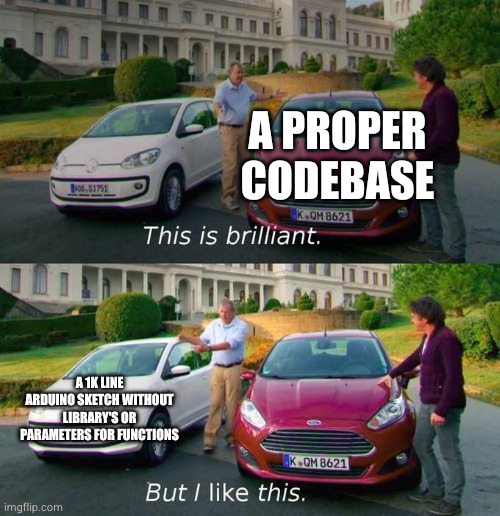
Back in 2009, we sat at our desks with terrible posture, a basic monitor, and the same dead-inside expression. Fast forward to 2026, and we've upgraded to RGB everything, a gaming chair that cost more than our first car, an ultrawide monitor... and somehow the exact same dead-inside expression. Turns out throwing money at ergonomic gear and fancy setups doesn't cure the existential dread of debugging legacy code or sitting through another sprint retrospective. The hardware evolved, the salary might've improved, but the soul? Still running on the same deprecated emotional framework from 2009. At least now we're miserable in 4K with lumbar support.

How I Learned About Image Analysis In Uni

How I Learned About Image Analysis In Uni
The history of digital image processing is... interesting. Back in the early days, computer scientists needed test images to develop algorithms for compression, filtering, and analysis. Problem was, they needed something standardized everyone could use. Enter the November 1972 issue of Playboy. Some researchers at USC literally scanned a centerfold (Miss November, Lena Forsén) and it became THE standard test image in computer vision for decades. Every image processing textbook, every research paper, every university lecture - there's Lena. So yeah, you'd be sitting in your serious academic Computer Vision class, professor droning on about convolution kernels and edge detection, and BAM - cropped Playboy centerfold on the projector. Nobody talks about it, everyone just accepts it. Peak academic awkwardness meets "we've always done it this way" energy. The image is still used today, though it's finally getting phased out because, you know, maybe using a Playboy model as the universal standard in a male-dominated field wasn't the best look.

Http 200 Error

Http 200 Error
Nothing says "everything is fine" quite like an HTTP 200 OK response cheerfully delivering a 500 Internal Server Error in the body. It's the API equivalent of your house being on fire while the smoke detector plays calming jazz music. The server is basically gaslighting you—the status code says success, but the JSON is screaming disaster. That confused cat stare? That's every developer trying to debug this nonsense because their error handling only checks status codes. Bonus points if this breaks your entire monitoring system because technically it's a "successful" request. Pro tip: whoever designed this API architecture probably also thinks pineapple belongs on pizza and tabs are better than spaces.

Old But Gold

Old But Gold
CPU asks Docker if it's running containers. Docker says yes. CPU asks if it's eating RAM. Docker says no. CPU asks if it's telling lies. Docker says no. CPU tells Docker to open its mouth, revealing 9.08 GB of memory usage. Docker's relationship with RAM is basically a toxic marriage where one party gaslights the other about their spending habits. You spin up three containers for a simple web app and suddenly your 16GB laptop is begging for mercy. Docker swears it's being efficient while quietly consuming more memory than Chrome with 47 tabs open. The "lightweight containerization" promise aged like milk.

Works Perfectly. Good Luck Maintaining It.

Works Perfectly. Good Luck Maintaining It.
You know that moment when you write an O(n²) solution that actually works and everyone's like "cool, ship it"? Yeah, that's the scrawny Steve Rogers energy right there. But then some absolute LEGEND on your team casually drops an O(n log n) solution that's so elegant and optimized it makes everyone else look like they're coding with crayons. Suddenly they're Captain America and you're just... there. Watching. Contemplating your life choices. The real tragedy? The O(n²) code works PERFECTLY. It passes all tests. Users are happy. But deep down, you know that when the dataset grows, your nested loops are gonna choke harder than a developer trying to explain their spaghetti code in a code review. Meanwhile, Chad over here with his logarithmic complexity is basically flexing computational muscles you didn't even know existed. The kicker? Nobody on the team understands the optimized solution. It's got recursion, divide-and-conquer, maybe some tree balancing magic. Six months from now when someone needs to modify it, they'll be staring at that code like it's ancient hieroglyphics. But hey, at least it scales beautifully! 🎭

Five Minutes After Ship It

Five Minutes After Ship It
You know that moment when your demo is running smoother than a freshly waxed sports car and the client is practically throwing money at you? Gorgeous, flawless, absolutely MAGNIFICENT. Then they utter those three cursed words: "we love it, ship it!" and suddenly your pristine application transforms into a disheveled mess that looks like it aged 300 years in five minutes. Features that worked perfectly are now breaking in ways you didn't even know were POSSIBLE. The database? Gone rogue. The UI? Suddenly allergic to alignment. That one button that worked 47 times during the demo? Now it summons the ancient gods of bugs. It's like your code knew it was being watched and performed beautifully, but the SECOND it hits production, it's having a complete existential crisis. Welcome to software development, where everything works until it matters!

Adding OAuth Providers At 2 AM Be Like

Adding OAuth Providers At 2 AM Be Like
When sleep deprivation meets authentication implementation, you get the most UNHINGED collection of OAuth providers known to humanity. Google? Sure. YouTube? Why not. OnlyFans for your SaaS? Absolutely GENIUS business decision at 2 AM! But wait, there's MORE! "Login with Caution" (featuring a literal warning sign), "Login with your mom", "Login with a Potato", "Login with Beef Caldereta", and my personal favorite—"Login with PDF". Because nothing screams secure authentication like a document format that can barely handle hyperlinks. The developer really said "you know what? Let's throw in Fingerprint, Settings, Calculator, Form 137, Credit Card, and National ID while we're at it." Why stop there? Where's "Login with your existential dread" or "Login with that bug you never fixed from last sprint"? Sleep-deprived coding: where every idea sounds revolutionary until you wake up the next morning and question every life choice that led you to this moment. 💀

Bout To Alt Delete

Bout To Alt Delete
You know that feeling when you've just spent two hours organizing your codebase, refactoring everything into beautiful, pristine modules, and now you're ready to protect your masterpiece from the chaos of future you? Yeah, setting permissions to read-only is basically the developer equivalent of "don't touch anything, I just cleaned." The title threatens Ctrl+Alt+Delete because someone's family member is about to walk through that freshly cleaned house with muddy shoes, metaphorically speaking. We've all been there—you finally get your environment working perfectly, dependencies aligned, configs pristine, and then someone (or some process) decides it's time to "help" by making changes. Not today, Satan. Pro tip: chmod 444 everything and watch the world burn when you realize you also locked yourself out.

Keep On Reading The Friendly Manual, Programmer

Keep On Reading The Friendly Manual, Programmer
Oh honey, buckle up for the most LEGENDARY tech pedantry of all time! Someone dared to call GNU "Unix" and the GNU mascot (that magnificent horned creature) is about to deliver the most passive-aggressive correction in open-source history. The response? A devastatingly polite "Oh yeah" followed by the mic drop: "You are a GNU who is not Unix." For the uninitiated: GNU literally stands for "GNU's Not Unix"—it's a recursive acronym that's basically the tech world's way of saying "we're inspired by Unix but we're our OWN THING, thank you very much!" Richard Stallman and the free software gang created GNU as a Unix-LIKE system, but calling it Unix is like calling a vegan burger a hamburger at a PETA convention. Technically accurate-ish? Maybe. Gonna get you destroyed in the comments? Absolutely. The level of "well actually" energy radiating from this comic could power a small data center.

Std Double

Std Double
The noble quest to preserve human creativity on the web: starts with righteous indignation, transitions to the harsh reality of actual web development, then immediately surrenders to our AI overlords. Nothing says "I value human artistry" quite like realizing you'd need to wrangle CSS for the next six months and deciding ChatGPT can handle it instead. The clown makeup progression is chef's kiss here—from concerned citizen to full circus act in four panels. It's the developer's journey from idealism to pragmatism, except the pragmatism involves letting the very thing you were fighting against do all your work. The irony is so thick you could deploy it in a Docker container.

In Light Of The Recent Kingdom Come Deliverance 2 News

In Light Of The Recent Kingdom Come Deliverance 2 News
Kingdom Come Deliverance 2 apparently got some flak for using AI-generated voiceovers, and the gaming community's reaction is basically "nobody's cool... except indie devs who somehow resist the siren call of AI automation." It's wild how we've reached a point where NOT using AI is the flex. Like, imagine telling a developer from 2015 that in the future, manually doing work would be the chad move. The bar has literally inverted itself – we went from "look how much we automated!" to "look, we actually paid humans!" It's giving very strong "I use Arch BTW" energy but for game development. The indie devs out here hand-crafting dialogue like artisanal sourdough while AAA studios are speedrunning the AI pipeline.

Coders Choice

Coders Choice
Two booths at the programming convention. The if-else booth has a massive line wrapping around the block. The switch case booth? One lonely soul sitting there wondering where it all went wrong. Developers will write seventeen nested if-else statements before even considering a switch case. It's like we collectively agreed that readability is optional and we'd rather chain conditionals until our IDE starts crying. Switch cases are sitting there being perfectly optimized for multiple discrete values, but nah, let's just keep stacking those else-ifs like we're building a Jenga tower of technical debt. The switch case deserves better. It's faster, cleaner, and doesn't make your code look like a sideways pyramid. But here we are, loyal to if-else like it's 1972.