

Manager Does A Little Code

Manager Does A Little Code
When your manager decides to "optimize" the codebase by shutting down "unnecessary" microservices, and suddenly 2FA stops working because—surprise!—everything in a microservices architecture is actually connected to everything else. Elon casually announces he's turning off "bloatware" microservices at Twitter (less than 20% are "actually needed"), and within hours people are locked out because the 2FA service got yeeted into the void. Classic move: treating a distributed system like it's a messy closet you can just Marie Kondo your way through. "Does this microservice spark joy? No? DELETE." Pro tip: Before you start playing Thanos with your infrastructure, maybe check what those services actually do. That "bloatware" might be the thing keeping your users from rage-tweeting about being locked out... oh wait. 💀

Open-Source Archaeology

Open-Source Archaeology
Every developer's proudest moment: getting complimented on code you copy-pasted from Stack Overflow at 3 AM. The secret to writing "clean and beautiful" code? Find someone else who already solved your problem six years ago and ctrl+c, ctrl+v your way to glory. It's not plagiarism, it's called "leveraging the open-source community." The real skill isn't writing the code—it's knowing which GitHub repo to raid and having the confidence to accept credit for it with a straight face.

Leave Me Alone

Leave Me Alone
When your training model is crunching through epochs and someone asks if they can "quickly check their email" on your machine. The sign says it all: "DO NOT DISTURB... MACHINE IS LEARNING." Because nothing says "please interrupt my 47-hour training session" like accidentally closing that terminal window or unplugging something vital. The screen shows what looks like logs scrolling endlessly—that beautiful cascade of gradient descent updates, loss functions converging, and validation metrics that you'll obsessively monitor for the next several hours. Touch that laptop and you're not just interrupting a process, you're potentially destroying hours of GPU time and electricity bills that rival a small country's GDP. Pro tip: Always save your model checkpoints frequently, because the universe has a funny way of causing kernel panics right before your model reaches peak accuracy.

When GPU Isn't The Only Problem Anymore

When GPU Isn't The Only Problem Anymore
Dropped $2000 on an RTX 5090 thinking you've ascended to gaming nirvana, only to discover your entire setup is held together by decade-old components running at peasant specs. Your shiny new flagship GPU is basically a Ferrari engine strapped to a horse-drawn carriage. That 1080p 60Hz monitor? It's like buying a telescope and looking through a toilet paper roll. And that CPU from the Obama administration? Yeah, it's bottlenecking harder than merge day with 47 unresolved conflicts. The 5090 is just sitting there, using about 12% of its power, wondering what it did to deserve this life. Classic case of optimizing the wrong part of the system. It's like refactoring your frontend to shave off 2ms while your backend is running SQL queries that would make a database admin weep.

No Thanks I Have AI

No Thanks I Have AI
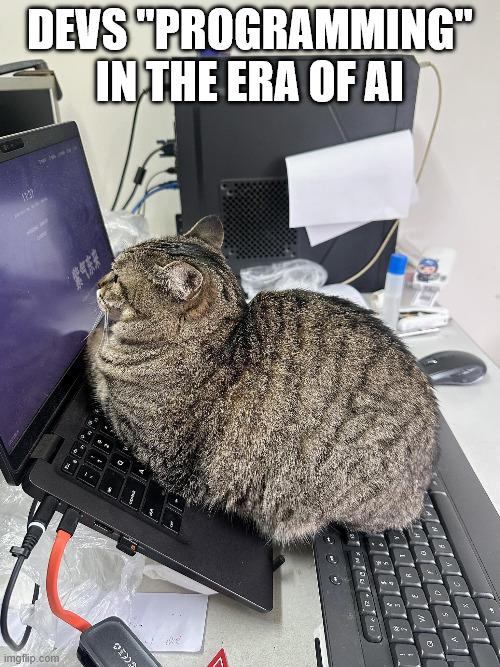
When someone suggests you actually learn something or use critical thinking but you've got ChatGPT on speed dial. Why bother with that wrinkly meat computer in your skull when you can just ask an LLM to hallucinate some plausible-sounding nonsense? The modern developer's relationship with AI: politely declining the use of their own brain like it's some outdated legacy system. Sure, debugging used to require understanding your code, but now we just paste error messages into a chatbot and pray. Who needs neurons when you've got tokens? Plot twist: the AI was trained on Stack Overflow answers from people who actually used their brains. Full circle.

Hard Coder

Hard Coder
You know that debugging technique where you just stare intensely at your code, squinting like you're trying to see through the Matrix itself? Yeah, that's the "hard look" method. It's the programming equivalent of trying to intimidate your bug into submission through sheer willpower and furrowed brows. The logic goes something like: "If I just glare at this stack trace long enough, maybe the universe will take pity on me and the segfault will magically disappear." Spoiler alert: it won't. But hey, at least you look really focused and professional while accomplishing absolutely nothing. This is usually employed right after the classic "run it again and see if it still happens" strategy and right before the desperate "delete everything and start over" phase. The bug remains undefeated, but your forehead wrinkles have definitely leveled up.

When You Spend 6 Hours Automating Coffee Instead Of Sleeping

When You Spend 6 Hours Automating Coffee Instead Of Sleeping
The classic programmer's dilemma: spend 5 minutes making coffee manually, or spend an entire night wiring up a microcontroller to do it for you. Our hero here has clearly chosen the path of maximum engineering effort for minimum practical gain. That coffee maker is now IoT-enabled with what looks like a development board sporting GPIO pins, probably running some Python script to trigger the brew cycle. The irony? They're now too exhausted to enjoy the automated coffee they just created. The duct tape on the cardboard box labeled "FRAGILE" is *chef's kiss* – nothing says "production-ready" like structural duct tape and repurposed Amazon packaging. Classic case of "I'll automate this to save time" turning into "I haven't slept in 28 hours but my coffee maker now has an API endpoint."

This Count As One Of Those Walmart Steals I've Been Seeing

This Count As One Of Those Walmart Steals I've Been Seeing
Someone found an RTX 5080 marked down to $524.99 at Walmart. That's a $475 discount on a GPU that literally just launched. Either the pricing system had a stroke, some employee fat-fingered the markdown, or the universe briefly glitched in favor of gamers for once. Your machine learning models could finally train at reasonable speeds. Your ray tracing could actually trace rays without your PC sounding like a jet engine. But mostly, you'd just play the same indie games you always do while this beast idles at 2% usage. The real programming challenge here is figuring out how to justify this purchase to your significant other when your current GPU works "just fine" for running VS Code.

The Big Score 2026

The Big Score 2026
Picture a heist crew planning their next big job, except instead of stealing diamonds or cash, they're targeting... RAM sticks from an AI datacenter. Because in 2026, apparently DDR5 modules are more valuable than gold bars. The joke hits different when you realize AI datacenters are already running hundreds of terabytes of RAM to keep those large language models fed and happy. With AI's insatiable appetite for memory growing exponentially, RAM prices are probably going to make GPU scalping look like child's play. Ten minutes to grab as much RAM as possible? That's potentially millions of dollars in enterprise-grade memory modules. The real kicker is that by 2026, you'll probably need a forklift just to carry out enough RAM to run a single ChatGPT competitor. Each server rack is basically a Fort Knox of memory chips at this point.

State Of Software Development In 2025

State Of Software Development In 2025
Oh, you sweet summer child suggesting we fix existing bugs? How DARE you bring logic and reason to a product meeting! While the backlog is literally screaming for attention with 10,000 unresolved issues, management is out here chasing every shiny buzzword like it's Pokémon GO all over again. "Blockchain! AI! Web3! Metaverse!" Meanwhile, Production is on fire, users can't log in, and Karen from accounting still can't export that CSV file—but sure, let's pivot to implementing blockchain in our to-do list app because some CEO read a Medium article. The poor developer suggesting bug fixes got defenestrated faster than you can say "technical debt." Because why would we invest in boring things like stability, performance, or user satisfaction when we could slap "AI-powered" on everything and watch the investors throw money at us? Who needs a functioning product when you have a killer pitch deck, am I right?

Who Wants To Join

Who Wants To Join
So you decided to get into AI and machine learning, huh? Bought all the courses, watched the YouTube tutorials, and now you're ready to train some neural networks. But instead of TensorFlow and PyTorch, you're literally using a sewing machine . Because nothing says "cutting-edge deep learning" quite like a Singer from 1952. The joke here is the beautiful misinterpretation of "machine learning" – taking it at face value and learning to operate an actual physical machine. Bonus points for the dedication: dude's wearing glasses, looking focused, probably debugging why his fabric won't compile. The gradient descent is now literally the foot pedal. To be fair, both involve threading things together, dealing with tension issues, and spending hours troubleshooting why nothing works. The main difference? One produces clothes, the other produces models that confidently classify cats as dogs.

Oopsie Doopsie

Oopsie Doopsie
You know that moment when you're casually browsing production code and stumble upon a `TODO: remove before release` comment? Yeah, that's the face of someone who just realized they shipped their technical debt to millions of users. The best part? That TODO has probably been sitting there for 6 months, survived 47 code reviews, passed all CI/CD pipelines, and nobody noticed until a customer found the debug console still logging "TESTING PAYMENT FLOW LOL" in production. The comment is now a permanent resident of your codebase, a monument to the optimism we all had during that sprint planning meeting.