

Java Memes

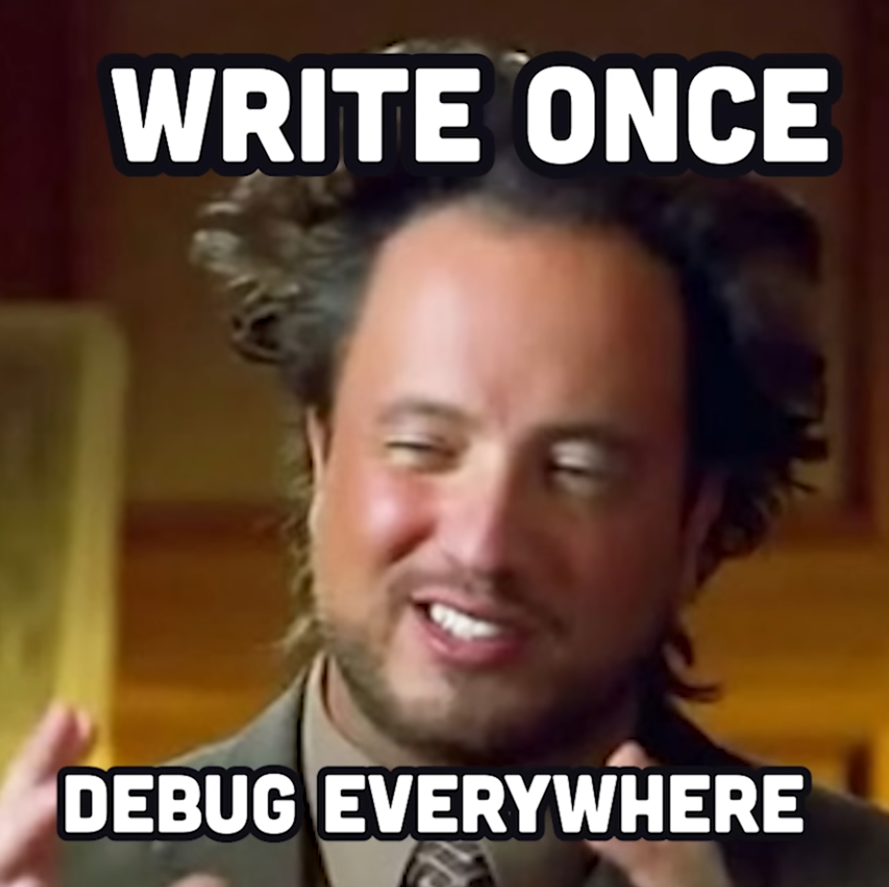
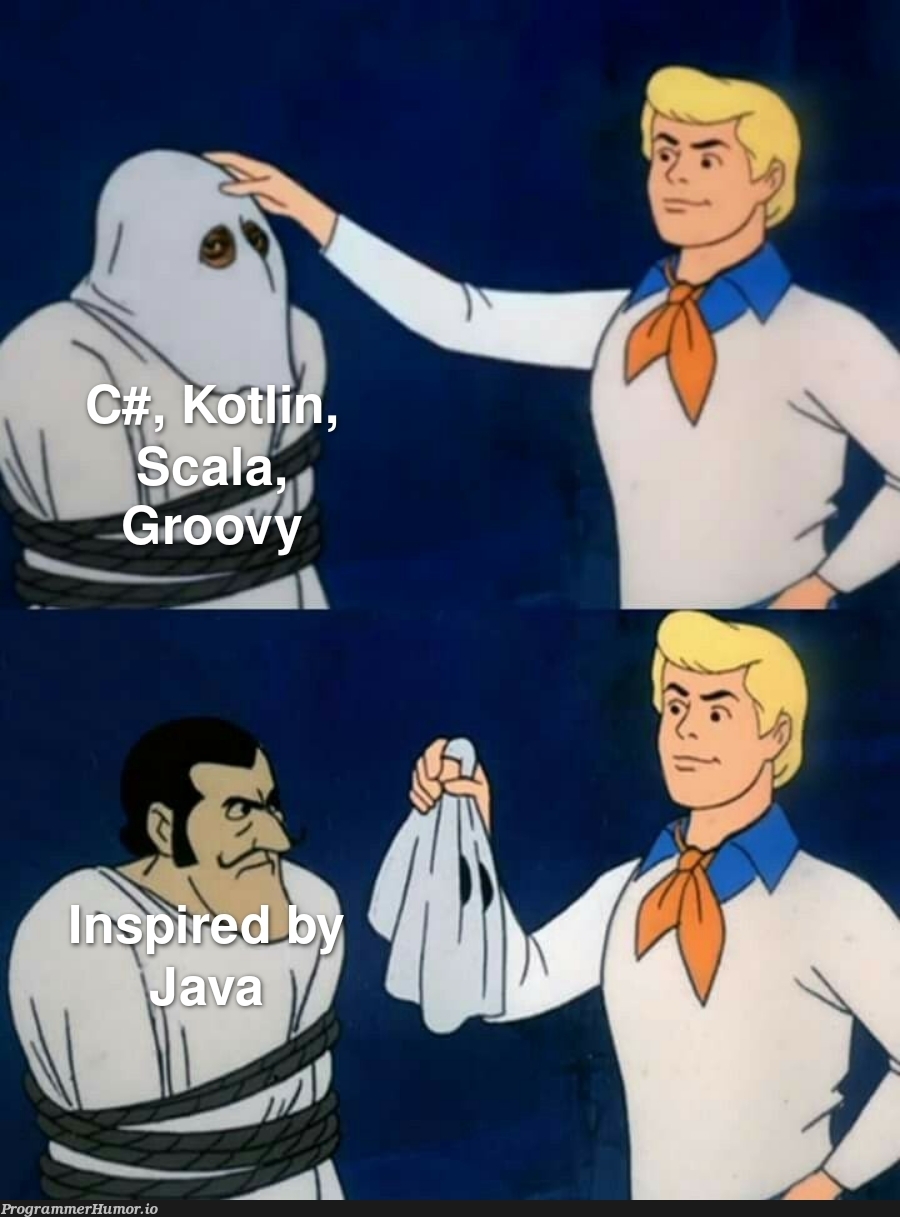
Java: where naming things isn't just hard – it's an art form requiring at least five words and three design patterns. These memes are for everyone who's experienced the special joy of waiting for your code to compile while questioning if AbstractSingletonProxyFactoryBean is really necessary. Java promised us 'write once, run anywhere' but delivered 'debug everywhere.' Still, there's something oddly comforting about a language so verbose that it practically documents itself. If you've ever had to explain to your boss why the JVM needs more RAM than your gaming PC, these memes will feel like a warm, object-oriented hug.
Upwards Mobility

Upwards Mobility
The corporate ladder speedrun: destroy a perfectly functioning system, make it objectively worse, get promoted, then bail before the dumpster fire you created becomes your problem. Peak software engineering right here. Dude took a Java service that ran flawlessly for 5 years and convinced management it needed a complete rewrite in Go with microservices because "modernization." The result? Slower performance, double the costs, and a memory leak that strikes at 2 AM like clockwork. But hey, that 20-page design doc had enough buzzwords to secure the L6 promotion. The best part? After getting the promo, they immediately transferred to a "chill Core Infra team" where they won't be on call for the disaster they created. Some poor new grad is now inheriting a $550k total comp nightmare. That's not upward mobility—that's a tactical extraction after carpet bombing production. Pro tip: If your promotion depends on creating "scope" and "complexity" instead of solving actual problems, you're not engineering—you're just resume-driven development with extra steps.

Brilliant Maneuver

Brilliant Maneuver
The corporate ladder climb speedrun any%. Dude took a perfectly functional Java service that ran flawlessly for 5 years and nuked it with an unnecessary microservices rewrite in Go—just to pad the resume with "scope" and "complexity" for that sweet L5 to L6 promotion at Amazon. The result? A system that's slower, costs 2x more, and has memory leaks that wake people up at 2 AM. But hey, the 20-page design doc was strategic enough to fool management. The real galaxy brain move though? Getting promoted, then immediately transferring to a "chill Core Infra team" before the whole thing implodes. Now some poor new grad inherits a ticking time bomb for $550k TC while our protagonist is sipping coffee, off-call, watching the chaos unfold from a safe distance. Truly a masterclass in corporate self-preservation and passing the buck. Fun fact: This is basically the tech industry version of "I'm not stuck in here with you, you're stuck in here with me"—except the villain escapes before the final act.

Suspicious Indentation Among Us

Suspicious Indentation Among Us
Your IDE just caught you red-handed creating an ArrayList right after an if statement, and it's treating this like a code crime scene. The tooltip is basically saying "hold up, why is this line indented like it's part of the if block when it clearly isn't?" It's that beautiful moment when your editor becomes a paranoid detective, questioning your formatting choices like you're about to commit a logic error. And honestly? Sometimes it's right to be suspicious. That innocent-looking indentation could fool a tired developer into thinking the ArrayList creation only happens when the list is empty, when in reality it executes every single time. The "EMERGENCY MEETING" is spot-on because this is exactly the kind of subtle bug that makes you call everyone over to your desk at 2 PM wondering why your code is behaving weird, only to realize you've been bamboozled by your own spacing. Java doesn't care about your indentation lies—only Python would actually fall for that trick.

The Evolution Of Programming Intelligence

The Evolution Of Programming Intelligence
Starting with Python's galaxy brain energy, descending through Java's merely brilliant neural activity, then C++'s dimming consciousness as you realize you're managing memory manually. Scratch brings us to the enlightened toddler phase where you're dragging colorful blocks around. And finally, we reach peak transcendence with command blocks in Minecraft—where you've ascended beyond traditional programming into a realm of redstone logic and block-based sorcery that somehow feels both incredibly powerful and deeply questionable at the same time. The progression from "I write elegant code" to "I literally program inside a video game" is a journey we all respect but don't necessarily understand.

Anime Gender Type Theory

Anime Gender Type Theory
Someone took their TypeScript generics knowledge and applied it to the most important problem in computer science: categorizing anime characters by gender presentation. Because nothing says "I understand covariance and contravariance" quite like explaining why that cute anime character might be a trap. The progression is beautiful: simple generic Girl, then a Variant that could be Boy OR Girl (Schrödinger's waifu), then a Boy that implements the IGirl interface (the classic "looks like a girl, sounds like a girl, but surprise"), and finally void—because some things transcend mortal understanding. The BitCast at the end is the cherry on top: when type safety fails you, just reinterpret those bits and pray. Your type system can't save you now.

A A A

A-A-A
The eternal debate that splits the programming world harder than tabs vs spaces. Baby's first word is "A-a-a" and the proud parent thinks it's adorable... until some psychopath suggests that arrays should start at 1. Zero-indexing is sacred. It's not just tradition—it's mathematically elegant, it's how memory offsets work, and it's been the foundation of programming since the dawn of time. But then you've got languages like Lua, MATLAB, and R out here acting like index 1 is where life begins, and frankly, they deserve to be left in that dumpster. The horror on that parent's face perfectly captures every C, Python, Java, and JavaScript developer's reaction when they encounter a 1-indexed language. It's not just wrong—it's an affront to nature itself.

The Best

The Best
Look, I've been in the trenches long enough to know that "compiled without errors" hits different than any romantic gesture ever could. Your code compiling on the first try? That's basically winning the lottery. It's the developer equivalent of finding out your soulmate exists and they also think tabs are better than spaces. We've all been there—staring at the screen, hitting compile, bracing for impact like it's a bomb defusal. Then... nothing. No red text. No angry compiler screaming at you about missing semicolons or type mismatches. Just pure, unadulterated success. That dopamine rush is unmatched. The bar for happiness in software development is so low it's practically underground. We celebrate the absence of failure like it's a major achievement. Which, let's be honest, it kind of is.

Verbatim What He Wrote Btw

Verbatim What He Wrote Btw
You know that moment when you're feeling kinda insecure about your coding skills, questioning your entire career path, maybe even googling "is it too late to become a barista"... and then you glance over at your classmate's screen and witness them comparing an integer variable to the LITERAL STRING "positive" in a for loop condition? Like bestie, that loop is NEVER going to execute because 'a' will NEVER equal the word "positive" 💀 And then declaring a variable called "double" (which is a reserved keyword in most languages) equals "balance"? The sheer audacity! The confidence! The complete disregard for syntax! Suddenly your imposter syndrome evaporates faster than your motivation on a Monday morning. Sometimes the best therapy is just... looking at someone else's code and realizing you're doing just fine, actually.

Imagine Not Using Camel Case

Imagine Not Using Camel Case
Nothing triggers a developer quite like someone using snake_case when they're a camelCase purist. The sheer horror of watching other programming communities embrace different naming conventions is enough to make you question everything. Meanwhile, the kebab-case folks are just chilling in their CSS files, and the PascalCase crowd is over there acting all superior. But hey, at least we can all agree that SCREAMING_SNAKE_CASE should be reserved for constants and angry commit messages.

Strong Developers Be Like

Strong Developers Be Like
You know you're living dangerously when your code could throw exceptions that would make the entire app crash, but you just... let it ride. No try-catch, no error handling, just pure faith in your logic. Then your senior dev does a code review and casually asks about exception handling, and suddenly you're sweating bullets trying to maintain composure. The "if he dies, he dies" mentality is peak confidence (or recklessness, depending on who you ask). Either the code works flawlessly, or production goes down in flames. No middle ground. It's like deploying to prod on a Friday afternoon—you're either a hero or updating your LinkedIn profile by Monday. Pro tip: Maybe wrap that database call in a try-catch before your senior finds out you're one null pointer away from taking down the entire microservices architecture.

Best Integer Type

Best Integer Type
Behold, the holy trinity of integer types in their natural habitat! INT32 is just vibing with a smooth brain, doing basic arithmetic like it's 1999. INT64 shows up with a galaxy brain, handling those bigger numbers like a responsible adult. But then INT54+SIGN bursts through the ceiling with cosmic enlightenment, achieving MAXIMUM EFFICIENCY by packing both the value AND the sign bit into a single integer type. It's like discovering fire, inventing the wheel, and landing on Mars all at once. The sheer elegance of explicitly acknowledging that yes, numbers can be negative too—revolutionary! Who knew that combining size with sign awareness would unlock the secrets of the universe?

Oracle Sues Navajo Nation

Oracle Sues Navajo Nation
Oracle's legal team just discovered that "Navajo" contains "java" backwards and immediately filed a trademark infringement lawsuit. Because nothing says "protecting intellectual property" quite like suing an entire Native American nation over a linguistic coincidence that's existed for centuries before Java was even a twinkle in Sun Microsystems' eye. The signature from "Toad Ellie Hep-End" (an anagram of "The Entitled People") at Oracle Corp is *chef's kiss*. Someone clearly spent their Friday afternoon crafting the perfect satirical jab at Oracle's notoriously aggressive legal department. Remember when they sued Google over Java APIs? Yeah, Oracle's lawyers have more billable hours than your production server has uptime issues. Fun fact: Oracle acquired Java when they bought Sun Microsystems in 2010, and they've been monetizing and litigating it ever since with the enthusiasm of a developer who just discovered their code works on the first try.