

try catch Memes

The Project I Was Hired For After They Fired The Entire Previous Team

The Project I Was Hired For After They Fired The Entire Previous Team
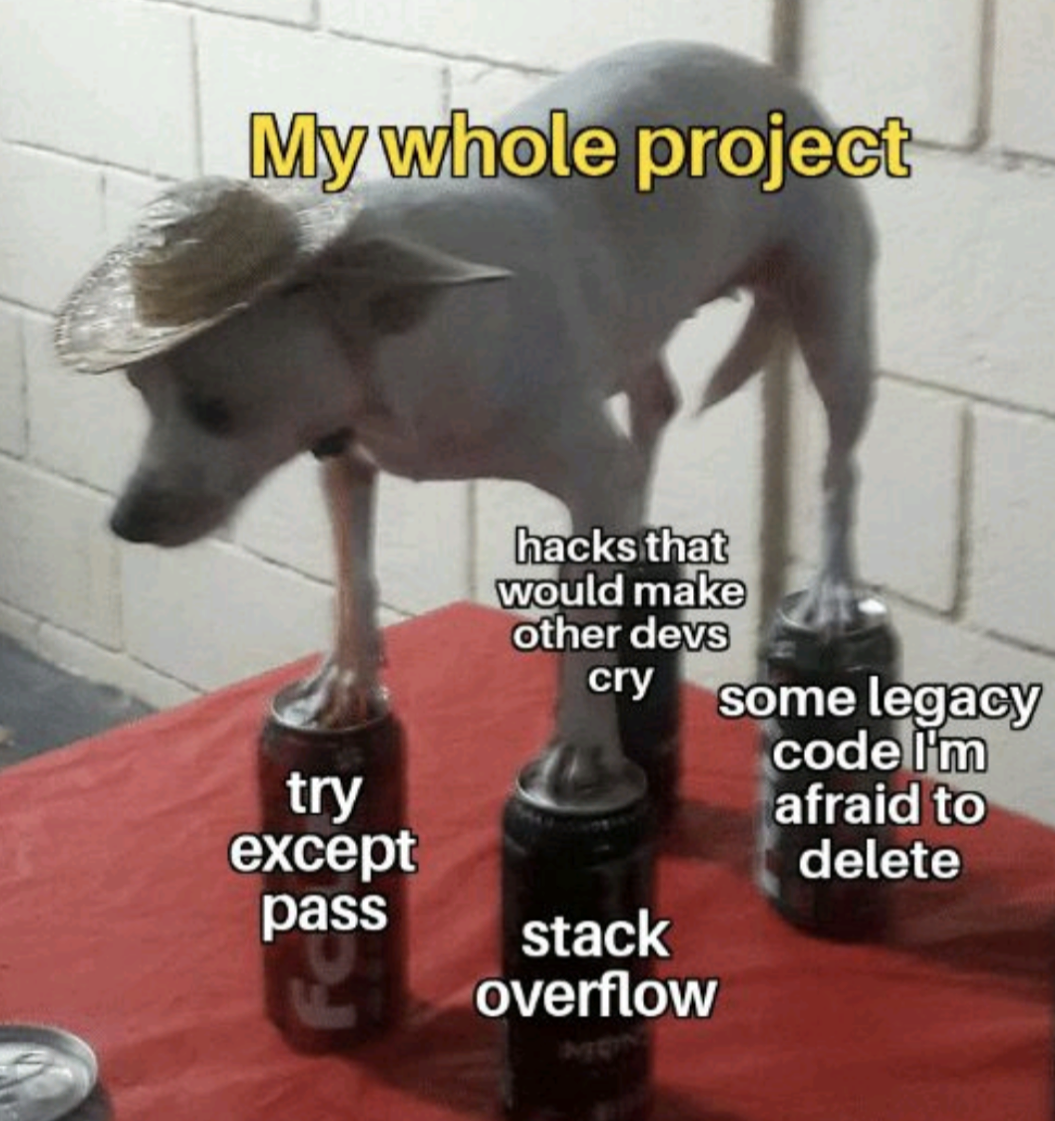
Nothing says "exciting new opportunity" quite like inheriting a codebase so cursed it got an entire team fired. You open the repo and it's like an archaeological dig of bad decisions—try-except blocks swallowing errors like a black hole, Stack Overflow answers copy-pasted with the original poster's username still in the comments, "hacks that would make other devs cry" (spoiler: you're crying), and legacy code so terrifying you're convinced deleting it will summon demons or break production in 47 different ways simultaneously. The whole thing is held together by duct tape, prayers, and what appears to be a single global variable doing the work of an entire microservices architecture. Management wonders why the previous team got fired. You wonder why they're still alive after maintaining this monstrosity. Now it's your problem. Congratulations on the promotion!

Improper Error Handling Be Like

Improper Error Handling Be Like
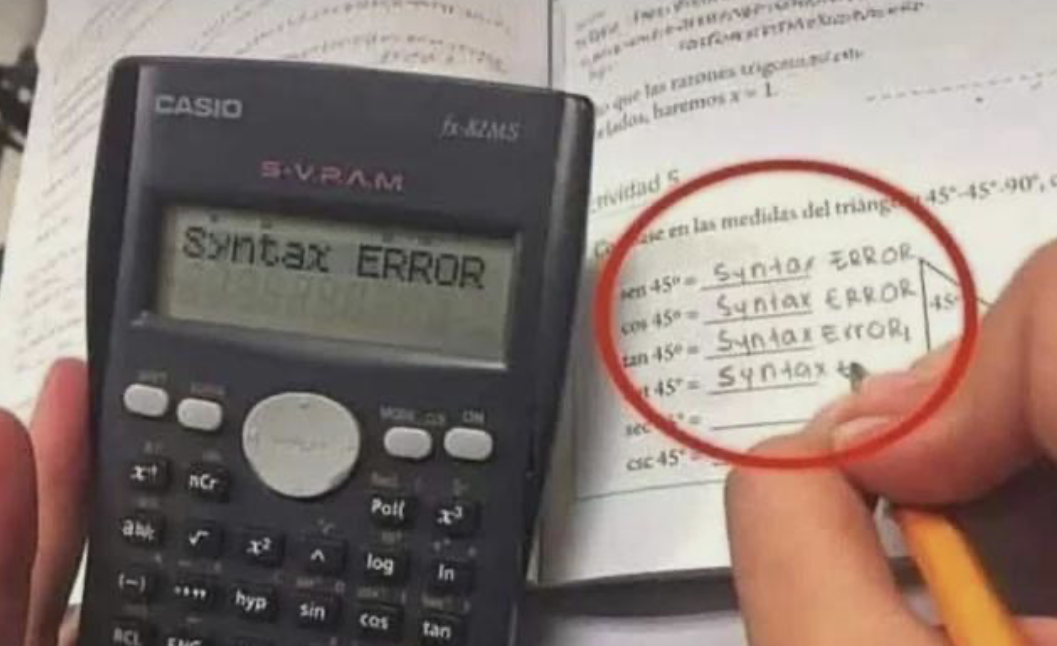
When your error handling strategy is literally just copying and pasting "Syntax ERROR" into your homework because the calculator threw a tantrum and you have ZERO clue what went wrong. Instead of actually debugging the problem, our genius mathematician here just transcribed the error message like it's the answer to life, the universe, and everything. Every single line: "Syntax ERROR." Beautiful. Poetic. Completely useless. The programming equivalent? That's your coworker who wraps everything in a try-catch block and just logs "Error occurred" without any context, stack trace, or will to live. No error codes, no meaningful messages, just pure chaos documented for posterity. Future you will absolutely LOVE trying to figure out what broke at 3 AM when the production server is on fire and all you have to work with is "Syntax ERROR" repeated seventeen times in the logs.

It's Just MCP Bro

It's Just MCP Bro
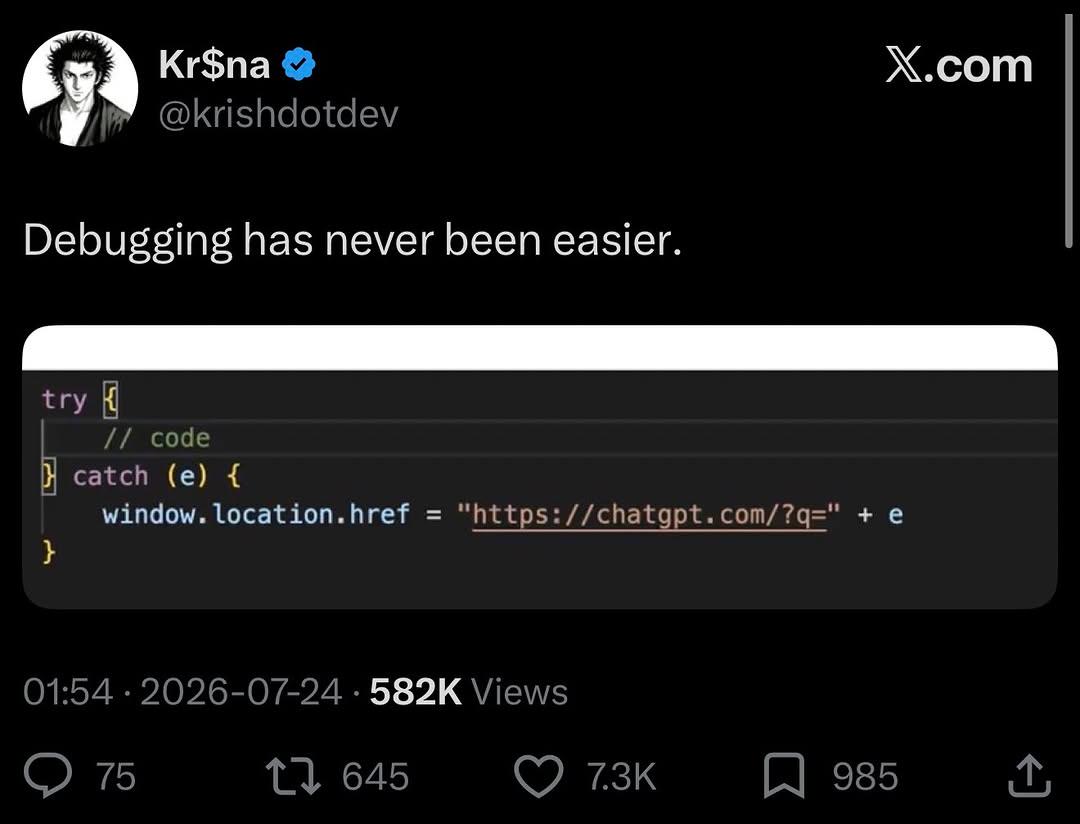
When your error handling strategy is literally just yeeting exceptions to ChatGPT via URL parameters. Why spend hours debugging when you can just redirect the entire stack trace to an AI and let it figure out what you did wrong? It's like having a senior dev on call 24/7, except they never judge you for that nested ternary operator you wrote at 2 PM on a Tuesday. The real genius here is the try-catch block that doesn't log, doesn't handle, doesn't recover—it just opens a new browser tab. Error-driven navigation at its finest. Your users won't even know the app crashed; they'll just think you're really passionate about AI assistance.

Stop Trying To Reinvent The Wheel

Stop Trying To Reinvent The Wheel
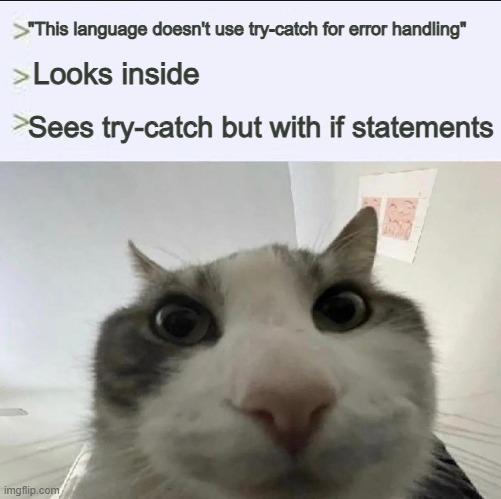
Every language designer ever: "We're going to revolutionize error handling by NOT using try-catch!" Then you peek under the hood and it's literally just try-catch wearing a fake mustache made of if statements. Result types in Rust? Try-catch with extra steps. Go's error returns? Try-catch but you manually carry the error like it's 1972. Swift's guard statements? Spicy try-catch. It's like watching someone insist they invented a "revolutionary new transportation method" and then showing you a bicycle with square wheels. Sure, it's technically different, but was it worth the effort? The industry has spent decades trying to make error handling look cool and different, but at the end of the day we're all just catching errors and pretending our syntax is superior.

Debugging For Professionals

Debugging For Professionals
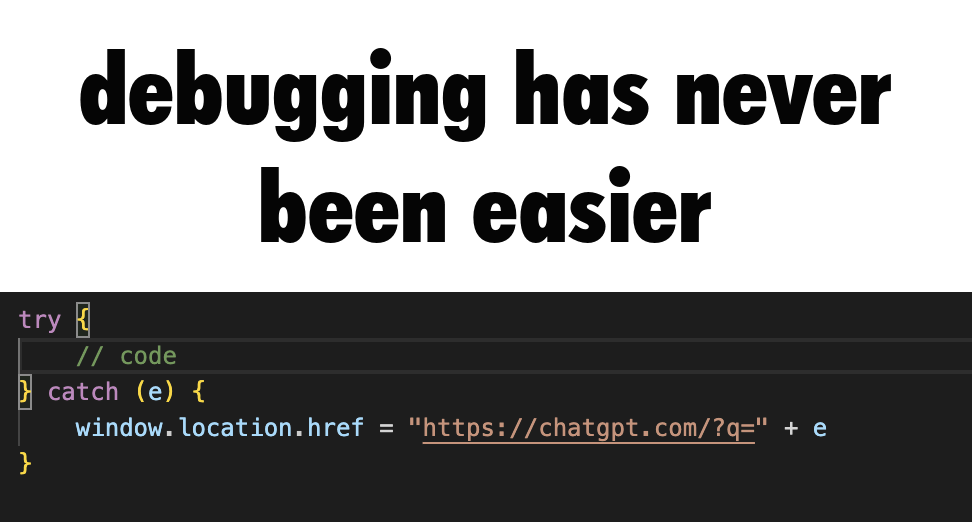
When your error handling strategy is to redirect the entire error message to ChatGPT and let AI deal with your problems. Why spend hours reading stack traces when you can just yeet the exception straight into an LLM's lap? Modern problems require modern solutions—specifically, solutions that involve outsourcing your debugging to a chatbot. The try-catch block has evolved from "handle the error gracefully" to "make it someone else's problem." Senior developer move right there.

Stackoverflow T-Shirt Overflowing like a boss Stack Overflow T-Shirt

Stackoverflow T-Shirt Overflowing like a boss Stack Overflow T-Shirt
Do you use Stackoverflow for most of your work? Love grinding and overflowing? Then this shirt suits best! Great gift idea for programmers, data scientists, coders and developers! Great fun for peopl…

Handling Exceptions Be Like

Handling Exceptions Be Like
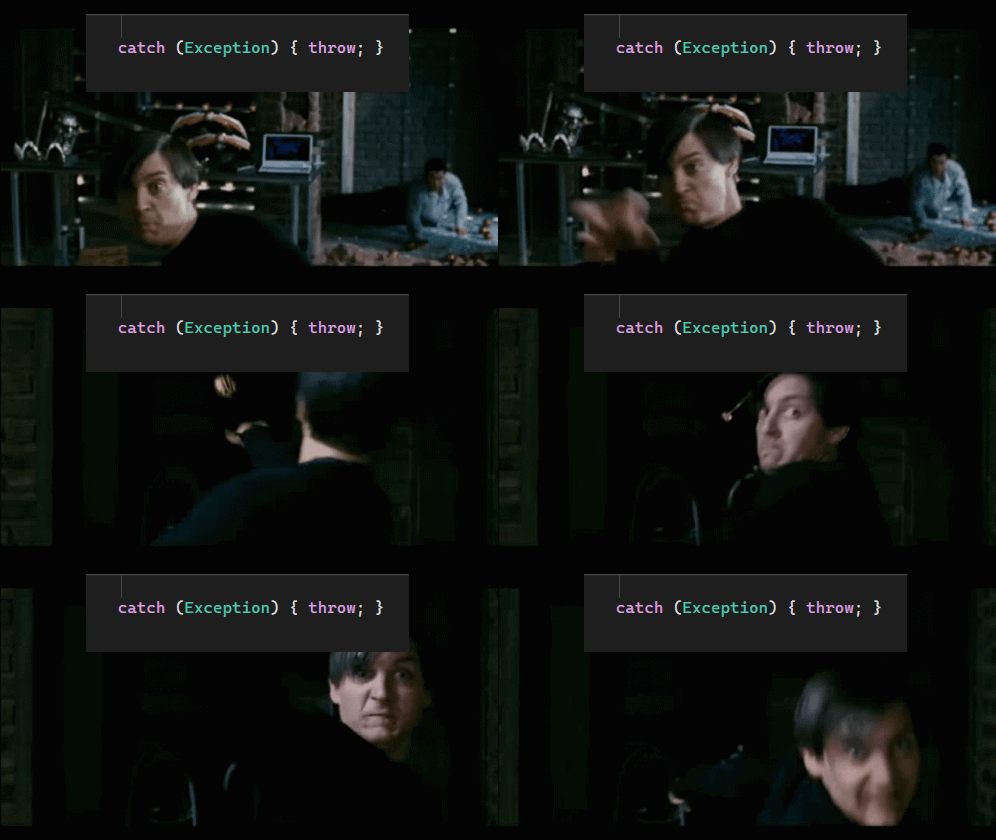
You know you've reached peak software engineering when your error handling strategy is literally "not my problem." Catching an exception just to immediately throw it again is like answering the phone, saying "nope," and hanging up. Zero value added, but hey, at least you can tell management you implemented proper exception handling. The best part? This actually compiles and runs. The code is technically doing something—it's just doing absolutely nothing useful. It's the programming equivalent of those meetings that could've been an email. Some junior dev probably added this during a panic-driven development session at 2 AM and somehow it made it past code review. We've all been there.

Based Java Developer

Based Java Developer
Java devs writing exception handling be like: "Yeah I'll catch it. Or not. Whatever happens, happens." The try-catch block is basically a suggestion at this point. Error handling? More like error acknowledging. The code runs, something breaks, you catch it, shrug, and move on with your life. No recovery logic, no fallback, just vibes. At least the compiler's happy.

Yoda Knows Error Handling

Yoda Knows Error Handling
Junior dev says they'll handle errors. Yoda drops the holy trinity of exception handling: try-catch blocks and the often-forgotten finally clause. That look of existential dread in the last panel? That's the exact moment you realize your "I'll just log it" approach wasn't cutting it. Finally blocks execute regardless of whether exceptions occurred, perfect for cleanup operations like closing database connections or file handles. But let's be honest, most of us remember finally exists only when the code reviewer asks "but what about resource cleanup?"

Throw It For The 2026

Throw It For The 2026
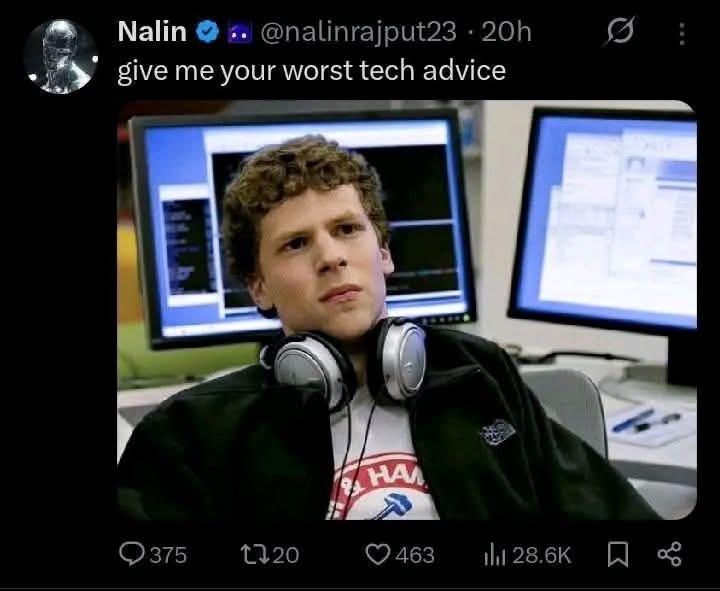
Someone asked for the worst tech advice and honestly, this is peak developer wisdom right here. Just wrap everything in a try-catch block and throw it into the void. Error handling? Never heard of her. Stack traces? Who needs 'em when you can just silently fail and pretend nothing happened. This is basically the programming equivalent of sweeping dirt under the rug and calling it cleaning. Your app crashes? Try-catch. Database connection fails? Try-catch. Existential crisis at 2 AM? Believe it or not, also try-catch. The catch block stays empty though—because acknowledging problems is for people who have time for proper error handling. Production bugs will love you for this approach. Future you will definitely not be cursing past you while debugging why the application just... stops working with zero logs or error messages. Ship it!

Strong Developers Be Like

Strong Developers Be Like
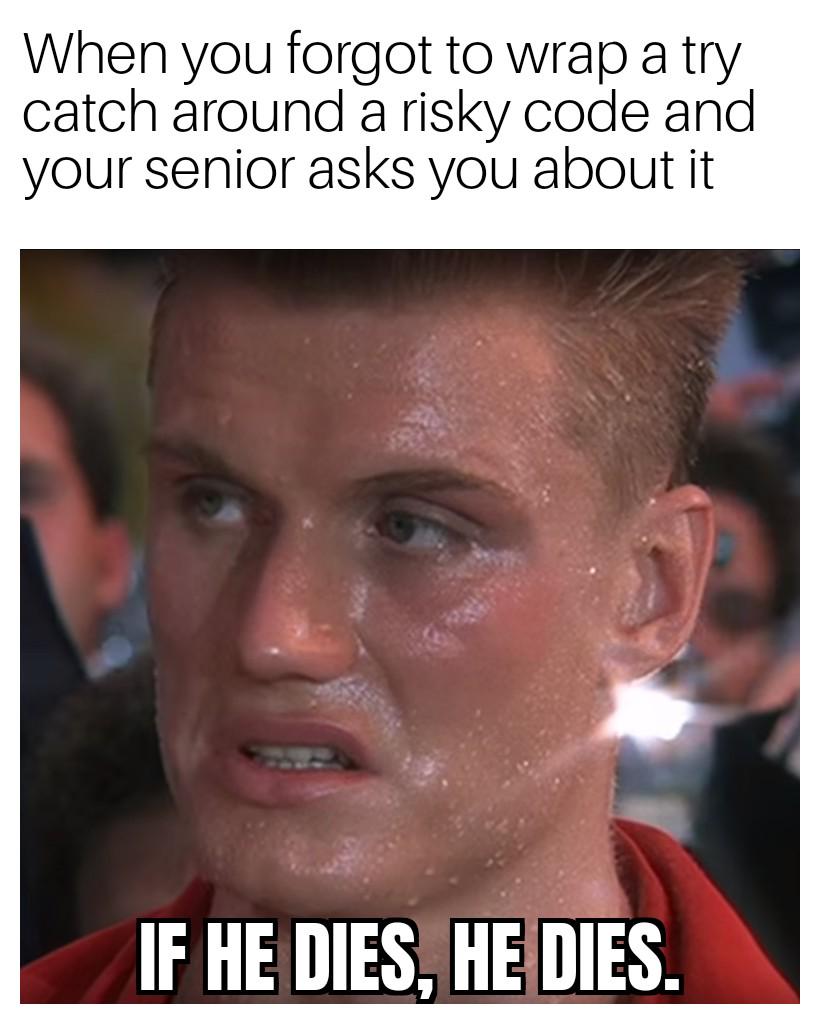
You know you're living dangerously when your code could throw exceptions that would make the entire app crash, but you just... let it ride. No try-catch, no error handling, just pure faith in your logic. Then your senior dev does a code review and casually asks about exception handling, and suddenly you're sweating bullets trying to maintain composure. The "if he dies, he dies" mentality is peak confidence (or recklessness, depending on who you ask). Either the code works flawlessly, or production goes down in flames. No middle ground. It's like deploying to prod on a Friday afternoon—you're either a hero or updating your LinkedIn profile by Monday. Pro tip: Maybe wrap that database call in a try-catch before your senior finds out you're one null pointer away from taking down the entire microservices architecture.

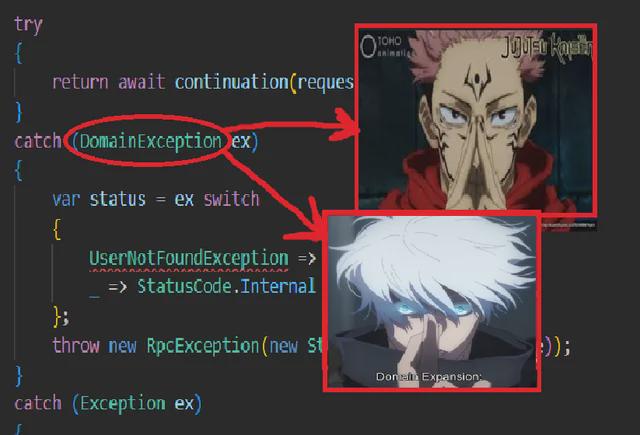
Expanding C Sharp: When Your Exceptions Go Anime

Expanding C Sharp: When Your Exceptions Go Anime
The meme brilliantly expands on the concept of "C#" (C Sharp) by turning it into a Jujutsu Kaisen anime reference. The code shows a DomainException being caught, which then expands into "Domain Expansion" - a powerful technique in the anime where sorcerers create a pocket dimension to amplify their cursed techniques. It's that perfect intersection of programming pain and weeb culture. When your C# exception handling suddenly turns you into Gojo Satoru, you know your code isn't just breaking - it's transcending dimensions. Next time your application crashes, just yell "DOMAIN EXPANSION" and pretend it was intentional all along.

Just Pointing It Out

Just Pointing It Out
The top panel shows a man pointing a gun with the caption "A null pointer exception in production." This is basically the coding equivalent of your app suddenly committing suicide in front of users. The bottom panel shows someone wrapped in a protective cocoon labeled "Me, wrapping the entire function in a giant try...catch block." It's the programming equivalent of bubble-wrapping your entire house because you dropped a glass once. Sure, it's lazy, inefficient, and would make your CS professor weep, but hey—at least the app doesn't crash! Ship it and let future-you deal with the technical debt. That's what code reviews are for, right?

Vintage Metal Sign Programmer Funny Poster Retro Tin Signs Funny Aluminum Sign For Man Cave, Garage, Living Roome, Cafe And Pub Decoration 8 X 12 Inch

Vintage Metal Sign Programmer Funny Poster Retro Tin Signs Funny Aluminum Sign For Man Cave, Garage, Living Roome, Cafe And Pub Decoration 8 X 12 Inch
Vintage Style: Add a touch of nostalgia to any space with this classic vintage metal sign, perfect for programmers and tech enthusiasts. · Funny & Unique: A humorous addition to your home or office, …