

Trust issues Memes

Posts tagged with Trust issues
I Don't Trust Myself

I Don't Trust Myself
The existential crisis when VS Code asks if you trust yourself. Sure, I wrote this code, but do I trust it? Hell no. That's future me's problem when it inevitably breaks in production. The suspicious side-eye is exactly how I look at my own commit history - like finding a ticking time bomb I planted and forgot about.

Power Button Paranoia Chronicles

Power Button Paranoia Chronicles
Trust issues level 9000! When someone asks why IT professionals are difficult, here's your answer: driving two hours just to physically verify a server is powered on despite THREE people's assurances. Because in the server room, "trust but verify" isn't just a motto—it's a survival mechanism. That blinking LED is worth more than any verbal confirmation. Remote management tools? Sure, they exist... but nothing beats the sweet relief of pressing that cold metal power button yourself and whispering, "I knew it" when you were right all along.

Did You Try Turning It On

Did You Try Turning It On
Someone asks why IT people are jerks, and gets the perfect response: an IT guy drove TWO HOURS just to push a power button that three people swore was already on. Trust issues? Justified. The first rule of tech support isn't "have you tried turning it off and on again" – it's "are you SURE it's actually on?" Four years of computer science education reduced to playing glorified electrician because users can't differentiate between a power light and their imagination.

Trust Issues With Your Own Code

Trust Issues With Your Own Code
Trust issues taken to a whole new level! VS Code's Git integration has the audacity to question if you trust yourself when opening your own project. The suspicious face perfectly captures that moment of existential coding crisis: "Do I even trust my own code? What did past-me hide in these commits?" Self-doubt.exe has been successfully installed.

The Great Clipboard Trust Deficit

The Great Clipboard Trust Deficit
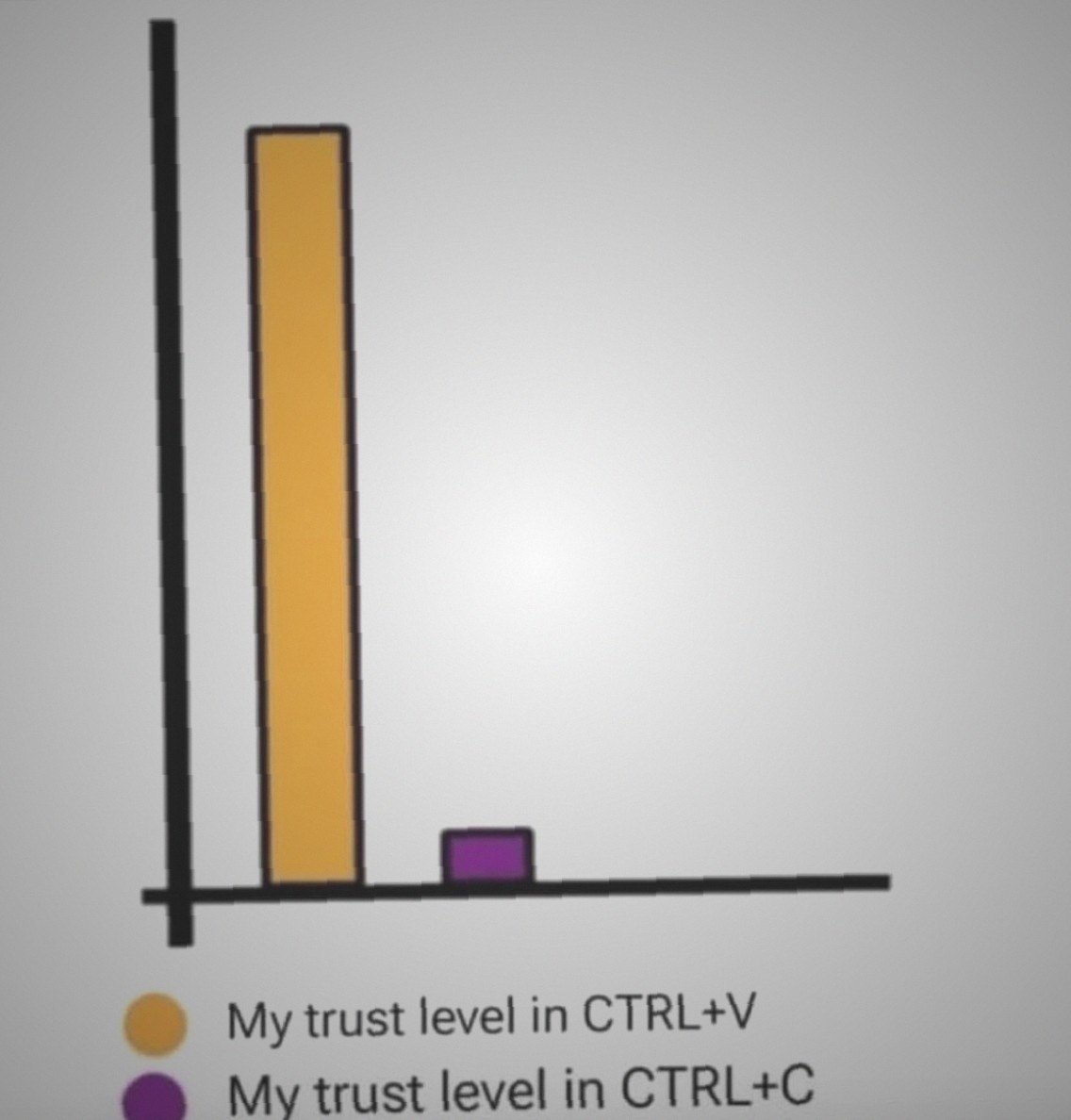
Ah, the existential crisis of keyboard shortcuts! The orange bar towers confidently, representing our unwavering faith in CTRL+V (paste), that magical savior after hours of work. Meanwhile, that tiny purple bar for CTRL+C (copy) might as well be labeled "trust issues." We've all been there—frantically hitting CTRL+C multiple times because did it actually copy though? That moment of panic when you're about to paste something important and suddenly wonder if the clipboard is holding your carefully selected text or just the remnants of that cat meme you copied three days ago. The most sophisticated developers among us have evolved to press CTRL+C at least 17 times in rapid succession. It's not paranoia if the clipboard really is out to get you.

Trust In The Most Vulnerable Moments

Trust In The Most Vulnerable Moments
THE AUDACITY of comparing junior developers to pooping dogs! 💀 When that fresh-faced junior makes terrified eye contact while deploying to production, they're not just scared—they're LITERALLY putting their entire career in your hands! Like a puppy in its most vulnerable moment, silently begging "please don't let this crash the server and get me fired on day 12." The deployment button might as well be labeled "career self-destruct" and yet they press it while staring at you with those wide, innocent eyes. The ultimate act of workplace vulnerability!

Pretty Please Don't Hack Our Users

Pretty Please Don't Hack Our Users
Open source maintainers having to explicitly tell contributors not to add malware is like telling a fox not to eat your chickens. That single bullet point in the contribution guide is doing some heavy lifting—as if malicious actors read documentation and go "oh darn, guess I'll have to find another repo to corrupt." The desperate plea of "Please do not add malware" has the same energy as Dora telling Swiper not to swipe. Spoiler alert: Swiper's gonna swipe anyway.

Never Trust The Copy

Never Trust The Copy
Evolution of a developer in three stages: First, the peasant way: manually highlighting with the mouse like it's your first day with a computer. Then, the standard keyboard shortcut approach that separates the professionals from the amateurs. But the final form? Hitting Ctrl+C multiple times because you've been burned too many times by phantom clipboard failures. That satisfying machine-gun tapping of the C key is the sound of trust issues developed over years of lost code and broken promises. The tuxedo is just what your soul wears after enough clipboard betrayals.

Trust Issues In The Digital Age

Trust Issues In The Digital Age
THE AUDACITY! Microsoft's OneDrive suggesting it'll protect you from ransomware is like a fox offering to guard your henhouse! 🦊🐔 Microsoft, sweetie, you can't be the solution when your products are half the problem! Windows is basically a welcome mat for malware at this point. And now you want me to store my precious recovery files with YOU?! The "Dismiss" button might as well say "I'm not THAT desperate yet." Honey, I'd rather write my files on stone tablets than trust the company whose security updates are basically just apologies.

The Save Button Trust Issues

The Save Button Trust Issues
The paranoia is real . While normal humans click save and move on with their lives, developers exist in a perpetual state of file-saving anxiety. That crucial code you just wrote? Did it actually save? Better check. Then save again. Then one more time for good measure. It's not paranoia if the system really is out to get you. We've all lost work to the void at least once, and our trauma manifests as this absurd save-check-save-check ritual that no amount of autosave functionality will ever cure. Ctrl+S is not just a keyboard shortcut—it's a nervous tic developed through years of trust issues with computers.

Is This A Virus?

Is This A Virus?
Ah, the legendary CrystalDiskInfo67.exe – that sketchy-looking executable with a CD icon that somehow ends up being more trustworthy than half your company's codebase. When your disk is making sounds like a blender full of paperclips, this is the hero you reluctantly download, hovering over the "Run Anyway" button while whispering "please don't steal my Bitcoin." The irony is that legitimate disk diagnostic tools often look more suspicious than actual malware. Trust issues? In this industry, we call that "experience."

Press X To Doubt

Press X To Doubt
ChatGPT's confidence is inversely proportional to the likelihood of its code actually working. Nothing screams "hidden runtime exception" quite like "thoroughly refined, rigorously tested, and fully stable." The skeptical face says it all—that code is about to crash your production server faster than you can say "but it worked on my machine." The only thing more reliable than AI-generated bugs is the human suspicion they inspire.