

threading Memes

The Best Way To Make An Infinite Loop

The Best Way To Make An Infinite Loop
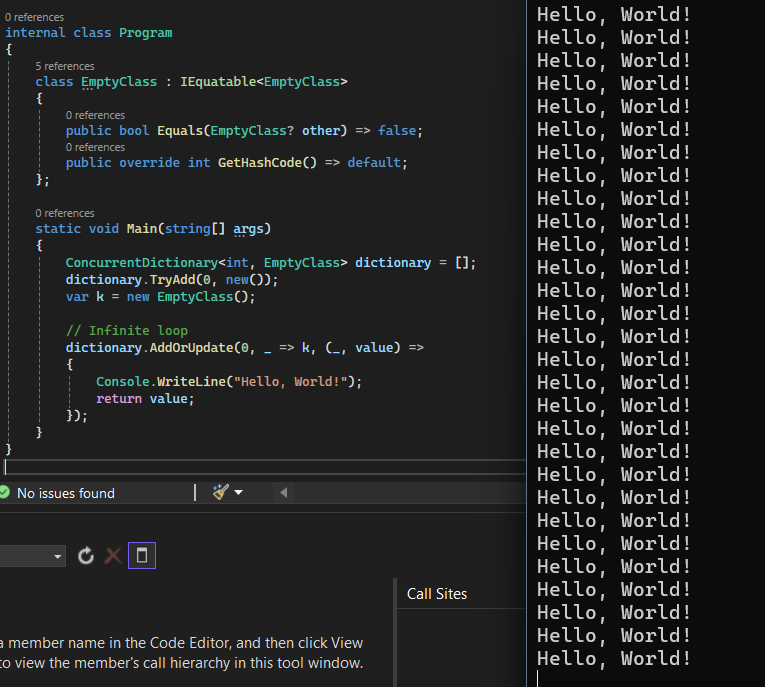
Someone discovered that C#'s ConcurrentDictionary.AddOrUpdate() method is basically a cheat code for infinite loops. Instead of the boring while(true) , they're using a lambda that ignores the key, ignores the current value, and just... keeps updating the same dictionary entry forever. The lambda returns value , which triggers another update, which calls the lambda again, which returns value , which... you get it. The genius part? The IDE shows "No issues found" because technically this is perfectly valid code. It's like telling your compiler "I'm not stuck in an infinite loop, I'm just very enthusiastic about updating this dictionary!" The output window spamming "Hello, World!" is chef's kiss—proof that sometimes the most cursed solutions are also the most creative. Pro tip: Don't actually do this unless you want your code reviewer to question your life choices and your CPU to file a restraining order.

Mutex Will Save You All

Mutex Will Save You All
Grammar lessons from the concurrency trenches. While you're busy learning Latin plurals for your CS vocabulary, the mutex is quietly plotting your demise with race conditions and deadlocks. The joke here is brutal: mutex (mutual exclusion) is supposed to be your savior in multithreaded programming, preventing race conditions by locking shared resources. But its plural? "Deadlock." Because when you start using multiple mutexes without proper ordering, you're basically writing a suicide note for your application. Thread A locks mutex 1 and waits for mutex 2, while Thread B locks mutex 2 and waits for mutex 1. Congrats, your program is now frozen in time like a developer staring at their production logs at 3 AM. The irony is chef's kiss—the very thing meant to save you becomes your downfall when you scale up. It's like hiring security guards who end up blocking each other in doorways.

Multithreading

Multithreading
The documentation makes multithreading look like a beautiful parade of orderly buses gliding smoothly down the street—so elegant, so synchronized, so *chef's kiss*. Then you actually implement it and suddenly you've got a catastrophic intersection pileup where nothing moves, everything's blocking everything else, and someone's honking their mutex in frustration. Race conditions? Deadlocks? A complete traffic jam of chaos? Welcome to the glamorous world of concurrent programming, where your threads are about as coordinated as buses trying to occupy the same physical space. Spoiler alert: physics doesn't allow that, and neither does your CPU.

Are You Living Or Is Your Process About To Die?

Are You Living Or Is Your Process About To Die?
Oh look, it's a CPU from AMD checking if your code is actually alive! Just like in Squid Game, where contestants had to survive deadly challenges, your programs are constantly being judged on whether they deserve to keep running or get brutally terminated by the OS. That horrified expression is exactly what happens when you realize your beautiful algorithm that worked perfectly in development is now deadlocked in production. The CPU is just sitting there like "Yeah, I'm gonna need you to respond in the next 0.5ms or I'm sending a SIGKILL your way." Spoiler alert: Your thread doesn't make it to the next round.

Python And Scalability In The Same Sentence

Python And Scalability In The Same Sentence
That visceral reaction when someone dares to mention Python and scalability together! Python's GIL (Global Interpreter Lock) is basically the relationship counselor that says "one thread at a time, please" - making true parallelism about as realistic as finishing a project before the deadline. Sure, you can use multiprocessing, but at that point you're just spawning separate Python instances like tribbles on a starship. The background presentation ironically warns about "investing in new frameworks without validating the problem first" while Python devs are frantically trying to AsyncIO their way out of performance bottlenecks. It's the language equivalent of bringing a butter knife to a gunfight and insisting it's actually a Swiss Army knife.

The Ultimate Deadlock Interview Paradox

The Ultimate Deadlock Interview Paradox
The classic chicken-and-egg problem of tech interviews. Can't explain deadlock without getting hired, can't get hired without explaining deadlock. Just like two threads waiting for each other's resources, this candidate and interviewer are stuck in their own human deadlock. The irony is so thick you could debug it.

Back In Our Time

Back In Our Time
Grandma's not senile—she's just a Python threading expert who's lived long enough to remember the GIL wars. The Global Interpreter Lock (GIL) is Python's infamous party pooper that forces your fancy multi-threaded code to basically take turns on the CPU like kids waiting for the ice cream truck. While junior devs are busy writing "async" everywhere thinking they're parallel programming wizards, Grandma here remembers the brutal truth: your 32-core machine is essentially a very expensive single-core processor when running Python threads. Maybe we should listen to her wisdom instead of wheeling her back to bed—she probably wrote COBOL that's still running the banking system you used this morning.

The Three Hardest Things In Computer Science (Actually Five)

The Three Hardest Things In Computer Science (Actually Five)
The joke is hiding in plain sight—just like that duplicate cache invalidation entry. Notice how the list claims to have "three" hardest things but actually lists five items? And cache invalidation appears twice? That's the meta-joke about cache invalidation being so hard you can't even remember you already listed it. Meanwhile, "Threlti-Muading" is just "Thread Loading" with a naming problem, proving the point about naming things being difficult. And the cherry on top? The list itself has an off-by-one error by promising three items but delivering five. It's recursively proving its own point!

Brute Force vs. The Swarm

Brute Force vs. The Swarm
The strongman pulling a truck represents your CPU - powerful but working alone, handling one big task at a time. Meanwhile, the GPU is like those dozens of people working together to pull an airplane - individually weaker but massively parallel. After 15 years in tech, I've watched countless developers throw CPU cores at problems that scream for GPU parallelization. It's like watching someone use a sledgehammer to hang a picture frame.

Your Mother Is A Shared Resource

Your Mother Is A Shared Resource
The classic "your mom" joke gets a distributed systems makeover. In programming, a shared resource is something multiple processes can access simultaneously—often leading to race conditions and deadlocks if not properly managed. Just like how everyone in the office apparently has access to your mother. Brutal efficiency in both the insult and the technical reference.

The Collective Chaos Of Race Conditions

The Collective Chaos Of Race Conditions
The joke here is brilliant because race conditions—those pesky bugs where multiple processes compete to access shared resources—are inherently unpredictable and chaotic. So asking for their "collective noun" is itself a paradox. Even better, the punchline "best answer will be submitted to Wikipedia" is the chef's kiss of irony. If multiple people simultaneously tried to update that Wikipedia entry, they'd create... you guessed it... a race condition! The math equations floating around just add that perfect "thinking really hard about a fundamentally unsolvable problem" vibe. It's like trying to mathematically prove which thread will win—spoiler alert: you can't.

Let Math Solve His Own Problems

Let Math Solve His Own Problems
Ah yes, the anti-programming manifesto from someone who clearly had their code compile on the first try and couldn't handle the success. The author seems to believe computers should just magically do math without being told how. Next they'll expect their car to drive without a steering wheel because "wheels are circles, not driving devices." My favorite part is complaining about recursive methods with threads while typing this rant on a device powered by... wait for it... programming. That's like yelling at clouds for raining while standing under an umbrella. And that final while(true){ print(money); } snippet? If only it were that easy. I've been running that code for years and my bank account remains stubbornly unimpressed.