

Pull request Memes

Posts tagged with Pull request
Just Made My First Pull Request To Main

Just Made My First Pull Request To Main
Someone just pushed +30,107 additions and -3,016 deletions directly to main. That's not a pull request, that's a war crime. The panicked scribbling to hide the evidence says it all—they know exactly what they've done. For context: a typical feature PR might be like +50/-20 lines. This person just rewrote the entire codebase, probably replaced the framework, migrated databases, and added a blockchain integration nobody asked for. The four green squares suggest this passed CI somehow, which means the tests are either non-existent or lying. Senior devs are already drafting the postmortem while the intern frantically Googles "how to undo git push force."

Best Pull Request Of All Time

Best Pull Request Of All Time
Someone really just opened a PR to add their own name to the README as a "random contributor" because they "thought it would be cool to be on it." The sheer audacity of this self-nomination is chef's kiss. No code changes, no bug fixes, no documentation improvements—just pure, unfiltered main character energy. And they're "open to feedbacks on the implementation" like they just architected a distributed system instead of typing their own name into a markdown file. The reactions tell the whole story: 1 thumbs up (probably from their alt account), 9 thumbs down, 8 laughing emojis, and 2 party poppers from people who appreciate the comedy gold. This is the kind of confidence we all need when negotiating salaries, honestly.

When You Think You Finished

When You Think You Finished
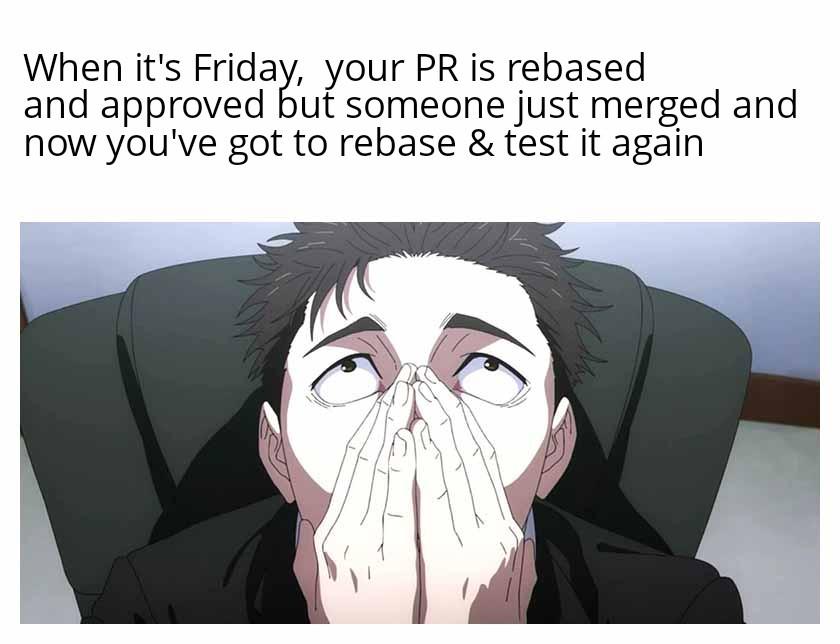
You've spent hours carefully building your feature, tested it locally, got it reviewed, pushed it up, and it's sitting there all nice and organized ready to merge. Then some maniac on your team merges their branch first and suddenly your pristine PR looks like a Lego explosion at a daycare. Now you're untangling merge conflicts that make no sense because they touched the same file you did for "unrelated" changes. The worst part? Half the time it's formatting changes or someone reorganizing imports. You went from "ship it" to "git merge --abort" real quick. Welcome to collaborative development, where your perfectly stacked blocks become chaos the moment you look away.

Looks Good To Me

Looks Good To Me
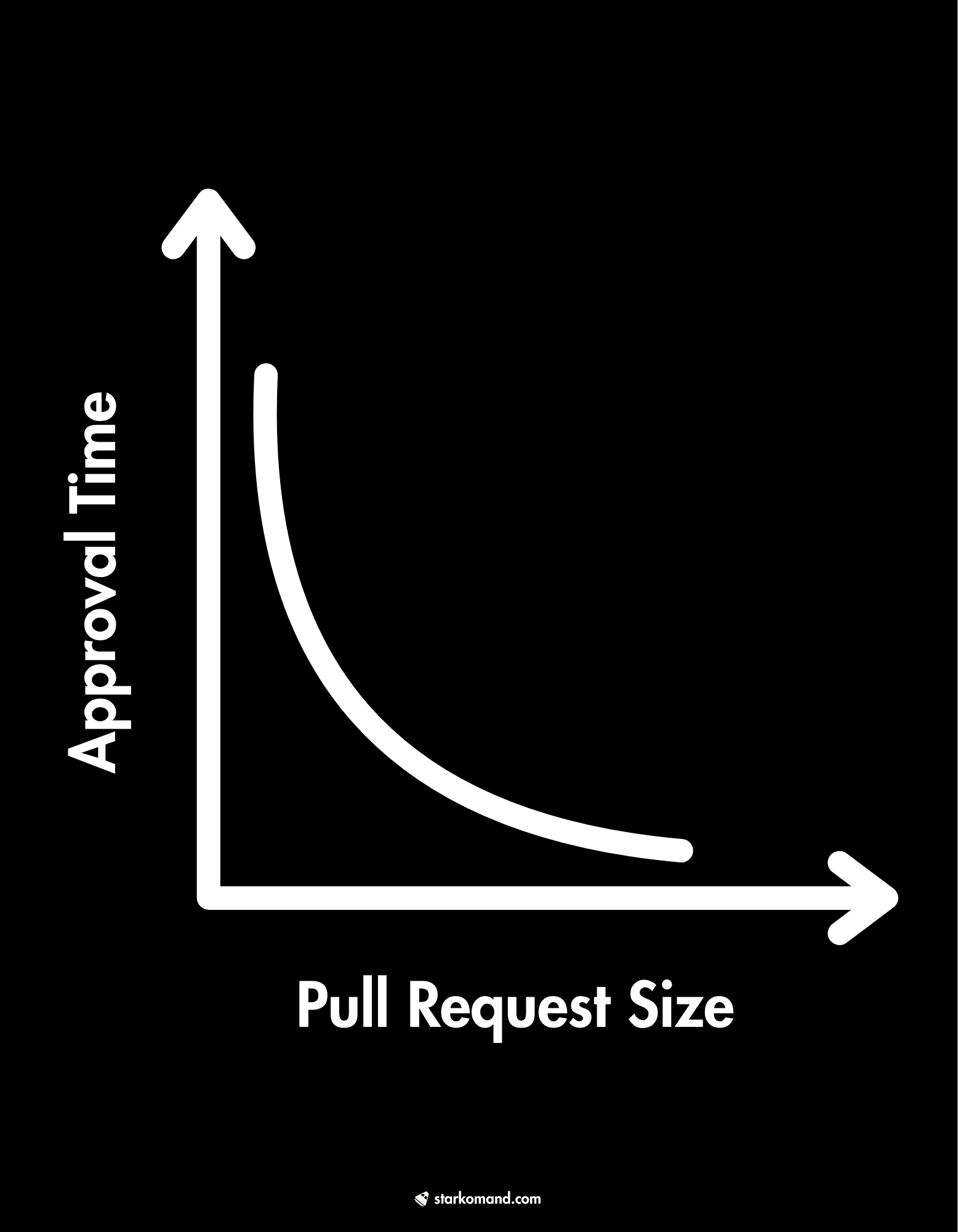
The inverse relationship between thoroughness and effort. Someone submits a 2-line bugfix? You'll scrutinize every character, suggest refactoring the entire module, and debate variable naming for 20 minutes. Someone drops a 47-file PR that touches half the codebase? "LGTM" and you're back to scrolling Reddit. It's not laziness—it's self-preservation. Nobody has the mental bandwidth to review a small country's worth of code changes, so we just trust that someone else will catch the bug that inevitably ships to production next Tuesday.

Ugliest Git History Ever

Ugliest Git History Ever
Junior dev discovers their company actually enforces clean git practices and suddenly realizes they can't just nuke their messy commit history with git push --force anymore. The existential crisis hits different when you realize you'll actually have to learn proper rebasing, squashing, and writing meaningful commit messages instead of your usual "fixed stuff" × 47 commits. For context: --force and --force-with-lease let you overwrite remote history, which is great for cleaning up your own branch but catastrophic on shared branches. Most teams disable this on main branches and PRs to prevent people from rewriting shared history and causing merge chaos. Now our friend here has to actually think about their commits like a professional instead of treating git like a save button in a video game. Welcome to the big leagues, where your commit history is public record and your shame is permanent.

When Your Intern Is More Productive Than You

When Your Intern Is More Productive Than You
That fresh-out-of-bootcamp intern just speedran your entire CI/CD pipeline while you were still reviewing their PR for typos. The audacity of youth—no fear of breaking production, no PTSD from merge conflicts, just pure unadulterated confidence. Meanwhile, you're over here triple-checking if your commit message follows the conventional commits spec, running tests locally for the fourth time, and wondering if you should add another comment explaining why you used a for-loop instead of map. The intern? Already merged. Build's green. They're probably on their third feature by now. The real kicker is that you taught them this workflow. You created a monster. A beautiful, efficient, slightly terrifying monster who doesn't know what "legacy code" means yet.

Can People Even Tell The Difference Anymore

Can People Even Tell The Difference Anymore
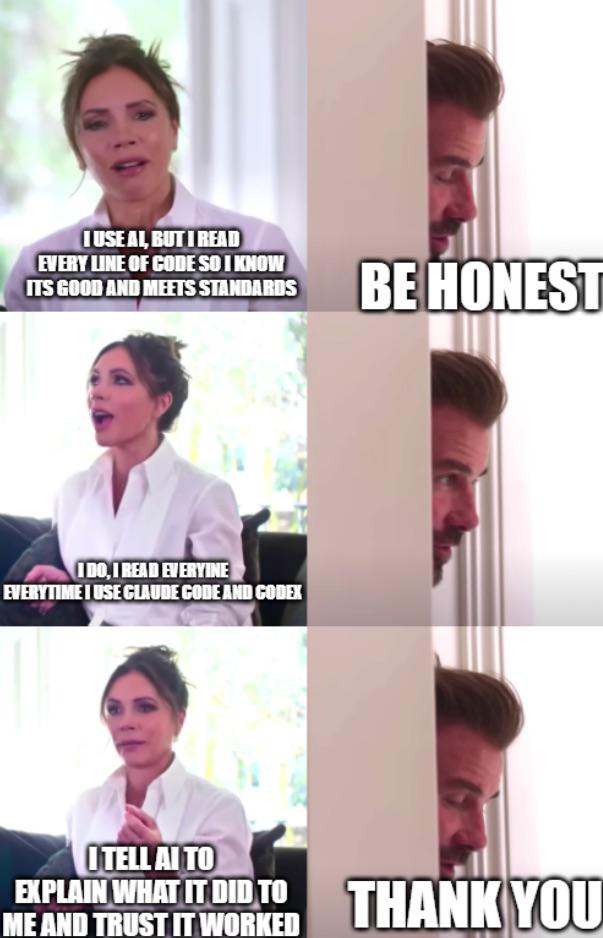
You spend days crafting a pull request, refactoring everything, writing tests, adding documentation, making it absolutely beautiful. Then some bot rolls up and says "Full of AI slop, completely unhelpful" and you just... lose it. The real gut punch? Half the time the bot is right. With AI code generators flooding repos with generic solutions and copy-paste answers, human-written code is starting to look suspiciously similar to GPT's homework. We've reached the point where genuine effort gets flagged as synthetic garbage while actual AI slop sneaks through because it happened to use the right buzzwords. The Turing test has officially reversed: now we have to prove we're NOT robots.

Every Fucking Time

Every Fucking Time
You know that feeling when you refactor a single variable name and suddenly Git thinks you've rewritten the entire codebase? Yeah, 34 files changed because you decided to update some import paths or tweak a shared constant. Smooth sailing, quick review, merge it and move on. But then there's that OTHER pull request. The one where you fix a critical bug by changing literally two lines of actual logic. Maybe you added a null check or fixed an off-by-one error. And suddenly your PR has 12 comments dissecting your life choices, questioning your understanding of computer science fundamentals, and suggesting you read a 400-page book on design patterns before touching production code again. The code review gods have a twisted sense of humor. Large diffs? "LGTM." Small, surgical changes? Time for a philosophical debate about whether your variable should be called isValid or valid .

The Four Stages Of A Code Review

The Four Stages Of A Code Review
Every code review starts with righteous indignation. "Why would anyone write it this way?" Then you read it again. "No seriously, WHY?" By the third pass, you're questioning your own sanity. Finally, enlightenment hits: "Oh, that's why." Turns out the original author was dealing with some cursed edge case, a legacy system from 2003, or a database that returns null when it feels like it. The journey from "this is garbage" to "actually, I would've done the same thing" takes about 15 minutes and three cups of coffee. Bonus points if you end up apologizing in the PR comments.

It Do Be Like That Sometimes

It Do Be Like That Sometimes
You know that brief moment of peace when your massive PR gets approved without conflicts? That's the calm before the storm. Because the real code review happens in Slack DMs where your coworkers suddenly remember they have "thoughts" about your architectural decisions. The merge button is just the midpoint of your emotional rollercoaster. First panel: pure anxiety wondering if anyone will actually approve your 47-file monstrosity. Second panel: euphoric relief when it merges cleanly. Third panel: existential dread when the notifications start rolling in and everyone's suddenly a software architect with opinions about your variable naming. Pro tip: Turn off Slack notifications before merging. What you don't know can't hurt you... until the daily standup.

Average Open Source Contribution

Average Open Source Contribution
Someone out here preaching about fighting corporate aggression through open source contributions, then their "contribution" is literally changing "390 million" to "395 million" in a README file. That's it. That's the revolution. The diff shows they updated OpenOffice's download stats by 5 million users. Not fixing bugs, not adding features, not improving documentation in any meaningful way—just bumping a number that'll be outdated again in like three months. Truly the hero open source deserves. Meanwhile, maintainers are drowning in actual issues and PRs, but sure, let's spend time reviewing your stat update. This is why "first-time contributor" PRs have such a... reputation.

The Age Of AI

The Age Of AI
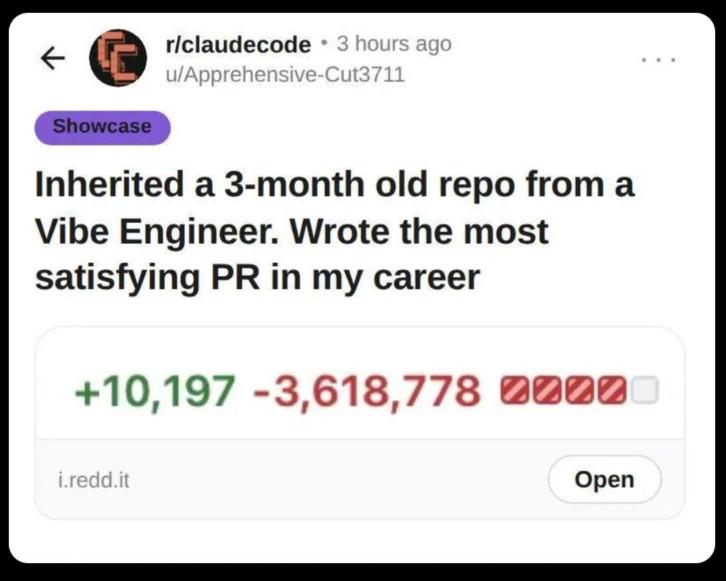
Developers spent years mastering their craft, conquering segfaults, memory leaks, and production bugs without breaking a sweat. But then AI code assistants showed up, and suddenly that little green/red diff showing "+61,104 -780" lines becomes absolutely terrifying. Nothing strikes fear into a programmer's heart quite like an AI confidently refactoring your entire codebase in milliseconds. Sure, it removed 780 lines, but at what cost? What eldritch horrors lurk in those 61,104 new lines? Did it just replace your elegant algorithm with 60,000 lines of nested if statements? The real nightmare isn't that AI will replace us—it's that we have to review its pull requests.