Product design Memes

Posts tagged with Product design
I Wonder Why

I Wonder Why
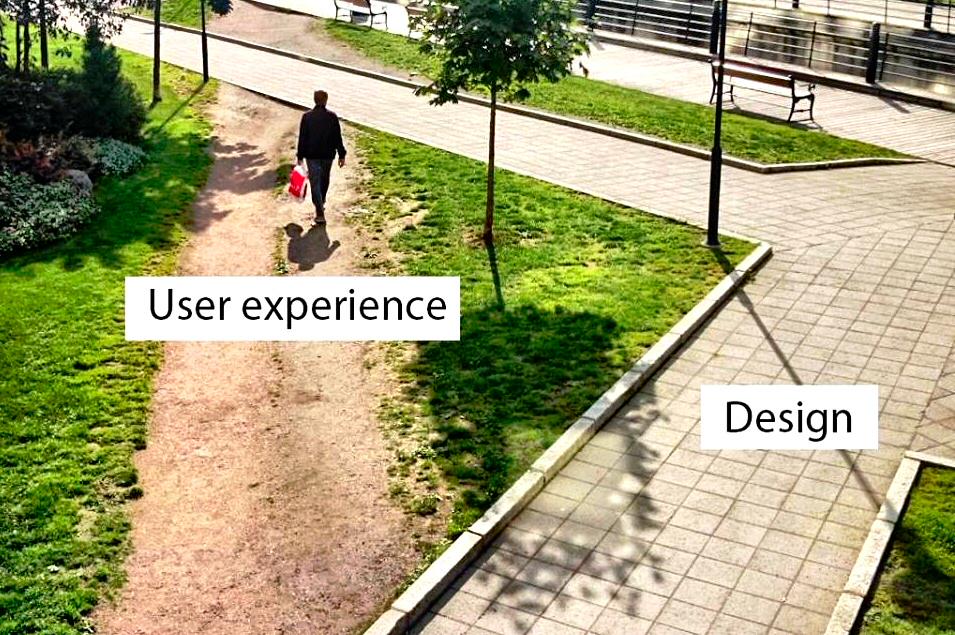
The beautiful paved walkway represents your meticulously crafted "Design" โ€“ complete with Figma mockups, perfect spacing, and that gradient everyone spent 3 hours debating. Meanwhile, users are taking the dirt path shortcut because it's literally faster and more convenient. Your design team spent weeks planning the perfect user flow, but users just want to get from point A to point B without your fancy curved navigation. This is what happens when designers forget that users are fundamentally lazy (in the most efficient way possible). They'll bypass your gorgeous UI faster than you can say "responsive breakpoints" if it saves them two clicks. The dirt path is basically the equivalent of users bookmarking the direct URL to skip your landing page entirely. Pro tip: If you see desire paths forming in your analytics, maybe listen to them instead of adding more guardrails. Sometimes the best UX is just admitting defeat and paving the dirt path.

How Software Is Used

How Software Is Used
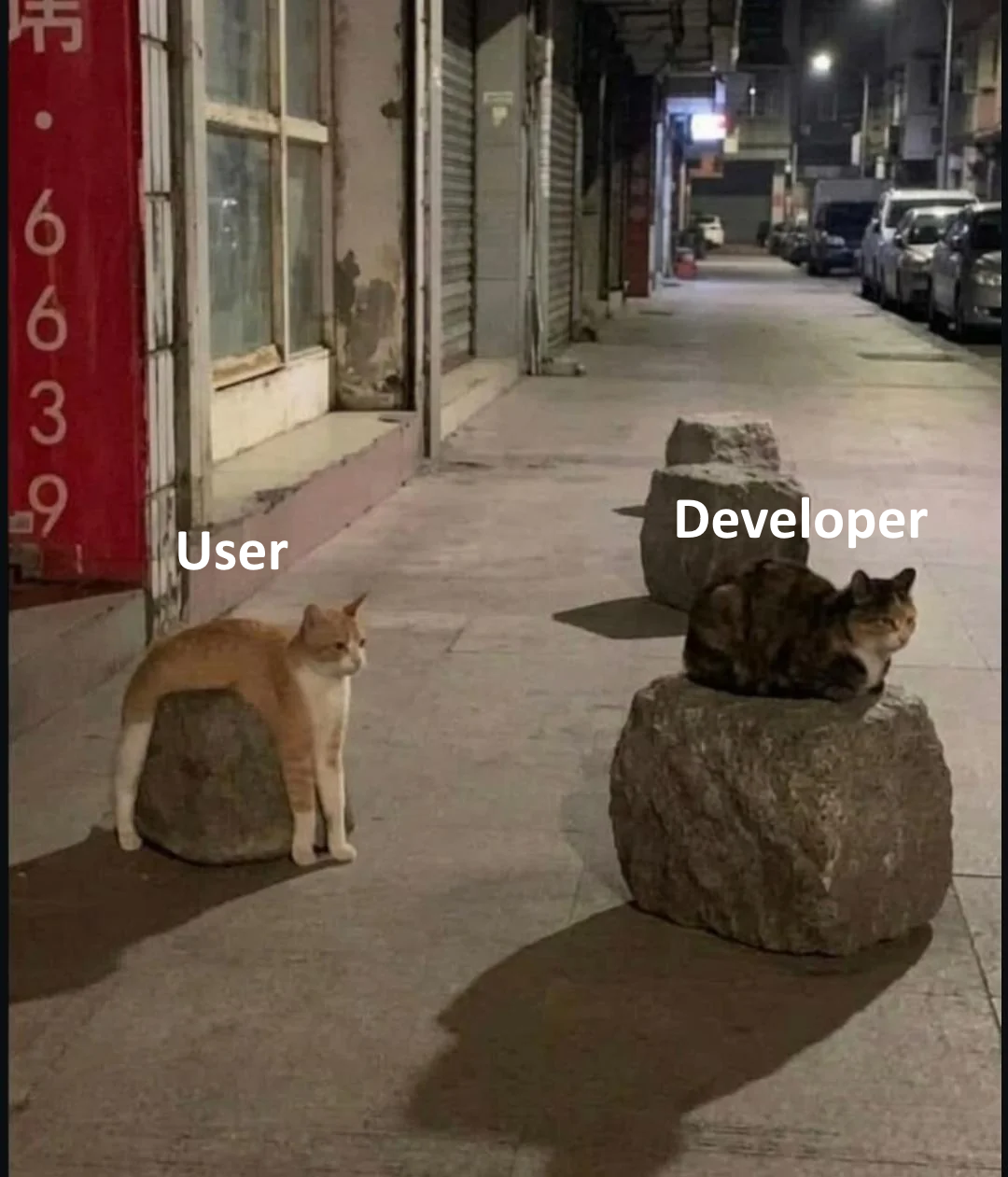
The user stands confidently on a tiny rock, using about 2% of the software's capabilities, while the developer sits awkwardly crammed on a massive boulder, intimately familiar with every edge case, deprecated function, and that one weird bug in the authentication module that only triggers on Tuesdays. You spent six months building a feature-rich platform with OAuth2, WebSocket support, and a custom caching layer. Users? They're just happy the login button is blue. Meanwhile, you're over here knowing exactly which database index is slowing down queries by 3ms and why the CI/CD pipeline fails when someone names a branch with an emoji. The size difference between those rocks perfectly captures the gap between "what users need" and "what developers know exists." It's like giving someone a Ferrari and watching them use it exclusively to drive to the mailbox.

Intuitive User Interface

Intuitive User Interface
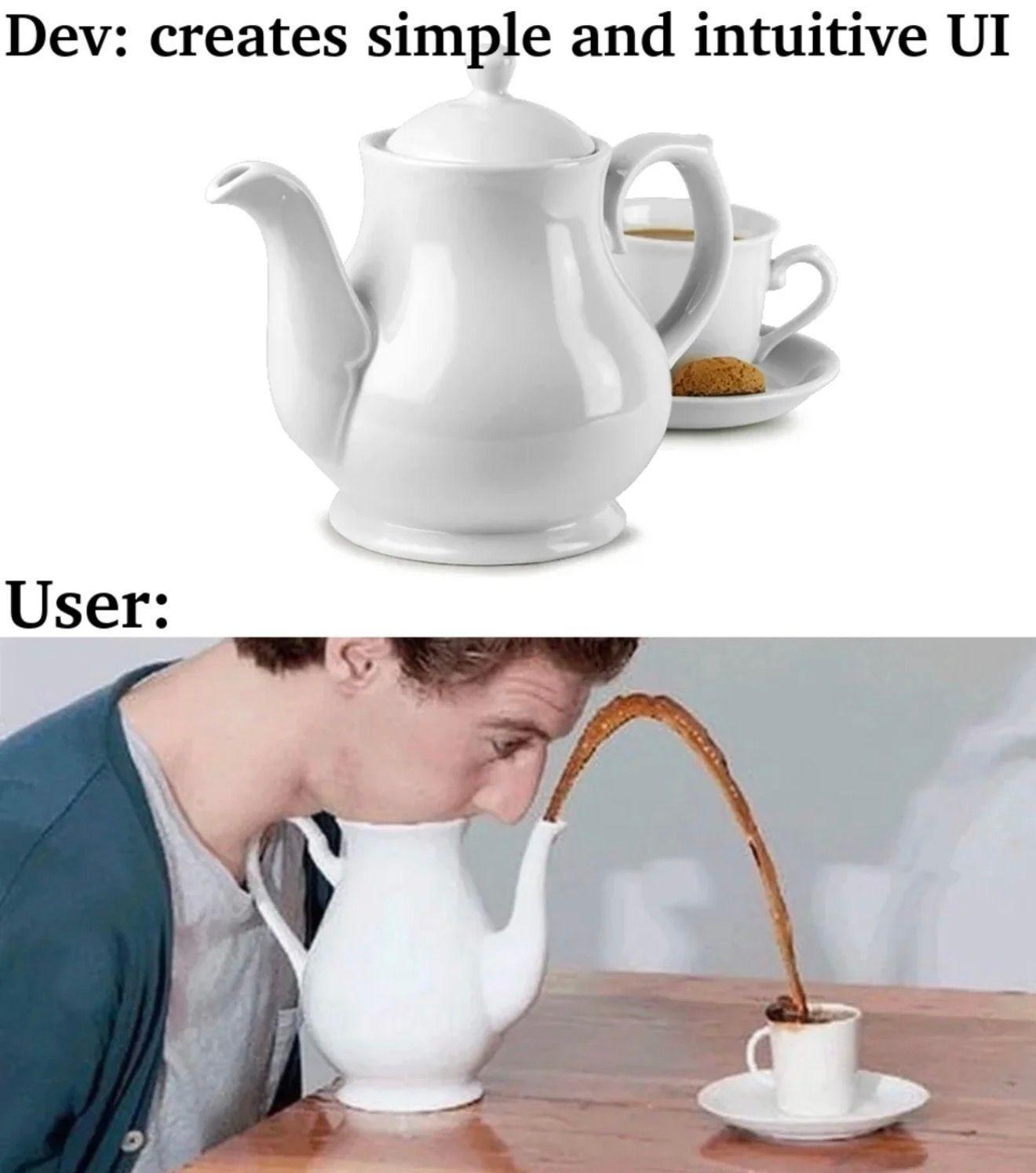
When developers think they've achieved UX perfection by making something "simple and intuitive," but users somehow find a way to use it in the most spectacularly wrong manner possible. That teapot has a perfectly functional spout, yet here we are watching tea arc through the air like some kind of caffeinated fountain. The gap between developer intent and user behavior is wider than the Pacific Ocean. You can spend weeks perfecting the user flow, adding tooltips, writing documentation, and conducting usability tests... only to watch users confidently ignore every design decision you made and create their own chaos. Pro tip: If you ever want to test your UI, don't give it to other developers. Give it to your non-technical relatives and prepare for your soul to leave your body.

Developers Vs Users

Developers Vs Users
You spend three months architecting the perfect mobile experience with smooth animations, intuitive gestures, and delightful micro-interactions. The team celebrates. The stakeholders are thrilled. Then you watch actual users through analytics and they're just... spinning the entire app upside down, tapping everything with their forehead, somehow managing to trigger edge cases you didn't even know existed. The eternal struggle: developers gently cradling their creation like a newborn, while users are out there treating it like a stress ball at a particularly intense sprint retrospective. And somehow they'll still find a way to blame YOU when things break. Classic.

The Cube Is Back... Technically

The Cube Is Back... Technically
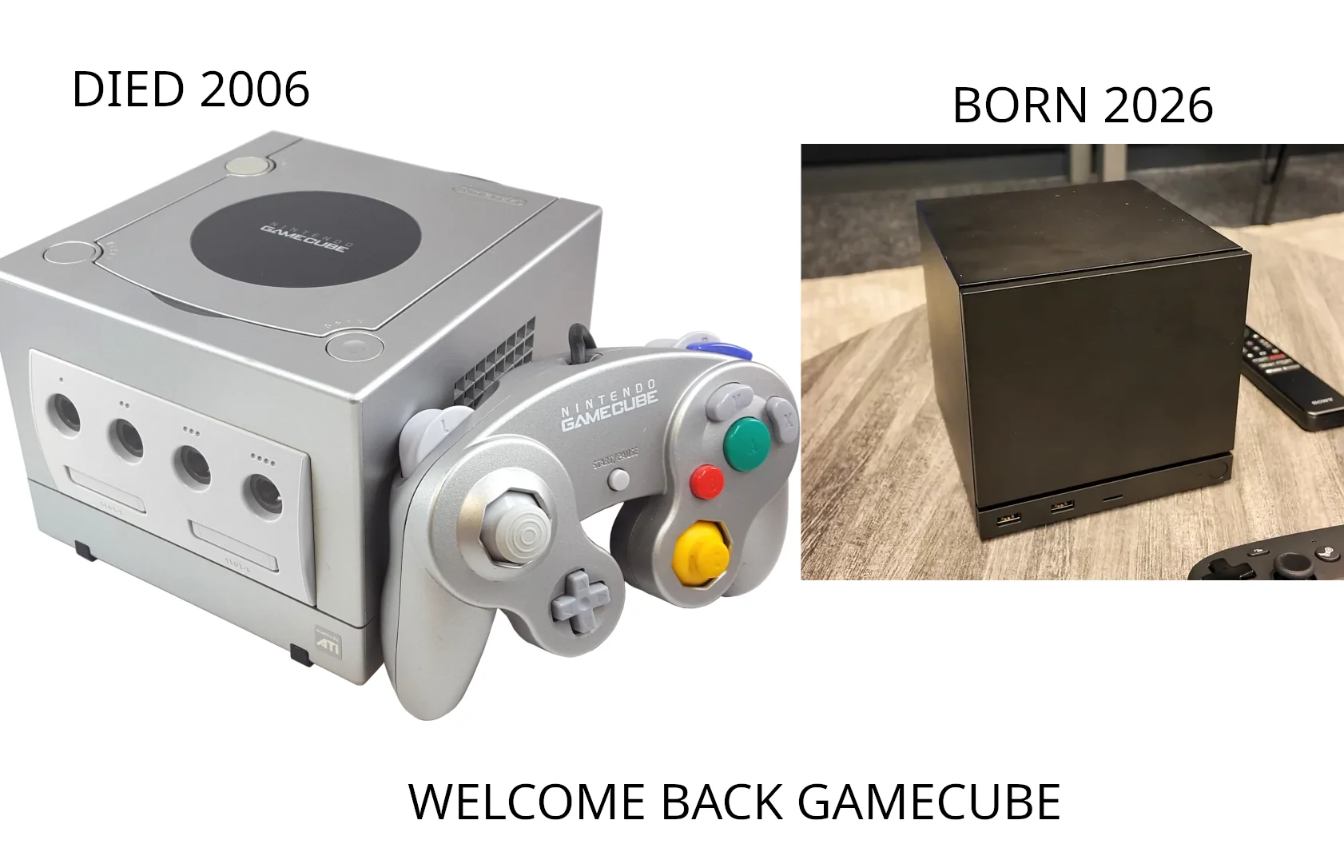
The classic Nintendo GameCube died in 2006, but its "reincarnation" in 2026 is just... a literal black cube. Minimalism gone too far? This is what happens when product designers take "return to your roots" too literally. Twenty years of innovation and we've circled back to "box that plays games" but without any of the personality. Next they'll remove the controller and call it "intuitive gesture control" while charging you double.

Developers vs. Users: The Eternal Struggle

Developers vs. Users: The Eternal Struggle
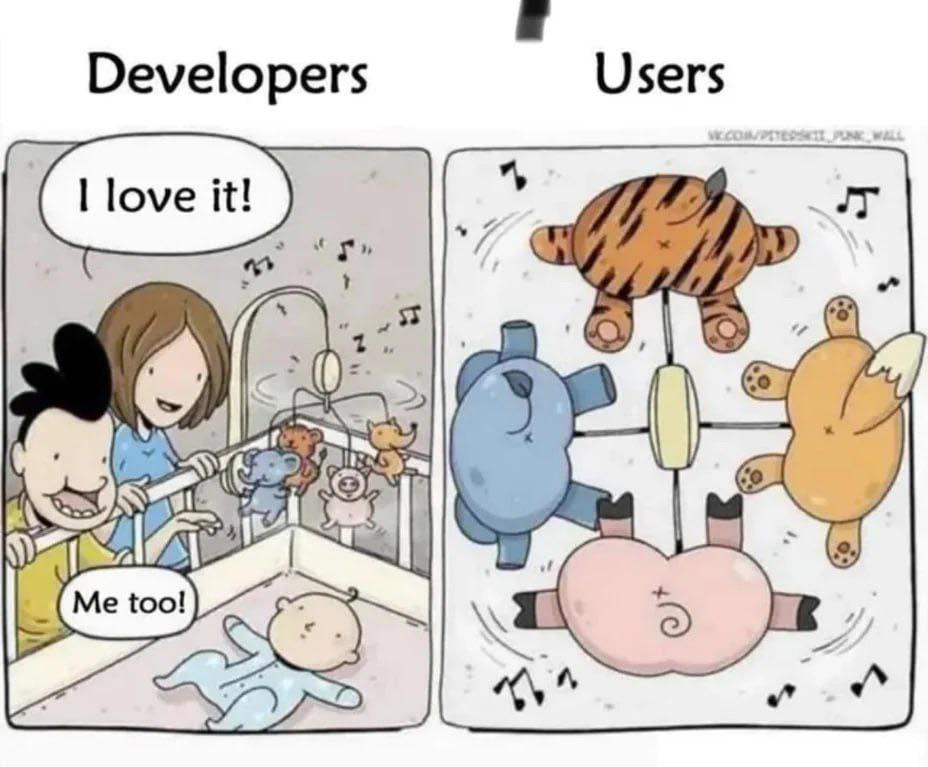
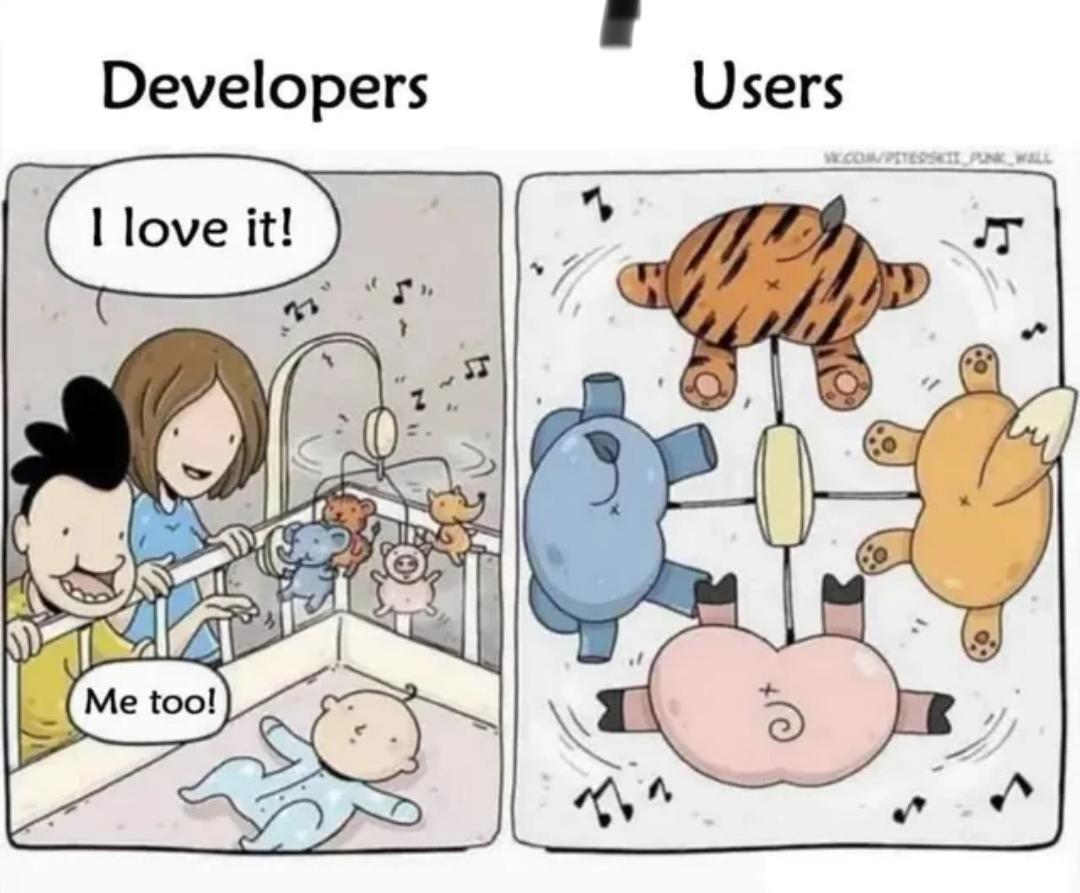
The eternal disconnect between how developers see their creation versus the absolute chaos users unleash upon it. On the left, developers admire their beautiful baby app with its perfectly arranged features and intuitive design. "I love it! Me too!" they proudly exclaim. Meanwhile on the right, users are basically stuffed animals in a washing machine - frantically smashing buttons, ignoring documentation, and somehow finding ways to break the software that developers couldn't imagine in their wildest fever dreams. Nothing quite captures the existential dread of checking error logs on Monday morning to discover what unholy combinations of inputs your users discovered over the weekend. "But why would anyone even TRY to do that?!"

The Four Horsemen Of Product Development

The Four Horsemen Of Product Development
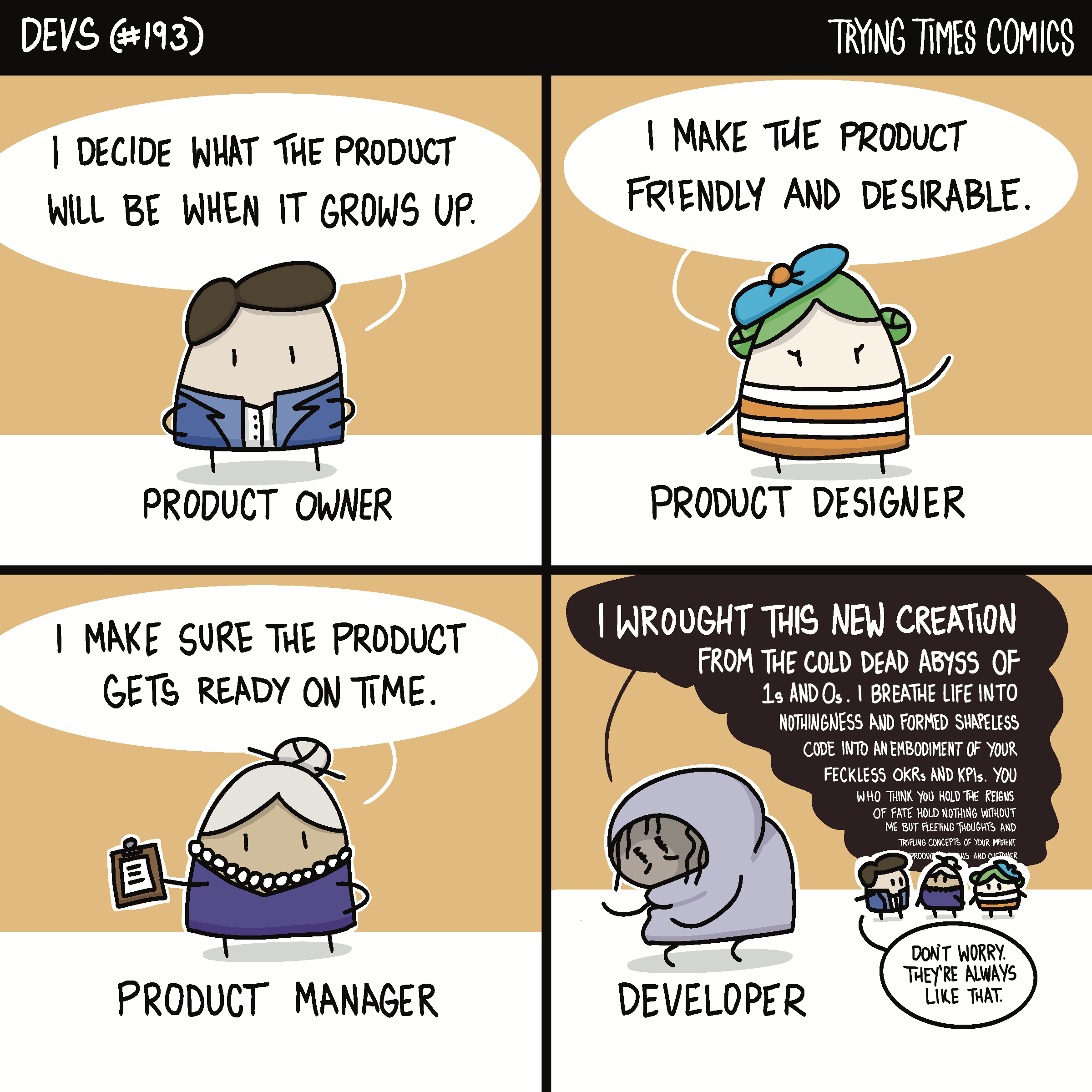
Ah, the software development hierarchy in its natural habitat! While product owners dream of the future, designers make things pretty, and managers obsess over deadlines, developers are out here performing dark rituals with 1s and 0s like some kind of code necromancers. That last panel is painfully accurate. Nothing says "typical Tuesday" like transforming business requirements into working code while having an existential crisis about OKRs and KPIs. Meanwhile, everyone else's job descriptions fit in a cute little bubble. And that tiny "Don't worry, they're always like that" at the bottom? Chef's kiss. Because yes, we are always like that - turning caffeine into code while contemplating the void. It's not a phase, it's a lifestyle.

It's Not Wrong, It's Tragically Accurate

It's Not Wrong, It's Tragically Accurate
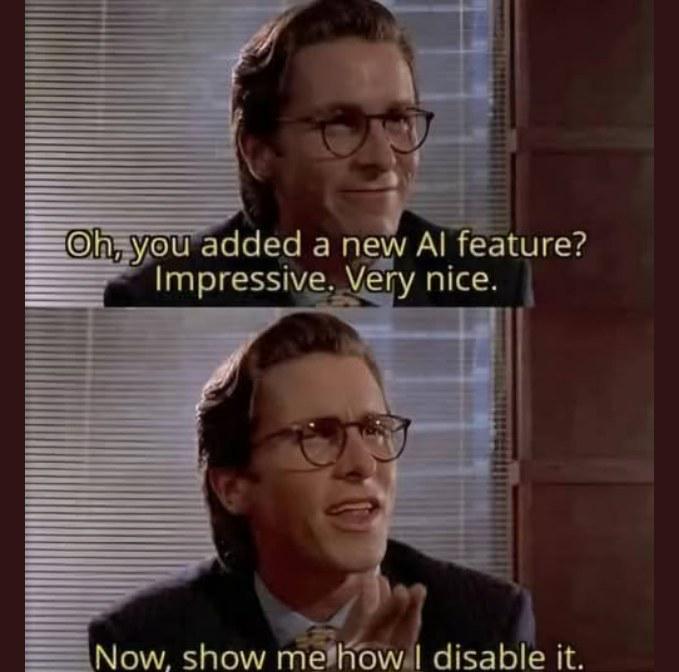
The ABSOLUTE DRAMA of modern tech! First frame: politely smiling through the pain as someone brags about their shiny new AI feature. Second frame: the DESPERATE PLEA that follows - "Now, show me how I disable it." Because nothing says "I trust your technology" like immediately wanting to turn it OFF! The eternal cycle of tech bros adding features nobody asked for while the rest of us frantically search for the off switch. It's not a bug, it's an unwanted feature! ๐Ÿ’€

Someone Needs To Do Better

Someone Needs To Do Better
The classic "desire path" phenomenon strikes again! While designers meticulously crafted that beautiful tiled walkway with perfect right angles, users said "nope" and blazed their own dirt trail straight to their destination. It's the physical manifestation of what happens when you spend weeks building a sophisticated UI with 17 different options, only for users to desperately search for the "skip this nonsense" button. The dirt path is basically a giant middle finger to your architecture diagrams.

When I'm Told I'm Going To Need To Incorporate User Testing Into My Design Pipeline

When I'm Told I'm Going To Need To Incorporate User Testing Into My Design Pipeline
Ah, the classic "I'm the only user that matters" syndrome. Nothing says "professional software development" quite like rejecting all forms of validation and building exclusively for an audience of one - yourself. The character's intense expression perfectly captures that moment when someone suggests your code might need to survive contact with actual humans. Truly groundbreaking approach to software development: "It works on my machine and in my brain, ship it."

The Overengineering Paradox

The Overengineering Paradox
The eternal gap between engineering effort and actual user needs. Left side: a complex, feature-rich cat tree with multiple platforms, tunnels, and scratching posts that probably took weeks to design and build. Right side: the cat sitting contentedly in a plain cardboard box. It's the perfect metaphor for that time you spent three sprints implementing a sophisticated notification system with customizable preferences, only to discover users just wanted a simple email. The cardboard box of solutions. The cat's smug face says it all: "Your overengineered solution is impressive, but have you considered just giving me what I actually asked for?"

The Golden Rule Of User Interface Design

The Golden Rule Of User Interface Design
The gospel truth of UI design hanging on a wall for all to see! If your users need a manual to figure out your interface, you've already failed. It's like dating someone who needs footnotes to understand your jokes - just painful for everyone involved. The number of "intuitive" interfaces I've seen that require a PhD to navigate could fill a library of disappointment. Remember folks: if your grandma can't figure it out after three glasses of wine, it's not user-friendly, it's user-hostile.