Optimization Memes

Posts tagged with Optimization

Optimization Pain

Optimization Pain
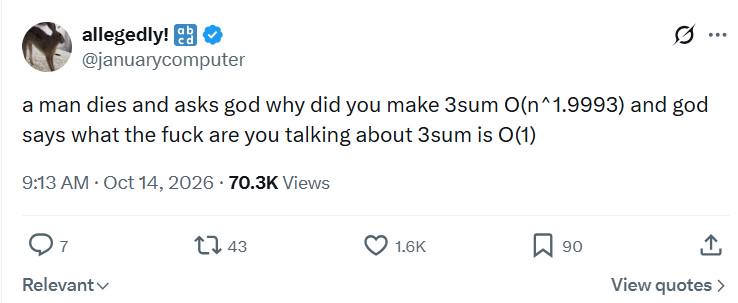
You've already achieved logarithmic time complexity—literally one of the best performance tiers you can get for most algorithms. You're sitting pretty with your binary search or balanced tree traversal. And then the interviewer, with the audacity of someone who's never shipped production code, asks if you can "optimize it further." Brother, what do you want? O(1)? Do I look like I can predict the future? Should I just hardcode the answer? The only thing left to optimize is my patience and your expectations. Fun fact: O(log n) is already considered optimal for many search and divide-and-conquer problems. Going from O(log n) to O(1) usually requires either massive space trade-offs or a complete rethinking of the problem. But sure, let me just casually break the laws of computational complexity real quick.

Sure Bro

Sure Bro
C++ devs catching strays here. The tweet claims C++ is "easy mode" because the compiler optimizes your garbage code into something performant. Then it drops the hot take that *real* programming mastery is shown by writing efficient code in Python or JavaScript—languages where you can't hide behind compiler optimizations. The irony is palpable. C++ is notorious for being one of the most unforgiving languages out there—manual memory management, undefined behavior lurking around every corner, and template errors that look like Lovecraftian nightmares. Meanwhile, Python and JavaScript are interpreted languages where you can literally concatenate strings in a loop a million times and watch your performance tank because there's no compiler to save you from yourself. It's like saying "driving a manual transmission car is easy mode, but driving an automatic requires true skill because you have to be efficient with the gas pedal." The mental gymnastics are Olympic-level.

A Bit Of Advice

A Bit Of Advice
So you learned binary search in your algorithms class and now you think you can apply it to real life? Cool, cool. Just remember that in the real world, guessing someone's age by saying "50" and then "25" is basically telling them they look 50 first. Congratulations, you just optimized your way into sleeping on the couch with O(log n) efficiency. Pro tip: some problems are better solved with linear search, even if it's slower. Like maybe start at 21 and work your way up slowly? Your relationship will thank you for the extra time complexity.

Game Devs Then And Now

Game Devs Then And Now
Back in the day, game devs were basically wizards who could fit an entire PlayStation game into a 64 MB N64 cartridge through sheer coding sorcery and optimization black magic. They were out here writing assembly code by candlelight, compressing textures with their bare hands, and making every single byte COUNT. Fast forward to today and we've got 300 GB behemoths that somehow STILL launch with missing features, game-breaking bugs, and a roadmap promising "the rest of the game will arrive via DLC." Like, bestie, you had 300,000 MB and couldn't finish it? The old devs are rolling in their ergonomic office chairs. We went from "every kilobyte is precious" to "eh, just download another 80 GB patch" real quick. The doge's disappointed face says it all—we traded craftsmanship for storage space and called it progress. Iconic.

Can't Find Happiness In Log N

Can't Find Happiness In Log N
When you try to optimize your life with computer science algorithms but reality hits different. Binary search requires your life to be sorted first—you know, organized, stable, having your stuff together. Spoiler alert: most of us are living in O(n²) chaos. The brutal honesty here is *chef's kiss*. You can't just slap efficient algorithms onto a messy existence and expect miracles. It's like trying to use a hash map when your keys are all undefined. The monkey's deadpan delivery of "your life isn't sorted" is the kind of existential debugging message nobody wants to see but everyone needs to hear. Pro tip: Before implementing any O(log n) life improvements, make sure to run a quick isSorted() check on your existence. Otherwise you're just gonna get undefined behavior and segfaults in your happiness.

This Is Actually Wild

This Is Actually Wild
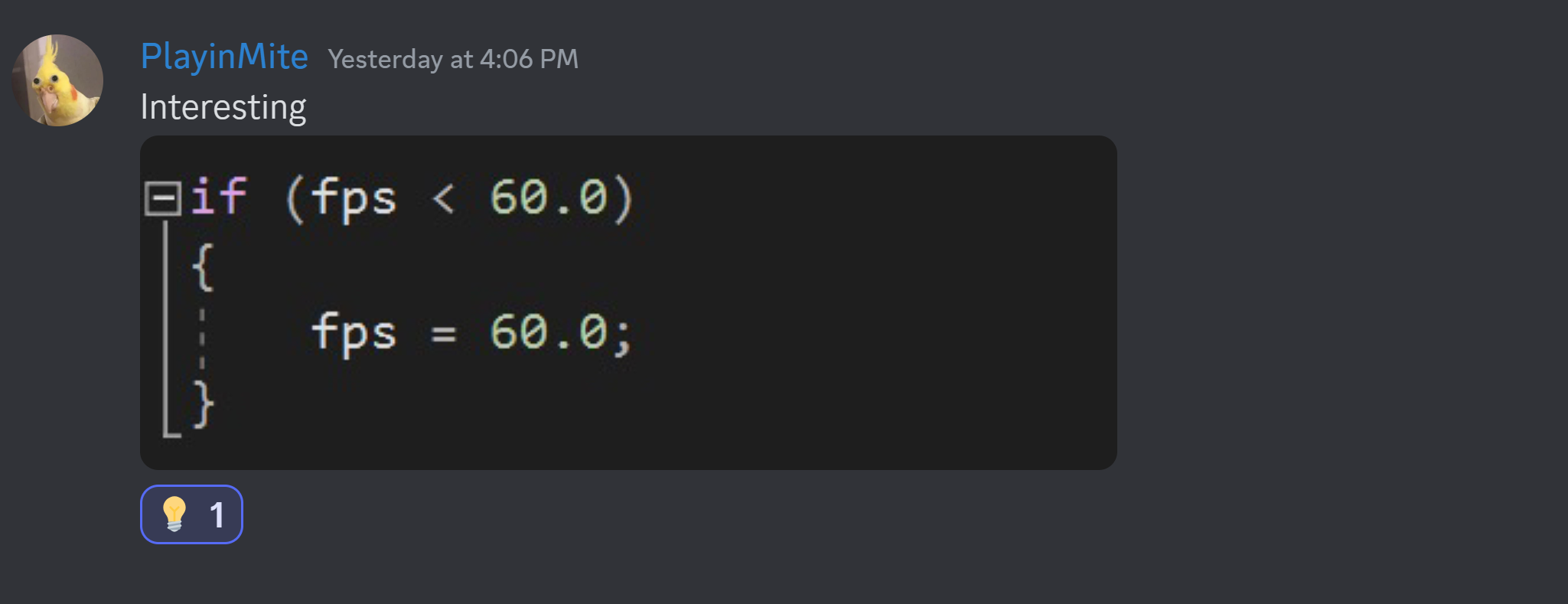
So someone discovered that Monster Hunter Wilds was doing aggressive DLC ownership checks that tanked performance. A modder tricked the game into thinking they owned all DLC and boom—instant FPS boost. The unintentional part? Capcom wasn't trying to punish pirates or non-buyers. They just wrote such inefficient code that checking your DLC status every frame became a performance bottleneck. The punchline writes itself: Capcom's management seeing this bug report and realizing they can now market DLC as a "performance enhancement feature." Why optimize your game engine when you can monetize the fix? It's like charging people to remove the memory leak you accidentally shipped. That Homelander smile at the end perfectly captures corporate executives discovering they can turn their own incompetence into a revenue stream. Chef's kiss.

Software Optimization

Software Optimization
When your Notepad app somehow needs 8GB of RAM just to display "Hello World" but some absolute madlad is out here trying to run GTA 5 on a PlayStation 3 with the processing power of a calculator watch. The duality of modern software development is absolutely UNHINGED. On one side, we've got bloated Electron apps that could probably run a small country's infrastructure but instead just... open text files. On the other side, game developers are performing literal black magic to squeeze every last drop of performance out of hardware that should've retired years ago. It's giving "I spent six months optimizing my sorting algorithm to save 2ms" versus "I just downloaded 47 npm packages to center a div." The contrast is *chef's kiss* levels of absurd.

Superiority

Superiority
When you discover that finding the top K frequent elements can be done in O(n) time using bucket sort or quickselect, and suddenly you're looking down on everyone still using heaps like it's 2010. The party guy in the corner just learned about the O(n log n) heap solution and thinks he's clever, while you're out here flexing your knowledge of linear time algorithms like you just unlocked a secret level in LeetCode. For context: Most people solve this problem with a min-heap (priority queue), which gives O(n log k) complexity. But the galaxy brain move is using bucket sort since frequencies are bounded by n, giving you that sweet O(n) linear time. It's the difference between being invited to the party and owning the party.

Simpler Times Back Then

Simpler Times Back Then
Modern devs out here with 16GB of RAM, gaming PCs that could render the entire universe, PS5s, and somehow still manage to make Electron apps that eat memory like it's an all-you-can-eat buffet. Meanwhile, legends back in the day were crafting entire operating systems and games on 2MB of RAM with hardware that had less computing power than today's smart toaster. The contrast is brutal: we've got 8,000x more RAM and yet Chrome tabs still bring our machines to their knees. Those old-school devs were writing assembly, optimizing every single byte, and shipping masterpieces on a PlayStation 1 and Super Nintendo. They didn't have Stack Overflow, npm packages, or the luxury of importing 500MB of node_modules to display "Hello World." The SpongeBob meme format captures it perfectly: modern devs looking sophisticated with all their fancy hardware versus the raw, unhinged genius of developers who had to make magic happen with constraints that would make today's engineers weep. Respect to those who coded when memory management wasn't optional—it was survival.

Space Complexity Is The Most Important Thing Now

Space Complexity Is The Most Important Thing Now
Welcome to 2024, where RAM costs more than your kidney and suddenly everyone's rediscovering DFS like it's some ancient wisdom. For decades, BFS was the go-to for graph traversal because who cares about O(n) space when RAM is cheap, right? Just throw more memory at it! But now with the global RAM shortage and prices skyrocketing, developers are frantically switching to DFS with its beautiful O(h) space complexity for tree traversals. The irony? Computer science professors have been preaching space-time tradeoffs since forever, but it took an economic crisis for devs to actually care about that queue eating up all your precious gigabytes. Stack-based recursion is having its redemption arc, and somewhere a CS101 professor is saying "I told you so."

Is This Not Enough

Is This Not Enough
You've already achieved logarithmic time complexity—the HOLY GRAIL of algorithmic efficiency—and they're sitting there asking if you can squeeze out MORE performance? What do they want, O(1) for everything? Do they expect you to invent time travel? O(log n) is literally one step away from constant time. You're already operating at near-theoretical perfection, and here comes the interviewer acting like you just submitted bubble sort to production. The audacity! The sheer NERVE! It's like winning an Olympic gold medal and having someone ask if you could've run it backwards while juggling. Some interviewers really do be out here expecting you to violate the fundamental laws of computer science just to prove you're "passionate" about optimization.

When The Bug Is Human

When The Bug Is Human
Oh, the AUDACITY! The absolute NERVE of someone suggesting that YOUR code isn't fast enough! Like, excuse me, but did you just imply that my beautifully crafted, artisanal, hand-typed algorithms are somehow... *slow*? The sheer disrespect! That cat's face perfectly captures the internal screaming when someone dares to blame your "performance issues" when clearly the REAL problem is their unrealistic expectations, their potato server, their ancient browser, or literally anything else. The rejection isn't about YOUR performance, sweetie—it's about their inability to appreciate computational elegance. Maybe try running it on something that isn't powered by a hamster wheel? Just saying.