Nostalgia Memes

Posts tagged with Nostalgia
Anyone Remembers Their Last Burned Data?

Anyone Remembers Their Last Burned Data?
There's something oddly poetic about the fact that somewhere in your past, you burned your last CD-R without knowing it would be your last CD-R. No ceremony, no farewell tour—just a quiet 700MB of data slowly becoming obsolete as USB drives, cloud storage, and git took over. That Sharpie sitting there is the real nostalgia bomb. Remember carefully labeling "Project Backup 2007" or "Linux ISOs" (sure, buddy) in your best handwriting? Now we just drag files into Dropbox like savages and call it a day. Technology moves so fast that we don't even get to say goodbye to the tools that once felt essential. RIP to CD burners, floppy disks, and the satisfying click of ejecting physical media. You served us well in the pre-cloud era.

How Has The Internet Come To This

How Has The Internet Come To This
We've gone full circle, folks. Back in the dial-up days, the internet was this magical portal where you could be anyone, do anything, and pretend your real life didn't exist. Fast forward to today, and we're all desperately trying to touch grass and remember what human interaction feels like without a screen between us. The irony is beautiful: we built this incredible global network to connect humanity, and now we need to actively disconnect from it to feel human again. Between doomscrolling, infinite feeds designed by algorithms that know you better than you know yourself, and the constant barrage of notifications, the internet went from being an escape pod to being the thing we need an escape pod from. Plot twist: the real bug was in the social network all along.

Sit Down Son

Sit Down Son
Grandpa dev just unlocked a core memory. Stack Overflow was the OG before ChatGPT started writing everyone's code. Back in the day, you'd copy-paste solutions from SO with religious devotion, close all 47 tabs, and pretend you understood what async/await actually does. The kid found it in the basement like some ancient artifact, probably next to a Flash Player installer and a jQuery plugin from 2011. Gramps is about to drop the entire lore of marking questions as duplicate, getting roasted for not showing your research effort, and the legendary Jon Skeet with his 1.4 million rep. Those were simpler times when you had to actually read documentation AND get passive-aggressively told your question already exists somewhere in a thread from 2009.

Can Someone Please Make Programming Good Again

Can Someone Please Make Programming Good Again
Visual Studio C++ 6.0 from 1998 was basically a tank - instant startup, zero lag, ready to compile before you even sat down. Fast forward to 2026 and we've got bloatware that takes longer to boot than Windows Vista, compiles at the speed of continental drift, and Copilot aggressively suggesting code in your comments like an overeager intern who won't shut up. The nostalgia hits different when you remember IDEs that didn't need 16GB of RAM just to say "Hello World." Sure, VS6 had the UI of a tax software from the '90s, but at least it didn't try to psychoanalyze your TODO comments with AI. Progress™ means trading snappy performance for features nobody asked for. Thanks, I hate it.

He Definitely Did

He Definitely Did
The question "How did he create Facebook without Claude?" hits different when you realize we're now at the point where devs genuinely can't imagine building anything without their AI coding assistant. Like, Mark Zuckerberg somehow managed to cobble together a social network in 2004 using just PHP, MySQL, and pure spite—no ChatGPT, no Claude, no Copilot whispering sweet code completions in his ear. The comment "He stole it from someone else" is chef's kiss perfect because it references the whole Winklevoss twins drama while also being the most programmer answer ever. Can't figure out how someone coded without AI? Obviously they just copied it. Stack Overflow wasn't even around back then, so where else could the code have come from? We've gotten so dependent on AI assistants that the idea of writing code from scratch feels like building a fire without matches. Your grandpa coded uphill both ways in the snow, kids.

Loved It

Loved It
Back in the day, computer cases were these beige, boxy fortresses that looked like they could survive a nuclear blast. They were built like tanks—literally weighing as much as one—with metal so thick you could probably stop a bullet. No RGB, no tempered glass, just pure utilitarian engineering that screamed "I mean business." Fast forward to today and we've got cases that look like they escaped from a rave. Rainbow RGB lighting everywhere, transparent panels showing off every component, and enough LEDs to guide aircraft. They're lighter, prettier, and basically the automotive equivalent of slapping neon underglow and a spoiler on your Honda Civic. Function took a backseat to aesthetics, and honestly? Some of us miss when our PCs looked like they were ready for combat instead of a TikTok photoshoot.

The Good Old Days

The Good Old Days
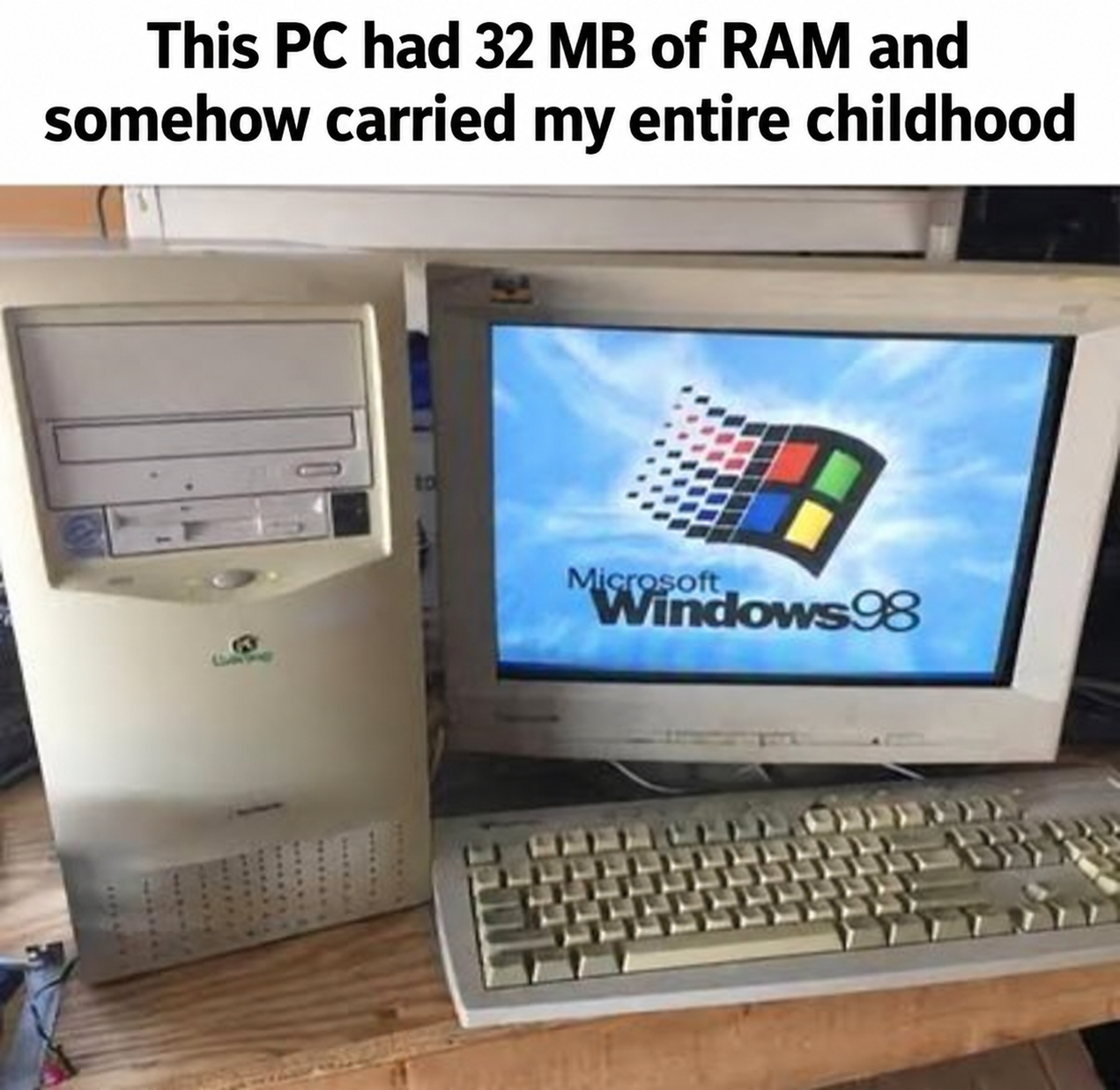
If you remember booting up Windows 98 on a beige tower that sounded like a jet engine preparing for takeoff, congratulations—you've unlocked a core memory that Gen Z will never understand. Back when "downloading a song" meant leaving your computer on overnight and praying nobody picked up the phone. When your entire dev environment fit on a 20GB hard drive and you thought you'd never fill it up. When the blue screen of death was just a regular Tuesday. Those chunky CRT monitors, that satisfying mechanical keyboard click, and the absolute chaos of driver installation from floppy disks. Simpler times? Maybe. More painful? Definitely. But somehow we still get nostalgic about it.

Back In The Days

Back In The Days
Remember when security was just asking nicely if your credit card got stolen? No encryption, no OAuth, no JWT tokens—just a simple form asking "hey, did someone take your money?" with the honor system as the primary authentication method. The best part? They're literally asking you to type your card number into a web form to check if it's been stolen. Galaxy brain security right there. It's like asking someone to hand you their keys to check if their house has been broken into. The early 2000s were wild. SSL was optional, passwords were stored in plaintext, and apparently credit card validation was just vibes and a checkbox. Now we have 2FA, biometrics, and security audits that make you question your life choices, but back then? Just tick "Check It" and pray.

Back Then Everything Was So Simple

Back Then Everything Was So Simple
Oh, the TRAGEDY of being a PC gamer in 2024! Remember when you could just say "I have a gaming PC" and people nodded in understanding? Now you need a PhD in hardware specifications just to explain your setup. Back in the Skylake era (Intel's 6th gen, circa 2015-2016), life was blissfully simple: Core i7, a decent board, some RAM, a GTX 1080 Ti, throw in an SSD, and BAM—you were gaming royalty. No essays required. Fast forward to today and you're out here reciting your entire PC specs like it's the Gettysburg Address. "Well ACTUALLY, I'm running a Ryzen 9 7950X3D with 64GB of DDR5-6000 CL30 RAM, an RTX 4090 Founders Edition undervolted to 0.95V, a custom loop with dual 360mm radiators, Gen 5 NVMe drives in RAID 0..." Sir, this is a Wendy's. The golden age was real, folks. Now we're drowning in motherboard chipsets, RAM timings, PCIe generations, and thermal paste debates. Simpler times, simpler specs, same gaming addiction.

DLSS 5 Demo - Tomb Raider 1

DLSS 5 Demo - Tomb Raider 1
NVIDIA's marketing department promised DLSS would enhance graphics quality, but apparently nobody told them it shouldn't work backwards . The "without DLSS5" shot shows the classic low-poly Lara Croft from 1996 looking relatively smooth, while "with DLSS5" somehow manages to make her face even more angular and aggressive—like the AI tried to "enhance" the polygons by making them fight each other. DLSS (Deep Learning Super Sampling) is supposed to use AI to upscale lower-resolution images to higher resolutions while maintaining quality. But slapping cutting-edge AI upscaling tech on a game that was built with like 230 polygons total is the equivalent of using a neural network to enhance a stick figure drawing—you're just gonna get a really detailed stick figure that somehow looks worse. The real joke here is that no amount of machine learning can save those 1996-era triangle counts. Some things are better left in their original pixelated glory.

2005: Me And My 35 Kg Case Heading To The Shop Because I Deleted System 32

2005: Me And My 35 Kg Case Heading To The Shop Because I Deleted System 32
Back when computers were basically small furniture and every mistake required Olympic-level strength training to fix. Deleting System32 was the classic Windows self-destruct move—like pulling the foundation out from under your house and wondering why everything collapsed. No cloud backups, no recovery partitions, just you, your shame, and a 77-pound beige tower that you now have to haul to the repair shop because some forum troll convinced you it would "speed up your PC." The real workout wasn't just the weight—it was explaining to the tech guy what you did without making eye contact. Those CRT monitors alone could double as home gym equipment. Different times.

When USB Ancestors Define The Age

When USB Ancestors Define The Age
Nothing screams "I've seen some things" quite like recognizing every single USB port in this lineup. USB-C? Baby stuff. USB 3.0? Still in diapers. USB 2.0? Getting respectable. But PS/2 and serial ports? ANCIENT RELICS FROM THE BEFORE TIMES. The progression here is absolutely BRUTAL. You start fresh-faced and innocent with your sleek modern laptop, then gradually age into a weathered tech veteran who remembers when keyboards had round purple plugs and mice had green ones. And don't even get me started on that serial port at the bottom—if you've ever had to configure a router using one of those bad boys, you've earned your gray hairs. The skeleton at the end? That's everyone who had to deal with IRQ conflicts and COM port assignments. They didn't make it out alive.