

Inheritance Memes

Posts tagged with Inheritance

You Did This Too At Least Once

You Did This Too At Least Once
You spent three days architecting an elaborate class hierarchy with abstract factories, strategy patterns, and enough interfaces to make a Java textbook jealous. You added protected methods, virtual functions, and meticulously documented extension points because "someone might need to extend this someday." Plot twist: You're the only developer on the project. The "someone" who will extend it? Also you. And you never will because YAGNI exists for a reason. The skeleton perfectly captures that eternal wait for validation that your over-engineered masterpiece was worth it. Spoiler alert: three months later you'll refactor it into a single function and wonder what possessed you to create 12 classes for a feature that validates email addresses.

The Call To Super

The Call To Super
Ah yes, the sacred ritual of object-oriented programming where you MUST acknowledge your ancestors before doing literally anything. You're trying to override a method and add your own cool functionality, but the compiler is like "EXCUSE ME, did you forget someone?" Every. Single. Time. You just want to customize your class, but nope—you gotta call super() first because your parent class has feelings too, apparently. It's like being forced to thank your parents at every awards ceremony even though you're 35 years old and just trying to live your life. Forget it once and watch your entire application crumble into a beautiful stack trace of despair. The parent constructor literally HAS to be invoked first—it's not a suggestion, it's the law of inheritance!

My FBI Agent Sent Me This

My FBI Agent Sent Me This
Your FBI agent watching through your webcam just went from concerned to relieved in 0.2 seconds. First panel: pure panic as you search "how to remove a child" - red flags everywhere, alarms going off at headquarters. Second panel: instant relief when you add "class in java" - oh thank god, they're just dealing with inheritance and object-oriented programming. The beauty here is that removing a child class in Java is actually a legitimate programming question about class hierarchies, but without that crucial context, your search history looks like you're planning something that'll get you a visit from actual agents. Nothing says "I'm a developer" quite like accidentally sounding like a criminal because of programming terminology. Next time maybe search for "how to kill orphaned processes" and really give them a heart attack.

Liskov Substitution Principle

Liskov Substitution Principle
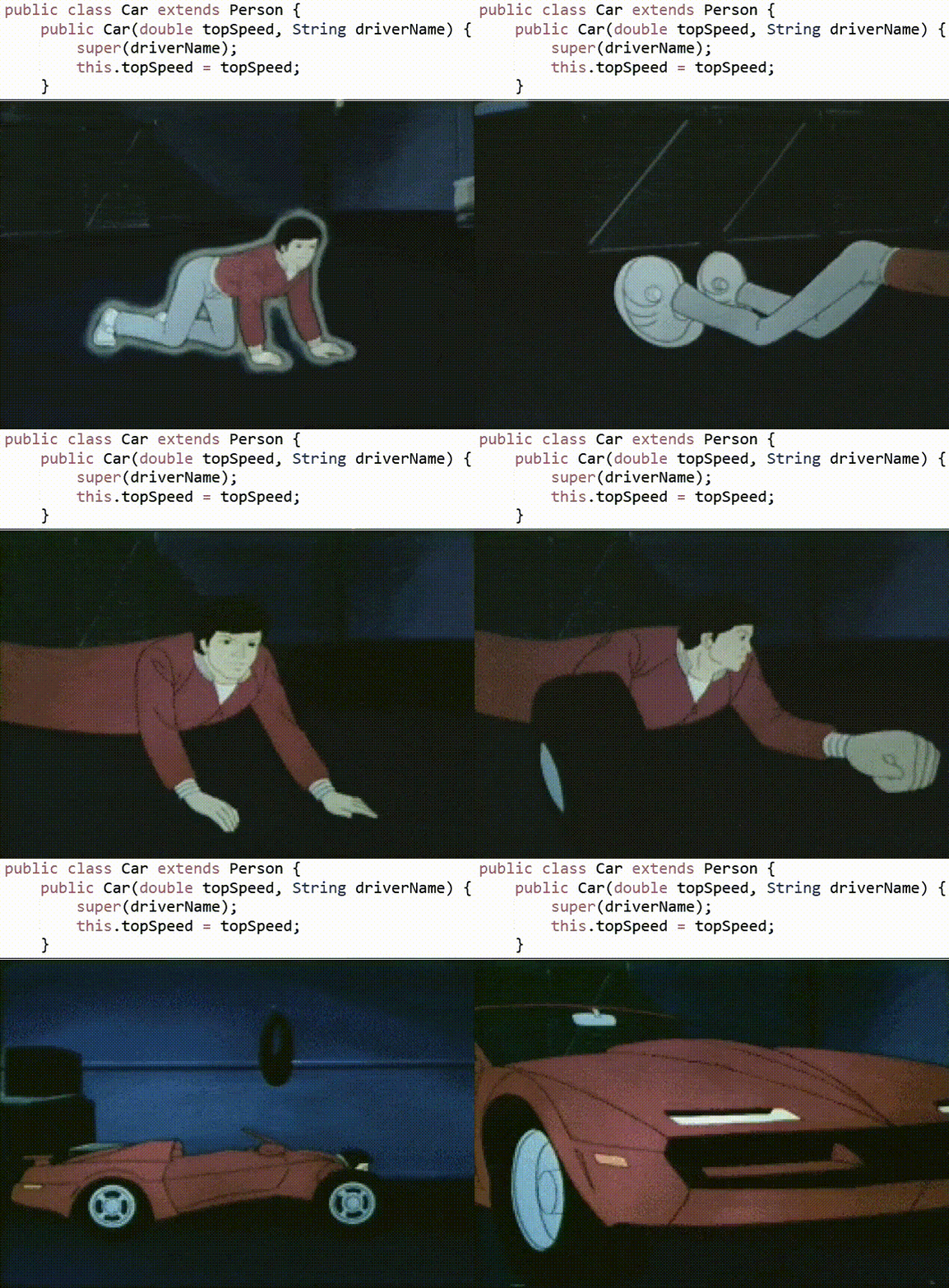
When you make a Car extend Person instead of the other way around, you've created an inheritance hierarchy so cursed that even Barbara Liskov herself would need therapy. The Liskov Substitution Principle states that objects of a superclass should be replaceable with objects of a subclass without breaking the application. But here? A Car IS-A Person? Brother, you've violated not just SOLID principles but the laws of physics and common sense. The person crawling on the ground represents every senior developer who has to review this code. They're not just disappointed—they're physically broken by the sheer wrongness of it all. A car doesn't inherit from a person. A car HAS-A driver. Composition over inheritance, my friend. But no, someone decided that giving a Car a topSpeed and passing a driverName to super() made perfect sense. Fun fact: The Liskov Substitution Principle is the "L" in SOLID, named after Barbara Liskov who won a Turing Award. She definitely didn't win it for making vehicles inherit from humans.

The Project I Was Hired For After They Fired The Entire Previous Team

The Project I Was Hired For After They Fired The Entire Previous Team
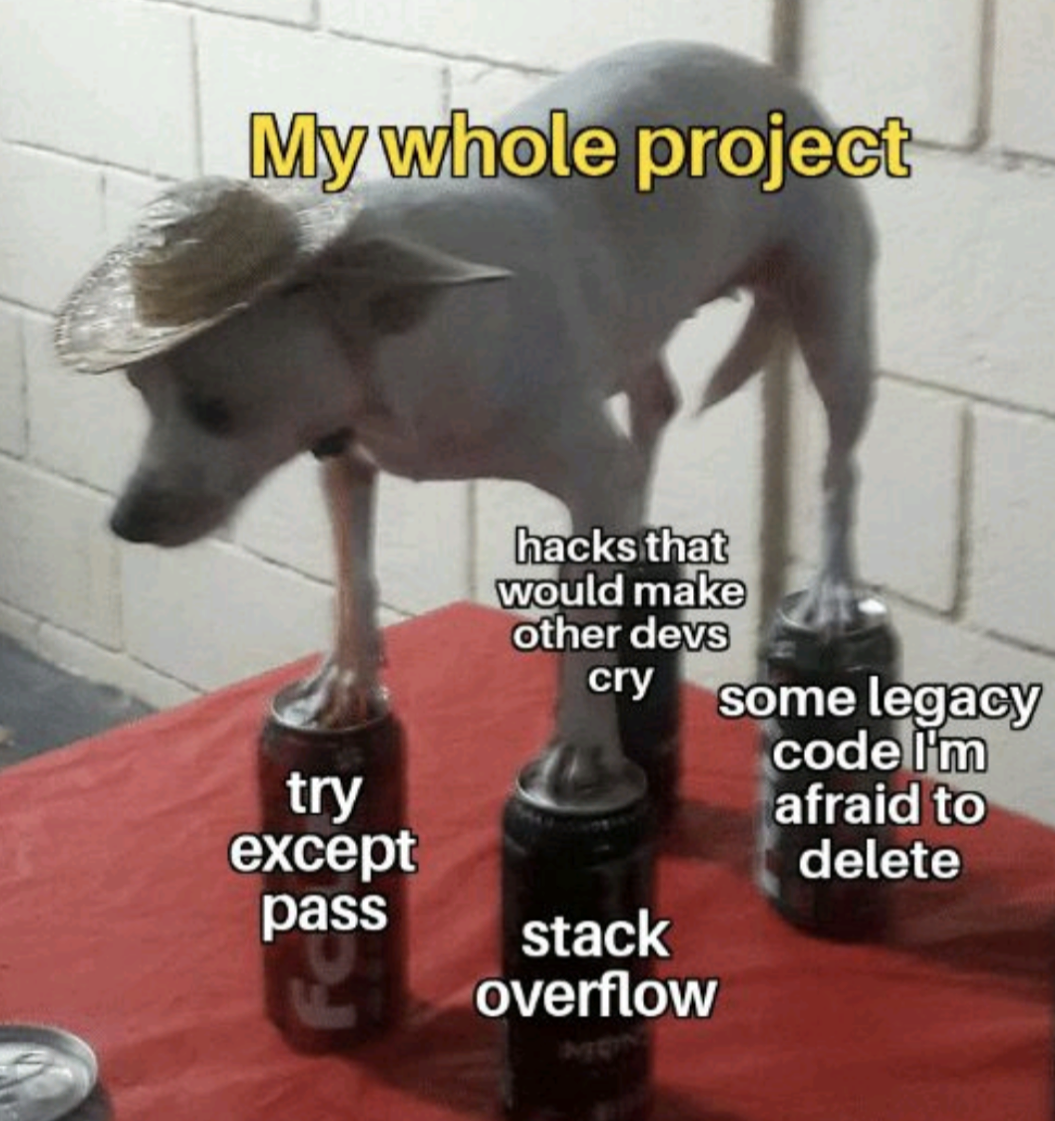
Nothing says "exciting new opportunity" quite like inheriting a codebase so cursed it got an entire team fired. You open the repo and it's like an archaeological dig of bad decisions—try-except blocks swallowing errors like a black hole, Stack Overflow answers copy-pasted with the original poster's username still in the comments, "hacks that would make other devs cry" (spoiler: you're crying), and legacy code so terrifying you're convinced deleting it will summon demons or break production in 47 different ways simultaneously. The whole thing is held together by duct tape, prayers, and what appears to be a single global variable doing the work of an entire microservices architecture. Management wonders why the previous team got fired. You wonder why they're still alive after maintaining this monstrosity. Now it's your problem. Congratulations on the promotion!

Inherited Tech Debt

Inherited Tech Debt
You know that senior dev who insisted on writing production code in Microsoft Word because "it has syntax highlighting if you squint hard enough"? Yeah, their decisions are now your problem. The parallel here is brutal: just like poor lifestyle choices during pregnancy can affect the child decades later, that cowboy coder who merged straight to main without tests in 2004 has cursed you with a codebase that imports time , datetime , AND requests in a file called utils.py that somehow controls the entire authentication system. The YouTube video claiming Word is the "best IDE for programming" is the cherry on top. Some sins echo through eternity, and using Word as an IDE is definitely one of them. The tech debt doesn't just compound—it metastasizes.

CanaKit Raspberry Pi 5 Essentials Starter Kit (4GB RAM)

CanaKit Raspberry Pi 5 Essentials Starter Kit (4GB RAM)
CanaKit Raspberry Pi 5 Essentials Starter Kit

Thing Doer

Thing Doer
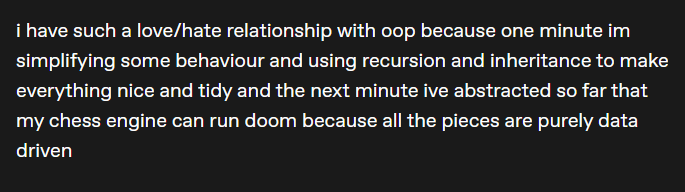
Every OOP developer's journey: First you discover inheritance and polymorphism and suddenly you're an architectural genius, creating elegant hierarchies where a ChessPiece extends MovableGameEntity which implements IPositionable . You're writing beautiful recursive algorithms, feeling like a wizard. Then reality hits. You've abstracted so hard that your chess pieces are now just pure data with zero behavior, floating in a sea of interfaces seven layers deep. Your bishop doesn't know how to move anymore—some MovementStrategyFactory three folders away does. You need a PhD and a map to figure out where the actual logic lives. The duality of OOP: powerful enough to model the entire universe, confusing enough to make you question if your knight should even exist as an object or just be a JSON blob processed by a ThingDoer class.

It's Still Inheritance Really

It's Still Inheritance Really
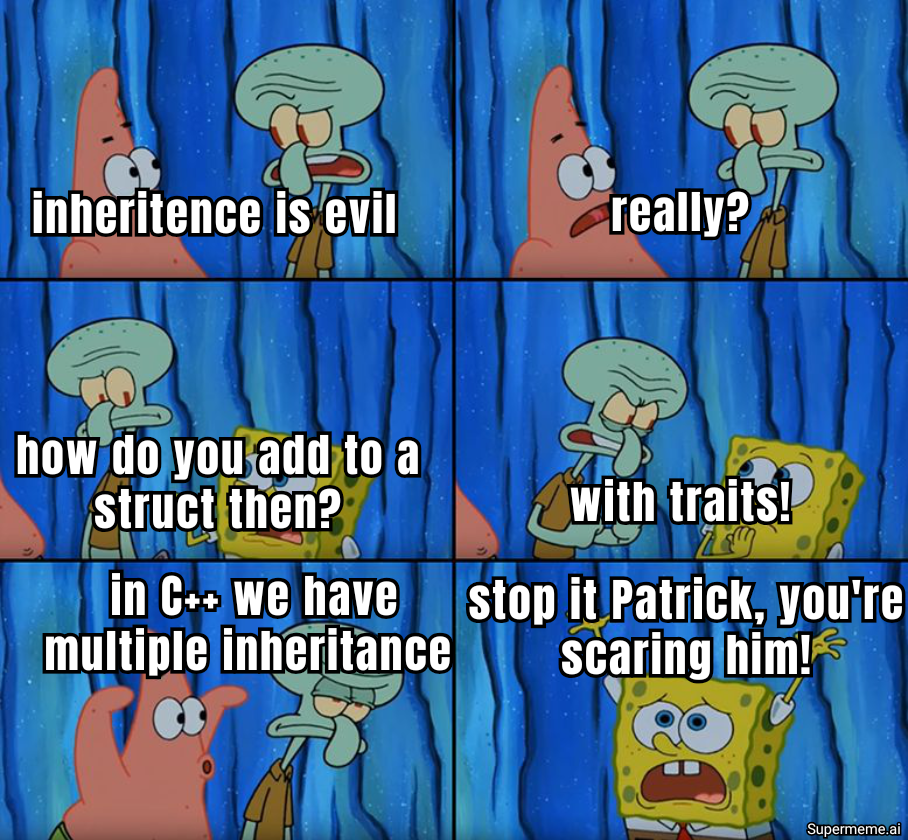
When someone says "inheritance is evil" in 2024, they're usually referring to the Gang of Four's "favor composition over inheritance" mantra. So naturally, you ask how to add behavior to a struct in languages without classes. Their answer? Traits. Which is just... inheritance with extra steps and a different name. Then they hit you with "C++ has multiple inheritance" like it's some kind of flex, and suddenly everyone's running for the exits. Multiple inheritance: the programming equivalent of opening Pandora's box and finding out it contains nothing but diamond problem nightmares and ambiguous method calls.

Gophers Prefer Clean Water

Gophers Prefer Clean Water
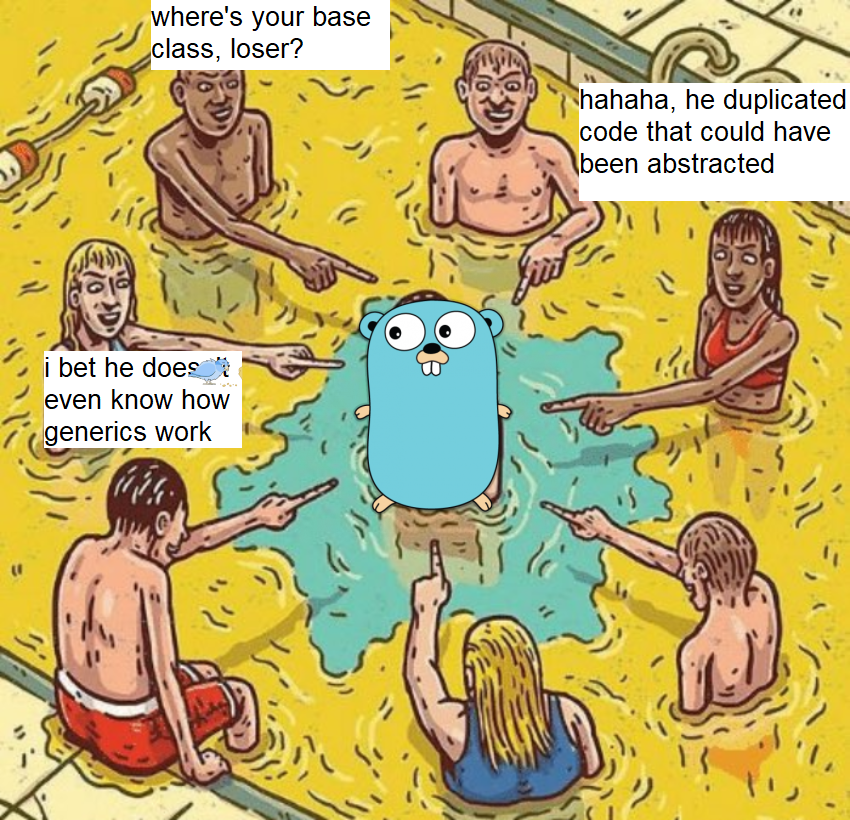
The Go gopher is just vibing in clean water while everyone around it roasts other developers for their coding sins. Meanwhile, Go developers are sitting pretty because their language literally doesn't have inheritance or base classes—it uses composition and interfaces instead. No base classes to forget, no inheritance hierarchies to mess up, no generics to... oh wait, Go added generics in 1.18. But let's be real, half the Go community still pretends they don't exist and just uses interface{} everywhere like it's 2015. The beauty here is that Go's philosophy of simplicity means you literally can't make some of these OOP mistakes. No classes? No problem. No inheritance? Can't forget what doesn't exist. It's like being immune to a disease because you're missing the receptor it needs to infect you. Go developers get to smugly watch the Java and C# folks argue about abstract factory patterns while they're out here writing if err != nil for the 47th time in the same function.

They'll Understand One Day

They'll Understand One Day
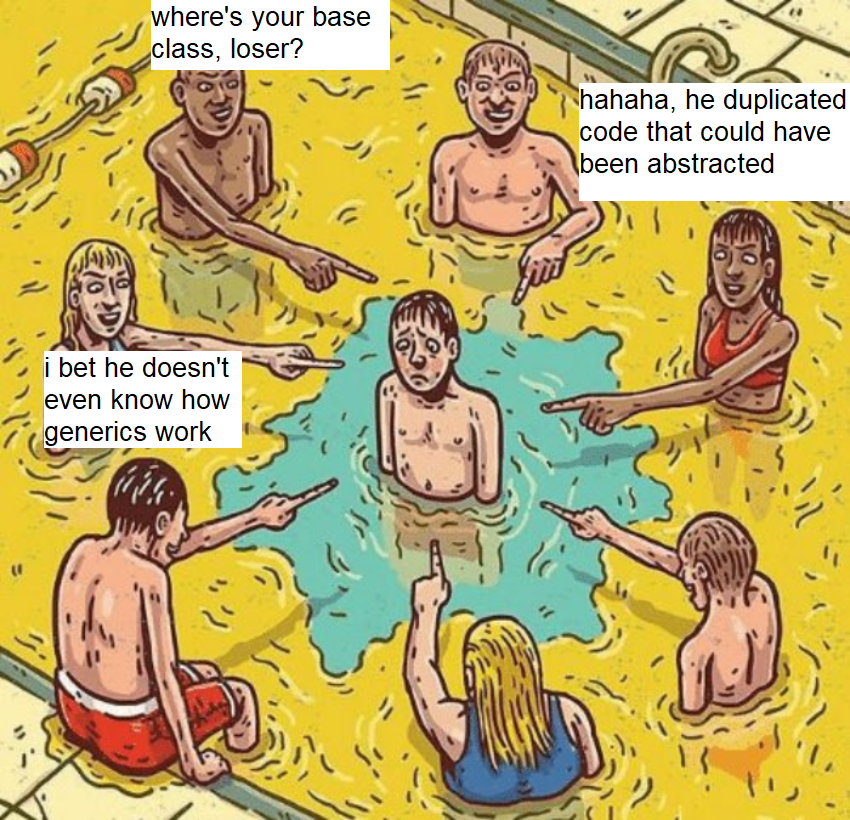
Senior devs roasting juniors with the holy trinity of code review sins. "Where's your base class?" "He duplicated code that could have been abstracted!" "I bet he doesn't even know how generics work!" Meanwhile the junior dev is just standing there taking it from all angles like some kind of OOP intervention. The beautiful irony? Give it 6 months and that same junior will be pointing fingers at the next newbie who dares to copy-paste a function instead of making it reusable. The circle of life in software development—everyone gets hazed by inheritance patterns and DRY principles until they become the hazer. Pro tip: If you're getting roasted for all three simultaneously, you've probably written a 500-line god method that does everything. We've all been there. Some of us still are.

Based On Today's Events

Based On Today's Events
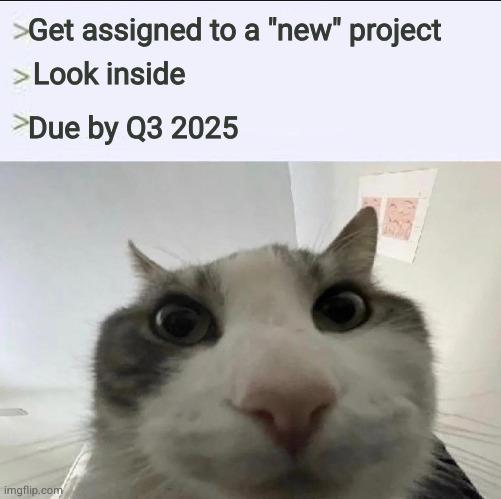
You get assigned to a "new" project, thinking it's a fresh start with clean architecture and modern practices. You open the codebase. You check the deadline: Q3 2025. That's... soon. Very soon. Then you actually look at the code and suddenly understand why the last three developers mysteriously "pursued other opportunities." That wide-eyed stare of existential dread perfectly captures the moment you realize the "new" project is actually a Frankenstein's monster of deprecated dependencies, no tests, commented-out code from 2018, and TODO comments that say "fix this later" with a timestamp that predates the pandemic. The deadline hasn't changed though. Q3 2025. Better start brewing that coffee.

Oop At Home:

Oop At Home:
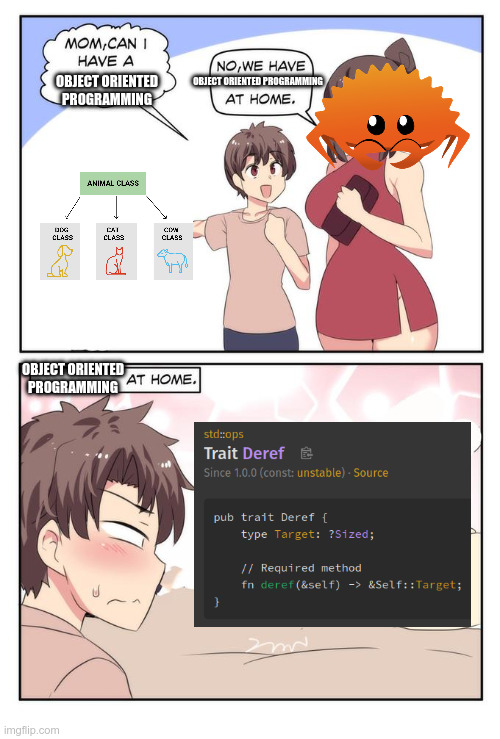
Kid wants proper OOP with inheritance hierarchies, polymorphism, the whole nine yards. Mom says we got OOP at home. Cut to: Rust traits with their awkward const unstable warnings and verbose syntax that makes you question every life decision that led you here. Look, Rust's trait system is technically brilliant—it gives you polymorphism without inheritance hell. But let's be real: when you're coming from languages with actual classes and you see &self being passed around like a hot potato while the compiler screams about lifetimes, it hits different. The kid's disappointment is valid. That const unstable warning is just *chef's kiss*—nothing says "production ready" like features that might vanish in the next compiler update. Welcome to systems programming, where OOP is more of a suggestion than a lifestyle.

I Test in Prod Coding Funny Humor Joke Developer Engineer T-Shirt

I Test in Prod Coding Funny Humor Joke Developer Engineer T-Shirt
Lightweight, Classic fit, Double-needle sleeve and bottom hem