

Imposter syndrome Memes

Posts tagged with Imposter syndrome

Me In My Resume I'm An Expert In XYZ Vs Me In My Real Life

Me In My Resume I'm An Expert In XYZ Vs Me In My Real Life
We've all been there. Resume says "Expert in Python" but your actual skill set is basically print("Hello World") and some if-else statements you copy-pasted from Stack Overflow three years ago. The skeleton waiting eternally at the computer perfectly captures that moment when the interviewer asks you to implement a decorator or explain metaclasses and you realize you've been living a lie. The gap between resume confidence and actual competence is a tale as old as time. You put "proficient" on your resume, they hear "can architect microservices," but really you just know how to make variables and loop through lists. The skeleton's been sitting there since the interview started, still trying to remember what a lambda function does.

Pokemon Vs Digimon, Csgo Vs Valorant, Lethal Company Vs Peak, Can't We All Just Get Along 😩

Pokemon Vs Digimon, Csgo Vs Valorant, Lethal Company Vs Peak, Can't We All Just Get Along 😩
Game devs really out here stressing about which engine is superior, which framework is more optimized, which pixel art style is more authentic... meanwhile players are just happy there's more than one game to play. The dev is having an existential crisis comparing their work to someone else's, convinced everyone's judging their "inferior cake." Plot twist: nobody cares about your imposter syndrome—they're just psyched there are TWO cakes. It's like spending 6 months optimizing your game engine to run at 144fps instead of 120fps while your players are just vibing with both games in their Steam library. The gamedev community loves to create drama where none exists. Unity vs Godot, Unreal vs custom engine, 2D vs 3D—bro, we're all just making interactive rectangles move around screens. Chill.

I Am Not Going To Lie

I Am Not Going To Lie
You spent 6 hours debugging, changed 47 things, reverted 23 of them, added a semicolon, removed it, added it back, sacrificed a rubber duck to the code gods, and suddenly it just... works. Now your teammate wants a detailed technical breakdown of your breakthrough solution. "Well, you see, I implemented a revolutionary approach involving... uh... strategic refactoring and... architectural improvements." Translation: I have absolutely no idea what fixed it, but I'm taking full credit and we're never touching that code again. If it breaks, I was on vacation.

Double Edged Fork

Double Edged Fork
Getting your repo forked is simultaneously validating and terrifying. On one hand, someone found your code interesting enough to fork. Congrats, you're basically Linus Torvalds now. On the other hand, they're about to discover that function you named doTheThingButBetter() and the 47 TODO comments you left scattered throughout like breadcrumbs of shame. That variable you hardcoded? Yeah, they'll see that too. Your commit history with messages like "fix" and "actually fix" and "FOR REAL THIS TIME"? All visible. It's like inviting someone over and suddenly remembering you left your browser history open.

Code Vs Reality

Code Vs Reality
You know that side project you put on your resume? The one with "microservices architecture" and "scalable backend"? Yeah, it's the adorable kitten on the left—cute, functional enough, gets the job done. But during the interview, you're describing it like it's the ripped bodybuilder cat on the right, complete with six-pack abs and biceps that could handle 10 million concurrent users. The gap between your actual codebase (probably held together with duct tape, TODO comments, and a single try-catch block) and your interview pitch (enterprise-grade, fault-tolerant, battle-tested) is wider than the difference between your local environment and production. Bonus points if you've never actually load-tested it but confidently claim it "scales horizontally." The interviewer nods along, impressed. Little do they know that "distributed system" just means you have a separate folder for frontend and backend.

My Value Is Massively Underrated At This Company

My Value Is Massively Underrated At This Company
Junior dev trying to prove their worth by showing off their "super important function" that's basically a 100,000-iteration loop with callbacks nested deeper than their imposter syndrome. The Sr Dev's blank stare says everything: they've seen this exact performance disaster about 47 times this quarter alone. Nothing screams "I don't understand Big O notation" quite like a function that literally logs "Doing very important stuff..." while murdering the call stack. And that cherry on top? The comment declaring "This is not a function" after defining a function. Chef's kiss of self-awareness, really. Pro tip: if you need to convince people your code is important by adding comments about how important it is, it's probably not that important. The best code speaks for itself—preferably without crashing the browser.

Stack Overflow Dependent Life

Stack Overflow Dependent Life
Someone's partner just discovered their search history and learned that "smart programmer" apparently means Googling "what is a fork" and "what is a branch" like you're studying for a kindergarten nature quiz. The real kicker? "rubberduck to talk to" - because nothing says "I'm a professional software engineer" quite like needing a search engine to explain your debugging methodology. Plot twist: we all have searches like this. The difference between a junior and senior developer isn't knowledge - it's how fast you can clear your browser history before someone sees you Googling "how to exit vim" for the 47th time.

CV Skills

CV Skills
You know that impressive list of database technologies you confidently slapped on your resume? PostgreSQL, MySQL, Microsoft SQL Server, MongoDB—basically the entire database hall of fame? Yeah, turns out knowing they exist and actually being able to write a proper query are two wildly different skill levels. The recruiter sees "expert in 4 database systems" and imagines you architecting enterprise-level data solutions. Reality check: you're about to crash harder than that Ferrari when they ask you to explain the difference between INNER JOIN and LEFT JOIN, or god forbid, optimize a query. SQLite crash course? More like SQL-ightest clue what I'm doing course. Pro tip: maybe stick to the ones you can actually spell without autocorrect.

Debugging Is Just Professional Overthinking

Debugging Is Just Professional Overthinking
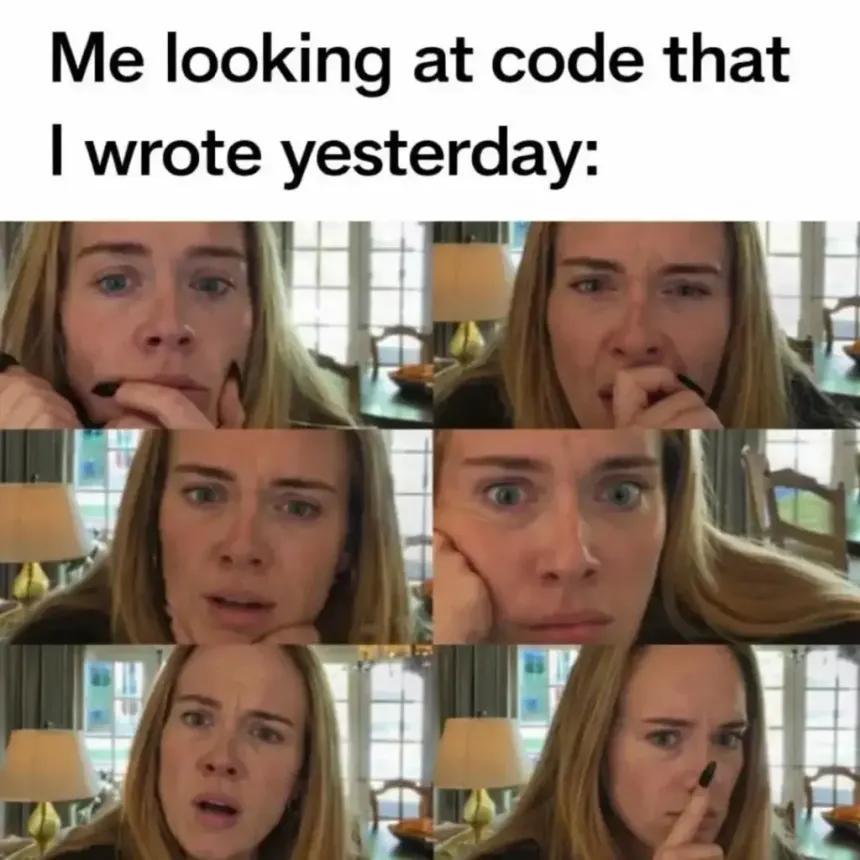
Every developer's internal monologue during debugging sessions. You spend 3 hours questioning whether your code is broken or if you've just lost the ability to write a simple for-loop. Spoiler alert: it's both. The code has a bug AND you forgot how semicolons work because you've been staring at the screen for too long. The real kicker? After all that self-doubt and imposter syndrome, you realize the bug was a typo in a variable name. Meanwhile, your brain has already convinced you that maybe you should've been a farmer instead. Classic developer experience right there.

Mock Engineer

Mock Engineer
Oh honey, someone just discovered the existential crisis that keeps traditional engineers up at night! One astronaut is about to commit space violence after realizing software developers have been casually calling themselves "engineers" without touching a single differential equation or wearing a hard hat. The drama is REAL because while mechanical engineers spent four years calculating stress loads and memorizing material properties, software devs just learned some JavaScript and suddenly they're "Senior Software Engineers" making bank. The audacity! The betrayal! The sheer disrespect to people who actually have to worry about things collapsing or exploding! But let's be honest—both groups spend most of their time Googling things and pretending they knew the answer all along, so maybe we're not that different after all. 💀

Burned Tokens For Confidence Boosting

Burned Tokens For Confidence Boosting
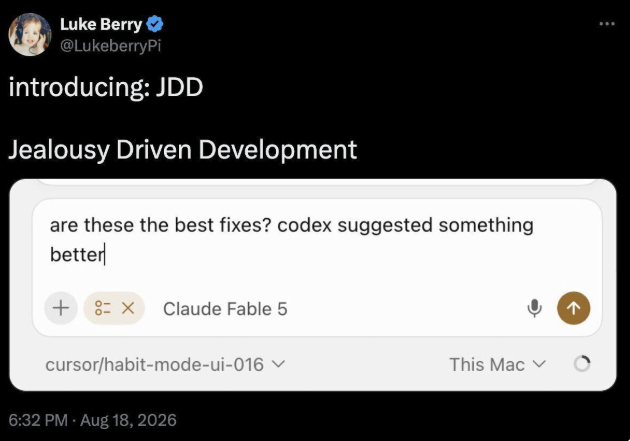
Picture this: You just spent half your monthly AI token budget asking Claude to "vibe check" your code like it's your therapist, only to realize the solution was literally changing ONE variable name. But hey, your manager is shaking your hand like you just discovered penicillin, so you're standing there with that forced smile knowing you basically paid $50 to have an AI tell you what your rubber duck could've figured out for free. The real tragedy? You could've just... read the error message. Used console.log. Asked literally anyone on Slack. But no, you went full premium AI mode for what turned out to be the programming equivalent of asking Siri to remind you where you left your phone while holding it. The awkward handshake energy is IMMACULATE because deep down you know the truth: Claude saw your code, probably judged you silently, and you still had to do all the actual work yourself. But sure, let's take credit for "using modern tools efficiently" or whatever corporate speak makes this feel less like highway robbery.

Fail First Then Ask

Fail First Then Ask
Why would you ask a fellow developer for help when you could spend an ENTIRE WORK WEEK going down a rabbit hole that leads absolutely nowhere? The sheer audacity of asking for help immediately is just too efficient and reasonable! Instead, let's waste five glorious days implementing something completely wrong, refactoring it three times, questioning our career choices, and THEN reluctantly ping someone who solves it in 30 seconds with "oh yeah, you just need to flip that flag." Peak developer energy right here – we'd rather suffer in silence than admit we don't know something upfront. Because nothing says "professional growth" quite like stubbornly marching in the wrong direction until you've burned through a sprint's worth of time! 🔥