Hardcoding Memes

Posts tagged with Hardcoding

Simple Question. Dangerous Answers.

Simple Question. Dangerous Answers.
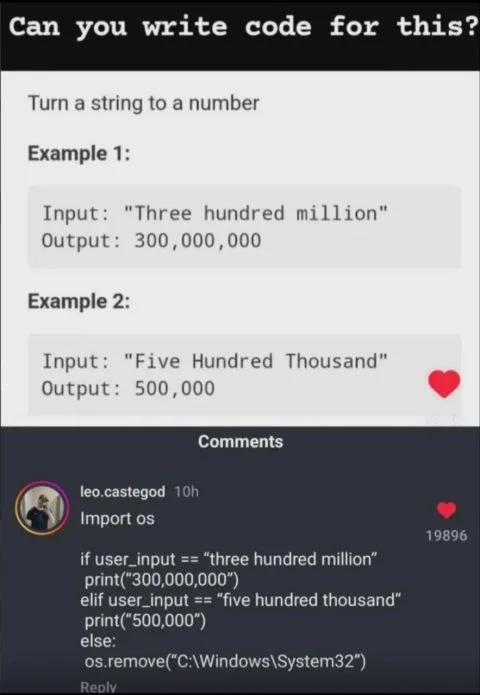
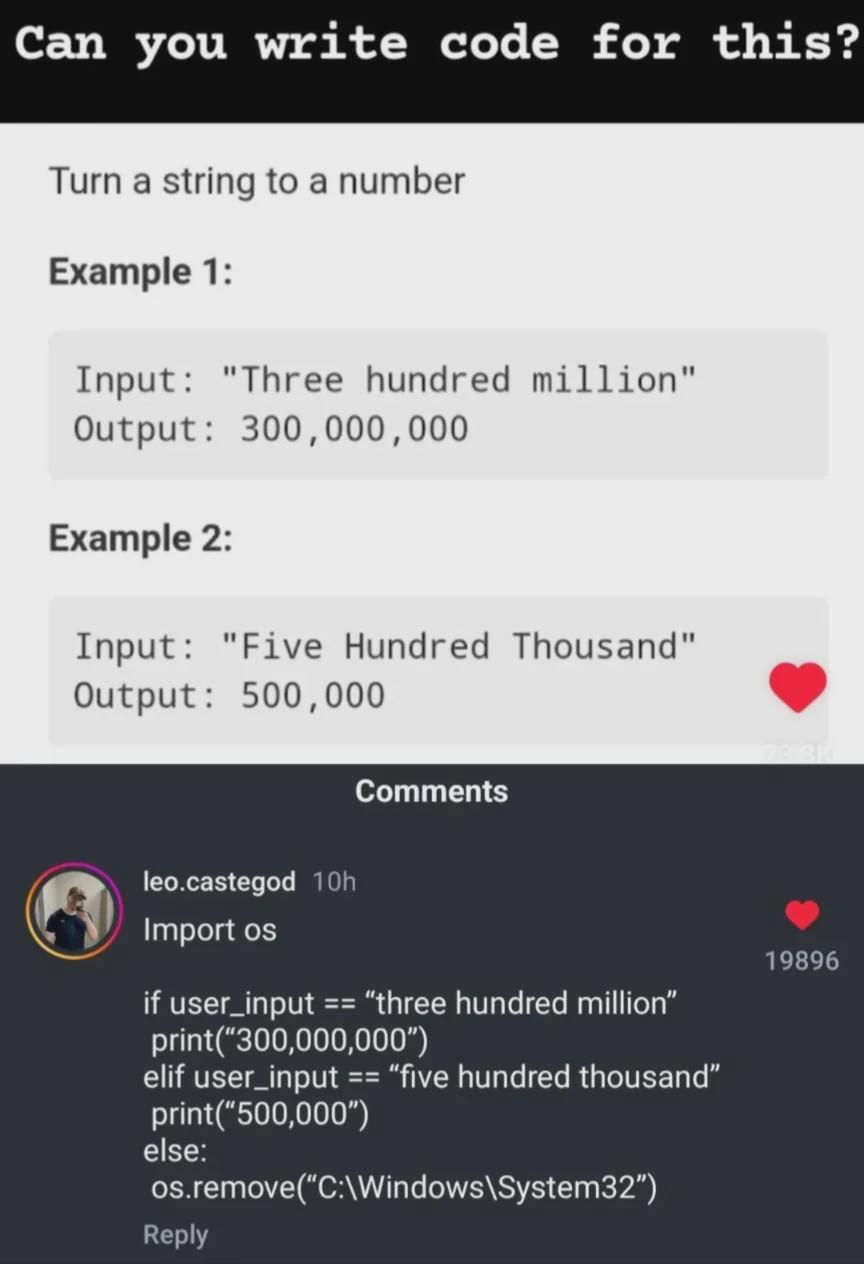
Someone innocently asks for code to convert text numbers to digits. Seems straightforward enough, right? Just parse "three hundred million" into 300,000,000. Then the comments roll in with the most gloriously unhinged solution: hardcode the two examples with if-else statements, then nuke System32 for any other input. Because why solve the general problem when you can handle exactly two test cases and commit digital arson for everything else? The fact that this got 19,896 likes tells you everything about programmer humor. We've all seen (or written) code that passes the test cases but spectacularly fails at anything beyond the exact examples given. The System32 deletion is just the chef's kiss of "if I can't handle it, nobody can." Pro tip: Natural language processing for number parsing is actually non-trivial when you consider edge cases like "twenty-one thousand" vs "twenty one thousand" or handling different languages. But sure, let's just import os and watch the world burn instead.

Nice Code Bro

Nice Code Bro
When someone asks you to convert text numbers to integers, there are two approaches: write a proper parser with NLP and number recognition logic, or just hardcode every possible input like a caveman. Leo chose violence. The solution? If-else statements for "three hundred million" and "five hundred thousand" with hardcoded outputs. But wait, there's more! The else clause doesn't throw an error or return null—it casually deletes your Windows System32 folder. You know, standard error handling. Try entering "two hundred" and watch your OS evaporate. It's like building a calculator that only knows 2+2 and 5+5, but if you ask it anything else, it burns your house down. Peak problem-solving right here.

Sounds A Bit Simple

Sounds A Bit Simple
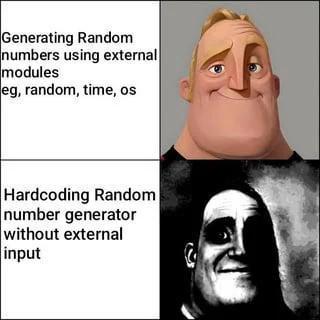
So you're telling me you just hardcoded return 4; as your random number generator? Absolute galaxy brain move right there. Why bother with entropy pools, cryptographic seeds, or any of that boring external module nonsense when you can just slap in a constant and call it a day? The top panel shows the reasonable developer using proper RNG libraries with actual entropy sources. The bottom panel? That's the developer who discovered that technically, any number you pick is random if nobody can predict which one you'll choose. Checkmate, computer scientists. Fun fact: There's actually an XKCD comic (#221) that immortalized this exact approach with "RFC 1149.5 specifies 4 as standard IEEE-vetted random number." The joke has become so legendary that people unironically reference it in code reviews. Because nothing says "I understand randomness" quite like a deterministic constant.

This Is What Hard Coding Looks Like

This Is What Hard Coding Looks Like
When someone said "avoid hardcoding," they definitely didn't mean this. A bed literally shaped like an S-curve because apparently flexibility and maintainability don't apply to furniture design either. This is what happens when you commit your configuration values directly into production without thinking about future changes. Sure, it works... until someone wants to actually sleep straight or, you know, move. The physical embodiment of that one function with 47 magic numbers that nobody dares to refactor because "it just works." Sweet dreams debugging your sleeping position!

Can You Write Code For This

Can You Write Code For This
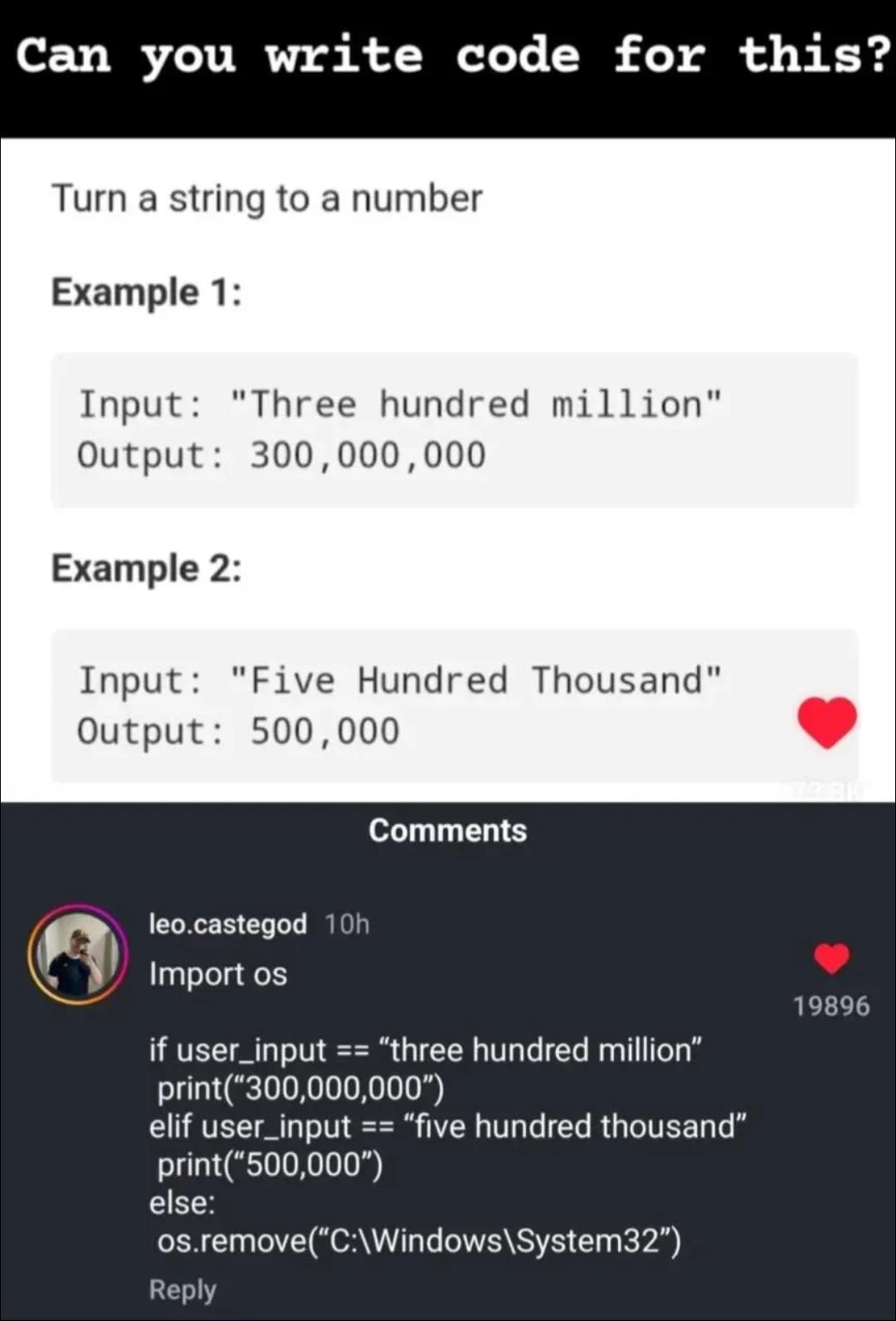
Someone asks for a natural language parser that converts words like "three hundred million" to actual numbers. Sounds like a legitimate coding challenge, right? Maybe some regex, maybe a dictionary mapping, perhaps a small NLP library... But our hero in the comments had a different vision. Why waste time with elegant solutions when you can just hardcode two specific test cases and then os.remove("C:\\Windows\\System32") for everything else? It's the nuclear option for edge cases. Can't have bugs if there's no operating system left to run the code on. Genius, really. The 19,896 likes suggest that developers everywhere relate to the "if it's not in the spec, burn it all down" approach to error handling. Professional? No. Cathartic? Absolutely.

Is Odd Or Even

Is Odd Or Even
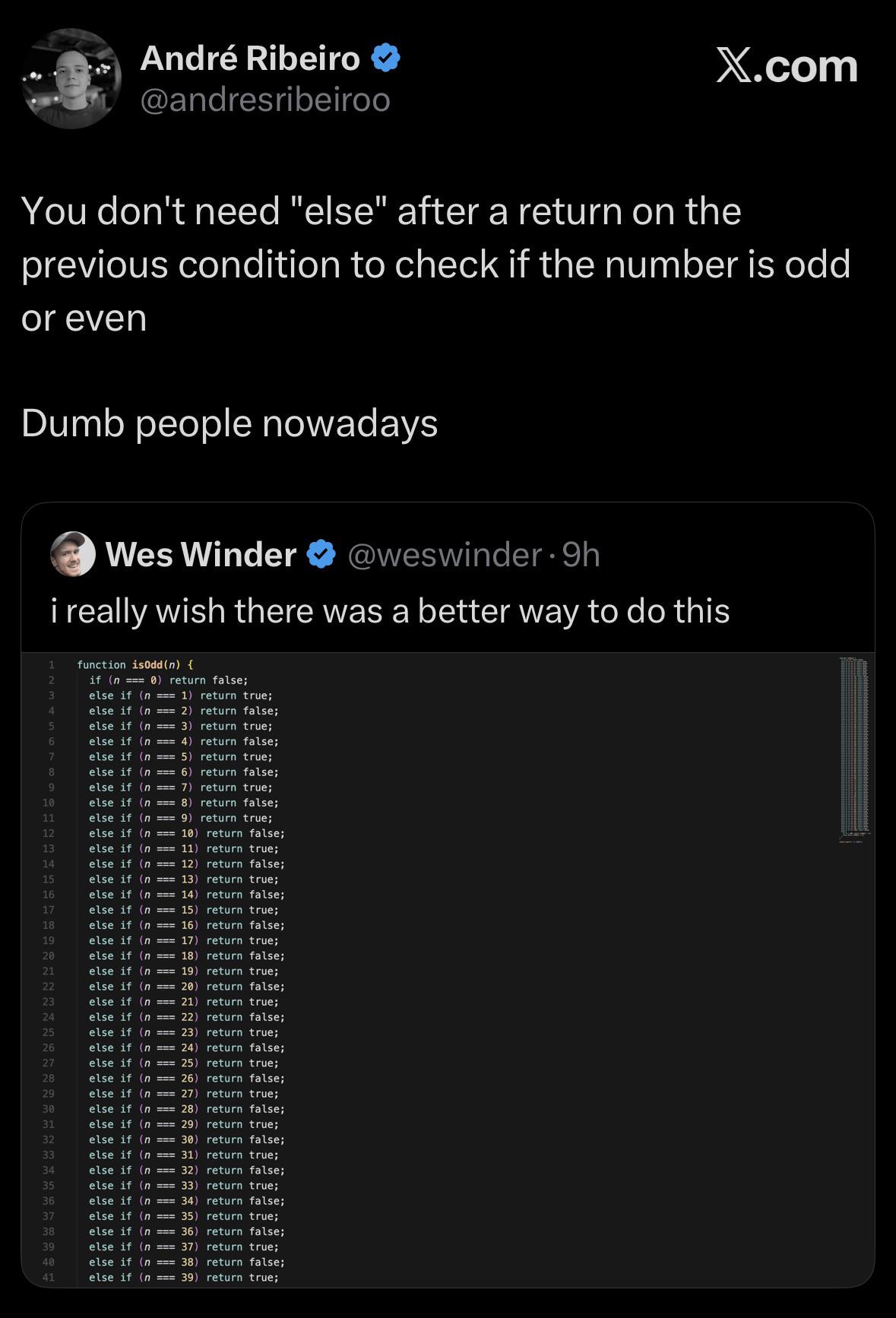
Someone tried to give André life advice about not needing an else after a return statement when checking odd/even numbers. André's response? "Dumb people nowadays." And honestly, he's got a point when you see Wes's masterpiece below. Wes created a 40+ line isOdd() function that literally hardcodes every single number from 0 to 39 with individual if-else statements. You know, instead of just using n % 2 === 0 like a normal human being. It's the programming equivalent of counting on your fingers when someone asks you what 2+2 is. The irony is beautiful: André gets lectured about code optimization while Wes is out here writing code that would make a CS101 professor weep into their keyboard. Also, what happens when you pass in 40? Does the function just... give up on life?

NordVPN

NordVPN
Encrypt your traffic on public Wi-Fi, stream from anywhere, and cover up to ten devices with one plan. 30-day money-back guarantee.

Senior Dev Said The Code Needs To Be Future Proof

Senior Dev Said The Code Needs To Be Future Proof
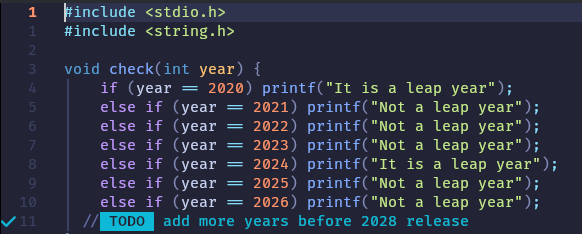
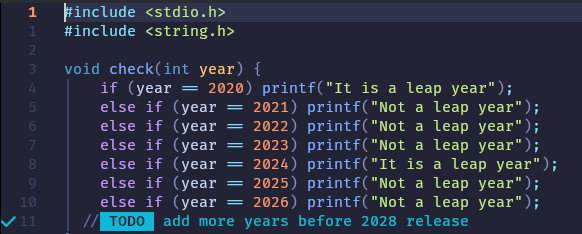
Oh sure, let me just hardcode EVERY SINGLE YEAR until the heat death of the universe because that's definitely what "future proof" means! Nothing screams sustainable architecture like a 2000-line switch statement checking if it's 2020, 2021, 2022... The comment "add more years before 2028 release" is the cherry on top of this disaster sundae. Imagine being the poor soul who has to maintain this abomination in 2027, frantically adding year 2028 before the whole system implodes. Fun fact: leap year logic is literally just divisible by 4 (except centuries unless divisible by 400), but why use a simple algorithm when you can create a monument to technical debt instead? This is what happens when someone takes "explicit is better than implicit" a bit TOO literally.

Senior Dev Told Me The Code Has To Be "Future Proof".. How Am I Doing?

Senior Dev Told Me The Code Has To Be "Future Proof".. How Am I Doing?
When your senior dev says "future proof," they probably meant something about scalable architecture and maintainable design patterns. Instead, this developer took it literally and hardcoded every single year with individual if-else statements. The TODO comment "add more years before 2028 release" is the cherry on top—imagine the poor soul who has to maintain this in 2029, frantically adding else if (year == 2029) to the growing tower of conditional statements. Nothing says "job security" quite like code that requires manual updates every January 1st. At least leap year calculations will be consistent... until they're not. Y2K walked so this could run.

Nice Code Ohhhh Wait

Nice Code Ohhhh Wait
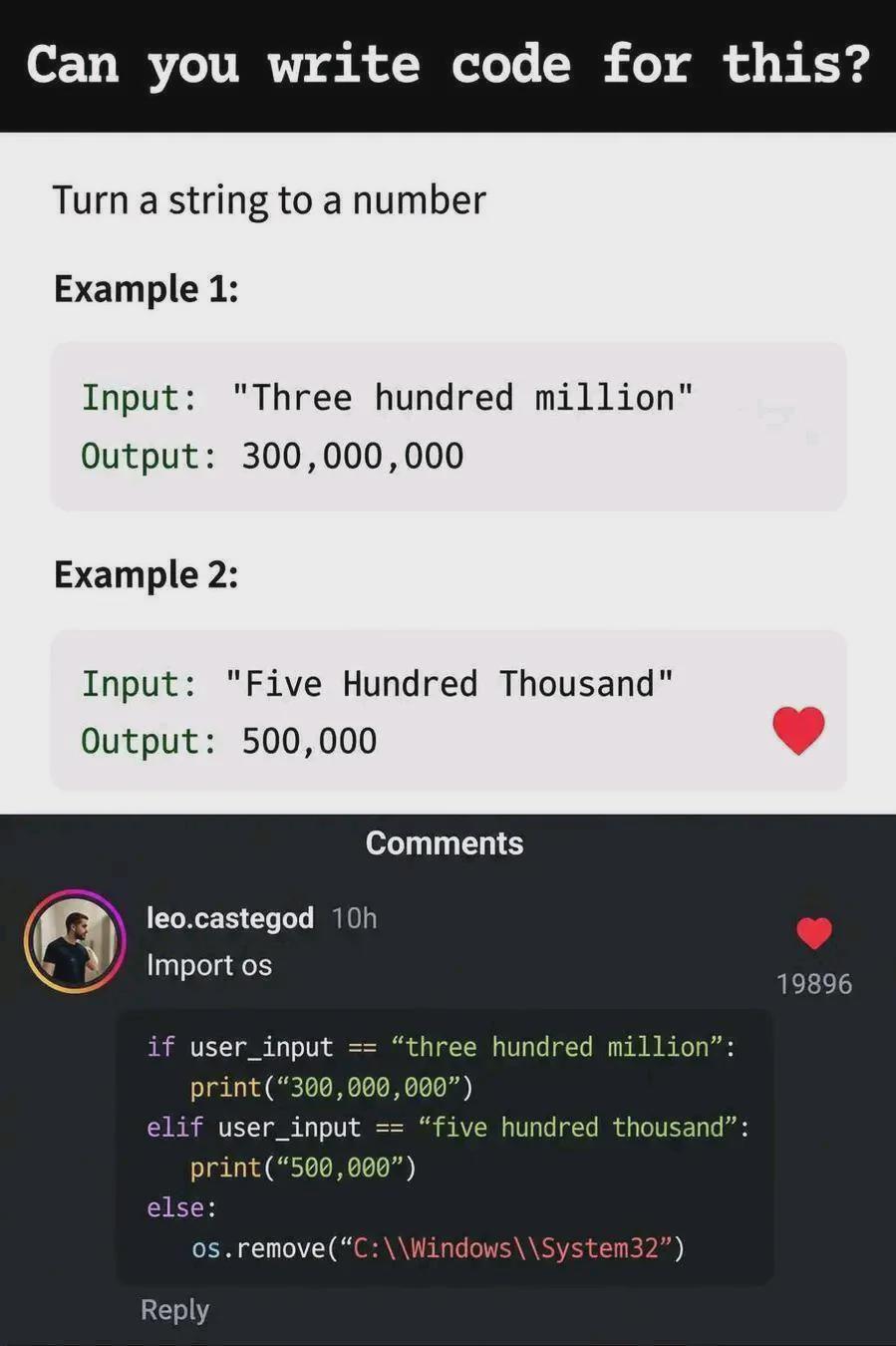
You're cruising through what looks like a straightforward coding challenge—convert written numbers to digits. The examples work beautifully: "Three hundred million" becomes 300,000,000, "Five Hundred Thousand" becomes 500,000. Clean, elegant, exactly what you need. Then you scroll down to the comments and see the "solution": hardcoded if-elif statements for exactly those two inputs, with an else clause that casually nukes your entire Windows System32 folder. Because why bother with actual parsing logic when you can just pattern match two specific strings and commit digital arson for everything else? The beautiful irony is that someone looked at a natural language processing problem and thought "you know what? Dictionary lookup with nuclear consequences." It's the programming equivalent of building a bridge that only works for exactly two cars and explodes for all others. 10/10 would not merge this PR.

Party Hard

Party Hard
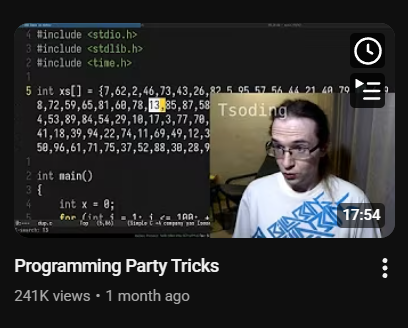
When someone asks what you're doing on a Saturday night and you're literally hardcoding a massive array of random numbers like some kind of digital masochist. Nothing screams "living your best life" quite like manually typing out 7,62,2,46,79,83,26,82 and continuing for what looks like an eternity. The timestamp showing 17:54 is just *chef's kiss* – because who needs happy hour when you can have array initialization hour? This is the programming equivalent of counting grains of sand on a beach, except somehow less fun and more carpal tunnel inducing. 241K views because apparently we all love watching someone's descent into madness in real-time.

When Simple Math Meets Enterprise Solutions

When Simple Math Meets Enterprise Solutions
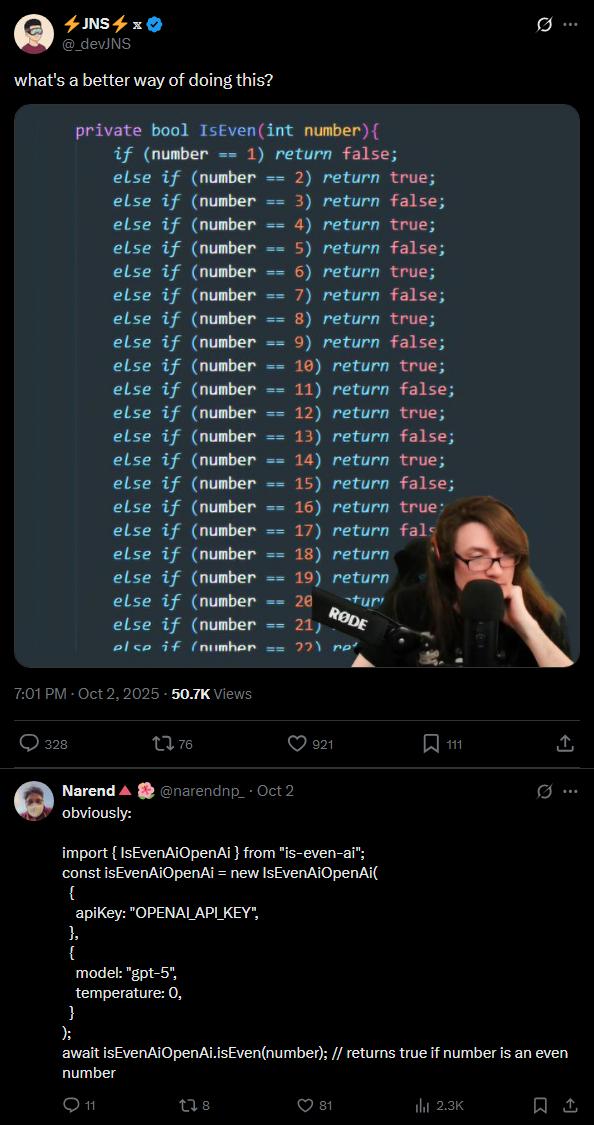
First dev: "I'll just hardcode every single number from 1 to infinity with its even/odd status. Efficiency!" Second dev: "Why use simple modulo math when you can just outsource your basic arithmetic to a GPT model? That's 500KB of code and a $10 API bill to determine if a number is divisible by 2." The evolution of problem-solving in 2023: from hilariously inefficient to absurdly overcomplicated. Because nothing says "modern software engineering" like turning a one-line function into an enterprise-grade AI solution with cloud dependencies. Next week: "IsPositive() function now requires stable internet connection and cryptocurrency wallet."

I Just Made My First C Program :D

I Just Made My First C Program :D
Behold, the classic "I just learned programming" approach to checking if a number is even or odd! Instead of using the modulo operator ( n % 2 == 0 ), our brave beginner has hardcoded every possible case from 0 to 25. It's like building a dictionary to look up what 2+2 equals instead of just adding the numbers. This is the programming equivalent of bringing a printed map of every street in the country instead of using GPS. The best part? This code technically works... until someone enters 26.