

hacking Memes

State Of Things

State Of Things
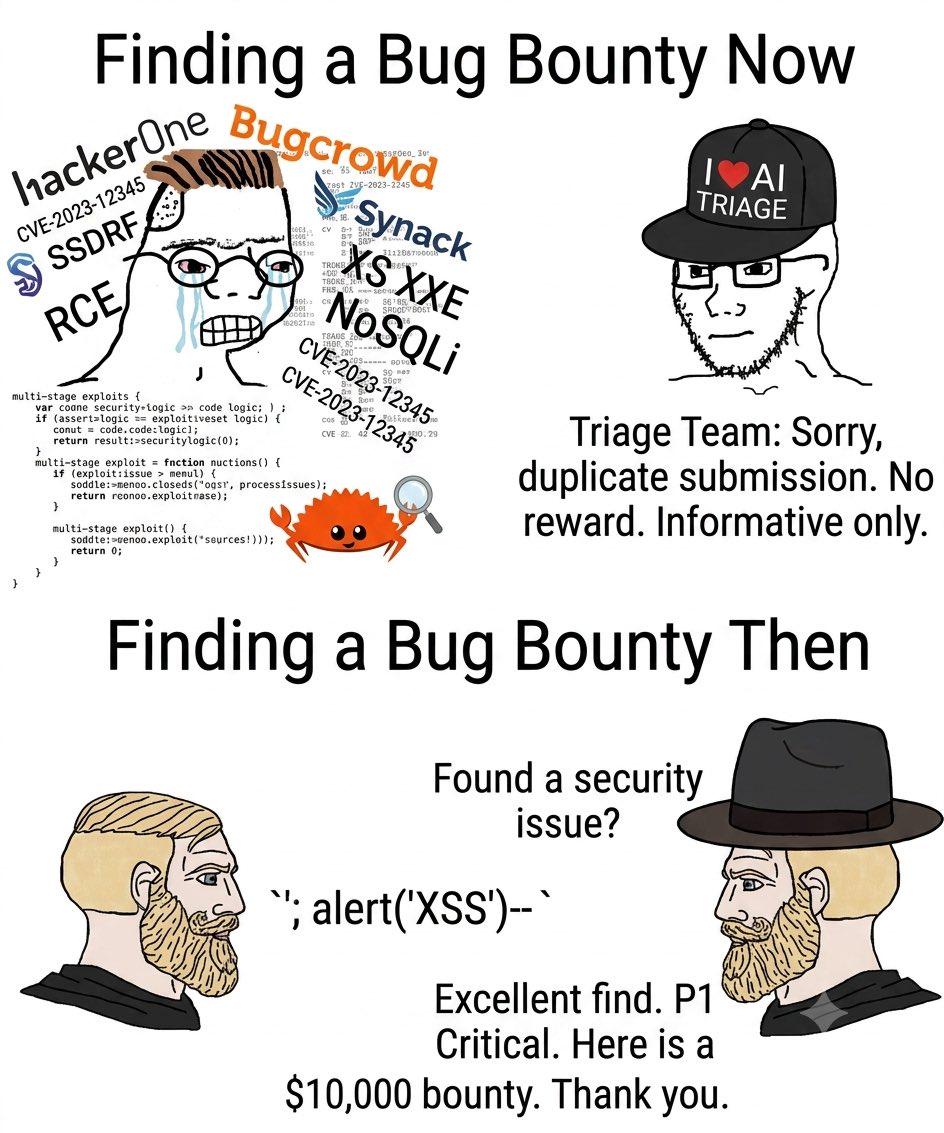
Bug bounty programs in 2026 are apparently going to be less "here's $50k for finding a critical vulnerability" and more "here's a dollar, now stop bothering us." The progression from confidently dropping those shiny metal balls (bugs) expecting a decent payout to literally begging for scraps with "one dollar please" is painfully accurate. Companies have mastered the art of devaluing security researchers' work. You find a zero-day that could compromise millions of users? Best we can do is a thank you in the changelog and maybe enough money for a coffee. Not even a fancy coffee—we're talking gas station coffee here. The real kicker is how bug bounty platforms keep adding more restrictions, longer validation times, and lower payouts while companies act like they're doing YOU a favor by letting you find their security holes for free. Peak capitalism meets cybersecurity, and somehow we're all surprised when critical vulnerabilities get sold on the dark web instead.

I'M In.

I'M In.
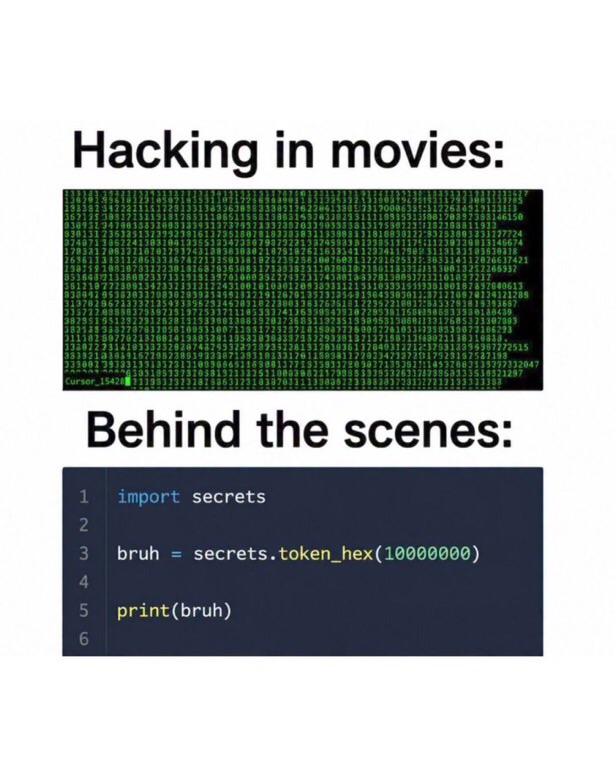
The hacker in every movie ever: *furiously types for 3 seconds* "I'm in." Meanwhile in reality: you console.log your way into the system and immediately get undefined back. The most anticlimactic hack of all time. No firewalls breached, no mainframes penetrated, just JavaScript being JavaScript and returning undefined because you forgot to actually return something from your function. Hollywood lied to us—real hacking is just debugging with extra steps.

You Can't Hack NASA With CSS

You Can't Hack NASA With CSS
Someone really thought CSS was their gateway to becoming a black hat hacker. You know, because nothing says "elite cyber warfare" like color: #FF0000; and margin-left: 10px; The response is chef's kiss though. "You can only change the color on their satellites" – technically accurate if you manage to inject CSS into their UI, which means you'd already need to have hacked them to... hack them. Circular logic at its finest. Frontend devs catching strays again. Meanwhile, the 197 people who reacted probably include at least 50 junior devs who genuinely weren't sure if this was possible.

I'm On My Way

I'm On My Way
You know that creepy basement door that looks like it leads straight to a horror movie? Yeah, that's where all the DDoS attacks are coming from. The sign says "GOTH GIRLS FREE DDOS" and honestly, the bait is working. Developers will literally walk through what appears to be a portal to the underworld for free distributed denial-of-service attacks. Is it a trap? Probably. Are we going anyway? Absolutely. The bloodstains on the floor are just from the last guy who tried to optimize his DNS queries down there. Worth it for that sweet, sweet free infrastructure stress testing though. Security best practices? Never heard of her.

Bash Or Bombard

Bash Or Bombard
When you're a government entity trying to decide between two equally terrible options: either hack into AWS to steal data, or just physically bomb their data centers. The joke here is the absurd false dichotomy – like these are the only two viable strategies in a government's playbook. But wait, there's a third option that nobody asked for: just send them a politely worded subpoena! Governments be sweating over this choice like they're picking between rm -rf / and sudo rm -rf /* . Spoiler alert: they probably already have a backdoor API key anyway.

Oh Yes!

Oh Yes!
Someone genuinely asked how hard it would be to hack NASA using CSS, and honestly, that's adorable. It's like asking if you can rob a bank with a paintbrush. Sure, you could make their website look *fabulous* with some gradient backgrounds and smooth transitions, but breaking into their systems? Not quite. The response is brutally accurate: the only thing you're hacking with CSS is the color scheme of their satellites. Maybe add some box-shadow to make them pop? Perhaps a nice hover effect when they orbit Earth? The fact that 197 people liked the original question is the real security vulnerability here. CSS is a styling language, folks. It makes things pretty. It's the makeup artist of the web, not the lockpick. But hey, if NASA's satellites suddenly start displaying in Comic Sans, we'll know who to blame.

Bros Gonna Hack Nasa

Bros Gonna Hack Nasa
Someone out here thinking they're about to breach NASA's cybersecurity infrastructure with CSS... you know, the styling language that makes buttons pretty and centers divs (if you're lucky). Sergey Berengard swoops in with the reality check: buddy, CSS isn't going to get you past NASA's firewalls, but hey, you might be able to give their satellites a fresh coat of paint. Maybe throw in some border-radius on those solar panels while you're at it. The confusion between CSS (Cascading Style Sheets) and actual hacking tools is peak beginner energy. It's like showing up to a bank heist with a paintbrush. The comment section roasting this person with 197 reactions says it all—the internet has no mercy for those who think color: #FF0000; is a security exploit.

Don't Mess With Me, My Boyfriend Is A Programmer

Don't Mess With Me, My Boyfriend Is A Programmer
The absolute AUDACITY of threatening someone with "my boyfriend will hack your social media" when homeboy is literally Googling how to declare variables in HTML. Sir, HTML doesn't even HAVE variables—it's a markup language, not a programming language! The girlfriend out here writing checks her boyfriend's skillset can't cash. Meanwhile, dude's having an existential crisis trying to figure out basic web fundamentals. The gap between reputation and reality has never been more devastating. He's about as threatening as a kitten with a keyboard. Nothing says "elite hacker" quite like searching for beginner-level concepts in the wrong language entirely. Truly terrifying stuff. 💀

Realizing That Installing Kali Linux Is Not Enough

Realizing That Installing Kali Linux Is Not Enough
You know those kids who think downloading Kali makes them instant hackers? Yeah, turns out you actually need to understand what's happening under the hood. Who knew? The brutal reality check hits when you realize hacking isn't just running nmap and watching the Matrix scrolling text. You need to climb the entire staircase of fundamentals: computer basics, networking basics, Linux basics... and then maybe you can start playing with the pentesting tools. But people skip straight to the top step and wonder why they're face-planting. Can't exploit a buffer overflow if you don't know what a buffer is, my friend. Can't SQL inject if you think a database is where criminals are stored. The escalator to elite hacker status is permanently broken—you're taking the stairs.

Don't Try This

Don't Try This
Security through absolute chaos. The digital equivalent of leaving your front door wide open with a sign that says "Free stuff inside" just to confuse burglars. Opening all ports, never updating the OS, and removing all passwords isn't security—it's creating a honeypot so cursed that hackers think it's a trap. They see this setup and their threat assessment models just crash. "Nobody could possibly be this reckless... must be the FBI." The real genius here is weaponizing incompetence to the point where it becomes indistinguishable from a sophisticated sting operation. Your move, hackers.

Integer Underflow Risk

Integer Underflow Risk
You placed first in a coding contest, feeling like a god among mortals. But then someone else placed 0th because they exploited an integer underflow bug in the ranking system. Classic competitive programming energy right here—where winning isn't about being the best, it's about finding that one edge case the organizers forgot to validate. For the uninitiated: integer underflow happens when you subtract from the minimum value of an integer type and it wraps around to the maximum value (or in this case, goes negative and becomes 0th place). It's like going so far backward you end up ahead. Honestly, if you can hack the leaderboard, you deserve that trophy more than anyone who actually solved the problems.

What You Think 😅

What You Think 😅
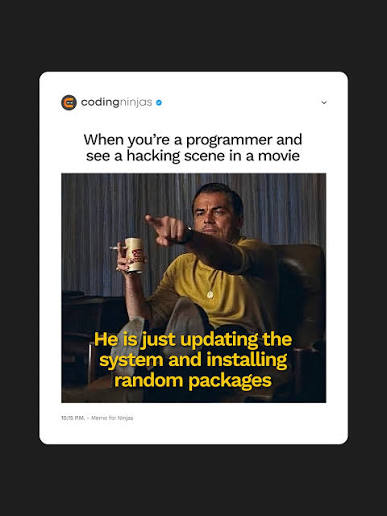
Hollywood really thinks "hacking" means furiously typing random commands while dramatic music plays in the background. Meanwhile, every developer watching is like "bruh, he's literally just running sudo apt-get update and installing packages." The most dangerous cyber attack in cinema history? Apparently it's just updating your Linux system and throwing in some npm installs for good measure. Nothing screams "elite hacker breaking into the Pentagon" quite like watching someone install dependencies for 20 minutes. At least they got the part right where it takes forever and you're just sitting there waiting with a drink in hand.