eslint Memes

Typescript More Like Typeslop

Typescript More Like Typeslop
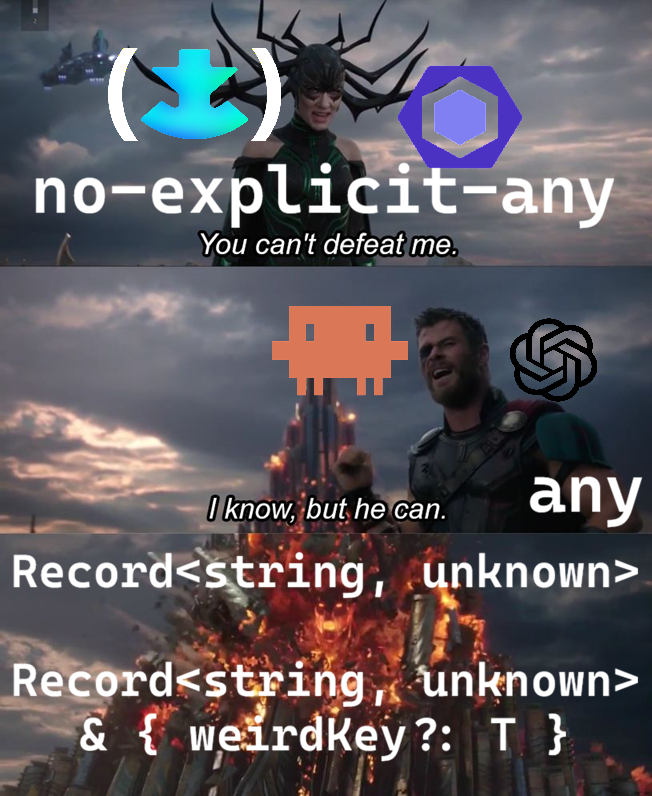
The TypeScript type safety power hierarchy, visualized through Thor's hammer-lifting scene. At the top, we have no-explicit-any looking all confident with its strict ESLint rule – "You can't defeat me" – thinking it's protecting your codebase from type chaos. Then comes the humble any type itself, and yeah, it absolutely can defeat that rule. Just slap any on your variables and watch your type safety evaporate faster than your motivation on a Monday morning. But wait – enter the final boss: Record<string, unknown> with its unholy alliance partner & { weirdKey?: T } . This monstrosity technically bypasses the no-explicit-any rule while achieving the same "I have no idea what's in this object" energy. It's the loophole that makes TypeScript devs simultaneously feel clever and dirty. You're not using any , you're just using a type-safe way to say "literally anything could be here" – which is basically any with extra steps and a superiority complex.

Then Please Provide Linter Config With Common Sense

Then Please Provide Linter Config With Common Sense
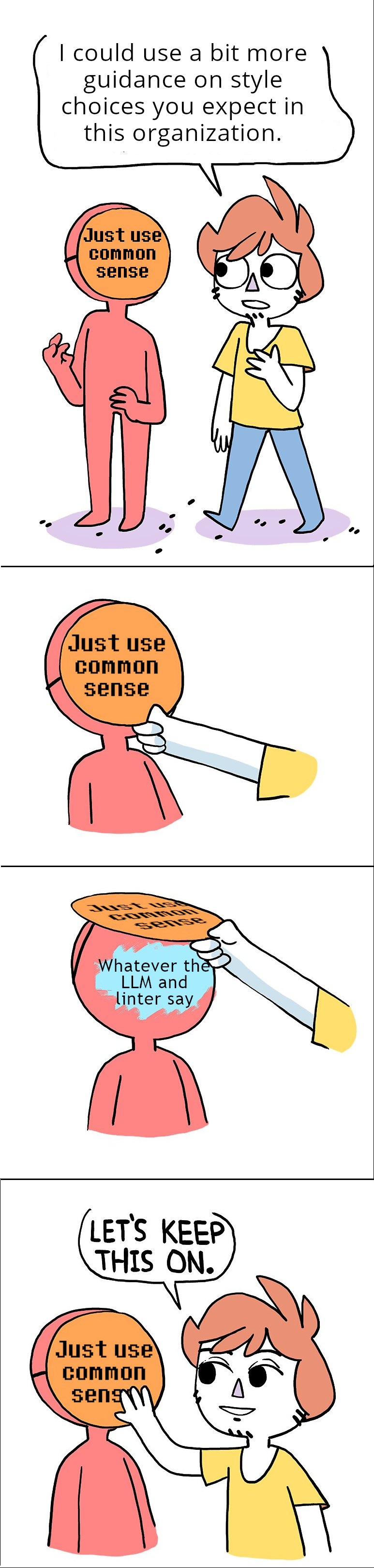
Junior dev asks for style guidance. Senior dev smugly says "just use common sense." Junior dev politely asks for actual linter config. Senior dev proceeds to forcefully inject "common sense" directly into their brain, which apparently translates to "whatever the LLM and linter say." Because nothing screams "common sense" like blindly following ESLint's 47 warnings about semicolons while your production server is literally on fire. The real kicker? Everyone's "common sense" is wildly different. One person's common sense is 2-space indentation, another's is tabs, and a third person's involves sacrificing a rubber duck to the code gods before every commit. Just give them the .eslintrc file, Karen. It takes 30 seconds and saves everyone from the philosophical debate about whether trailing commas are a war crime or a gift from the heavens.

This Shi Cooked Me Gang

This Shi Cooked Me Gang
You start with dreams of shipping the next big thing. Three hours later, you're in a philosophical debate with a linter about semicolons and trailing commas. ESLint doesn't care about your vision—it cares about that missing space before your function parenthesis. The transformation from excited developer to defeated shell of a human being is complete. The code works, but at what cost? Your soul is now property of the config file.

Beauty Is The Standard

Beauty Is The Standard
You know that feeling when you finish writing a feature and your code looks like a crime scene? Variables named temp2 , nested ternaries three levels deep, and comments that just say "fix later"? Then you run your linter and suddenly you're forced to confront your sins. The transformation is real. That messy, functional-but-ugly first draft gets groomed into something presentable with proper indentation, consistent naming conventions, and all those trailing commas in the right places. Your code goes from "it works on my machine" energy to "ready for code review" sophistication faster than you can say ESLint. The bow tie is chef's kiss—that's your code after fixing all 47 linting errors and finally getting that green checkmark in your CI/CD pipeline.

NordVPN

NordVPN
Encrypt your traffic on public Wi-Fi, stream from anywhere, and cover up to ten devices with one plan. 30-day money-back guarantee.

Adding Linter To Legacy Codebase

Adding Linter To Legacy Codebase
So you thought adding ESLint to that 5-year-old codebase would be a good idea? Congratulations, your entire screen is now a sea of red squiggly lines. Every file. Every function. Every variable named "data" or "temp" from 2018. The linter is basically Oprah now: "You get a warning! You get a warning! EVERYBODY GETS A WARNING!" Turns out the previous dev team had some... creative interpretations of code standards. Who needs semicolons anyway? Const? Never heard of her. Unused variables? They're just there for moral support. Now you have two choices: spend the next three months fixing 47,000 linting errors, or add that sweet // eslint-disable at the top and pretend this never happened. We both know which one you're picking.

Eslint After One Line Of Code

Eslint After One Line Of Code
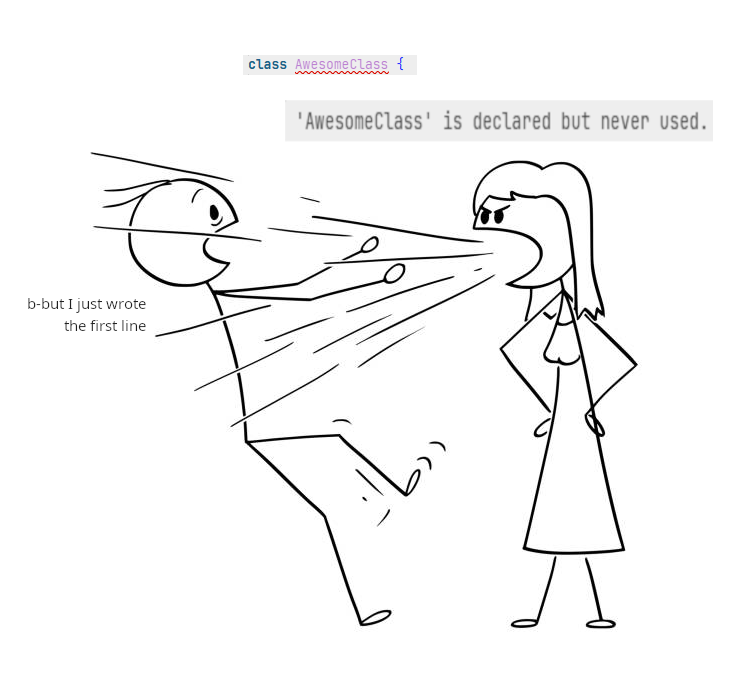
You literally just declared a class. You haven't even written a constructor yet. But ESLint is already throwing hands like you committed a war crime against code quality. The audacity to complain about unused variables when the ink isn't even dry on your first line is peak linter energy. It's like having a backseat driver who starts screaming before you've even left the driveway. Yes, ESLint, I know it's unused—I just created it 0.2 seconds ago. Let me breathe. Let me live. Let me at least finish my thought before you judge my entire architectural decision. The best part? You're probably going to use it in the next line, but ESLint doesn't care about your future plans. It lives in the eternal now, where every unused declaration is a personal attack on its existence.

Linting Errors

Linting Errors
You know that sweet, sweet moment when your build finally passes and you're feeling like a coding god? Then you notice the only thing standing between you and victory was... unused imports. Not logic errors, not race conditions, not some cursed memory leak—just variables you imported and forgot about like old gym memberships. The relief is real but also slightly embarrassing. It's like preparing for a boss fight and realizing you were just battling your own shoelaces. Your linter is out here doing the Lord's work, keeping your codebase clean while you're over here importing half of npm for a single function.

Coding With Eslint

Coding With Eslint
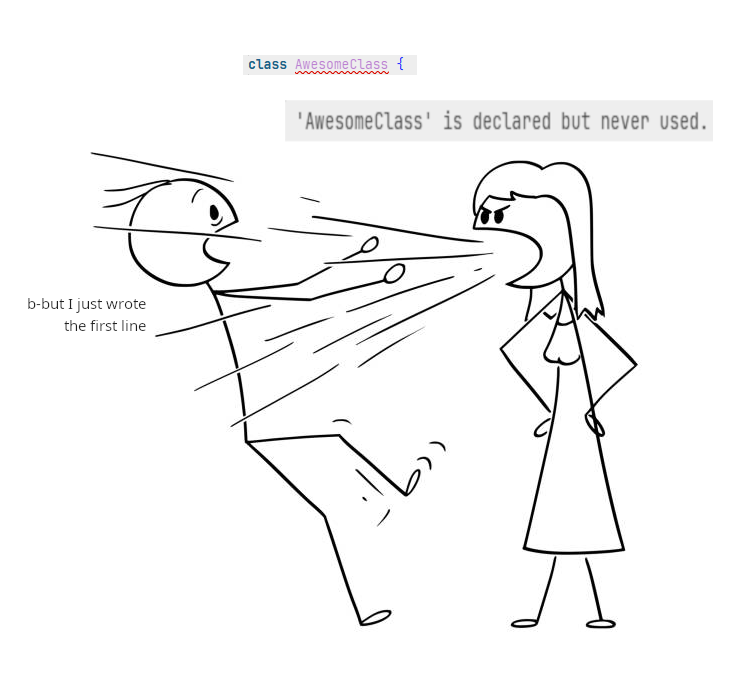
You declare one class for the first time in your life, feeling proud of yourself, and ESLint immediately comes at you with the fury of a thousand linters. "Declared but never used" it screams, as if you weren't planning to use it in literally the next line. But no, ESLint has already judged you, found you wanting, and sentenced you to squiggly red underlines. It's like having a backseat driver who starts yelling before you even put the car in drive.

If It Runs It Runs

If It Runs It Runs
When your IDE is screaming at you with 47 warnings, your linter is having a mental breakdown, and ESLint is threatening to quit, but the code compiles and runs perfectly fine. You just close all those warning tabs and move on with your life like the apex predator you are. Deprecated functions? Unused variables? Potential memory leaks? That's future-you's problem. Right now, the client wants features, not clean code. The lion doesn't lose sleep over the opinions of sheep, and you don't lose sleep over the opinions of static analysis tools. Sure, your code might be held together with duct tape and prayers, but if it passes the ultimate test—actually working—then who cares? Warnings are just suggestions anyway, right? Right?

Configuration Hell: Modern JavaScript Edition

Configuration Hell: Modern JavaScript Edition
The modern JavaScript project directory, where config files multiply faster than rabbits. What started as a simple idea now requires 20+ config files just to tell your computer how to run "hello world". The character on the left represents the old-school developer shocked at seeing a modern TypeScript project with its ecosystem of linters, type checkers, and build tools. Meanwhile, the character on the right is just trying to survive in a world where your package.json needs its own support group.

Everytime When I Use ESLint

Everytime When I Use ESLint
That magical moment when you run ESLint hoping to fix your code, only to discover it's playing multiplayer instead of single-player mode. You start with 10 errors, hit that glorious "Fix All" button with the confidence of someone who's never been betrayed by technology, and suddenly you're the proud owner of 20 errors. It's like watching your technical debt compound interest in real-time. Six years of professional development experience and I still fall for this every damn time. The only thing more reliable than ESLint breaking your code is your PM asking "how hard could it be to add this small feature?"

SAMSUNG T7 Portable SSD, 1TB External Solid State Drive, Speeds Up to 1,050MB/s, USB 3.2 Gen 2, Reliable Storage for Gaming, Students, Professionals, MU-PC1T0H/AM, Blue

SAMSUNG T7 Portable SSD, 1TB External Solid State Drive, Speeds Up to 1,050MB/s, USB 3.2 Gen 2, Reliable Storage for Gaming, Students, Professionals, MU-PC1T0H/AM, Blue
MADE FOR THE MAKERS: Create; Explore; Store; The T7 Portable SSD delivers fast speeds and durable features to back up any endeavor; Build your video editing empire, file your photographs or back up y…

The Art Of "Fixing" Lint Errors

The Art Of "Fixing" Lint Errors
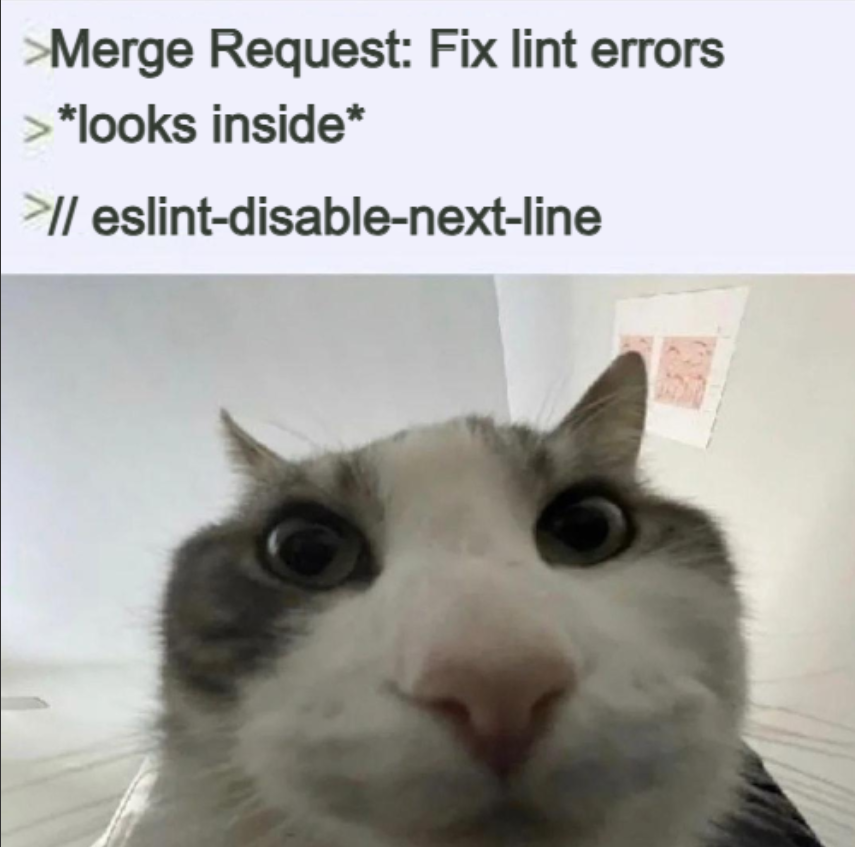
The eternal shortcut of the desperate developer. You're asked to fix lint errors in a merge request, but instead of actually fixing the underlying code issues, you just slap an eslint-disable-next-line comment and call it a day. It's like putting a piece of tape over your check engine light and considering the car "fixed." Sure, the PR will pass now, but we all know what you did... and we've all done it too when deadlines loom. Technical debt? That's a problem for future you!