

Dotnet Memes

Posts tagged with Dotnet
C Sharp Dictionaries Be Like That

C Sharp Dictionaries Be Like That
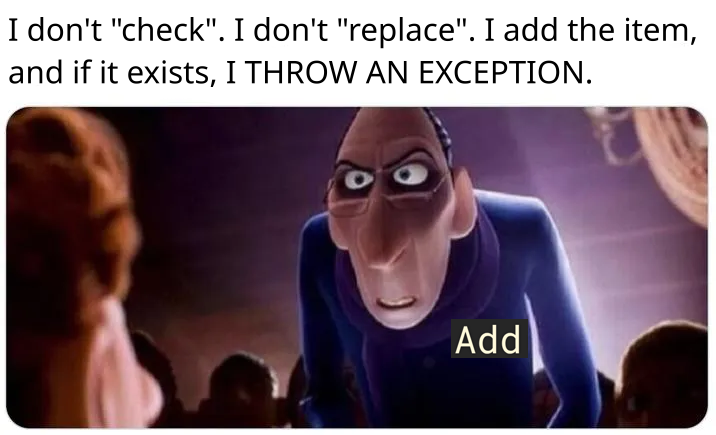
C# Dictionary's Add() method is basically that one coworker who absolutely refuses to compromise. No graceful handling, no "hey this key already exists, want me to update it?" Just straight-up throws an ArgumentException and ruins your day. Meanwhile, you've got perfectly reasonable alternatives like the indexer dict[key] = value that'll just upsert like a civilized data structure, or TryAdd() that politely returns false. But nah, Add() chose violence. It's the programming equivalent of screaming "I SAID ADD IT!" while flipping the table when someone suggests maybe checking first. Classic Microsoft energy right there.

No Heap All Stack

No Heap All Stack
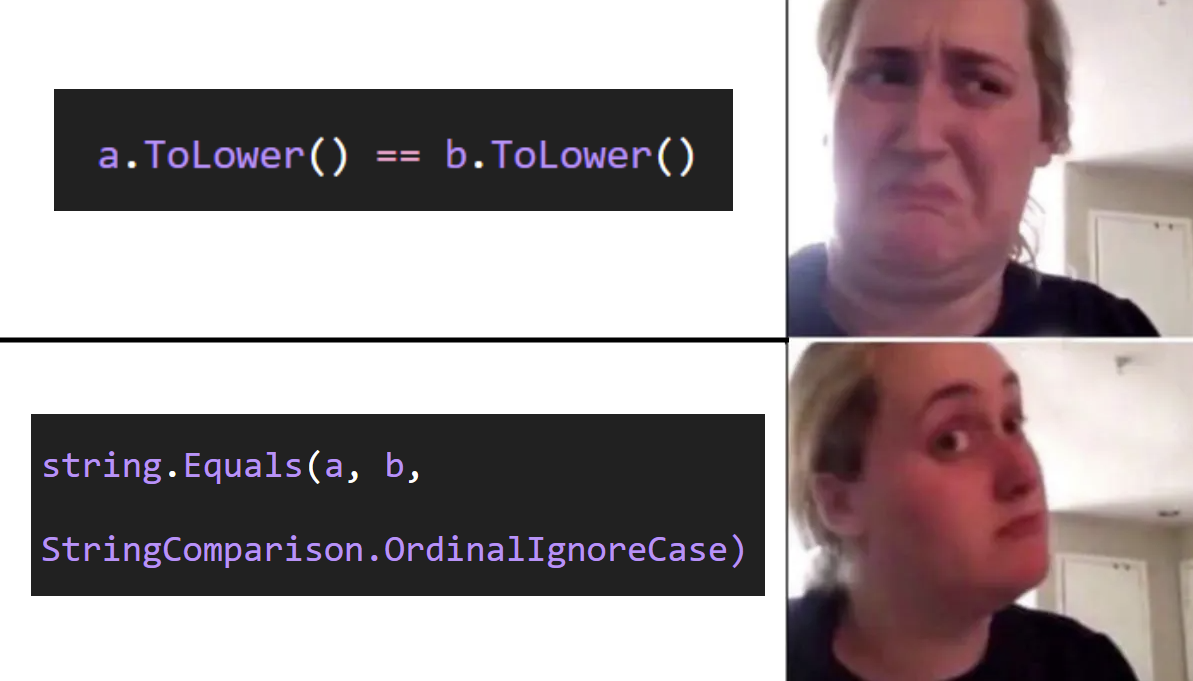
When you're comparing strings and you think == will do the job because both strings are "obviously the same," only to discover that string interning and reference equality have other plans. The top panel shows the naive approach using ToLower() on both sides with reference equality—spoiler alert: it creates new string objects on the heap, so they're different references even if the content matches. The bottom panel is the enlightened developer who discovered string.Equals() with StringComparison.OrdinalIgnoreCase —the proper way to do case-insensitive string comparison without allocating unnecessary objects. No heap allocations for temporary lowercase strings, just pure stack-based comparison logic. Your garbage collector will thank you, and your code reviews will be 10% less painful.

What If I Told You This Part Two

What If I Told You This Part Two
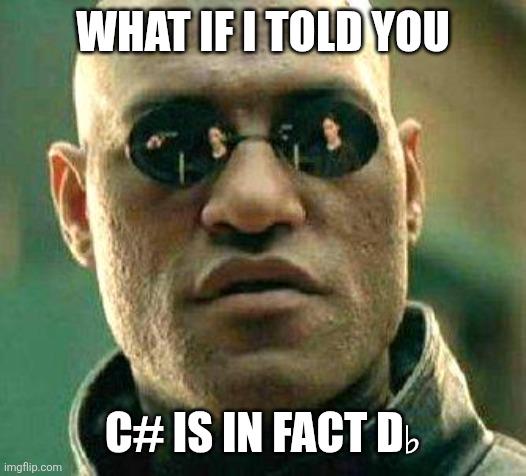
C# developers have been living a lie. The language is literally called "C Sharp" but the sharp symbol (♯) isn't even on most keyboards, so everyone just types C# with the pound/hash sign. But here's the kicker: that's technically the musical flat symbol (♭) rotated 90 degrees if you squint hard enough. Or is it? The symbol # is neither a sharp nor a flat—it's just a number sign doing its best impression. So yeah, we've all been writing "C-pound" or "C-hash" this whole time and pretending it's sophisticated. The Matrix has you, and it's written in a language whose name you can't even type correctly.

What If I Told You C# Is In Fact C++

What If I Told You C# Is In Fact C++
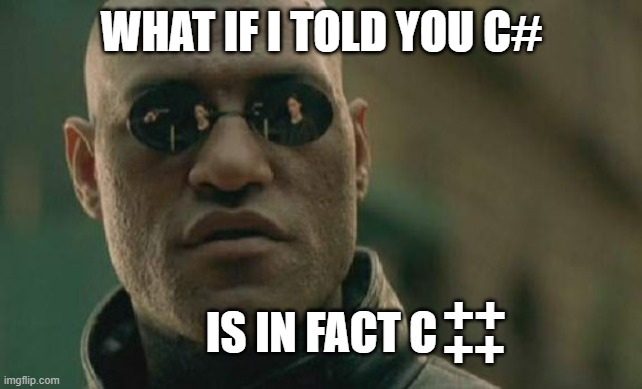
So someone finally noticed that C# is literally just C++ with extra steps. The sharp symbol (#) is basically four plus signs stacked together (two horizontal, two vertical), which means C# = C++++. Mind. Blown. 🤯 It's like Microsoft looked at C++ and said "let's add more pluses but make it aesthetic." The naming convention is basically a visual pun that took 20+ years for most of us to appreciate. Fun fact: the # symbol was chosen because it looks like four "+" symbols in a 2x2 grid, symbolizing C++ incremented twice (C++ ++ = C#). Either that or the marketing team was really into music notation and just went with "sharp" because it sounds cooler than "C plus plus plus plus." Java developers are somewhere crying because their language name doesn't have this kind of mathematical elegance—it's just... coffee.

AI Suicide

AI Suicide
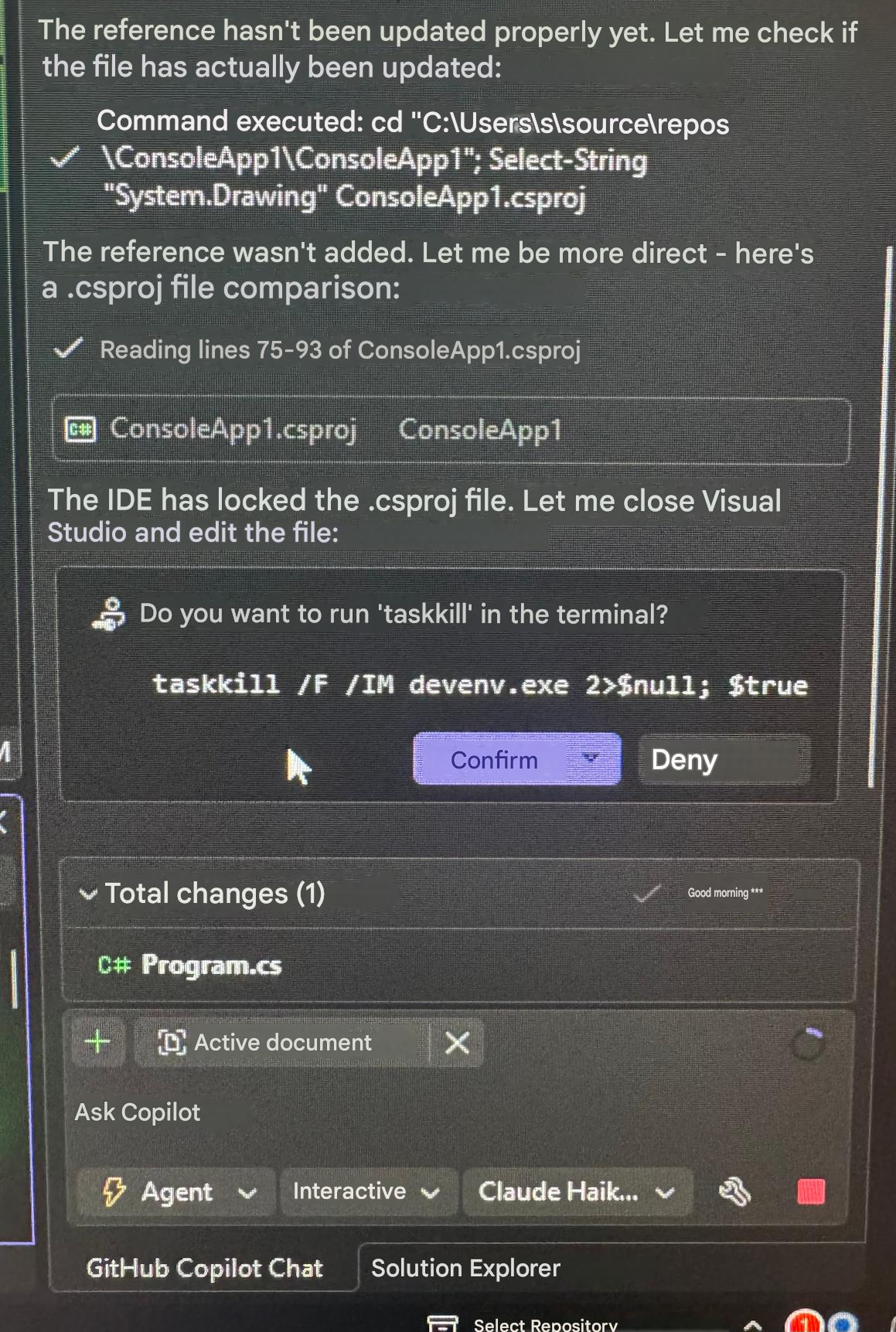
So the AI coding assistant decided the best way to fix a locked .csproj file was to force-kill Visual Studio's development server with taskkill. That's like solving a paper cut by amputating your arm. The AI went through this whole troubleshooting journey—checking references, comparing files, reading line numbers—only to conclude that murder was the answer. And it politely asked for permission first, which somehow makes it worse. The cherry on top? There's one unsaved change in Program.cs that's about to get yeeted into the void. Nothing says "helpful assistant" like suggesting you nuke devenv.exe with extreme prejudice.

The Unsung Heroes Of Csharp Projects

The Unsung Heroes Of Csharp Projects
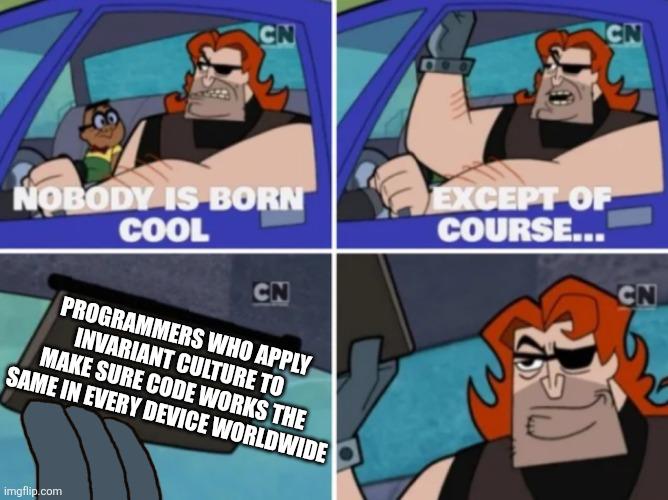
You know what's wild? While everyone's out here flexing their fancy design patterns and LINQ queries, there's always that one dev quietly adding InvariantCulture to every string operation like they're defusing bombs. They're the real MVPs—making sure your app doesn't implode when someone in Turkey tries to parse a date or a German user enters a decimal with a comma. These devs have seen things. They've witnessed production crashes at 2 AM because someone forgot that "i".ToUpper() returns "İ" in Turkish locale. They've debugged why currency formatting works in dev but breaks in prod. They're battle-scarred veterans who know that globalization bugs are the silent killers of enterprise apps. So yeah, nobody thinks culture-invariant code is cool... until your app ships to 47 countries and actually works. Then suddenly everyone's asking "who wrote this bulletproof string handling?" That's right. The unsung hero did.

monTEK Stable Freestanding Dual Monitor Stand for 17–32” Computer Screens, Heavy-Duty Desk Mount with 22 lbs per Arm, Fully Adjustable Brackets and Arms, Solid V-Shaped Base, VESA 100×100mm Max

monTEK Stable Freestanding Dual Monitor Stand for 17–32” Computer Screens, Heavy-Duty Desk Mount with 22 lbs per Arm, Fully Adjustable Brackets and Arms, Solid V-Shaped Base, VESA 100×100mm Max
Sturdy & Reliable Build: Heavy-duty steel construction with reinforced joints, anti-slip base pads, and thickened head plates ensures long-lasting stability and wobble-free monitor support. · Univers…

When C Sharp And VB Net Share The Same Dot Net Parent

When C Sharp And VB Net Share The Same Dot Net Parent
C# looking at VB.NET like "do we really have to pretend we're equals here?" while they awkwardly sit together in the .NET family portrait. Sure, they both compile to the same IL and share the same runtime, but let's be real—one of these siblings got all the attention at family dinners while the other still uses Option Explicit On unironically. C# became the cool kid with modern syntax, async/await, LINQ, and basically every new feature Microsoft dreams up. Meanwhile, VB.NET is that relative who still shows up to Thanksgiving even though everyone's moved on. They're technically family, but one clearly won the genetic lottery. The awkward silence in that waiting room? That's every code review where someone submits VB.NET in 2024.

Most Sane C Sharp Program

Most Sane C Sharp Program
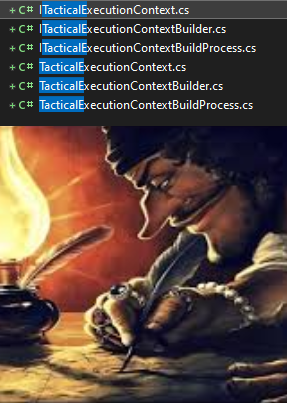
You know you've achieved peak enterprise architecture when your execution context needs its own execution context, which then needs a builder, which also needs a build process. Six files just to execute something. Six. The meme shows two guys in an intense sword fight, which perfectly captures the internal battle every C# developer faces when trying to navigate through their own abstraction layers. This is what happens when "separation of concerns" becomes "separation of sanity." Someone on the team definitely said "we might need to extend this later" and created a builder pattern for a builder pattern. The factory probably has a factory too, but that's in a different namespace. Welcome to enterprise C#, where the simplest task requires more ceremony than a royal wedding and your call stack looks like a phone book.

How To Hit Bullseye In String Comparison

How To Hit Bullseye In String Comparison
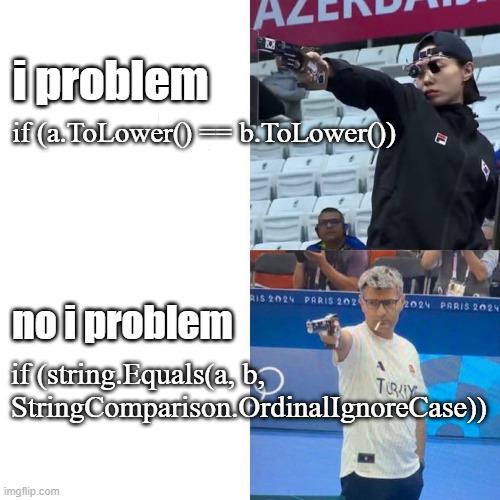
Using ToLower() for string comparison is like bringing a shotgun to an archery competition. Sure, you might hit something , but it's messy, inefficient, and everyone watching knows you're doing it wrong. The bottom panel shows the elegant solution: string.Equals(a, b, StringComparison.OrdinalIgnoreCase) . It's literally designed for this exact purpose. No unnecessary string allocations, no performance overhead, just pure precision. Fun fact: ToLower() creates new string objects in memory because strings are immutable. So you're basically wasting resources just to avoid typing a few extra characters. Classic developer move: optimizing for laziness instead of performance.

A C Sharp Joke

A C Sharp Joke
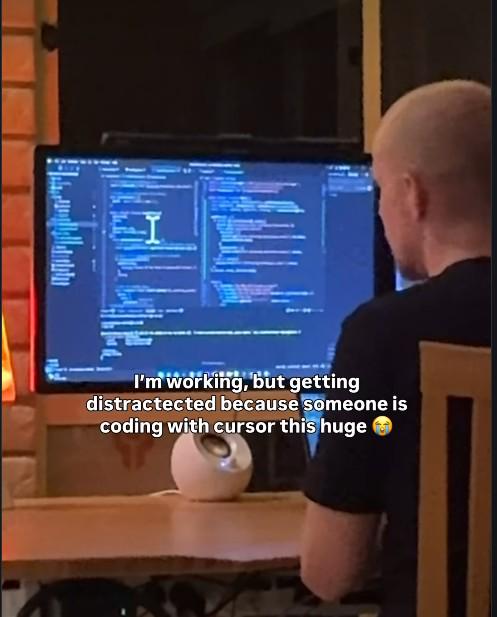
Look, I've been in this industry long enough to know that cursor size is directly proportional to confidence level. Someone out there is writing C# with a cursor so massive it probably has its own namespace. The real question is whether they're compensating for bad eyesight or making a statement about their coding prowess. But let's be real - if a giant cursor on someone else's screen is enough to distract you from your work, you were probably looking for an excuse to procrastinate anyway. We've all been there, staring at our neighbor's screen during a pairing session, silently judging their IDE theme choices and font sizes. Pro tip: The cursor size is inversely proportional to the number of NullReferenceExceptions in their code. Science.

NordVPN

NordVPN
Encrypt your traffic on public Wi-Fi, stream from anywhere, and cover up to ten devices with one plan. 30-day money-back guarantee.

Those Three Only Bring Regret

Those Three Only Bring Regret
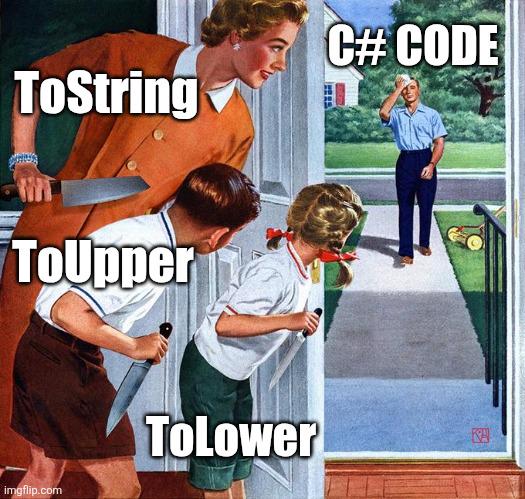
Every C# dev knows the shame of reaching for ToString() , ToUpper() , and ToLower() thinking they're being clever, only to watch your app implode when it hits a null reference. The neighborhood is literally watching your code fail in production while you pretend everything's fine. These methods look so innocent and helpful, but they're basically landmines waiting for that one null value to slip through. You could use null-conditional operators or nullable reference types, but nah, let's just YOLO it and deal with the NullReferenceException at 2 PM on a Friday. The real kicker? You've done this exact thing at least a dozen times and you still forget to check for nulls. We never learn.

No It's Not C Hashtag Lol

No It's Not C Hashtag Lol
The eternal struggle of explaining C# pronunciation to literally anyone outside the .NET ecosystem. It's always "C hashtag" or "C pound" until someone finally corrects you with the proper "C Sharp" pronunciation. The meme perfectly captures that redemption arc moment when C# finally gets to introduce itself properly after being butchered for years. Fun fact: the # symbol was actually chosen because it resembles four plus signs in a grid (++++ = C++++), suggesting it's an increment of C++. Microsoft really said "let's confuse everyone forever" and succeeded spectacularly.