Boolean Memes

Posts tagged with Boolean
Toilet Paper Issues

Toilet Paper Issues
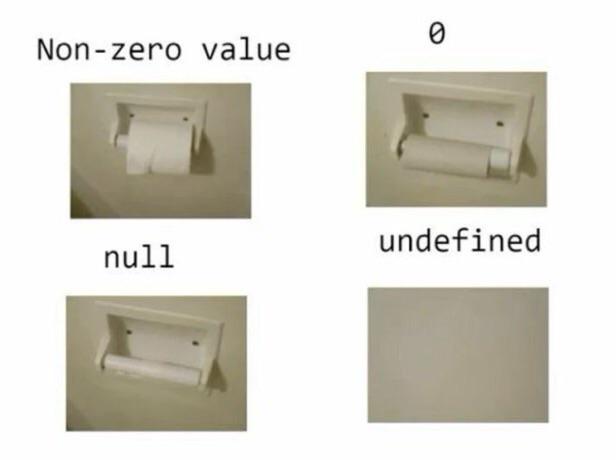
Your toilet paper situation mapped to programming logic—because nothing says "existential crisis" quite like checking if something exists before using it. Non-zero value: There's actually paper on the roll. You're living the dream. 0: Empty roll still mounted. The classic "technically present but utterly useless" scenario—like having a variable initialized but with no meaningful data. null: Empty roll removed, holder exposed. At least someone acknowledged the problem existed and cleared it out. Respectful. undefined: The holder itself has vanished into the void. Did it ever exist? Who knows. This is what happens when you forget to declare your bathroom fixtures. The hierarchy of desperation, perfectly visualized through bathroom architecture and type coercion.

Everything Is A String

Everything Is A String
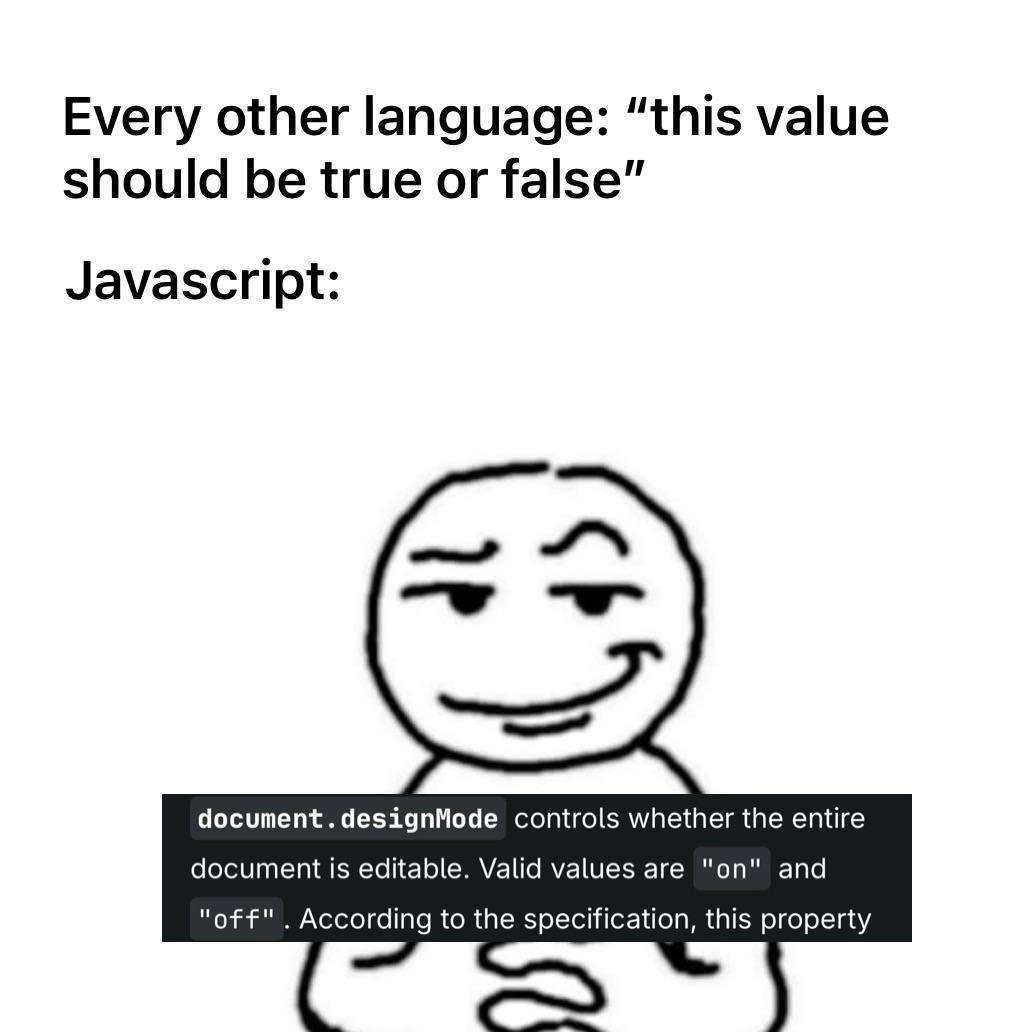
JavaScript really said "booleans? never heard of her" and decided that "on" and "off" are perfectly valid boolean values. Because why use true or false like a normal language when you can just... use strings? The document.designMode property is the perfect example of JS's commitment to making type safety engineers cry themselves to sleep. Other languages have strict typing and sensible boolean values. JavaScript has vibes and string literals pretending to be booleans. This is fine.

Big If True

Big If True
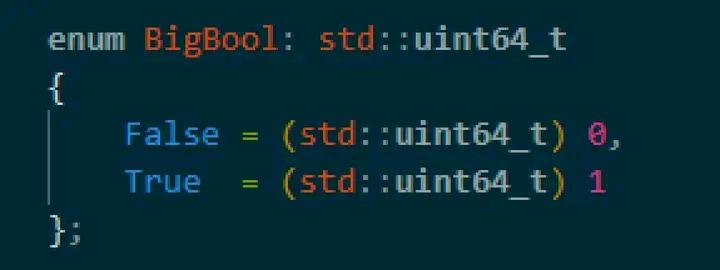
Someone really looked at a boolean and thought "you know what this needs? 64 bits of storage." False gets a whole 0, True gets a modest 1, and the remaining 18,446,744,073,709,551,614 possible values? Just vibing in the void, unused and unloved. The title "Big If True" is chef's kiss because it's both a play on the phrase AND literally describing what's happening here. You're using an unsigned 64-bit integer to store a single bit of information. That's like renting a stadium to store a single chair. The memory efficiency here is making embedded systems developers weep into their 8-bit microcontrollers. Fun fact: Most modern languages use a full byte (8 bits) for booleans anyway because of memory alignment, but going full uint64_t is just flexing at this point. It's the programming equivalent of arriving to a knife fight in a tank.

Megabool

Megabool
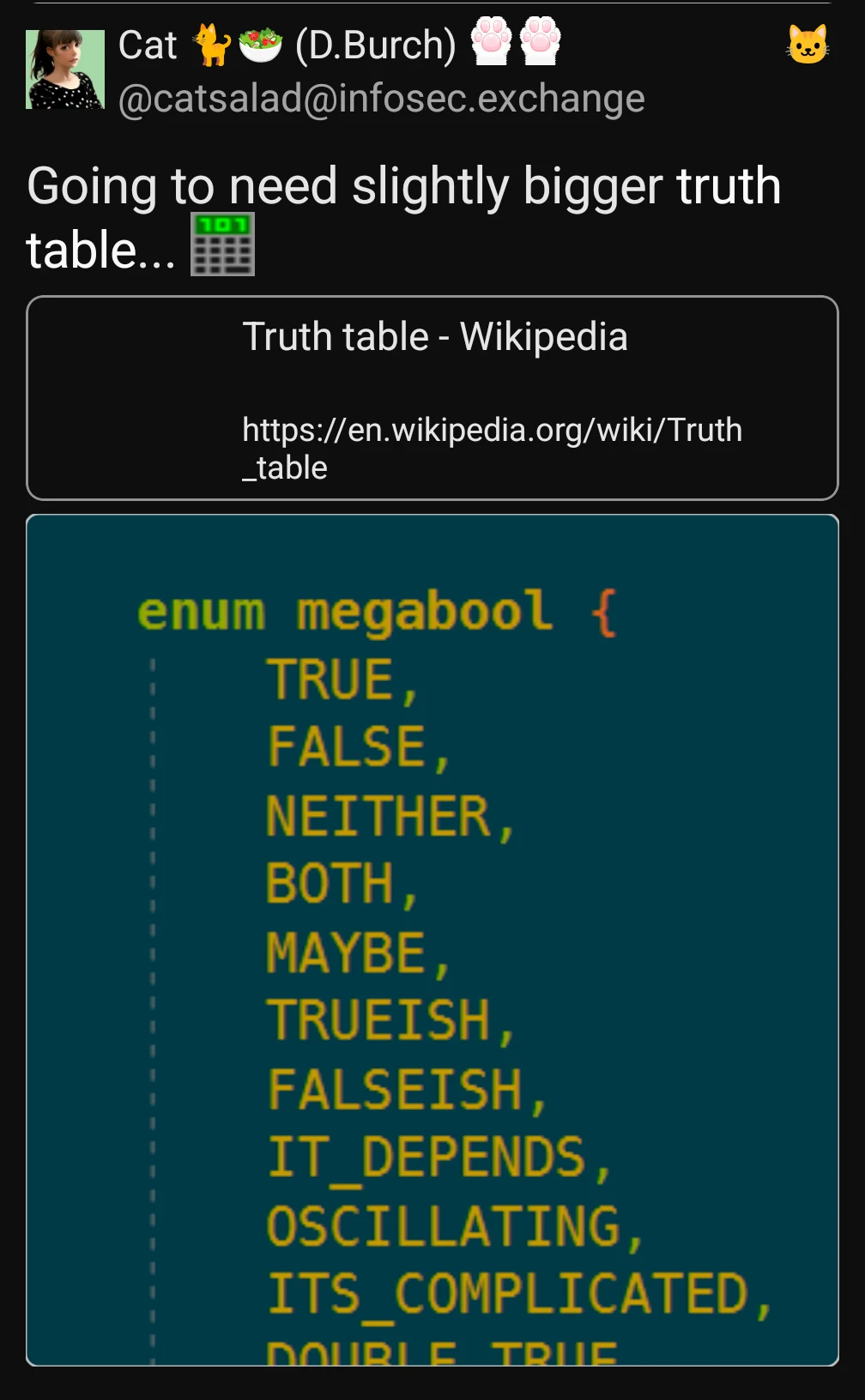
Someone really looked at the classic boolean with its two measly options and said "you know what? This is LIMITING my artistic expression." So they created the Megabool enum with TRUE, FALSE, NEITHER, BOTH, MAYBE, TRUEISH, FALSEISH, IT_DEPENDS, OSCILLATING, ITS_COMPLICATED, and presumably DOUBLE_TRUE just out of frame. Because why settle for binary when you can have the entire emotional spectrum of a relationship status on Facebook? This is what happens when you let JavaScript developers design type systems. Schrödinger's cat would be THRILLED to finally have a data type that accurately represents its vibe.

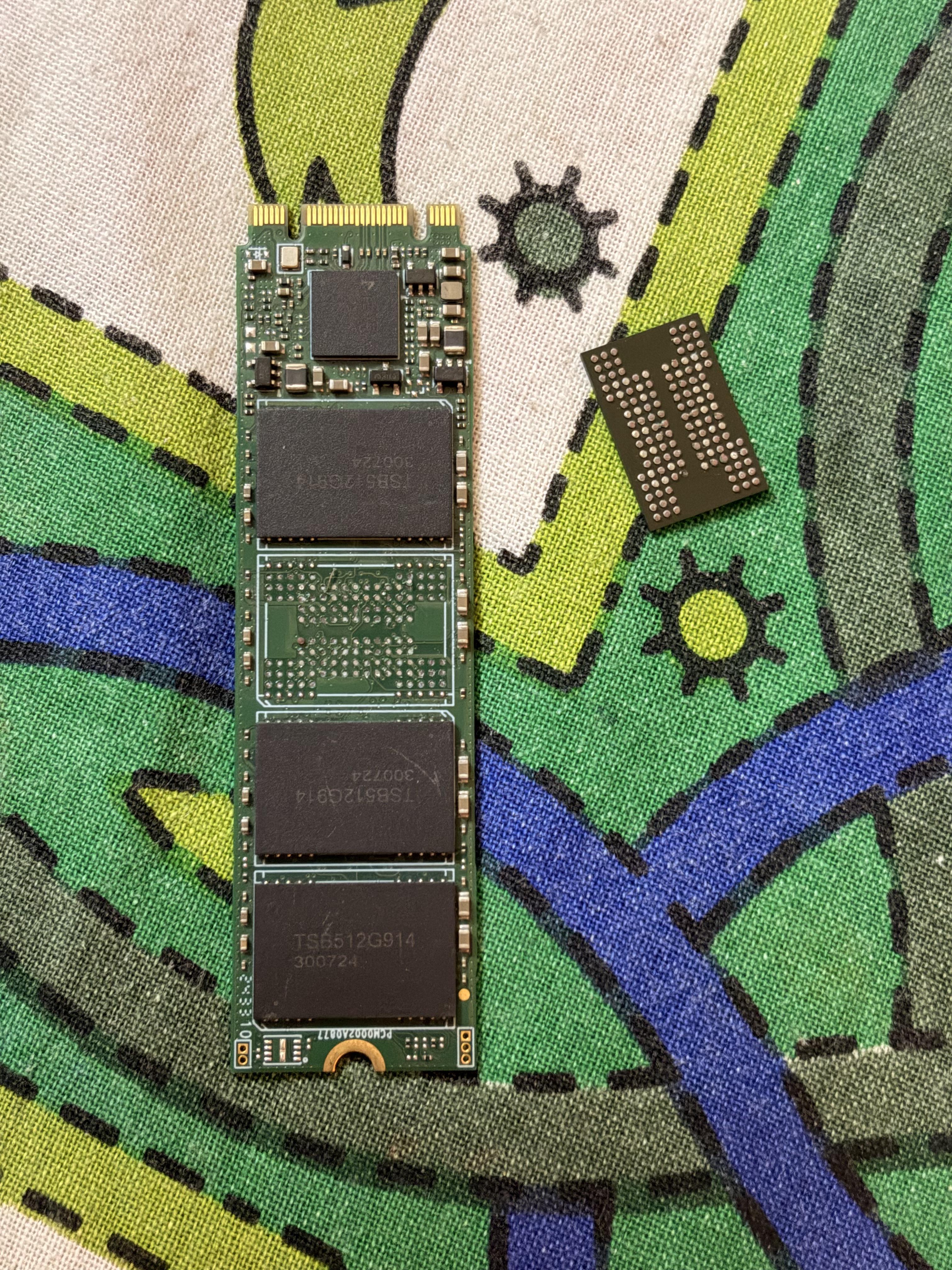
SSK M.2 NVME SATA SSD Enclosure, Improved RTL9210B Chip USB 3.2 Gen 2 10Gbps to PCI-E NGFF Adapter, M-Key/B+M Key External SSD Enclosure Aluminum Support UASP Trim 2242/2260/2280

SSK M.2 NVME SATA SSD Enclosure, Improved RTL9210B Chip USB 3.2 Gen 2 10Gbps to PCI-E NGFF Adapter, M-Key/B+M Key External SSD Enclosure Aluminum Support UASP Trim 2242/2260/2280
Applicable SSD: This M.2 SSD Enclosure is for NVMe PCIE & SATA M-Key / B+M connectors M.2 SSD. Applicable to sizes 2242 / 2260 / 2280 solid state drivers. This SATA/ NVMe Enclosure does not support M…

Boolean Variable Naming Crisis

Boolean Variable Naming Crisis
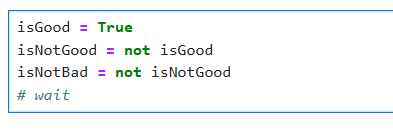
When you start with isGood = True , everything seems fine. Then you need the opposite, so naturally you go with isNotGood = not isGood . But wait, you need another layer of negation, so you create isNotBad = not isNotGood . At this point, you're basically playing semantic Jenga with your brain. The # wait comment is the chef's kiss here. That's the exact moment where you pause, stare at your screen, and question every life choice that led you to this triple-negative nightmare. Is something that's not bad actually good? Is not not good just bad? Who even knows anymore. Time to refactor... or just add another comment and call it a day.

The World If SQLite Supported Booleans

The World If SQLite Supported Booleans
SQLite's approach to data types is... let's call it "flexible." While most databases have proper boolean types, SQLite just shrugs and goes "eh, store it as an integer: 0 or 1." Want a true/false? Too bad, you're getting 0/1. Want to be fancy and store "true" as text? Sure, why not. SQLite doesn't judge. The joke here is that if SQLite actually had native boolean support like a civilized database, we'd apparently be living in a futuristic utopia with flying cars and chrome buildings. Because nothing says "technological advancement" quite like proper data type implementation. Developers have been working around this quirk for decades, writing helper functions and ORMs that pretend booleans exist. It's like SQLite is that one friend who refuses to get a smartphone in 2024 and everyone just... deals with it.

Cool Format

Cool Format
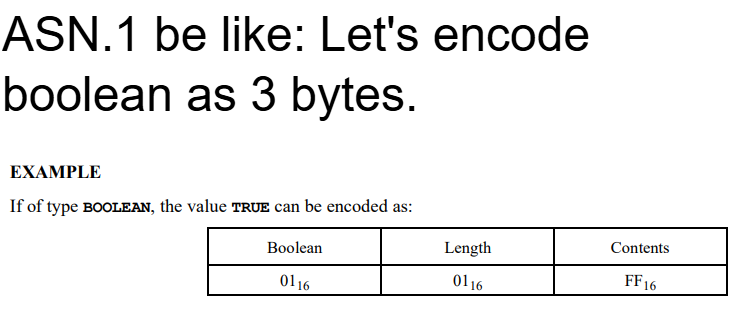
ASN.1 (Abstract Syntax Notation One) is that ancient data serialization format that nobody asked for but everyone in telecom and cryptography has to deal with. It's basically the granddad of JSON, except it makes encoding a simple boolean value feel like you're performing cryptographic surgery. So you want to encode TRUE? Cool, that'll be 3 bytes please: one byte for the type (01₁₆ = Boolean), one byte for the length (01₁₆ = 1 byte of data), and finally one byte for the actual value (FF₁₆). That's right, a single bit of information now costs you 24 bits. It's like paying $3 in transaction fees to send $1. Meanwhile, JSON just goes true and calls it a day. But hey, at least ASN.1 is "efficient" and "well-structured" according to the 1984 standards committee that designed it.

Boolean Things

Boolean Things
When someone complains about getting 1's and 0's and the response is "that's boolshit" – it's the kind of pun that makes you groan and laugh simultaneously. The wordplay here is *chef's kiss* – combining "boolean" (the data type that literally stores true/false as 1's and 0's) with a certain four-letter word to create the perfect programming dad joke. The beauty is in the double meaning: they're literally talking about boolean values (which are represented as 1 and 0 in binary), but the pun suggests it's nonsense. It's like the programming equivalent of "sounds fishy" but for data types. Every developer has stared at binary output or boolean logic at 3 AM wondering if it's all just... well, boolshit.

Find Your Place

Find Your Place
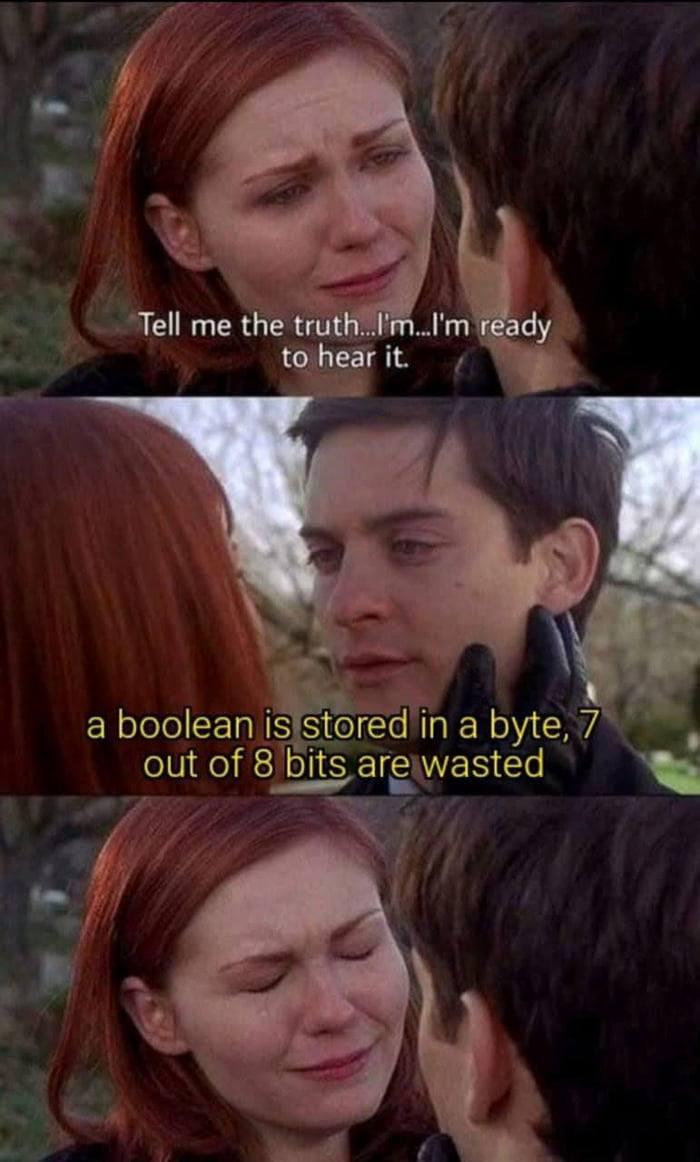
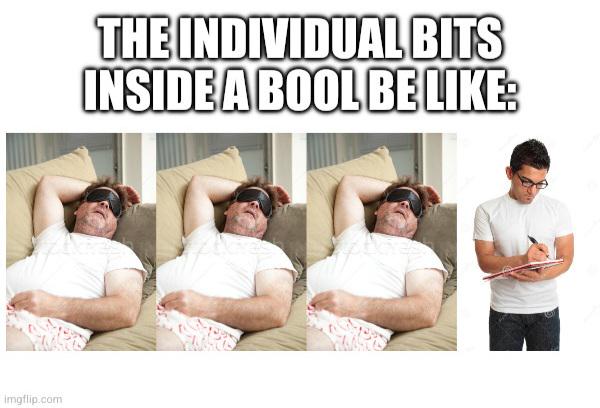
The hard truth that keeps memory-conscious developers up at night. A boolean only needs 1 bit to represent true or false, but because most systems can't address individual bits, it gets allocated a whole byte. That's 87.5% storage efficiency loss, which is basically the computing equivalent of buying a mansion to store a single shoe. Some languages try to optimize this with bit fields or packed structures, but let's be real—most of the time we're just casually wasting 7 bits per boolean like we're made of RAM. Which, to be fair, we kind of are these days. Storage is cheap, existential dread about inefficiency is free. The real tragedy? Those 7 bits could've been living their best life storing actual data, but instead they're just... there. Unemployed. Collecting dust. A monument to the gap between theoretical computer science and practical implementation.

Tell Me The Truth

Tell Me The Truth
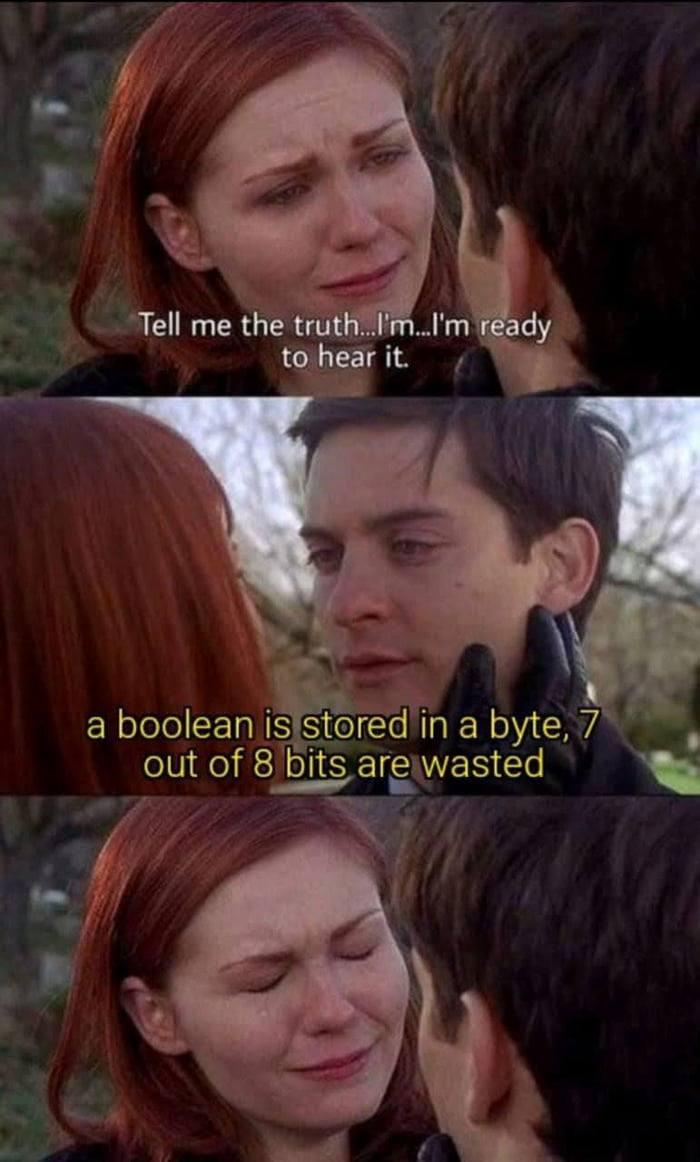
The harsh reality that keeps systems engineers up at night: we're using an entire byte (8 bits) to store a boolean value that only needs 1 bit. That's an 87.5% waste of memory. It's like buying an 8-bedroom mansion just to store a single shoe. But here's the thing—computers can't efficiently address individual bits. Memory is byte-addressable, so we're stuck with this inefficiency unless you want to manually pack bits together like some kind of medieval bit-packing peasant. Sure, you could optimize it with bitfields or bit arrays, but at what cost? Your sanity? Readability? The ability to debug without wanting to throw your laptop out the window? So we accept this beautiful waste in exchange for simplicity and speed. Sometimes the truth hurts more than a segmentation fault.

Just A Simple Boolean Question

Just A Simple Boolean Question
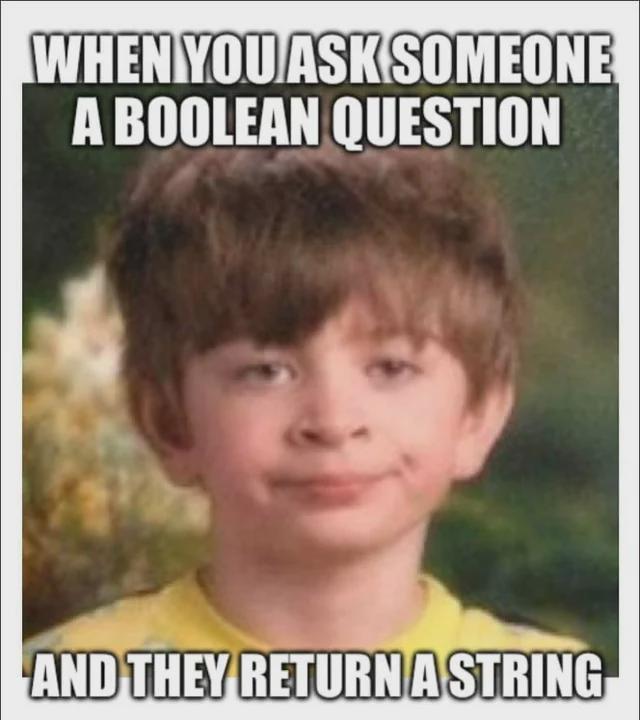
You ask for a simple true or false , and suddenly you're parsing "Yes", "yeah", "Y", "true", "1", "ok", or my personal favorite: "success". The contract was clear—return a boolean. Instead, you get back a string that requires a whole new layer of validation logic. Now you're sitting there writing if (response.toLowerCase() === "true" || response === "1") like some kind of type-system archaeologist. Strong typing exists for a reason, people! The smugness on that kid's face? That's the exact energy of someone who just returned "False" with a capital F from an API endpoint.

NordVPN

NordVPN
Encrypt your traffic on public Wi-Fi, stream from anywhere, and cover up to ten devices with one plan. 30-day money-back guarantee.

Weather App Went Low Level

Weather App Went Low Level
When climate change gets so catastrophic that your weather app just gives up on human-readable formats and starts outputting raw binary. "Screw it, you figure it out," says the API. The temperature readings are literally 1° and 0° alternating like some kind of Boolean fever dream. It's not Celsius, it's not Fahrenheit—it's straight-up true and false weather. Your weather app just downgraded from a high-level API to assembly language because apparently the climate situation is now so dire it needs to be expressed in the most fundamental data type possible. Next update: weather forecasts delivered in machine code. "Partly cloudy" will be 0x4A3F2B .