 AI
AI
 AWS
AWS
 Agile
Agile
 Algorithms
 Android
 Apple
Apple
 Azure
Azure
 Backend
 Bash
Bash
 C++
C++
 Cloud
Cloud
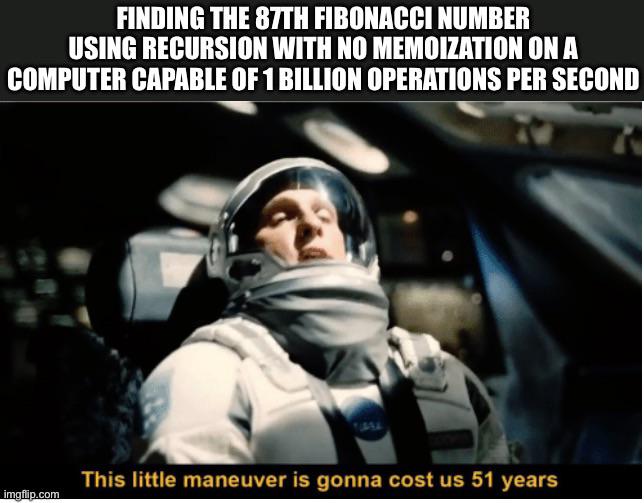
Calculating the 87th Fibonacci number with naive recursion? Buckle up, because your CPU is about to experience the heat death of the universe in real-time.
The joke here is that recursive Fibonacci without memoization has O(2^n) time complexity—meaning each call spawns two more calls, which spawn two more each, creating an exponential explosion of redundant calculations. For fib(87), you're looking at roughly 2^87 operations, which is about 154 quintillion function calls. Even on a supercomputer doing 1 billion ops/second, that's... yeah, 51 years sounds about right.
Meanwhile, a simple iterative solution or dynamic programming approach would solve it in under a microsecond. It's the textbook example of why Big O notation matters and why your CS professor kept screaming about memoization during that algorithms lecture you slept through.
Fun fact: The 87th Fibonacci number is 679,891,637,638,612,258,246,517,205,275,170,766,368. Your recursive function will calculate fib(2) approximately 43 billion times to get there. Efficiency? Never heard of her.