

recursion Memes

How Virtual Machine Works

How Virtual Machine Works
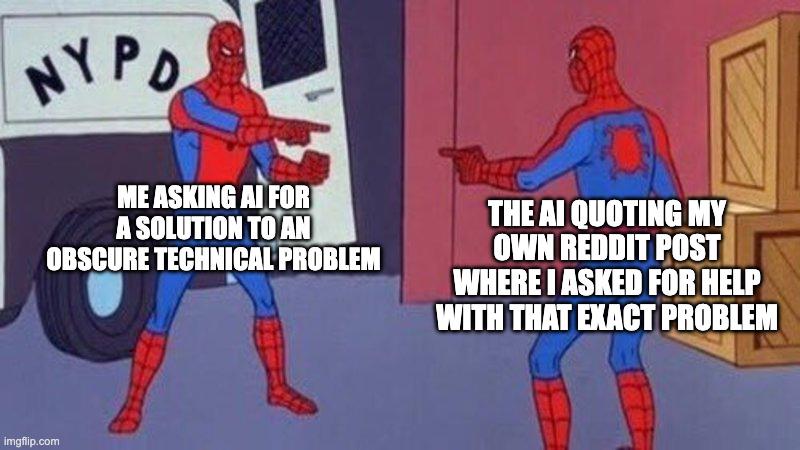
So you thought virtualization was complicated? It's literally just a van inside a van inside a truck. Simple recursion, baby. The DevOps team explaining their infrastructure setup be like: "Yeah, we run Docker containers in a VM, which runs on a hypervisor, which runs on bare metal... somewhere in AWS." Meanwhile your production server is just Russian nesting dolls with extra steps and a monthly cloud bill that makes your CFO cry.

Don't Do Recursive Fib Kids

Don't Do Recursive Fib Kids
Calculating the 87th Fibonacci number with naive recursion? Buckle up, because your CPU is about to experience the heat death of the universe in real-time. The joke here is that recursive Fibonacci without memoization has O(2^n) time complexity—meaning each call spawns two more calls, which spawn two more each, creating an exponential explosion of redundant calculations. For fib(87), you're looking at roughly 2^87 operations, which is about 154 quintillion function calls. Even on a supercomputer doing 1 billion ops/second, that's... yeah, 51 years sounds about right. Meanwhile, a simple iterative solution or dynamic programming approach would solve it in under a microsecond. It's the textbook example of why Big O notation matters and why your CS professor kept screaming about memoization during that algorithms lecture you slept through. Fun fact: The 87th Fibonacci number is 679,891,637,638,612,258,246,517,205,275,170,766,368. Your recursive function will calculate fib(2) approximately 43 billion times to get there. Efficiency? Never heard of her.

When Formatting Gives You Depression

When Formatting Gives You Depression
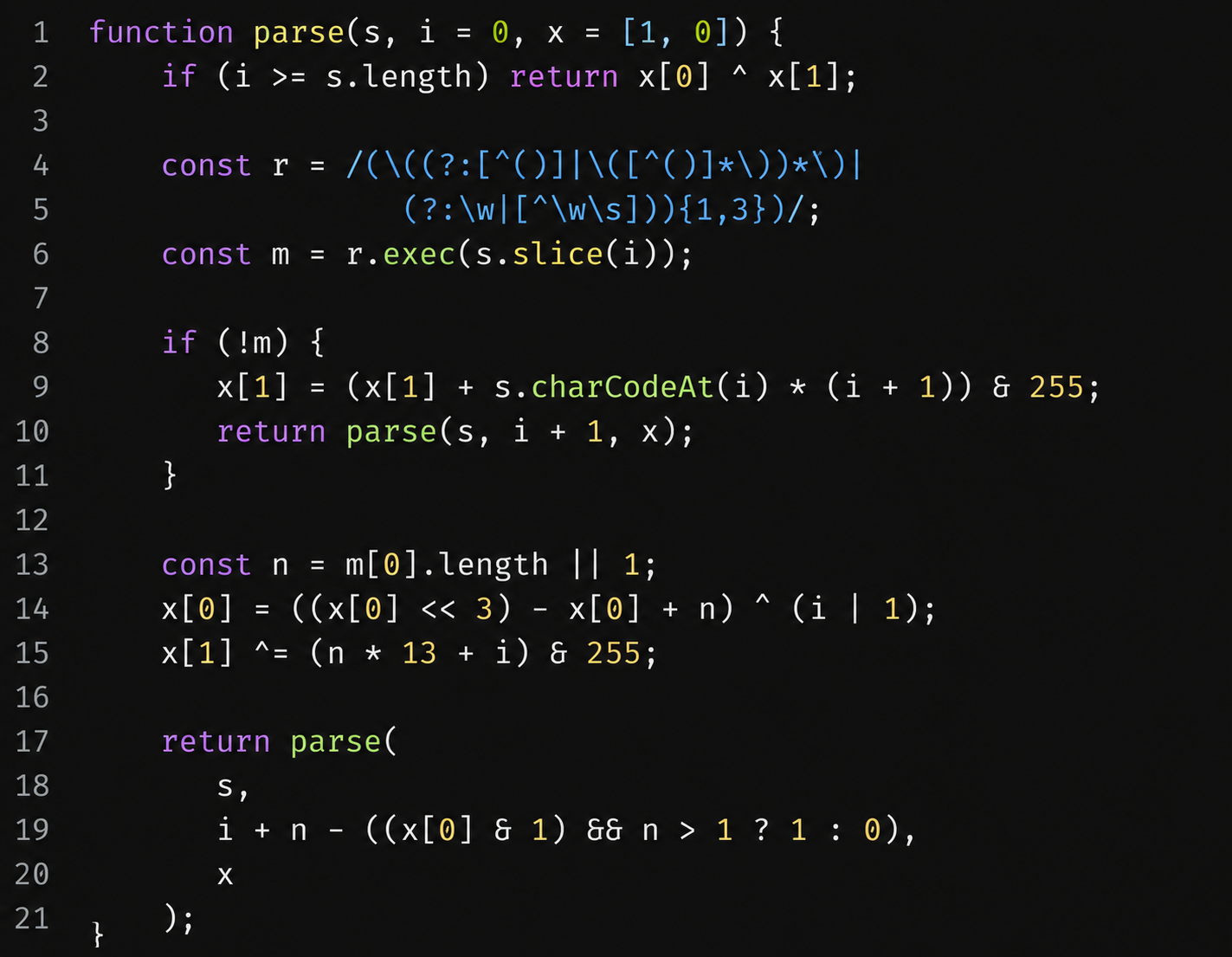
You know what's worse than actual depression? Opening someone's code and discovering they've never heard of the spacebar. Every bracket is a crime scene, the indentation is playing hide and seek, and the ternary operator looks like it's having an existential crisis. That recursive permutation function is already hard enough to parse mentally without the formatting making it look like someone sneezed on the keyboard. Your friend really said "here's my Java code" like they're proud of this chaotic masterpiece. The real depression isn't the sad aesthetic photo—it's realizing you have to refactor this before you can even BEGIN to understand what it does. Time to introduce them to Prettier or an IDE that actually cares about their mental health.

What Do You Mean

What Do You Mean
You know you've reached peak software engineering when you need to write unit tests to verify that your unit tests are working correctly. The recursive nature of testing your own code is like that inception moment where you question reality itself. Why trust your new code when you can't even trust the code you wrote five minutes ago? The circular logic here is chef's kiss – if the verification code has bugs, how would you even know? You'd need tests for your tests for your tests. It's turtles all the way down, except the turtles are all potentially buggy and none of them have been properly peer reviewed.

There Is No Escape

There Is No Escape
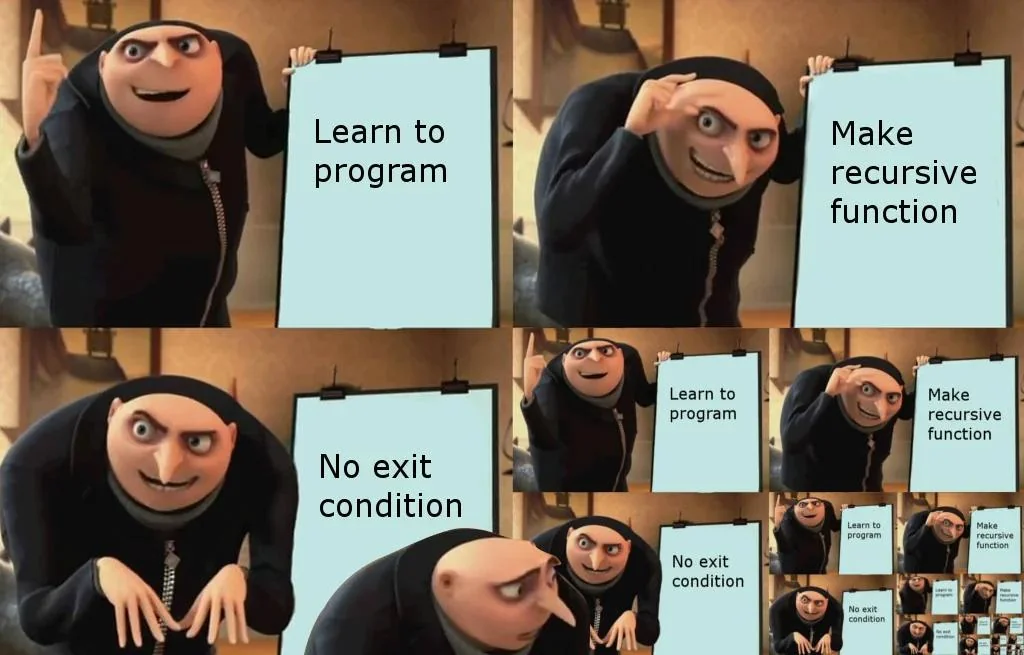
So you learned to program, congrats! Now let's make a recursive function, shall we? Oh, but wait—you forgot the exit condition. And just like that, you've created a beautiful infinite loop that calls itself forever and ever and EVER until your stack overflows and your program crashes in a blaze of glory. The meme itself becomes recursive, spiraling into smaller and smaller versions of itself, perfectly capturing the sheer panic of watching your function call itself into oblivion. It's like looking into a mirror with another mirror behind you, except instead of reflections, it's your CPU screaming for mercy and your RAM filing a restraining order. Welcome to programming, where your first recursive function is also your last because you're still debugging it to this day!

When You Forget The Base Case

When You Forget The Base Case
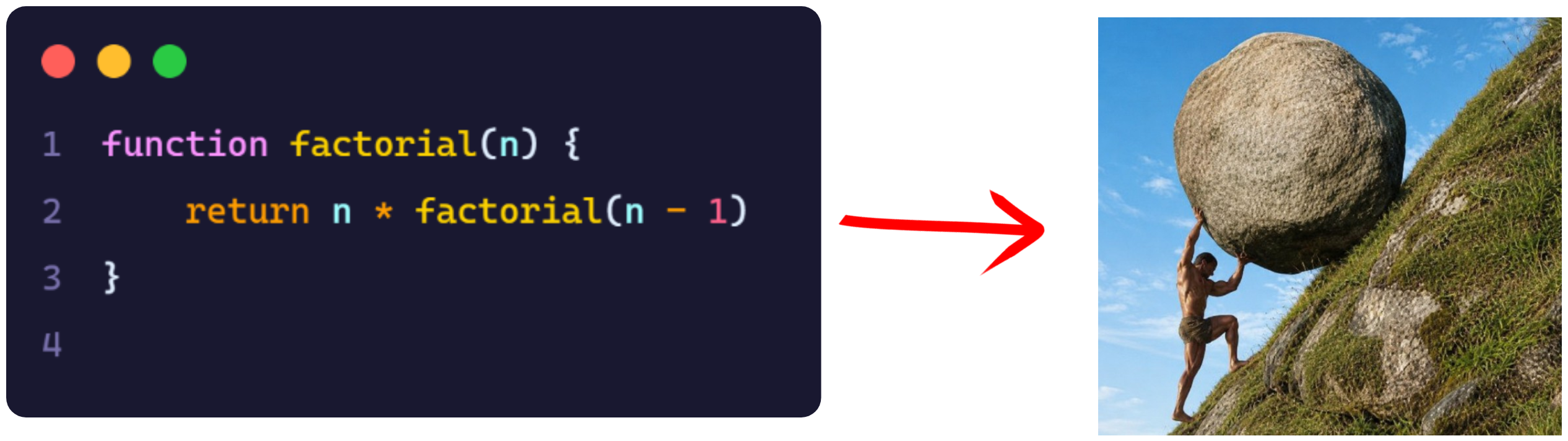
So you just learned recursion and you're feeling like a genius. You write your beautiful recursive function, hit run, and... congratulations, you've just created an infinite loop that's spawning copies of itself faster than Gru spawns evil plans. The stack overflow isn't just a website anymore—it's your reality. That base case? Yeah, turns out it's not optional. It's the emergency brake on your runaway train of function calls. Without it, your program becomes a fractal nightmare that keeps calling itself into oblivion until your computer begs for mercy. Fun fact: forgetting the base case is the programming equivalent of asking "Are we there yet?" on an infinite road trip.

This Pro Gaming Stuff Is Easy 😤

This Pro Gaming Stuff Is Easy 😤
Two functions locked in an infinite recursive embrace, each checking if the other says it's the opposite type of number. It's like watching two people argue "no, you hang up first" except neither will ever hang up because they keep asking each other for the answer. The `isEven` function calls `isOdd`, which calls `isEven`, which calls `isOdd`... until your stack overflows and your program crashes harder than a junior dev's first production deployment. The bitwise operations (`a&1` and `a%2 ==1`) are actually correct checks for odd numbers, but they're completely pointless since the functions immediately delegate to each other instead of using them. It's the programming equivalent of asking your coworker to do your job while you do theirs. Efficient? No. Entertaining? Absolutely.

BenQ RD280UA 28.2” 4K 3840x2560 Programming Monitor Backlight, Ergo Flexible Arm, 90W USB-C, Fine-Coated Panel, Advanced Coding Modes, Night Hours Protection, Coding HotKey, Eye-Care Tech

BenQ RD280UA 28.2” 4K 3840x2560 Programming Monitor Backlight, Ergo Flexible Arm, 90W USB-C, Fine-Coated Panel, Advanced Coding Modes, Night Hours Protection, Coding HotKey, Eye-Care Tech
Nano Matte Panel: Unlock peak productivity with BenQ's exclusive anti-glare, anti-reflective Nano Matte Panel designed for programmers · Advanced Coding Modes for Improved Codes Differentiation: Craf…

Fuck Haskell Long Live Java Script

Fuck Haskell Long Live Java Script
So someone decided to implement functional programming in JavaScript by... literally just calling functions recursively and pretending they're doing Haskell. The isEven function checks if a number equals zero (true) or one (false), then recursively calls isOdd with n-1. The isOdd function just... calls isEven back. This is the programming equivalent of asking your roommate if they're hungry, and they respond by asking if YOU'RE hungry, and this continues until someone starves or the call stack explodes. Instead of using the modulo operator like a normal human being ( n % 2 === 0 ), this genius decided to torture the JavaScript engine with mutual recursion. The irony? Haskell would actually handle this elegantly with tail call optimization. JavaScript? It'll blow up your stack faster than you can say "Maximum call stack size exceeded." So yeah, "long live JavaScript" indeed—until you try to check if 10000 is even.

Agent Prompts Have Evolved

Agent Prompts Have Evolved
We've reached peak meta: using AI agents to write the instructions for other AI agents. Why spend 10 minutes crafting the perfect prompt when you can spend 3 hours building an agent that writes prompts for agents that write prompts? It's like that scene where you automate your job so well that your automation needs its own documentation, except now the documentation writes itself. And honestly? It's beautiful. We've gone full circle from "learn to code" to "learn to prompt" to "prompt the prompter." Next up: agents that review other agents' prompt-writing abilities and leave passive-aggressive comments in the PR. The real galaxy brain move is when the agent starts optimizing its own prompts and you realize you're just a middleman in a recursive AI feedback loop. Welcome to 2024, where even laziness requires automation.

Agentic Money Burning

Agentic Money Burning
The AI hype train has reached peak recursion. Agentic AI is the latest buzzword where AI agents autonomously call other AI agents to complete tasks. Sounds cool until you realize each agent call burns through API tokens like a teenager with their parent's credit card. So now you've got agents spawning agents, each one making LLM calls, and your AWS bill is growing exponentially faster than your actual productivity gains. The Xzibit "Yo Dawg" meme format is chef's kiss here because it captures the absurdity of meta-recursion—you're literally paying for AI to coordinate with more AI, doubling (or tripling, or 10x-ing) your token consumption. Meanwhile, your finance team is having a meltdown trying to explain why the cloud costs went from $500 to $50,000 in a month. But hey, at least it's agentic , right?

Sabrina Carpenter

Sabrina Carpenter
So someone decided to create an AWS Lambda that calls itself recursively without a timeout limit. That's not a bug, that's a financial suicide note. Lambda functions have a 15-minute max execution timeout for a reason—to protect you from yourself. But forget to set it? Congrats, you just created an infinite loop that'll keep spawning new instances until your AWS bill looks like a phone number. The best part? AWS won't stop you. They'll just keep charging while your function enthusiastically calls itself into oblivion like an ouroboros made of JSON and regret.

Logitech 4k Webcam

Logitech 4k Webcam
SUPPORT WORK FROM ANYWHERE WITH SYNC: Whether employees are in the office, at home, or somewhere else, Sync device management software helps everyone stay connected by letting you ensure their Logite…

Base 10

Base 10
The classic number base paradox strikes again! The alien sees 10 rocks and says "10 rocks" in base 4 (which equals 4 in decimal). The astronaut assumes base 10 and gets confused. But here's the kicker: no matter what base you're using, you always represent it as "base 10" in that base . In base 4, the number 4 is written as "10". In base 16 (hex), the number 16 is written as "10". In binary, the number 2 is written as "10". Every civilization thinks they're using "base 10" because that's literally how you write the base number in that base. It's like asking "What is base 4?" and the answer is always "base 10" from that base's perspective. The real galaxy brain moment: when you realize that if aliens showed up and said they use "base 10", we'd have absolutely no idea what they actually mean without seeing them count first. Could be binary for all we know.