

Git Status

Git Status
The compulsive need to run git status after literally every command is the developer equivalent of checking if you locked the door three times before leaving the house. You just pushed your changes? Better check the status again to make sure the universe didn't spontaneously create new uncommitted files in the 0.2 seconds since your last check. The sequence here is chef's kiss: status → add → status (just to be sure) → commit → push → status (because what if the push created local changes somehow???). It's pure paranoia mixed with muscle memory, and the guy staring at the screen waiting for that sweet "working tree clean" message is all of us.

More Than Just Coincidence

More Than Just Coincidence
They trained AI on corporate speak and somehow expected it to develop consciousness. Plot twist: it just learned to say a lot of words without actually committing to anything. Turns out when you feed an LLM thousands of hours of "let's circle back on that" and "I'll loop you in," you don't get sentience—you get something that's really good at sounding busy while providing zero actionable value. The real kicker? We can't even tell if it's hallucinating or just doing what middle managers do naturally: confidently presenting information that may or may not be accurate while deflecting accountability. Maybe the Turing test should've been "can you attend a meeting that could've been an email?"

Apt Get Chaeyoung

Apt Get Chaeyoung
Debian users really do be out here typing apt-get install for literally everything like they're summoning ancient incantations. While the rest of the world moved on to simpler package managers or just downloads things like normal people, Debian folks are still riding that 1993 wave with the confidence of a drummer in a K-pop music video. The "NO ONE:" format perfectly captures how absolutely nobody asked, yet here they are, dramatically installing packages with the flair of a rock band photoshoot. It's giving "I use Arch btw" energy but make it Debian. You know they've got that sudo apt-get update && sudo apt-get upgrade aliased to something ridiculous.

I Guide Others To A Treasure I Cannot Possess

I Guide Others To A Treasure I Cannot Possess
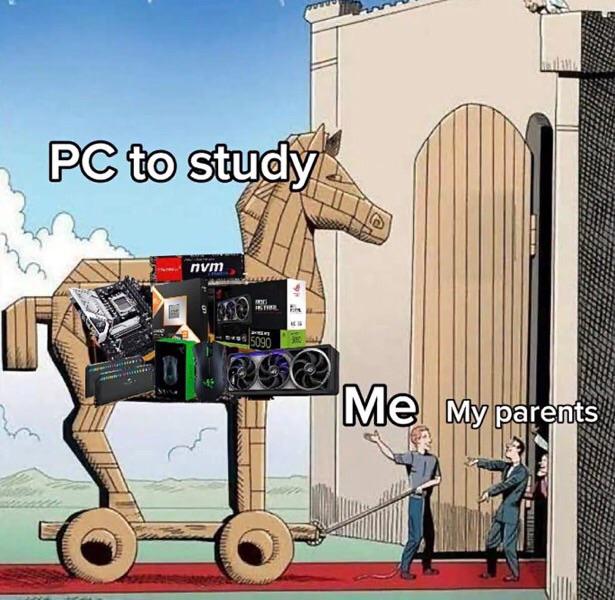
You know you've reached peak tech bro enlightenment when you're researching RTX 4090s, custom water cooling loops, and RGB everything for your buddy's dream rig while you're still rocking a laptop that thermal throttles opening Chrome tabs. The irony is beautiful—you've got all the knowledge, you know exactly which components to pair for maximum FPS, but your bank account is screaming in binary. So there you are, playing system architect for someone else's gaming paradise while you'll be going home to play Minecraft on low settings. The Red Skull knew this pain.

So Where Are The Users

So Where Are The Users
You spent months architecting the perfect backend, wrote pristine documentation, deployed with zero downtime, and even set up monitoring dashboards that look absolutely gorgeous. Launch day comes and goes. Week one passes. Week four hits and you're still staring at your analytics dashboard showing a grand total of... *checks notes* ...your mom, your best friend who felt obligated, and what's probably a bot from Russia. The painful reality: building the app is only like 20% of the battle. Marketing, user acquisition, finding product-market fit—that's the other 80% that most devs conveniently forget exists. You can have the most elegant codebase in the world, but if nobody knows it exists, you're just fishing in an empty pond while your server costs keep ticking up. Fun times!

Junior Vs Senior Googling

Junior Vs Senior Googling
Junior devs out here asking "how do I loop through an array in JavaScript?" with proper grammar and punctuation like they're writing a thesis. Meanwhile, seniors have evolved beyond language itself—they just slam their error message directly into Google, typos and all. No context, no politeness, just raw stack trace energy. The senior's search history is basically a crime scene of cryptic keywords: "undefined not function react" or "segfault malloc why". They've learned that Google doesn't need your life story, it needs the exact three words that unlock Stack Overflow's ancient wisdom. The junior is still trying to explain their problem to a search engine like it's their therapist, while the senior treats Google like a database query—maximum efficiency, zero fluff.

Just Play The Game Bro

Just Play The Game Bro
Gamers will drop $400 on an RGB keyboard with 8000Hz polling rate, custom actuation points, and hall effect switches that can register a keypress before you even think about it. Meanwhile, the average gamer is still getting destroyed in ranked because they have the reaction time of a sleepy sloth. Your $20 membrane keyboard isn't why you're hardstuck silver, my friend. It's the decision-making. But sure, blame the hardware—we've all been there. At least your desk looks cool while you're losing.

Jarvis I'm Locked In

Jarvis I'm Locked In
The modern corporate developer experience: clock in, attend eight hours of meetings about meetings, bikeshed over whether to use tabs or spaces for the thousandth time, write exactly zero functional code, then collect that sweet paycheck like you just shipped a revolutionary feature. The "locked in" energy is strong—locked into doing absolutely nothing productive, that is. At least the headphones make it look like you're in deep focus mode while you're really just listening to lo-fi beats and contemplating your life choices.

Vibe Coder Spotted

Vibe Coder Spotted
You know you've encountered a true artist when their code looks like they're summoning ancient spirits with emoji incantations. Fire, party poppers, explosions, X marks, and checkmarks—it's like their IDE is having a rave while the rest of us are just trying to write readable code. The reaction face says it all. That mix of respect, confusion, and mild concern you get when reviewing code that somehow works despite looking like a Unicode fever dream. Does it pass the tests? Sure. Can anyone maintain it? Debatable. Will it cause the next dev to question their career choices? Absolutely. These are the developers who name their variables with emojis when the language allows it, who comment exclusively in memes, and who genuinely believe that if the code isn't fun to write, what's even the point? They're not wrong, but they're also not getting invited to the enterprise Java team.

Assume T Pose For Dominance

Assume T Pose For Dominance
Someone's desk setup has achieved sentience and decided to assert dominance through structural engineering. The monitor's standing there in perfect T-pose formation, supported by what appears to be a combination of hope, prayer, and questionable physics. The labels are chef's kiss. Segfault coredumps and stack traces holding up one side, C++ template compiler errors doing the heavy lifting on the other. Both are known for their ability to produce walls of incomprehensible text that could physically support a monitor, so the physics checks out. Nothing says "I'm a senior developer" quite like using your most painful debugging experiences as literal load-bearing pillars. At least when this setup inevitably collapses, you'll get a fresh segfault to add to the collection.

Every Indie Developer Eventually Gets This Card

Every Indie Developer Eventually Gets This Card
The indie dev grind captured in one brutal UNO card. You're building your passion project, pouring your soul into it, juggling 47 different roles (developer, designer, marketer, customer support, janitor), and then life deals you this: either quit indie development entirely or draw 25 more problems to deal with. The guy's hand is absolutely stuffed with cards because quitting? That's not in the vocabulary. Instead, he's drawn every single card in the deck: scope creep, feature requests, bug fixes, marketing struggles, imposter syndrome, financial stress, and the classic "why isn't anyone downloading my app?" existential crisis. The deck becomes your entire life. Fun fact: studies show indie devs work an average of 60+ hours per week while making less than minimum wage in the first few years. But hey, at least you're your own boss, right? Right?? *nervously clutches 73 cards*

When My Website Down

When My Website Down
Every developer's first instinct when their site goes down: blame Cloudflare. DNS issues? Cloudflare. Server timeout? Cloudflare. Forgot to pay your hosting bill? Definitely Cloudflare. Meanwhile, it's usually your own spaghetti code throwing 500 errors or that database migration you ran on production without testing. But sure, let's refresh the Cloudflare status page 47 times and angrily shake our fist at the CDN that's probably the only thing keeping your site from completely melting down under traffic. The real kicker? Nine times out of ten, Cloudflare is actually working fine—it's just proxying your broken backend like the loyal middleman it is.