

Senior Devs...

Senior Devs...
Oh, the sheer GENIUS of it all! Senior devs out here creating AbstractFactoryFactoryProviderBuilderManagers just to avoid writing a simple if-statement. Why solve a problem in 5 lines when you can architect an entire galaxy of design patterns, interfaces, and dependency injection frameworks? They'll spend three weeks building "scalable infrastructure" for a feature that literally just needs to check if a number is greater than zero. The celebration? Chef's kiss. They've just turned a straightforward solution into something that requires a PhD to understand. Future maintainers will weep, but at least it's "enterprise-ready" and follows SOLID principles so hard it became LIQUID.

Infra As React

Infra As React
Someone really woke up and said "You know what DevOps needs? More JSX." Because apparently writing infrastructure as code in YAML or HCL wasn't hipster enough, so now we're defining VPCs, RDS instances, and Lambda functions with React components and className props. Nothing screams "production-ready" quite like treating your AWS infrastructure like it's a frontend component library. Next thing you know, someone's gonna useState() to manage their Kubernetes cluster state and useEffect() to provision EC2 instances. The fact that it generates actual Terraform files is both impressive and deeply concerning – like watching someone build a house with a spoon and somehow succeeding.

Graphics Inflation

Graphics Inflation
Remember when 720p was basically IMAX quality and you felt like you were living in the future? Now it's what you get when your streaming service decides you don't deserve bandwidth. Same resolution, different emotional response. Back then, upgrading from 480p to 720p was like seeing for the first time. Now 720p is what loads when you're on your phone's hotspot in a Walmart parking lot. Technology didn't change—our standards did. Welcome to the hedonic treadmill, display edition.

Do You Prefer Fluffy UI Over Liquid Glass?

Do You Prefer Fluffy UI Over Liquid Glass?
Someone went full arts-and-crafts mode and turned their phone into a tactile nightmare. Every UI element is literally covered in felt, fur, and what appears to be the remnants of a craft store explosion. The Gmail widget looks like it's been through a dryer cycle, the camera icon has achieved maximum fluffiness, and that Google search bar? It's basically a caterpillar now. The "fluffy UI" vs "liquid glass" debate just got physical. While Apple and Google spend millions on perfecting their glassmorphism, neumorphism, and material design languages, this person said "nah, I want my interface to feel like petting a sheep." The volume controls have individual fur coats, and the music widget looks like it's wearing a shag carpet. Props for the commitment though—every single element is meticulously crafted. This is what happens when a frontend developer discovers a hot glue gun and loses all sense of restraint. Your battery life might be fine, but your lint roller is definitely crying.

What Do I Need The Include Lines For

What Do I Need The Include Lines For
Someone just discovered the secret to writing memory-safe C code: free your memory before you allocate it. Galaxy brain move right there. The cherry on top? They included assert.h like they're about to write production-quality code with proper error handling, but then immediately went full chaos mode with free(&malloc()) . That's like putting on a seatbelt before driving off a cliff. Pro tip: Those include statements are actually the only correct part of this code. Everything after line 5 is a war crime against computing.

Binary Search My Life

Binary Search My Life
Binary search requires O(log n) time complexity, but only if your array is sorted first. Otherwise you're just randomly guessing in the middle of chaos. Kind of like trying to find the exact moment your life went off the rails by checking your mid-twenties, then your teens, then... wait, it's all unsorted? Always has been. The brutal honesty here is that you can't efficiently debug your life decisions when they're scattered across time in no particular order. You need that sweet O(log n) efficiency, but instead you're stuck with O(n) linear search through every regret. Sort yourself out first, then we'll talk algorithms.

Look At This Junk!

Look At This Junk!
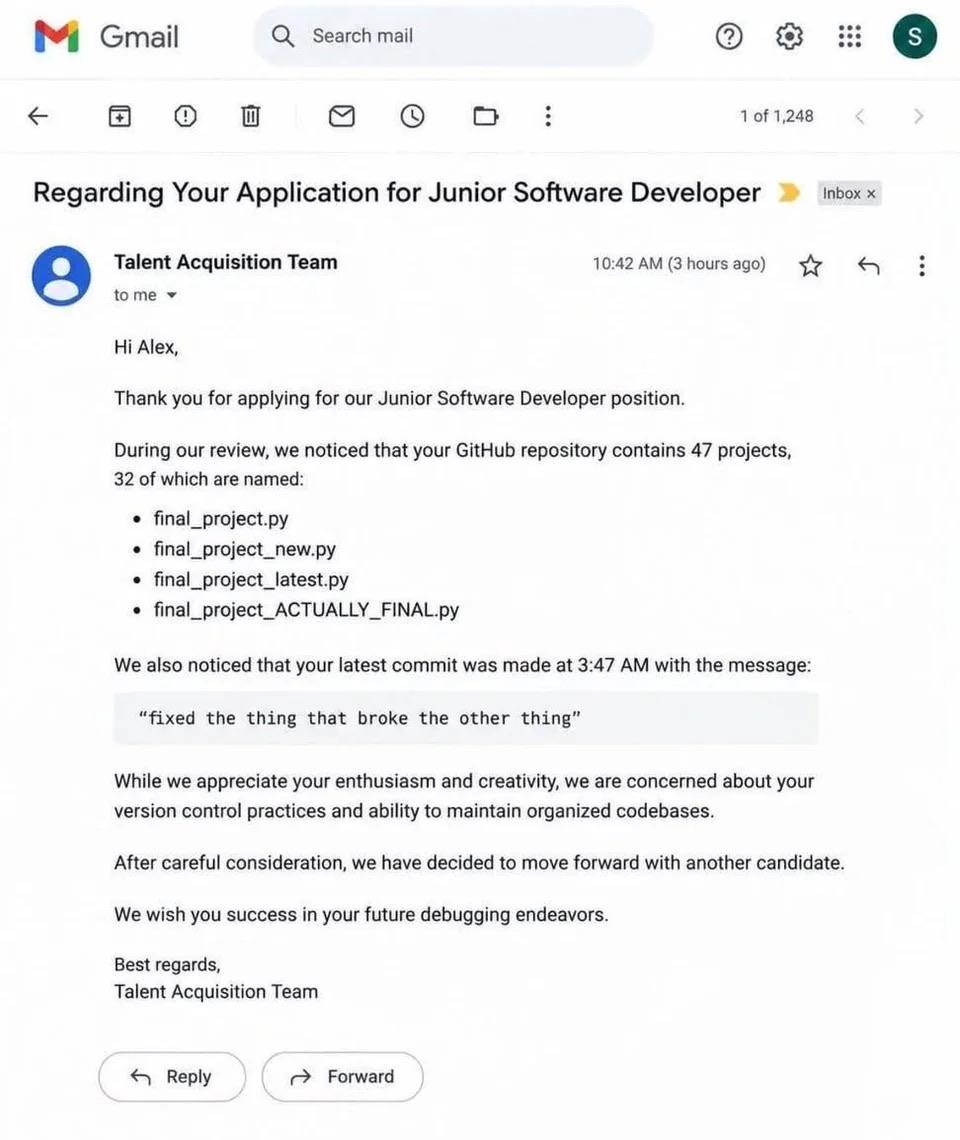
You know that feeling when you revisit your old code and suddenly wonder if you were drunk, sleep-deprived, or just fundamentally broken as a human being? Two months is that perfect sweet spot where the code is old enough to be incomprehensible, but recent enough that you can't blame a different version of yourself. The horror sets in when you realize there are no comments, variable names like x2 and temp_final_ACTUAL , and a function that's somehow 400 lines long. You start questioning your career choices, your education, and whether that CS degree was worth anything at all. The real kicker? It works perfectly in production. You're terrified to touch it because you have absolutely no idea how or why it functions. It's like archaeological code—best left buried and undisturbed.

Justified

Justified
Ah yes, the ancient art of waterboarding someone for suggesting best practices. Your team watches in silent approval as you're stretched on the rack for daring to propose that maybe, just maybe , spending a sprint on documentation and unit tests could prevent the production fires that happen every other Tuesday. The irony? Six months later when the codebase is an undocumented dumpster fire and nobody knows what anything does, they'll be asking "why didn't we write tests?" while you're still recovering from the torture chamber. But sure, let's ship that feature with zero coverage and comments that say "//TODO: fix this later" because technical debt is just a myth invented by people who hate fun, right? At least the medieval executioners had the decency to make it quick. Your team prefers the slow death of watching you maintain their spaghetti code alone.

Operator Overloading Is Fun

Operator Overloading Is Fun
Someone wants to overload the == operator for value comparison instead of reference comparison. Java, being Java, has a complete meltdown because that would be "abuse." Meanwhile, C++ just shrugs and says "go ahead" when asked about overloading the & operator to nuke an object's internal data. Java protects you from yourself by refusing operator overloading entirely. C++ hands you a loaded footgun and a blindfold, then walks away whistling. One language thinks you're a child who can't be trusted with scissors. The other assumes you're a responsible adult who definitely won't use operator overloading to create cursed abominations that make code reviewers weep. Spoiler: C++ is wrong about you being responsible.

Gets Phished By It Anyways

Gets Phished By It Anyways
Ah yes, the mandatory security training that starts with good intentions and somehow evolves into a 4-hour PowerPoint odyssey about password hygiene you learned in 2003. You're nodding along for the first 15 minutes, then suddenly you're on slide 247 about the history of phishing attacks dating back to AOL chatrooms. The real kicker? After sitting through this marathon of "don't click suspicious links" and "verify sender addresses," Karen from accounting still clicks on "URGENT: Your Amazon package needs immediate verification" from [email protected] and compromises the entire company's credentials. Security training is like that gym membership—great start, zero follow-through, and somehow you're worse off than before because now you're overconfident.

I Feel Targeted And Triggered By That Except I Would Never Buy A Mac

I Feel Targeted And Triggered By That Except I Would Never Buy A Mac
The brutal truth about tech bros and their spending priorities hits different when it's laid out like this. You'll drop $5k on a maxed-out MacBook Pro and another grand on a Herman Miller Aeron because "ergonomics" and "productivity," then rationalize it with spreadsheets showing cost-per-hour calculations over a 10-year lifespan. But that conference T-shirt from a startup that's been dead for half a decade? That's your daily uniform. The irony is chef's kiss—we optimize our tools to perfection while our wardrobe screams "I got dressed in the dark at a hackathon." The real kicker? Posted from an iPhone. The self-awareness is there, just not strong enough to actually change anything.

What An Odd Choice

What An Odd Choice
Tell me you don't understand computer science without telling me you don't understand computer science. Some tech journalist really looked at 256 and thought "wow, what a random, quirky number!" Meanwhile every programmer within a 50-mile radius just felt their eye twitch. For those blissfully unaware: 256 is 2^8, which means it's literally THE most natural limit in computing. It's the number of values you can represent with a single byte (0-255, or 1-256 if you're counting from 1 like a normal human). WhatsApp's engineers didn't sit in a room throwing darts at numbers—they picked the most obvious, efficient, byte-aligned limit possible. The real tragedy? Someone got paid to write that article while having zero clue about binary numbers. Meanwhile, we're all debugging segfaults for free.