Welcome To The Real World

Welcome To The Real World
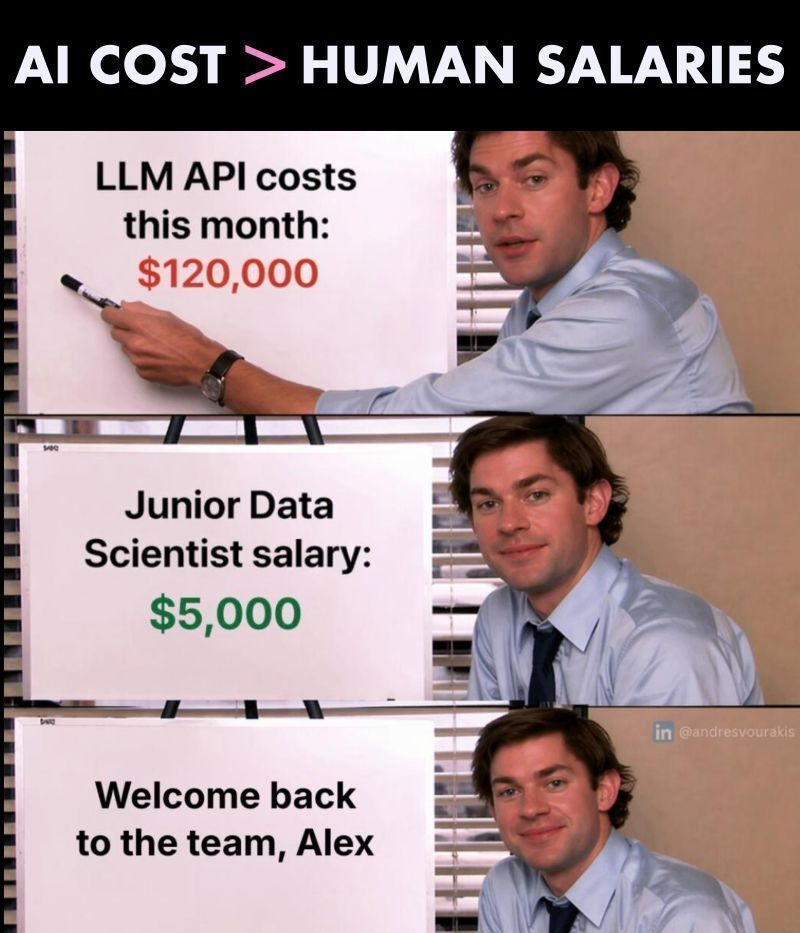
Nothing says "welcome back" quite like a $150k monthly API bill from your friendly neighborhood LLM provider. You thought you were building the next big AI feature? Nope, you just accidentally funded OpenAI's next yacht. The best part? Management approved the POC with 100 users, and now you're serving 100,000. Turns out streaming consciousness to every user request gets expensive real fast. Who knew that letting GPT-4 write your product descriptions would cost more than your entire engineering team's salary? Time to implement that token caching strategy you've been putting off and maybe, just maybe, consider if users really need AI to tell them their password is incorrect.

Modern Problems Require Trespassing

Modern Problems Require Trespassing
When the job market is so brutal that you're contemplating a career pivot into unauthorized employment. Just show up at a random company, sit at an empty desk, and start committing code. Worst case scenario? They escort you out. Best case? Free office snacks and you've accidentally joined their daily standup for three weeks before anyone notices. The real galaxy brain move is the police station backup plan. "Officer, I'm here to optimize your database queries." They can't arrest you if you're already at the station, right? That's just efficiency. Honestly though, with how desperate companies claim to be for developers while simultaneously ghosting 500 applications, this guerrilla employment strategy might be the innovation the hiring process needs.

Maybe We Are Back

Maybe We Are Back
The AI hype cycle has officially eaten itself. Companies rushed to replace developers with AI to "cut costs," only to discover that GPT-4's API bills are basically a second mortgage and the output still needs three senior devs to debug. Meanwhile, developers are out here basking in the desert sun like they just survived the apocalypse, watching the same executives who laid them off frantically calculate whether hiring humans back is cheaper than their OpenAI invoice. The irony is chef's kiss: AI was supposed to be the cost-effective replacement, but turns out hallucinating code and needing constant prompt engineering isn't quite the productivity boost the C-suite imagined. Who could've predicted that years of experience, context, and not making up functions that don't exist would actually be valuable? Don't worry though, they'll rehire you at 60% of your previous salary and call it "market adjustment."

Spiced Up Vim

Spiced Up Vim
Someone took Vim—the text editor that already feels like you're hacking the Matrix—and decided it needed MORE. Now it's got a full-blown video game HUD with combo counters and max stats like you're about to pull off a fatality on your Python code. Power Mode is ENABLED, which means every keystroke probably triggers fireworks, screen shake, and an existential crisis about whether you're editing code or speedrunning Dark Souls. The best part? You're still in NORMAL mode, which is hilarious because there's absolutely NOTHING normal about turning your text editor into an arcade cabinet. But hey, if writing a simple "Hello World" doesn't make you feel like a coding god with particle effects exploding everywhere, are you even living?

I Hate It

I Hate It
You're reading an article, carefully scrolling through the content, everything's perfectly aligned and readable. Then suddenly—BAM—a lazy-loaded ad pops in at the top and triggers a reflow , shifting the entire DOM tree down just as your finger is about to tap. You end up clicking on "LOSE 50 POUNDS WITH THIS ONE WEIRD TRICK" instead of the actual content you wanted. This is what happens when developers don't implement proper Cumulative Layout Shift (CLS) prevention. Reserve space for your ads, people! Use skeleton loaders! Set explicit width and height attributes! Your Core Web Vitals are crying and so are your users. Fun fact: Google now penalizes sites with poor CLS scores in their search rankings, so this isn't just annoying—it's literally costing websites traffic and revenue. Karma's real.

We Really Lost Diamonds

We Really Lost Diamonds
The tech industry's obsession with sleek, minimalist design has reached peak absurdity. We went from iconic, personality-packed mascots and UI elements that had soul to gradient blobs that all look like they came from the same corporate design workshop. Remember when software had character? Clippy might've been annoying, but at least you remembered him. That wizard screensaver? Legendary. Now we get... a teal knot? A purple sparkle? Icons so generic you need to read the label to know what app you're opening. The "gold" represents modern design—technically polished, aesthetically "clean," but utterly soulless. Meanwhile, the "diamonds" were those quirky, memorable elements that made computing feel less like interacting with a sterile machine and more like having actual personality in your digital life. We traded charm for conformity, and honestly? The ROI on that decision is questionable at best.

Python Users Watching The Chaos Unfold

Python Users Watching The Chaos Unfold
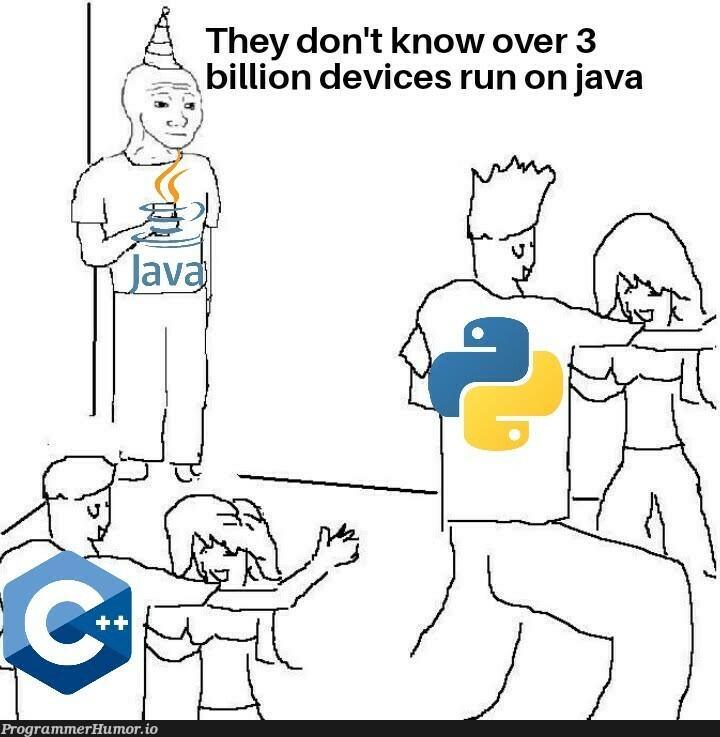
Nothing quite like watching Java and C++ devs lose their minds over a missing semicolon while you're just vibing with your indentation-based syntax. They're drowning in compiler errors and type declarations, meanwhile Python's over here like "yeah I'll figure out what type that is at runtime, no biggie." The beauty of dynamic typing and not having to declare every single variable with its ancestral lineage. Sure, we might discover our bugs at 3 AM in production instead of compile time, but at least we're not writing 47 lines of boilerplate just to print "Hello World."

Beelink Mini PC, AMD Ryzen 7 6800U (8C/16T, up to 4.7GHz), 24GB LPDDR5 500GB PCIe4.0 SSD, SER5 MAX Mini Desktop Computer Support 4K@60Hz Triple Display/DP1.4/HDMI/Type-C/WiFi 6/BT5.2 for Office/Home

Beelink Mini PC, AMD Ryzen 7 6800U (8C/16T, up to 4.7GHz), 24GB LPDDR5 500GB PCIe4.0 SSD, SER5 MAX Mini Desktop Computer Support 4K@60Hz Triple Display/DP1.4/HDMI/Type-C/WiFi 6/BT5.2 for Office/Home
✅【 AMD Ryzen 7 6800U Processor】The SER5 MAX Mini Computer is the upgraded version of the SER5 5800U mini PC, it's equipped with AMD Ryzen 7 6800U (8C/16T, L3 cache 16MB). The base frequency is 2.7GHz…

Can't Leave Vim Though

Can't Leave Vim Though
You know you've hit rock bottom when your AI coding assistant runs out of free tokens and suddenly you're raw-dogging production files with vim like it's 1991. No autocomplete, no suggestions, just you, your questionable regex skills, and the cold realization that you've become dependent on a chatbot to remember basic syntax. The best part? You're still faster than waiting for your manager to approve that ChatGPT Plus subscription.

Do You Think Doing This Helps?

Do You Think Doing This Helps?
Someone literally plugged their server into itself and honestly? The chaotic energy is unmatched. It's giving "I fixed the bug by commenting out the error message" vibes. This is the physical manifestation of a circular dependency, a hardware ouroboros if you will. The server is now simultaneously the power source AND the power consumer, defying all laws of thermodynamics and common sense. Does it help? Absolutely not. Will it create a black hole that swallows your entire network infrastructure? Possibly. Is this person a genius or completely unhinged? Yes.

Day 2 Of Git Hub Outages

Day 2 Of Git Hub Outages
When GitHub goes down for more than 24 hours, developers enter a state of existential crisis. Can't push code? Can't pull requests? Can't even pretend to be productive by scrolling through repos? The entire software industry basically grinds to a halt because we've collectively decided to store every line of code humanity has ever written on one platform. It's like watching society realize their entire civilization depends on a single server farm in Virginia. Day 1: "Haha, guess I'll work on local stuff." Day 2: *aggressive sweating* "WHAT DO YOU MEAN I CAN'T DEPLOY?" The SpongeBob meme format perfectly captures that escalating panic when you realize your entire workflow is held together by the uptime of Microsoft's infrastructure.

I Made This Meme Really Fast

I Made This Meme Really Fast
Management asks if you can work faster with AI tools to ship higher quality products. You confidently say yes. Then they ask again. And again. And again. And again. And again... Eventually you're just a shell of a developer, dead inside, repeating "to make higher quality products, right?" while management keeps pushing for more velocity. The irony? They never actually cared about quality—they just wanted you to work faster. Classic bait-and-switch. The meta-joke here is that the meme itself is repetitive and low-effort, perfectly embodying what happens when you're told to "move fast" without caring about the end result. You end up shipping the same garbage over and over, just slightly repackaged. Tech debt? Never heard of her.

OneOdio A71D Wired Over-Ear Headphones, Studio Monitor Headsets, Hi-Res DJ Stereo Headphone with Foldable Design, 3.5/6.35MM Plug for AMP Recording Podcast Mixing PC Guitar - Black

OneOdio A71D Wired Over-Ear Headphones, Studio Monitor Headsets, Hi-Res DJ Stereo Headphone with Foldable Design, 3.5/6.35MM Plug for AMP Recording Podcast Mixing PC Guitar - Black
Studio-Grade Sound – 40mm drivers deliver deep bass, clear mids, and crisp highs for DJing, studio recording, mixing, and monitoring. · Single-sided Monitoring – The 90° swiveling ear cups allow for …

When You Forget To Specify The Target

When You Forget To Specify The Target
You know that moment when you confidently tell the client "the UI is intuitive, anyone can use it" and then they try to scan their toe as a fingerprint? Yeah, turns out "simple" is relative. What seems obvious to you after staring at wireframes for weeks apparently needs a 50-page manual and maybe some arrows pointing to the actual fingerprint sensor. But sure, let's keep pretending users read tooltips and hover states. The real kicker here is the developer probably spent hours perfecting the fingerprint authentication flow, making it "seamless" and "user-friendly," only to watch someone attempt biometric authentication with their big toe. Sometimes the gap between developer assumptions and user behavior is wider than the Grand Canyon.