

Pray For Me

Pray For Me
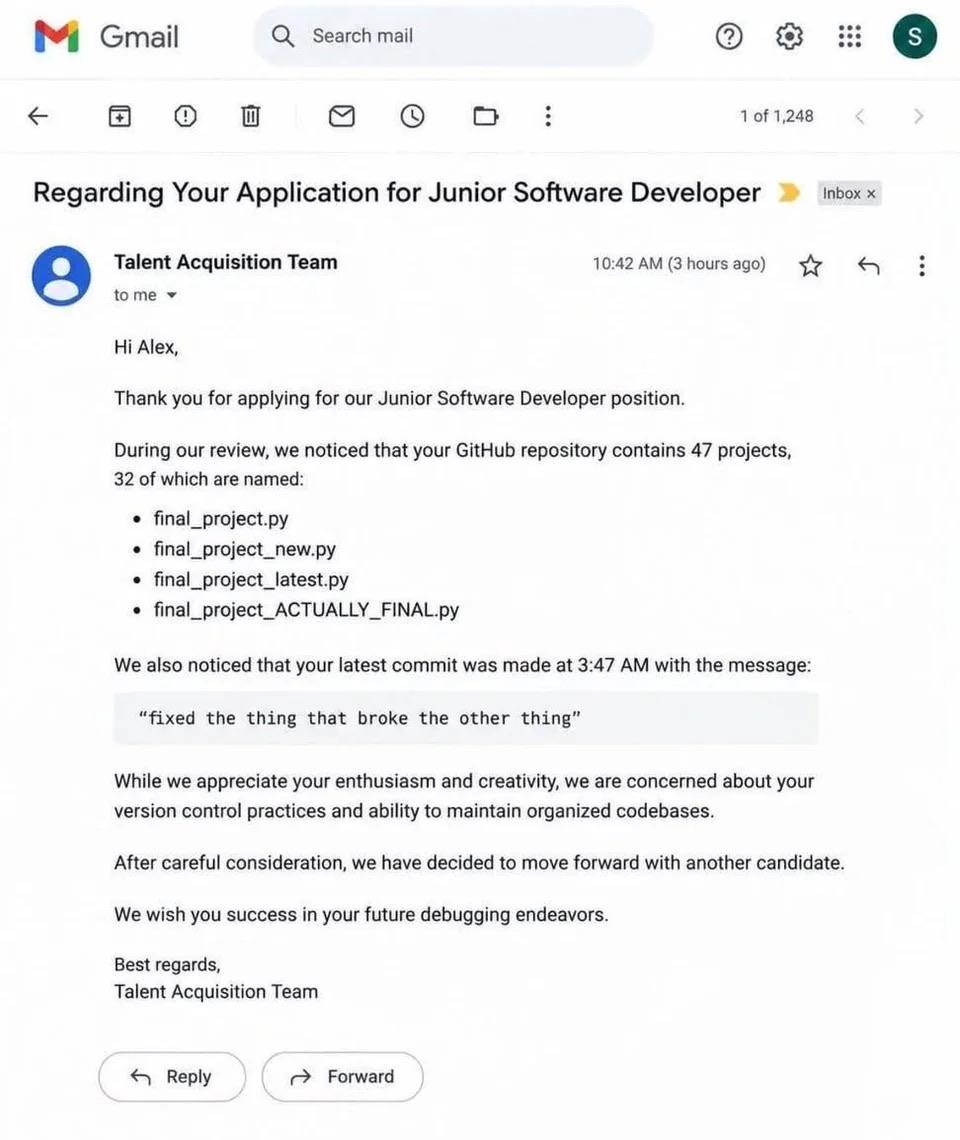
So your PC just bricked itself and refuses to boot. Cool. Nothing says "professional workday" quite like announcing to your entire team that you're basically unemployed until IT can resurrect your machine from the dead. Hope you weren't working on anything important that you definitely saved and backed up regularly. You did back it up, right? Right? Time to dust off that personal laptop from 2015 that takes 10 minutes to boot and runs slower than a turtle on sedatives. Or maybe you'll just sit there contemplating your life choices while your colleagues carry on without you. Either way, you're about to experience what developers call "forced vacation" but management calls "unacceptable downtime."

More Like The "If" And "When" But Never "Is" Guy

More Like The "If" And "When" But Never "Is" Guy
The "Idea Guy" strikes again with his legendary 007 stats: zero planning, zero contributions, but somehow 7 million "revolutionary" ideas that will "totally disrupt the industry." You know this person. They show up to every sprint planning meeting with grandiose visions of building the next Facebook-meets-Uber-but-for-cats, yet mysteriously vanish when it's time to write actual code or, heaven forbid, document anything. Their ideas exist in a perpetual state of quantum superposition—simultaneously brilliant and completely unimplemented. The real kicker? While you're grinding through merge conflicts at 2 PM on a Tuesday, they're already brainstorming idea number 7,000,001: "What if we rebuilt the entire backend in Rust?" Sure, buddy. You go ahead and open that JIRA ticket.

For The Glory Of The God

For The Glory Of The God
God really said "let there be suffering" and gave us bodies perfectly optimized for debugging hell. Eyes bloodshot from marathon coding sessions? That's not a bug, that's a feature. Mouth for rubber duck debugging instead of actually talking to your teammates? Divine intervention. Ears tuned to hear screen readers test accessibility (because we all know nobody actually does manual a11y testing until the lawsuit arrives)? Blessed. And hands—those precious carpal tunnel factories—designed specifically to translate caffeine into semicolons at 2 AM. The whole package is basically a developer starter kit from the heavens. The real kicker is "everything has its purpose"—yeah, the purpose is pain. But hey, at least we're suffering with intention now. Glory to the LORD of merge conflicts and production bugs.

This Is A Very Good Idea

This Is A Very Good Idea
Nothing says "I've learned nothing from security training" quite like this masterpiece. Dude's planning to spoof AWS billing alerts via SMS and even wants to include a link to the "official AWS dashboard" to make it look legit. Because obviously, the best way to prank your friends is by potentially getting arrested for phishing and identity theft. The real comedy here is thinking your friends won't immediately panic and call their bank, or worse, actually click that link. Then you'll be explaining to HR why half the company reported a security incident that traces back to your phone number. Pro tip: if your prank requires you to clarify "it's not phishing," it's definitely phishing. Also, $50k? That's rookie numbers. If you're gonna fake an AWS bill, at least make it realistic—like $127,483.29 from accidentally leaving a NAT Gateway running in 47 regions.

Accurate Estimates

Accurate Estimates
The classic tale of AI-powered estimation tools versus developer hubris. An AI tool analyzes the feature and conservatively estimates 4-6 weeks. The developer, filled with caffeine-fueled confidence, scoffs and declares they'll knock it out in an afternoon. Fast forward 6 weeks, and surprise—it's finally working. Plot twist: both the overconfident dev AND the AI were wrong, because the real timeline was exactly 6 weeks regardless of who predicted what. The meme brilliantly captures how whether you're using fancy AI estimation tools or just winging it with blind optimism, software projects have a mysterious way of taking exactly as long as they're going to take. Edge cases, scope creep, and that one bug that makes you question your entire career don't care about your predictions.

Wallet Left Chat

Wallet Left Chat
Someone just discovered that "AI-powered" tools come with a side of financial ruin. They ditched their SaaS subscriptions thinking they'd save money, went all-in on OpenClaw (presumably OpenAI's API), and watched their monthly bill skyrocket from $480 to $1,245. The cherry on top? They're now spending 15 hours a week wrestling with YAML configuration files like it's 2015 Kubernetes all over again. The real kicker is the cost breakdown: they're paying more AND working harder. Those convenient SaaS tools with their fancy UIs were actually... worth it? Who would've thought that abstracting away complexity has value? The "adapt or be left behind" line is chef's kiss irony—they adapted right into a worse situation. Sometimes the old way of throwing money at a problem to make it go away is actually the optimal solution. Pro tip: API costs scale with usage, and if you're not careful with prompt engineering and caching strategies, GPT-4 will drain your bank account faster than you can say "token limit exceeded."

Ultimate Source Protection

Ultimate Source Protection
Oh honey, someone really said "I'm gonna protect my JavaScript code" and then wrote it entirely in CLASSICAL CHINESE. Like, forget minification and obfuscation—just throw in some ancient dynasty poetry and call it a day! 😭 This is literally the nuclear option of code protection. You've got arrays, sorting algorithms, and what appears to be a quicksort implementation, but it's all written using traditional Chinese characters with classical grammar. It's like someone took their CS homework and decided to cosplay as a Tang Dynasty scholar. The best part? This would ACTUALLY work as protection because even Chinese-speaking developers would need a degree in ancient literature to decode this masterpiece. Good luck to the junior dev who has to maintain this code. They'll need a dictionary, a history textbook, and possibly a time machine.

Lean And Mean Eng Team

Lean And Mean Eng Team
Upper deck's packed with C-suite executives having strategic meetings about synergy and KPIs, while the lone IC (Individual Contributor) is down in the engine room actually rowing the sinking ship. Two CTOs though? That's efficiency right there. Nothing says "lean engineering team" quite like having more chiefs than the entire Native American population and one engineer doing all the actual work. The EM hanging off the side is the perfect touch—middle management literally falling off the boat while trying to shield everyone from the reality that they're taking on water.

There Is A Page For Everything Yet Nobody Looks Before Slacking Me

There Is A Page For Everything Yet Nobody Looks Before Slacking Me
Oh, the TRAGEDY of being the person who actually documented everything! You spent hours crafting beautiful Confluence pages with step-by-step guides, architecture diagrams, and troubleshooting FAQs. You even added screenshots! But does anyone read them? ABSOLUTELY NOT. Instead, they ping you on Slack every five minutes asking questions that are literally answered in the FIRST PARAGRAPH of the docs. The savage tagline "where documentation goes to die" is painfully accurate. Confluence has become the digital equivalent of that drawer where you throw instruction manuals you'll never read. Your coworkers would rather interrupt you mid-flow than spend 30 seconds using the search bar. And when you send them the link? "Oh I didn't know we had that documented!" YES YOU DID, KAREN, I LITERALLY ANNOUNCED IT IN THREE CHANNELS. Documentation is immortal, but apparently so is everyone's refusal to read it.

Shooting Yourself In The Foot

Shooting Yourself In The Foot
The ouroboros of web development economics: blocking the very thing that pays your bills. Installing an ad-blocker while simultaneously lamenting your salary is like being a farmer who refuses to eat vegetables. Here's the brutal irony—web devs spend countless hours implementing ad placements, optimizing ad load times, and debugging why ads won't display properly, only to go home and nuke every single ad from existence. Then they wonder why their paycheck isn't growing. It's the circle of life in tech: complain about ads, block ads, wonder why companies can't monetize, watch salaries stagnate, repeat. Chef's kiss of self-sabotage.

It's That Time Again

It's That Time Again
You know that rare magical moment when you actually clean out your PC case, blow out all the dust bunnies that have been living rent-free in your CPU cooler, and somehow—against all odds—the machine actually boots up successfully? That deserves a formal announcement. The fancy frog in Victorian attire perfectly captures that smug satisfaction when your hardware survives your "maintenance." Because let's be real, every time we open up that case and start yanking cables or blasting compressed air everywhere, there's a 50/50 chance something's getting unseated or a SATA cable is going to mysteriously stop working. The formal tone makes it even better—like you're presenting groundbreaking research at a conference when really you just vacuumed some Cheeto dust out of your GPU fans and didn't accidentally brick your motherboard in the process. Victory tastes sweet.

Not So Open Of You

Not So Open Of You
OpenGL? Friendly handshake. OpenCV? Sure, let's be buddies. OpenSSH? Come here, friend! OpenCL? Absolutely! OpenVPN? Of course! But then OpenAI shows up and suddenly everyone's like "wait, you're calling yourself WHAT now?" The irony is absolutely *chef's kiss* because OpenAI is about as open as a bank vault on a Sunday. They literally went from a non-profit promising open research to a multi-billion dollar company keeping their models more locked down than Fort Knox. Meanwhile, all the other "Open" technologies are actually, you know, OPEN SOURCE. The betrayal! The audacity! It's like showing up to a potluck empty-handed and still putting "generous" in your Instagram bio.