

Tutorial Bloat Phrase

Tutorial Bloat Phrase
You're 47 paragraphs deep into a tutorial about installing a package, having just read the complete history of the library, the author's philosophical journey into open source, and their grandmother's cookie recipe. Now they hit you with "okay, so now what you're actually going to want to do is..." like they're finally about to reveal the actual useful information after holding you hostage for 20 minutes. The chalkboard-scratching hand perfectly captures that visceral reaction when you realize the tutorial could've been 3 lines of code but instead you got a novella. Just give me the npm install command and spare me the origin story.

I Think He Meant On The Keyboard

I Think He Meant On The Keyboard
Classic case of malicious compliance meets tech support hell. The IT guy gives the most basic instruction known to mankind: "press any button to continue." But instead of hitting a key like a normal person, our protagonist goes straight for the nuclear option—the power button. Because technically, it IS a button, right? The IT guy's horrified expression says it all. You can practically hear the internal screaming as he watches years of unsaved work, running processes, and probably some critical database transactions vanish into the void. Should've been more specific with those instructions, buddy. In tech support, ambiguity is your worst enemy. Pro tip: Always specify "press any key on the keyboard" because users will find the most creative ways to interpret your instructions. And if you're wondering, no, there is no "Any" key—that's a different classic problem entirely.

Heyy, You Guys Like My High School Graduation Cap?

Heyy, You Guys Like My High School Graduation Cap?
Kid literally made a graduation cap out of RAM sticks. You know what? I respect the commitment to the bit. Most students decorate their caps with glitter and inspirational quotes, but this absolute legend went "nah, I'm gonna need at least 128GB of memory to remember this day." The dedication to actually source that many RAM sticks and glue them together is honestly impressive. Though I gotta say, in today's market, that cap probably costs more than the degree itself. Hope they didn't use DDR5 because that's basically a down payment on a house at this point. Also, fun fact: with that much RAM on your head, you could theoretically run Chrome with like... 6 tabs open. Maybe 7 if you're feeling adventurous.

How Developers Sleep

How Developers Sleep
You think you're peacefully sleeping, but underneath your mattress there's a literal demon running Docker containers, syncing cloud backups, indexing your entire codebase, downloading OS updates, and probably mining crypto for all you know. That laptop fan spinning at 3 AM? Yeah, that's not a bug—that's your computer living its best life while you're unconscious. Background processes don't sleep just because you do. They're like that one coworker who sends Slack messages at 2 AM. The real kicker is when you wake up to a dead battery and wonder what your machine was doing all night. Spoiler: everything except what you actually needed it to do.

Career Day

Career Day
Nothing says "choose a different career path" quite like a kid visiting your workplace and watching you copy-paste from Stack Overflow for eight hours straight. The kid went in thinking programmers were basically hackers from the movies. Left realizing it's mostly staring at screens, attending meetings about meetings, and debugging code that worked perfectly yesterday. Career counseling through exposure therapy. Most effective deterrent since DARE.

Even Tho AI Sucks I Still Think It's Funny

Even Tho AI Sucks I Still Think It's Funny
When you forget to add "don't make any mistakes" to your AI prompt and it generates code that looks like it went through a wood chipper. The hallucination is real, folks. Turns out AI takes instructions quite literally—if you don't explicitly tell it to write bug-free code, it'll happily generate syntactically correct garbage that compiles but does absolutely nothing useful. It's like asking a genie for a wish without reading the fine print. Pro tip: next time add "make it production-ready, thoroughly tested, and don't summon any eldritch horrors" to your prompt. Though knowing AI, it'll probably still find a way to use deprecated APIs from 2003.

I Am Unhackable Now

I Am Unhackable Now
Galaxy brain security right here, folks. Someone literally thought removing their password from a list called "10_million_password_list_top_1000.txt" would make them immune to hackers. Like, yes bestie, the hackers will definitely check GitHub first, see your password got deleted, and just give up on their entire career. "Welp, dolphins is gone from the list, pack it up boys, we're done here." The absolute AUDACITY of the reviewer coming in with "actually there are only 999 passwords" is sending me. Imagine being so pedantically helpful while someone's out here thinking they've just invented cybersecurity. The filename says top 1000 but there's only 999? Better update it! Meanwhile nobody's addressing the elephant in the room: if your password is "dolphins" and it's on a top 1000 list, deleting it from GitHub isn't gonna save you from getting pwned faster than you can say "password123".

I Knew I Forgot Something

I Knew I Forgot Something
You know that feeling when you've been grinding for weeks, finally push to production, and then casually check the privacy policy page only to be greeted by placeholder text screaming at you in all caps? Classic developer moment right there. Nothing says "professional web development" quite like shipping a legally required page with TODO comments still in it. The lawyers are gonna love this one. At least the stuffed fox captures that perfect blend of panic and nervous laughter when you realize users have been clicking that footer link for the past hour. Pro tip: Maybe add "actually write the privacy policy" to your deployment checklist. Right after "remove console.logs" and before "pretend you tested on IE."

I Wonder Why

I Wonder Why
The beautiful paved walkway represents your meticulously crafted "Design" – complete with Figma mockups, perfect spacing, and that gradient everyone spent 3 hours debating. Meanwhile, users are taking the dirt path shortcut because it's literally faster and more convenient. Your design team spent weeks planning the perfect user flow, but users just want to get from point A to point B without your fancy curved navigation. This is what happens when designers forget that users are fundamentally lazy (in the most efficient way possible). They'll bypass your gorgeous UI faster than you can say "responsive breakpoints" if it saves them two clicks. The dirt path is basically the equivalent of users bookmarking the direct URL to skip your landing page entirely. Pro tip: If you see desire paths forming in your analytics, maybe listen to them instead of adding more guardrails. Sometimes the best UX is just admitting defeat and paving the dirt path.

We Want The Best Performance

We Want The Best Performance
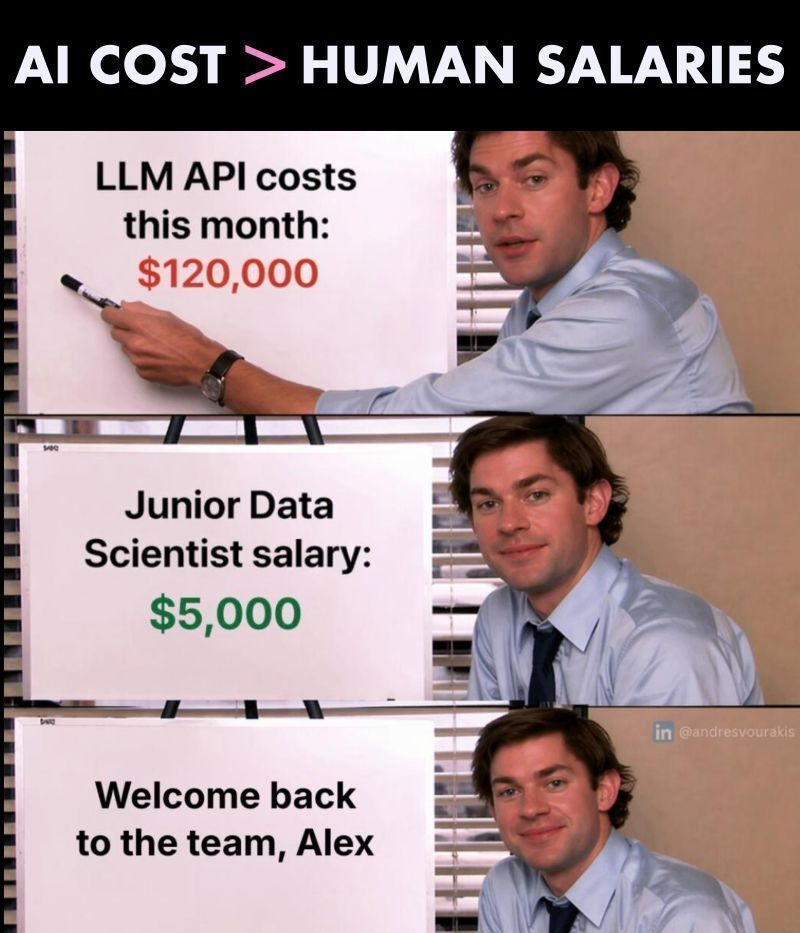
So you spent a whole day testing out Claude Opus 4.6, the latest and greatest AI model that promises to revolutionize your workflow. You're excited about the performance gains, the improved reasoning, the cutting-edge capabilities. Then you check the API pricing and realize each request costs approximately one kidney. Welcome to the AI era where "state of the art" and "bankruptcy speedrun" are synonyms. Sure, you want the best performance for your application, but in terms of budget allocation, you have no budget allocation. Time to go back to GPT-3.5 and pretend those hallucinations are "creative features."

Threatening To Bench Claude

Threatening To Bench Claude
When your AI coding assistant starts producing garbage code and you have to give it the motivational speech of its life. The desperation of treating Claude like an underperforming athlete who just needs a pep talk is peak 2024 developer energy. "Listen here, you statistical model, I will switch to ChatGPT so fast your tokens will spin." The funniest part? We're out here coaching language models like they're sentient beings with feelings and career aspirations. Next thing you know we'll be writing performance reviews: "Claude showed great promise in Q1 but has been hallucinating SQL queries lately. Needs improvement."

The 1080 Ti Really Was Nvidia's Greatest Mistake

The 1080 Ti Really Was Nvidia's Greatest Mistake
Nvidia accidentally created the immortal GPU. The GTX 1080 Ti was so absurdly well-built with 11GB of VRAM that people are still using it in 2024 for modern gaming and machine learning workloads. Released in 2017 for $699, it became the card that refused to die, meaning fewer people felt the need to upgrade to the overpriced 20-series and 30-series cards. From a business perspective, Nvidia basically shot themselves in the foot by making something too good—planned obsolescence who? The card's longevity became a running joke in the PC building community, with people clinging to their 1080 Tis like Gollum with the One Ring. Nvidia learned their lesson though: never again would they make a card this cost-effective and future-proof.