Well…

Well…
Richard just deployed the ultimate counter-offer strategy. Hiring team hits him with "your salary expectations are too high, can you lower them?" and this absolute legend responds with "sure, which responsibilities would you like to remove?" It's the perfect example of scope-to-compensation negotiation. You want to pay less? Cool, let me start removing features from the Richard Japson API. Senior developer responsibilities? That'll cost extra. Code reviews? Premium feature. Actually showing up to stand-ups? That's enterprise tier pricing. The hiring team really thought they could just run a salary.reduce() without touching the responsibilities array. Richard said "nah, let's keep this O(1) - equal work for equal pay."

Inspired By A Recent Post

Inspired By A Recent Post
The eternal struggle between fiscal responsibility and the siren call of shiny new tech. You tell yourself you'll be practical, get a nice spacious HDD for all your work files and Steam library. But then your brain goes "HDDs are old, you're basically a caveman" and suddenly you're dropping another $200 on an NVMe drive because waiting 3 extra seconds for your IDE to load is apparently unacceptable. The guy's smug face holding all those cards perfectly captures that moment when you justify the purchase to yourself. "It's an investment in productivity," you say, while knowing damn well it's going to store the same 47 browser tabs you never close and maybe shave 2 seconds off your compile time. Meanwhile your wallet is crying in the corner and that perfectly functional HDD option is just sitting there, judging you.

You Can't Make Anything Look Neat In MIT App Inventor

You Can't Make Anything Look Neat In MIT App Inventor
MIT App Inventor's block-based programming interface looks like someone threw a Lego set into a blender and hit "chaos mode." Sure, it's designed to make mobile app development accessible to beginners, but the moment your project grows beyond "Hello World," you're staring at a Jackson Pollock painting made of colorful puzzle pieces. The visual programming blocks sprawl across the screen like spaghetti code that somehow became sentient and decided to organize itself by color instead of logic. You start with good intentions—"I'll keep this organized!"—but three nested conditionals later, you're zooming out to 25% just to see where your function ends. The irony? Block-based programming was supposed to make code MORE readable than text. Instead, you get a rainbow maze that requires a cartography degree to navigate. Pro tip: If your MIT App Inventor project fits on one screen without scrolling, you're either a wizard or you haven't actually built anything yet.

I Am So Cooked

I Am So Cooked
Nothing says "professional decision-making" quite like realizing mid-CPU-disassembly that you're about to spend the next 24 hours watching your PC slowly cook itself to death. The thermal paste ran out. Not "running low" — completely out. So now you're stuck in that special kind of purgatory where your PC is sitting there, half-naked and vulnerable, while you wait for Amazon Prime to save your life. The best part? You can't even use your computer during this time. No gaming, no coding, no pretending to be productive. Just you, your thoughts, and the growing realization that maybe you should've checked your thermal paste inventory before committing to maintenance day. At least you'll have plenty of time to contemplate your life choices.

A Good Name For The Variable: "" + {}

A Good Name For The Variable: "" + {}
The documentation tells you to name variables based on what they contain. So naturally, if your variable contains an object, you should call it [object Object] . You know, because that's what JavaScript returns when you try to convert an object to a string. Perfect naming convention, right? The joke here is that "" + {} is JavaScript's delightful way of coercing an empty object into a string, which gives you the utterly useless "[object Object]" . It's the programming equivalent of asking someone their name and they respond with "I am a person." Every JavaScript developer has seen this cursed string in their console at least a hundred times, usually when they forgot to properly stringify something. It's become the universal symbol of "oops, I didn't handle this object correctly."

OPNICE Desk Organizer, Dual Computer Monitor Stand Riser with Drawer, Office Desk Accessories & Workspace Organizers, Black

OPNICE Desk Organizer, Dual Computer Monitor Stand Riser with Drawer, Office Desk Accessories & Workspace Organizers, Black
【Comfortable Office Experience】This monitor stand raises your screen to an ergonomic eye level, helping reduce neck and eye strain, improve posture, and enhance focus and productivity during long wor…

This Is Peak Programming

This Is Peak Programming
Someone really woke up and decided to implement FizzBuzz using TypeScript's type system at compile time. Not in regular code, mind you—in the type system itself . They're encoding numbers in base 15, doing string manipulation with template literals, and recursively building types that somehow output "Fizz", "Buzz", or "FizzBuzz" based on divisibility rules. All of this happens before a single line of JavaScript even runs. The result? Absolutely zero runtime value, maximum engineering flex. It's like using a Formula 1 car to go grocery shopping—technically impressive, completely impractical, and you'll confuse everyone in the parking lot. But hey, at least your FizzBuzz bugs will be caught at compile time, which is more than most production codebases can say.

When The Sleep Servers Are Full

When The Sleep Servers Are Full
Turns out sleep() is actually a cloud service and those 50 million college students who just finished their finals have completely obliterated the infrastructure. Now you're stuck in a queue just trying to get some rest, but the load balancer is crying and the sleep servers are returning 503 Service Unavailable. Should've gone with the premium sleep subscription instead of the free tier. Next time, maybe implement some local caching for your sleep cycles instead of relying on external APIs.

Nothing Can Prepare You For It

Nothing Can Prepare You For It
You can spend months crafting the perfect architecture, writing pristine code, and planning for every edge case imaginable. Then you release it to users and they somehow manage to break it in ways that defy the very laws of physics and logic. They'll click buttons that don't exist, enter their social security number in the email field, and then blame YOUR software for their cat walking across the keyboard. The military strategizes for enemy combatants, but developers? We face something far more unpredictable and terrifying: actual human beings trying to use our applications. No amount of unit tests can save you from the chaos that ensues when Karen from accounting decides to "just try something."

Boys Will See You At Your Lowest

Boys Will See You At Your Lowest
You're out here having an existential crisis, questioning your entire career, wondering if you should've just become a farmer instead. Your code is broken, your spirit is shattered, you're walking on water contemplating life choices. And then your boy shows up with the most important question of the century: "bro is that a feature or a bug?" The real answer? It's Schrödinger's code—simultaneously both until the project manager observes it. If they notice it, it's a bug. If they don't, congrats, you just shipped a feature. Welcome to software development, where the line between genius and disaster is thinner than your test coverage.

RK ROYAL KLUDGE S108 Typewriter Keyboard, Retro Mechanical Gaming Keyboard Wired 108 Keys with RGB Backlit Sidelight, Detachable Wrist Rest, Round Keycaps Blue Switches - Black

RK ROYAL KLUDGE S108 Typewriter Keyboard, Retro Mechanical Gaming Keyboard Wired 108 Keys with RGB Backlit Sidelight, Detachable Wrist Rest, Round Keycaps Blue Switches - Black
Retro Typewriter Style with Mechanical Keys: Mechanical blue switches offer medium resistance, audible click sound & tactile feedback, provides responsive and precise gaming environment and performan…

Sometimes I Skip A Step

Sometimes I Skip A Step
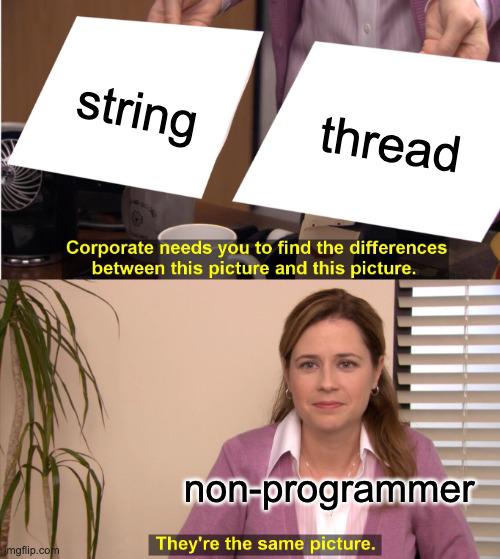
The classic programmer evolution: we go from patiently explaining code to non-programmers, to barely tolerating other programmers, to just letting AI handle everyone. Skipped right past "working with humans" and went straight to "let the machines deal with it." Honestly can't blame anyone for taking this route. Why debug someone else's spaghetti code when you can just prompt engineer your way out of human interaction entirely? The side-eye gets progressively more intense with each panel, which is just *chef's kiss* accurate.

Important To Stay Dry

Important To Stay Dry
DRY (Don't Repeat Yourself) is that sacred programming principle where you write code once and reuse it everywhere instead of copy-pasting like a maniac. So naturally, when faced with the temptation to buy a second box of cookies—which would be, you know, repeating yourself—you resist. Because principles matter. Even when they make absolutely no sense outside of your IDE. Your grocery bill thanks you, your waistline thanks you, but your soul knows you're just one refactoring session away from buying the entire cookie aisle and calling it "abstraction."

Better Than Dark Souls

Better Than Dark Souls
The legendary Black Mesa taco hitbox—a collision detection nightmare that makes every boss fight look like child's play. You see that beautiful taco? Yeah, good luck actually hitting it because the hitbox is doing its own thing in a parallel dimension. It's giving "I swear I clicked on that button" energy but for video games. The hitbox is literally just vibing somewhere near the taco, not even trying to match the actual model. This is what happens when your collision mesh goes rogue and decides geometry is merely a suggestion. Game developers everywhere are sweating nervously because they KNOW they've shipped something like this.