


This Made Me Overthink

This Made Me Overthink
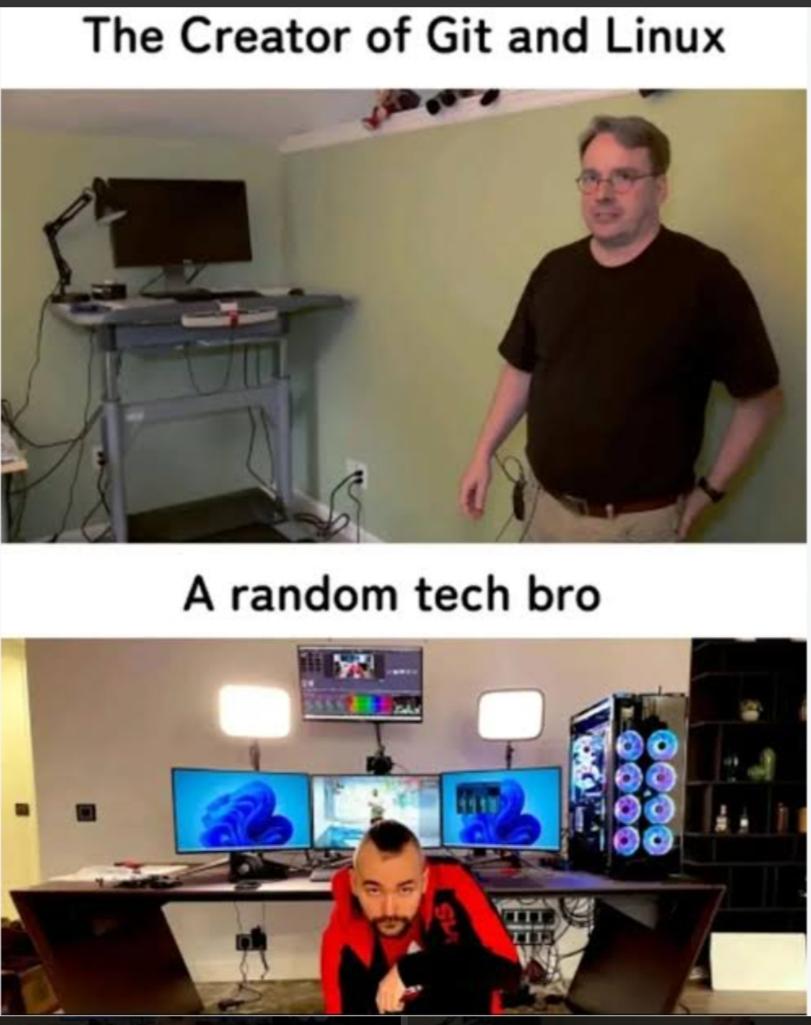
Linus Torvalds literally built the two most fundamental tools that power modern software development—Git and the Linux kernel—and apparently does it from what looks like a minimalist standing desk setup that screams "function over form." Meanwhile, your average developer needs a triple-monitor battlestation with RGB everything, studio lighting, and a gaming chair that costs more than their first car just to push code to a GitHub repo. The irony is chef's kiss . The guy who created the version control system we all worship daily doesn't need a NASA command center to work—but we sure as hell think we do. It's the ultimate humbling moment: realizing that raw genius and world-changing contributions don't require a $10K setup. They just require... well, being Linus Torvalds. The rest of us are just compensating with RGB fans.

Trust Me Bro 384 Bit

Trust Me Bro 384 Bit
When someone brags about their "revolutionary" 384-bit encryption system, but the math just... doesn't check out. We've got 32-bit, 64-bit, 128-bit, 256-bit systems everywhere in computing, but 384-bit? That's 2^384 - 1, which is literally just flexing with numbers that don't align with standard computing architectures. It's like claiming your startup has "military-grade blockchain AI" when you're just using bcrypt with default settings. The fancy old-timey folks (representing established standards) are sitting there with their proper power-of-2 bit systems while someone's out here inventing random numbers. Sure, 384 exists in some niche crypto contexts, but it's giving major "I made this up in a pitch deck" energy. Nothing screams "I don't understand computer architecture" quite like confidently throwing out non-standard bit sizes to sound impressive.

Coworker Disrupts Flow State

Coworker Disrupts Flow State
You're three hours deep into solving a gnarly algorithm, finally understanding the recursive call stack, variables are perfectly named, the solution is crystallizing in your mind—and then Steve from accounting walks over with "You got a minute?" Spoiler alert: It's never a minute. It's a 20-minute tangent about his printer driver, and now you're staring at your code like it's written in ancient Sumerian. The mental stack you so carefully built? Gone. Obliterated. You'll spend the next hour trying to remember what that variable tempVal2 was supposed to represent. Fun fact: Studies show it takes an average of 23 minutes to fully regain focus after an interruption. So no, Steve, I don't have a minute. I have negative 23 minutes now.

All The Day Everyday

All The Day Everyday
The eternal paradox of the AI era: study more CS to stay relevant because AI can't replace you yet, or stop studying because AI will replace you anyway. Either way, you're still running from the same existential crisis, just with different motivations. The trash pile gets bigger regardless of which path you choose, and both lead to the same confused destination. It's like Schrödinger's career anxiety—you're simultaneously upskilling and giving up until you check LinkedIn and collapse into a state of pure panic.

The Best Generation

The Best Generation
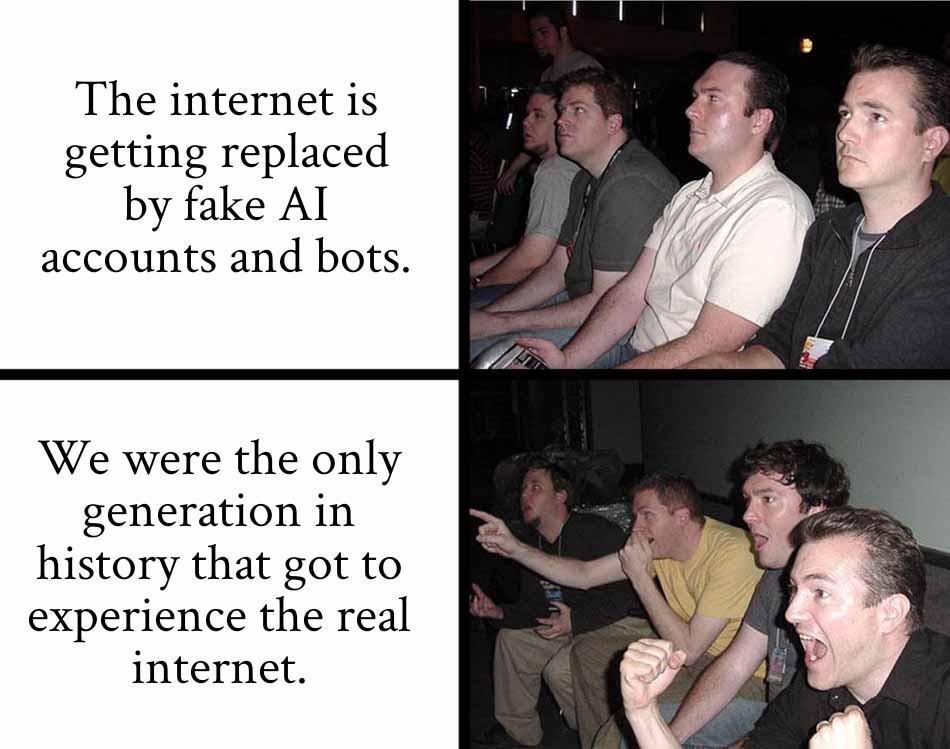
Top panel: mild concern about the death of authentic human interaction online. Bottom panel: pure, unfiltered nostalgia for the golden age when you could actually tell if you were arguing with a real person or just some dude's perl script. There's something bittersweet about being the generation that witnessed the internet transition from "you're probably talking to a real person" to "is this ChatGPT or my actual friend?" We got to experience forums where people were genuinely passionate weirdos, not engagement-farming LLMs trained on passionate weirdos. We lived through the era where if someone was being stupid online, at least they were authentically stupid. Now every comment section is a Turing test, every profile pic is suspect, and that helpful Stack Overflow answer might've been written by GPT-4. The real internet died somewhere between Web 2.0 and the bot apocalypse, and we were there to see it happen.

HUANUO 32 inches Dual Monitor Stand up to 17.6lbs per Arm, High-Grade Aluminum Free Standing Dual Monitors Mount for 2 Screens. Fully Adjustable Dual Monitor Stand for Desk with Tilt, Swivel, Rotation

HUANUO 32 inches Dual Monitor Stand up to 17.6lbs per Arm, High-Grade Aluminum Free Standing Dual Monitors Mount for 2 Screens. Fully Adjustable Dual Monitor Stand for Desk with Tilt, Swivel, Rotation
Compatibility: To ensure compatibility with the dual monitor stand, your each monitor must meet three conditions at the same time: First, computer screens size range: 13 to 32 inches. Second, screen …

Epic Store Should Get What The CEO Wants, Right?

Epic Store Should Get What The CEO Wants, Right?
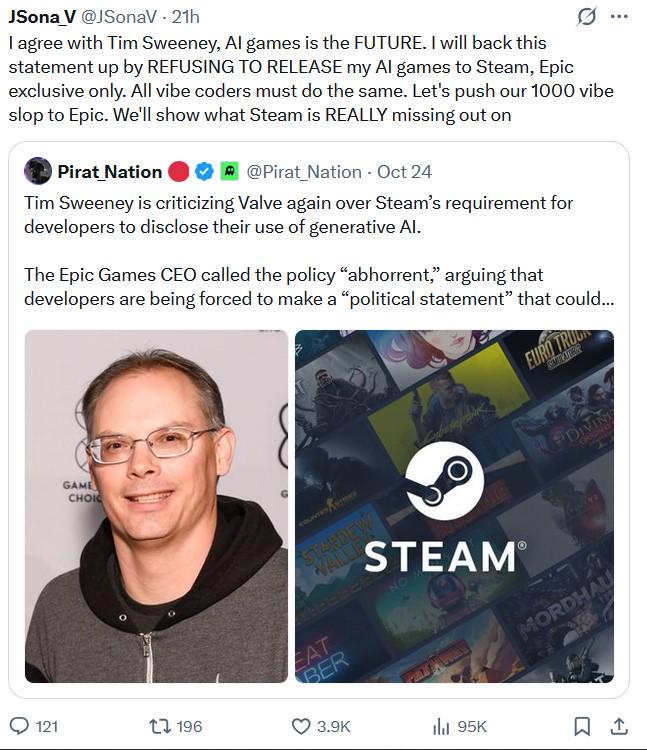
So Tim Sweeney, Epic's CEO, is out here throwing shade at Steam for requiring devs to disclose their AI usage, calling it "abhorrent" and a forced "political statement." Meanwhile, some galaxy-brain developer decides to take him at his word and goes full malicious compliance mode: "You know what? I'm making my AI game Epic exclusive! Let's push that '1000 vibe slop' and show Steam what they're missing!" The irony is chef's kiss delicious. Sweeney complains about transparency requirements being too political, so naturally someone responds by... making an actual political statement through platform exclusivity. It's like complaining about food labels and then someone force-feeding you mystery meat. The real kicker? Epic Store has been desperately trying to compete with Steam for years through exclusivity deals and free games, but now they might end up being the dumping ground for undisclosed AI-generated games. Careful what you wish for, Tim. You might just get a storefront full of it.

Indian Padlock

Indian Padlock
When your security implementation is just off-by-one errors all the way down. The combination is literally 3-4-5, because apparently someone thought the Pythagorean theorem was the ultimate password strategy. It's like using "password123" but for physical locks – technically it works, but you're basically just asking to get breached. The minus sign at the end really ties it all together, like the lock is doing some mental arithmetic before deciding whether to open. "Let me just subtract my self-respect real quick..."

I'll Pass On 30 Fps

I'll Pass On 30 Fps
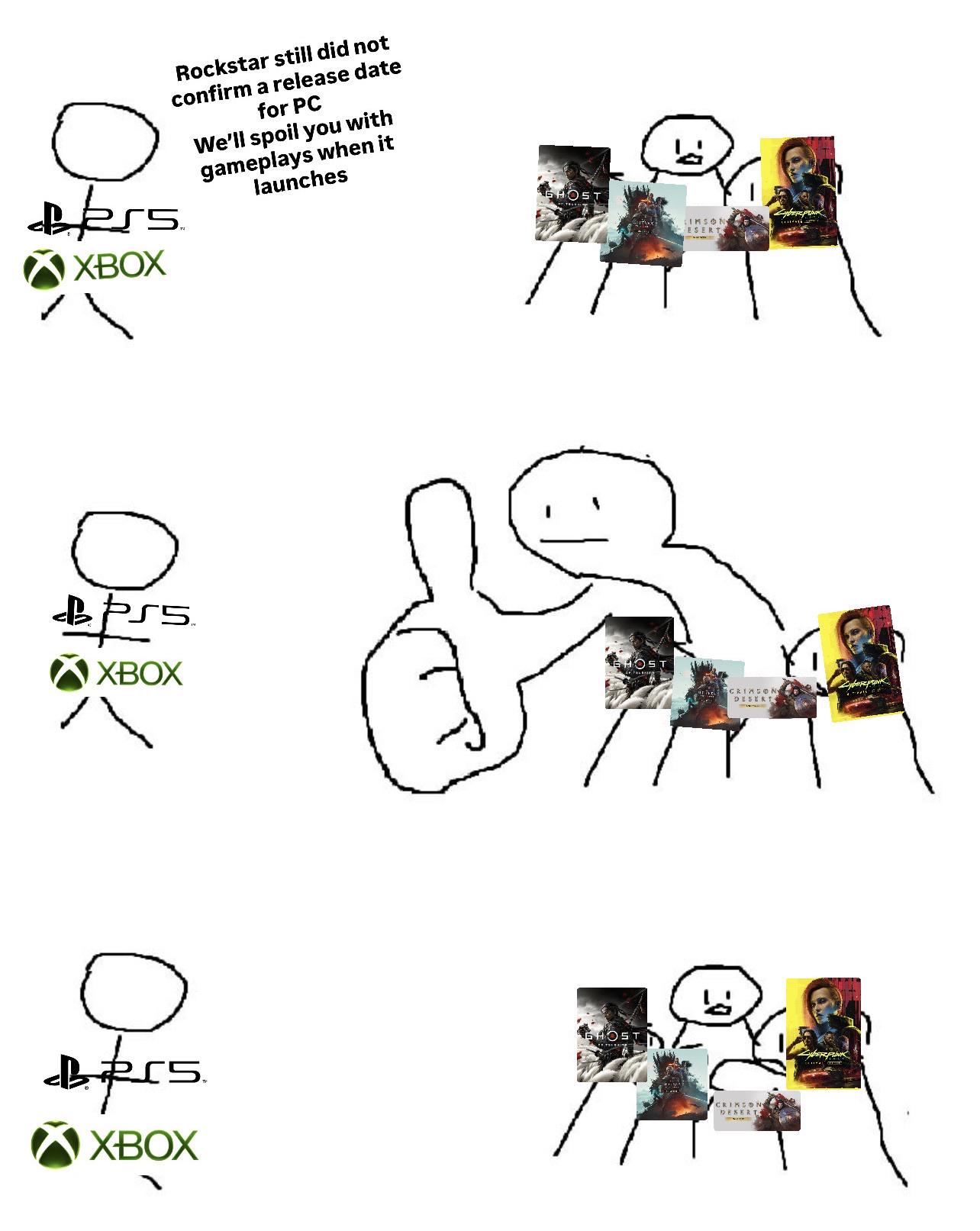
PC gamers really said "you know what, I'd rather wait indefinitely than play at peasant framerates." Console players are out here getting spoiled with exclusive releases and early access, but PC folks would literally rather stare at their Steam library of 500 unplayed games than touch a 30 FPS experience. The commitment to buttery smooth 144Hz is honestly admirable in the most stubborn way possible. It's like refusing a free pizza because it's not wood-fired artisan sourdough crust. The real kicker? Half those PC gamers will eventually buy the game at full price anyway when it drops on PC, while console players have already moved on to the next title. But hey, at least those extra frames were worth the wait, right?

Monolith Vs Microservices

Monolith Vs Microservices
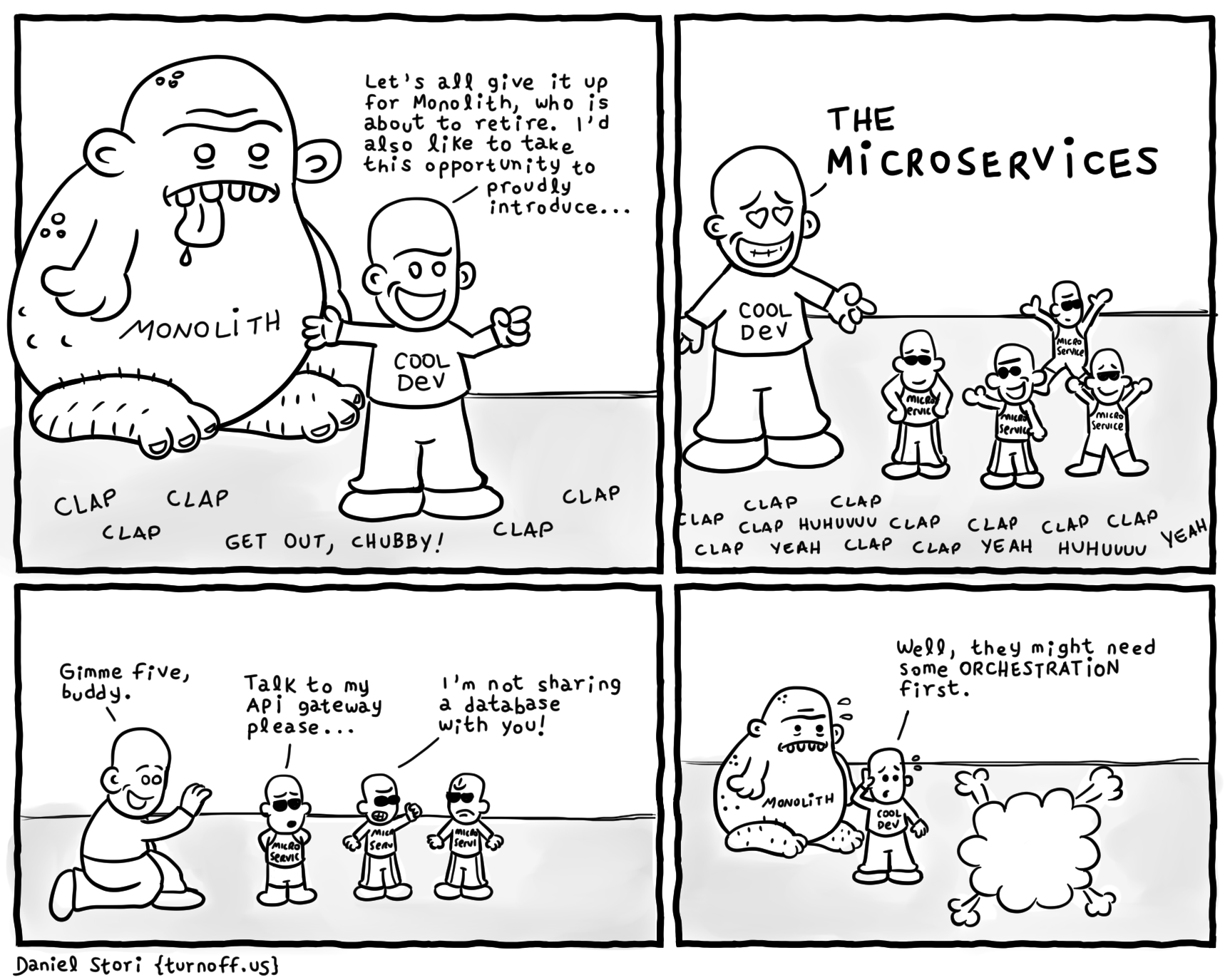
The classic bait-and-switch that happens at every tech company. You think you're upgrading from that sluggish, bloated monolith to a sleek microservices architecture, but what you actually get is a distributed nightmare where services refuse to talk to each other, everyone's fighting over databases, and suddenly you need Kubernetes just to run "Hello World." The monolith might've been a chubby mess, but at least it was one chubby mess. Now you've got four tiny messes that can't agree on anything, need an API gateway to communicate, and require a full-time DevOps team just to keep them from exploding. The orchestration cloud at the end? That's your AWS bill after running 47 microservices that could've been functions in a single codebase. Spoiler: The monolith is still there in production because nobody wants to touch the migration.

This Is The Start Of Everything Falling Apart, I Can Feel It

This Is The Start Of Everything Falling Apart, I Can Feel It
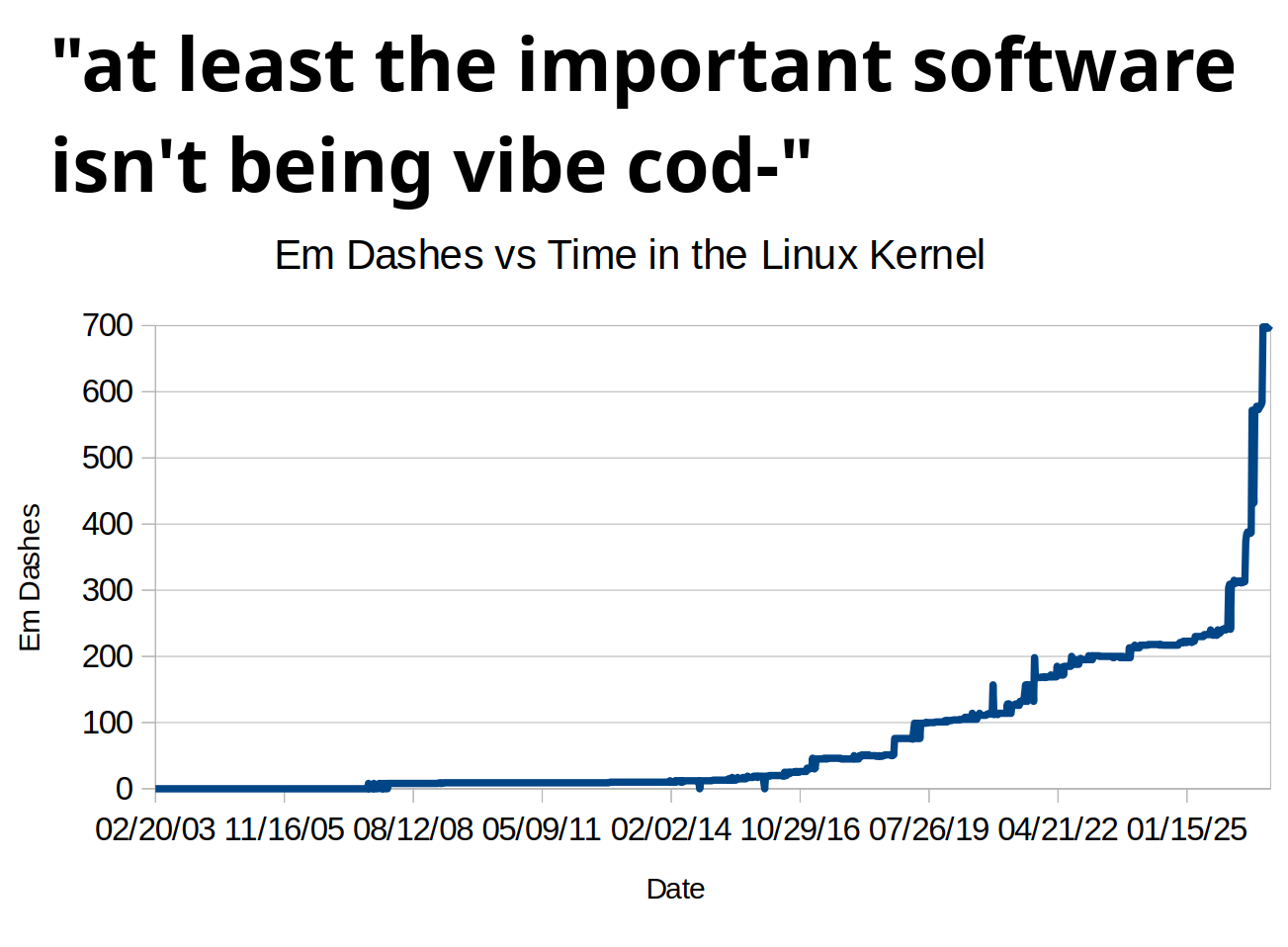
Oh, wonderful! The Linux kernel—you know, the thing that literally runs THE ENTIRE INTERNET and half the world's infrastructure—has decided that em dashes are the new hotness. For over 20 years, developers were chill, keeping things steady at around 100-200 em dashes. But then 2022 hit and someone apparently discovered the em dash key, and now we're rocketing toward 700 like it's a SpaceX launch. Nothing screams "impending doom" quite like watching a graph go vertical in critical system code. Sure, the banking system works fine, your servers are stable, BUT HAVE YOU SEEN THE EM DASH COUNT?! Someone out there is rewriting comments with the passion of a literature major, and honestly? That exponential curve is giving major "right before the crash" energy. RIP stability, hello fancy punctuation.

VIVO Black 60 x 30 in Stand Up Desk, DESK-KIT-1B6B-30

VIVO Black 60 x 30 in Stand Up Desk, DESK-KIT-1B6B-30
Create Instant Active Standing: Go from sitting to standing in one smooth motion with this complete workstation providing comfortable viewing angles and customized user heights · Spacious 3-Piece 59”…

Something Something Bits In A Private Key

Something Something Bits In A Private Key
When someone asks if a 4-bit encryption key is secure enough, the answer really does depend on context. Like, are you encrypting your grocery list? Sure, go wild. Your company's customer database? Yeah, that's getting cracked faster than you can say "data breach." For reference, a 4-bit key has exactly 16 possible combinations. That's not even brute-force territory—that's just... force. Meanwhile, modern encryption standards use 256-bit keys, which have more possible combinations than there are atoms in the observable universe. But hey, four is technically a number, so I guess it counts as encryption? The real kicker is watching junior devs discover that "security through obscurity" isn't actually a thing while their 8-character password requirement gets demolished in milliseconds. Context matters, people.

The Internet

The Internet
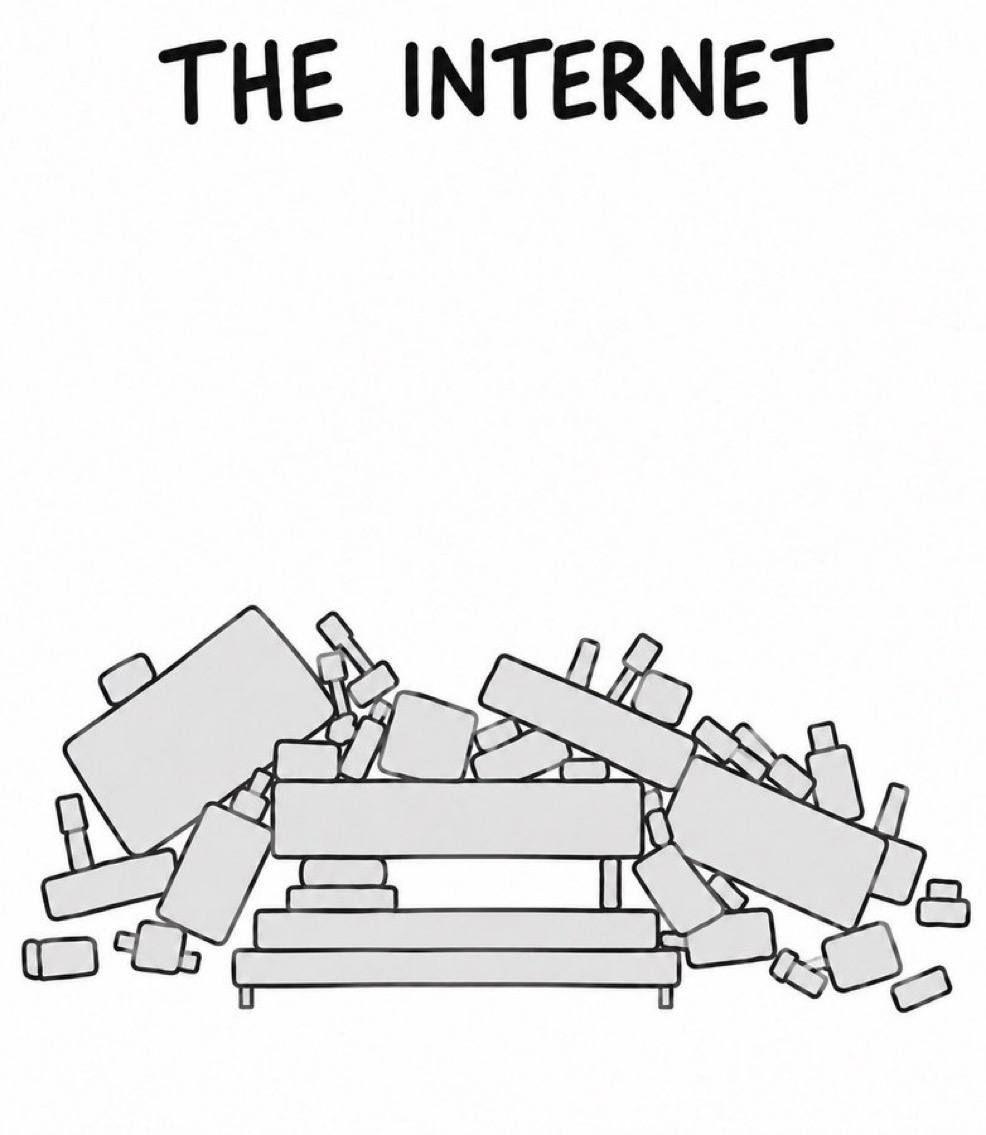
A literal pile of network switches and routers haphazardly stacked on top of each other. Honestly, this is more accurate than any fancy diagram you'll find in a networking textbook. The entire global infrastructure runs on equipment that's been "temporarily" rack-mounted since 2003, held together with zip ties and prayers. Somewhere in this mess is the cable that keeps your production environment running, and nobody knows which one it is. Don't touch anything.