Wtf Memes

Posts tagged with Wtf
The One And Only Measurement

The One And Only Measurement
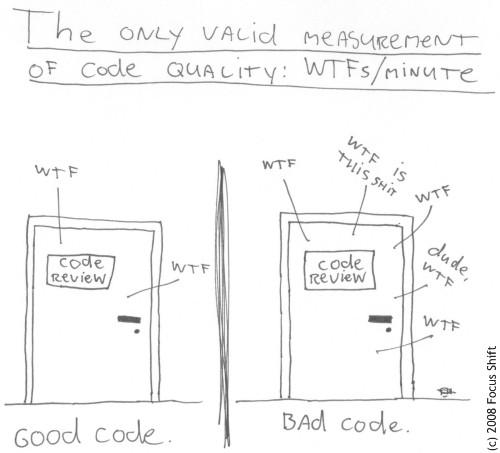
So apparently the ONLY scientifically valid metric for measuring code quality is WTFs per minute during code review, and honestly? The accuracy is TERRIFYING. Good code gets you maybe one confused "WTF" every few minutes. Bad code? You're drowning in a tsunami of "WTF IS THIS?!" and "DUDE WTF" faster than you can say "technical debt." It's like the difference between a gentle rain and a category 5 hurricane of confusion. Forget cyclomatic complexity, forget test coverage—if your teammate is muttering expletives at a rate that could power a small generator, you KNOW you've written some truly cursed garbage. The people have spoken, and they're screaming WTF.

JavaScript Is Weird

JavaScript Is Weird
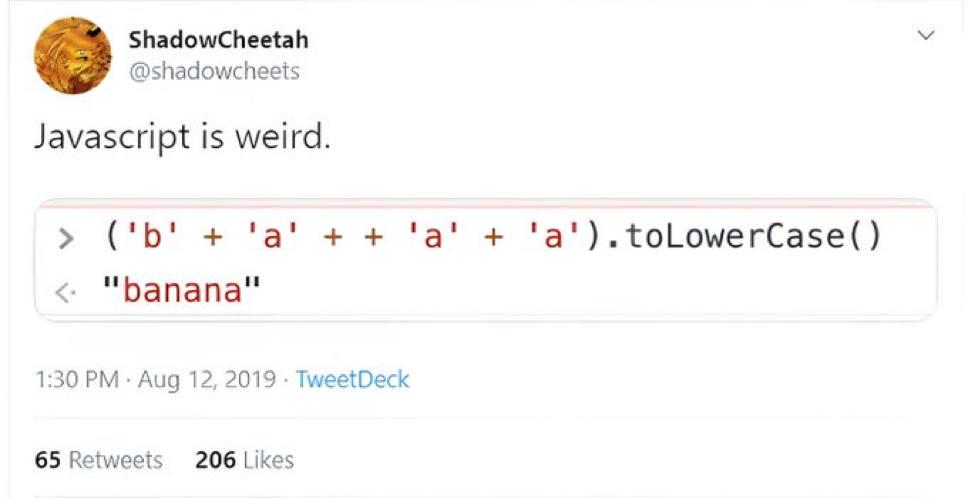
So you're telling me that adding the string 'b' to 'a' twice, then adding 'a' twice more, and calling toLowerCase() somehow produces "banana"? Yeah, that tracks. JavaScript's type coercion is basically that friend who always "helps" by making things infinitely more confusing. Here's what's happening: 'b' + 'a' gives you "ba". Then + + converts the next 'a' to NaN (because unary plus on a string that's not a number = NaN). "ba" + NaN = "baNaN". Add another 'a' and you get "baNaNa". Call toLowerCase() and boom—"banana". It's like JavaScript is gaslighting you into thinking this makes sense. The real question is: who discovered this, and what were they doing at 3 AM to stumble upon it?

Now Which One Of You Wrote This Library

Now Which One Of You Wrote This Library
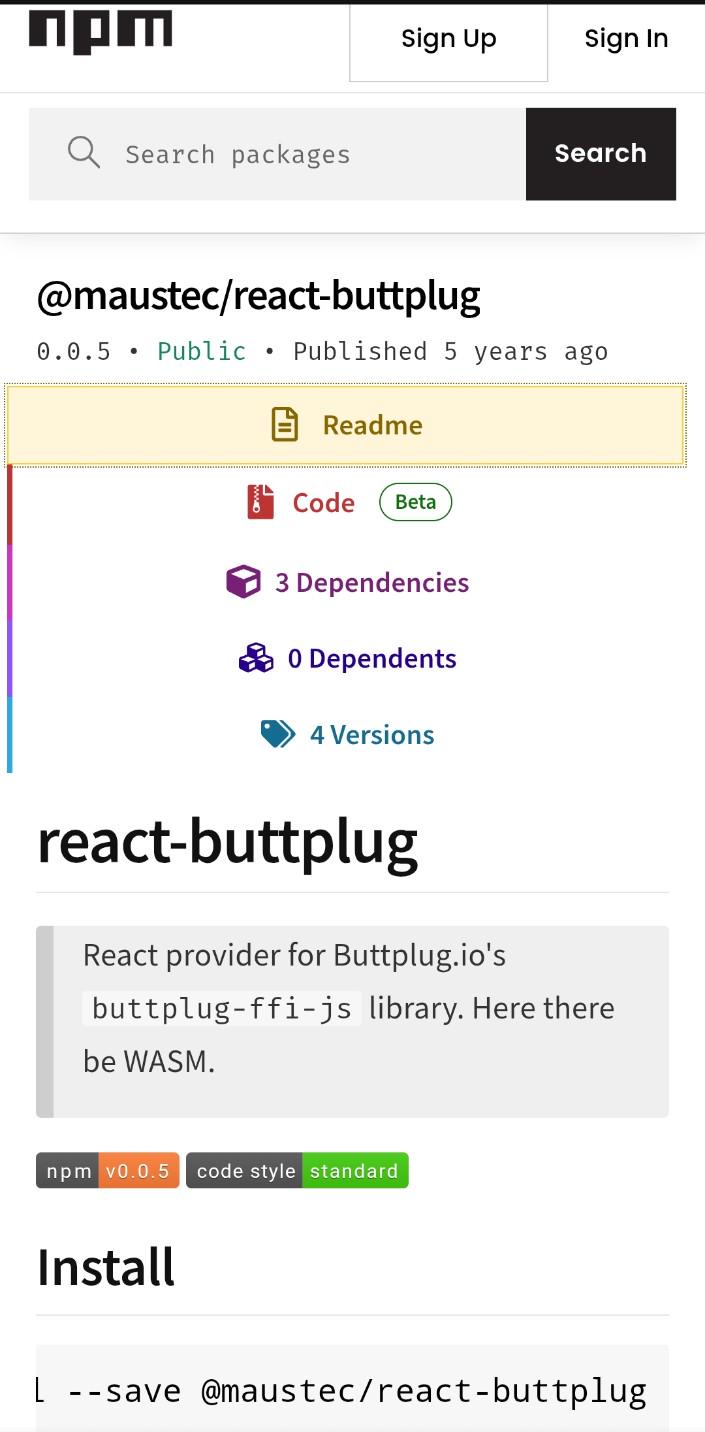
Found in the wild depths of npm: a package called "react-buttplug" that connects React to... well, exactly what you think. The description "Here there be WASM" is the cherry on top of this cursed sundae. The fact that someone spent actual development hours creating a React provider for Buttplug.io (a real "intimate hardware" API) and then published it with that name is peak developer humor. Five years later and zero dependents - shocking absolutely no one. This is what happens when you tell developers "you can build anything" without adding "but please don't."

I Swear It Was Broken Before

I Swear It Was Broken Before
That awkward moment when your code decides to work after you've spent two hours debugging it, and you have absolutely no idea why. Just sitting there with that Kermit face, questioning your entire career choice. Is it cosmic rays? Cache clearing itself? The programming gods taking pity on you? Whatever it is, you'll take the win but deep down you know this mysterious fix will come back to haunt you in production next week. The most terrifying line in programming isn't an error message—it's code that works when it absolutely shouldn't.

JavaScript's Equality: A Horror Story

JavaScript's Equality: A Horror Story
OH. MY. GOD. Welcome to the JavaScript circus of horrors where zero equals a string of "0.0" but zero with an 'n' doesn't?! And then—PLOT TWIST—the string "0.0" with a NOT operator suddenly equals zero with an 'n'?! 💀 This is the EXACT moment your brain cells commit mass suicide during a coding session. JavaScript's type coercion is like that toxic ex who keeps changing the rules mid-argument. "Yeah, that makes sense" turns into "WHAT THE ACTUAL HELL IS HAPPENING" faster than you can say "use TypeScript instead."

JavaScript's Quantum Logic: NaN Is A Number

JavaScript's Quantum Logic: NaN Is A Number
JavaScript's type coercion strikes again! In JS, NaN (Not a Number) is technically categorized as a "number" type. Check it yourself with typeof NaN and watch your sanity slowly dissolve. It's like labeling a vegetarian restaurant "meat" because it's a food-related establishment. The wide-eyed shock on that cat's face perfectly represents every developer's reaction when discovering this cosmic joke buried in the language spec. The ECMAScript committee is probably still giggling about this one.

Some Actual Code I Found Inside A Game

Some Actual Code I Found Inside A Game
The code is a perfect example of why game developers shouldn't be allowed near RNGs unsupervised! 😂 What we're looking at is a glorious mess of Python where someone created two nearly identical functions ( count_greater_than_11 and count_greater_than_5 ) that generate random numbers between 1-20 and increment a counter when the number exceeds a threshold. But wait! The function names and comments don't even match - one says "greater than 11" in the comment but checks for > 10 in the code, while the other claims to check for > 5 but actually checks for > 4! And then there's that lonely is_divisible_by_7 function at the bottom, just hanging out with no apparent connection to anything else. It's like someone started implementing their own version of RNG bias with specific magic numbers, got bored halfway through, and shipped it anyway. This is probably why that boss battle feels unfairly difficult every 7th attempt...

JavaScript's Type Conversion: A Horror Story

JavaScript's Type Conversion: A Horror Story
JavaScript's type conversion is like that friend who's confident but wrong about everything. Empty string? That's clearly 0! "07foo"? Obviously 7! And my personal favorite: a tiny decimal like 0.0000005 somehow becomes 5, because who needs those pesky zeros anyway? The best part is how parseInt() and Number() can't even agree with each other. One sees scientific notation, the other just sees numbers to ignore. It's like watching two drunk mathematicians argue about how to split the bill. This is why JavaScript developers drink.

The Quantum Debugging Paradox

The Quantum Debugging Paradox
The universal debugging strategy: code breaks, add a comment that changes absolutely nothing, suddenly works. That moment of existential dread when you realize you're not actually in control of your own code. The compiler is just letting you think you are. Quantum debugging - where observing the problem fixes it, but you'll never know why. Just back away slowly and don't make eye contact with the codebase.