

Workplace culture Memes

Posts tagged with Workplace culture
These Heroes Are The Real Ones

These Heroes Are The Real Ones
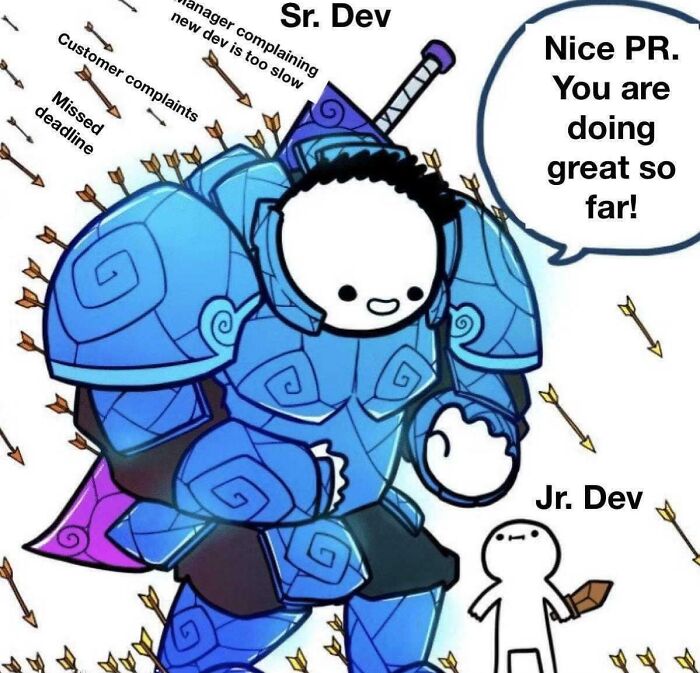
You know what's beautiful? When a senior dev shields their junior from the absolute chaos raining down from management, customers, and missed deadlines. While the Sr. Dev is out here taking arrows like a tank in full armor—dealing with complaints about velocity, feature creep, and that one customer who thinks their bug is literally bringing down civilization—the junior dev gets to just... code. That simple "Nice PR. You are doing great so far!" is doing more heavy lifting than any sprint retrospective ever could. It's not just positive reinforcement; it's creating a safe space where juniors can actually learn without getting traumatized by the business side of software development. The senior is basically saying "I got the politics, you got the semicolons." Real leadership isn't about delegating stress—it's about absorbing it so your team can focus on what matters. And honestly? That's the difference between a senior developer and a senior developer.

Two Types Of Sidekicks

Two Types Of Sidekicks
When you're pair programming and your teammate is either your biggest cheerleader or your harshest critic. No in-between. On the left, we've got the supportive dev who thinks every semicolon you type is genius-level work. On the right? That's the senior developer who's been watching you write a nested for-loop inside a while loop and is about to have an aneurysm. The duality of code review culture in one image. Either you get the wholesome "great job on that PR!" comment, or you get 47 change requests and a link to Clean Code with a passive-aggressive "might be helpful :)" attached.

Just Try It

Just Try It
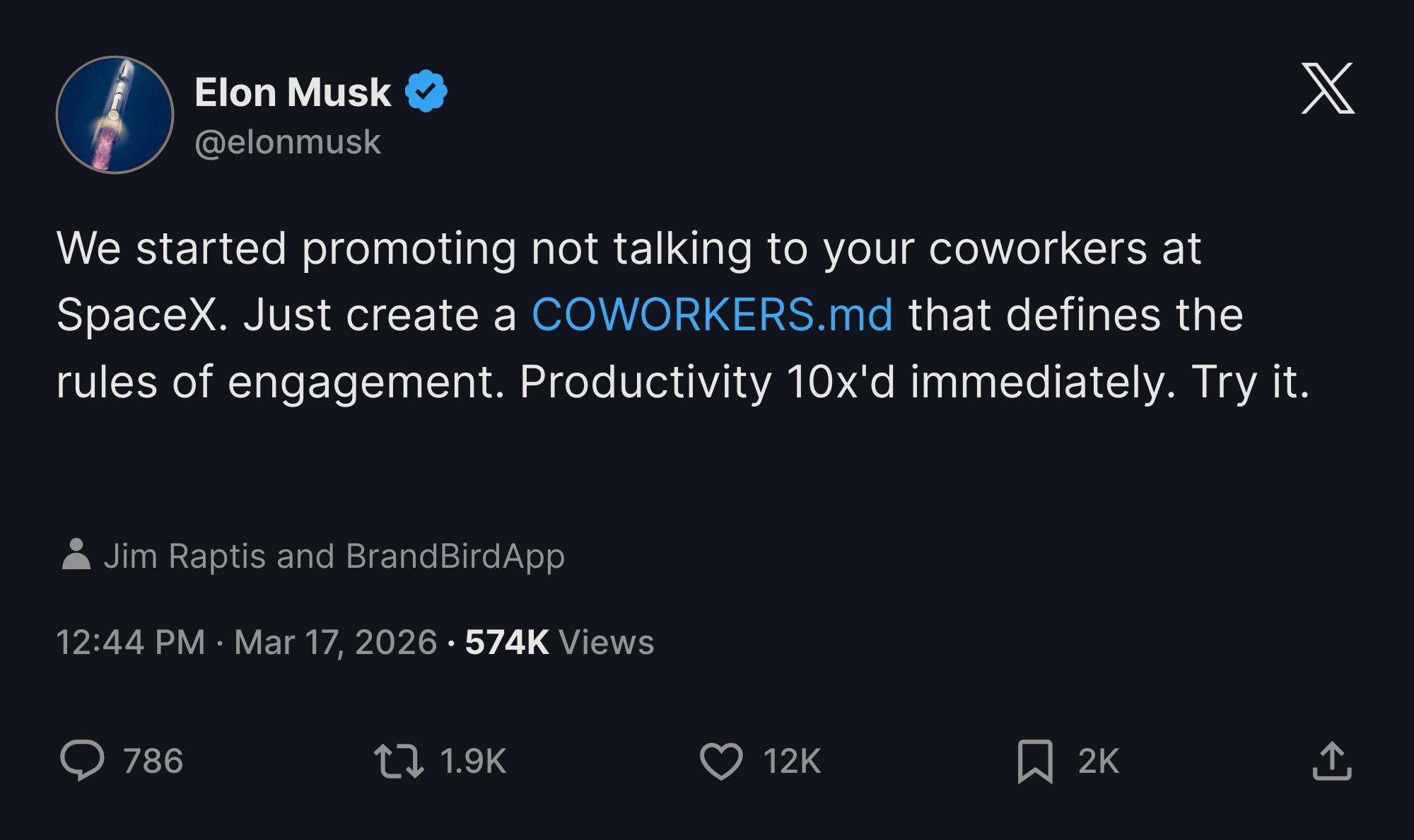
When your CEO discovers markdown files and suddenly thinks documentation will solve all your communication problems. "Productivity 10x'd immediately" - yeah, because nothing says productivity boost like everyone frantically updating a COWORKERS.md file instead of just... you know... talking. The real joke here is thinking a single markdown file will magically transform workplace culture. We've all seen this play out: Week 1, everyone's excited and updating the doc. Week 2, it's outdated. Week 3, nobody remembers it exists. Week 4, someone creates a COWORKERS_v2.md because the first one got too messy. But hey, at least they can version control their social awkwardness now. Git blame will have a whole new meaning when you need to figure out who added "Jim talks too loud during standup" to the repo.

Who Was It

Who Was It
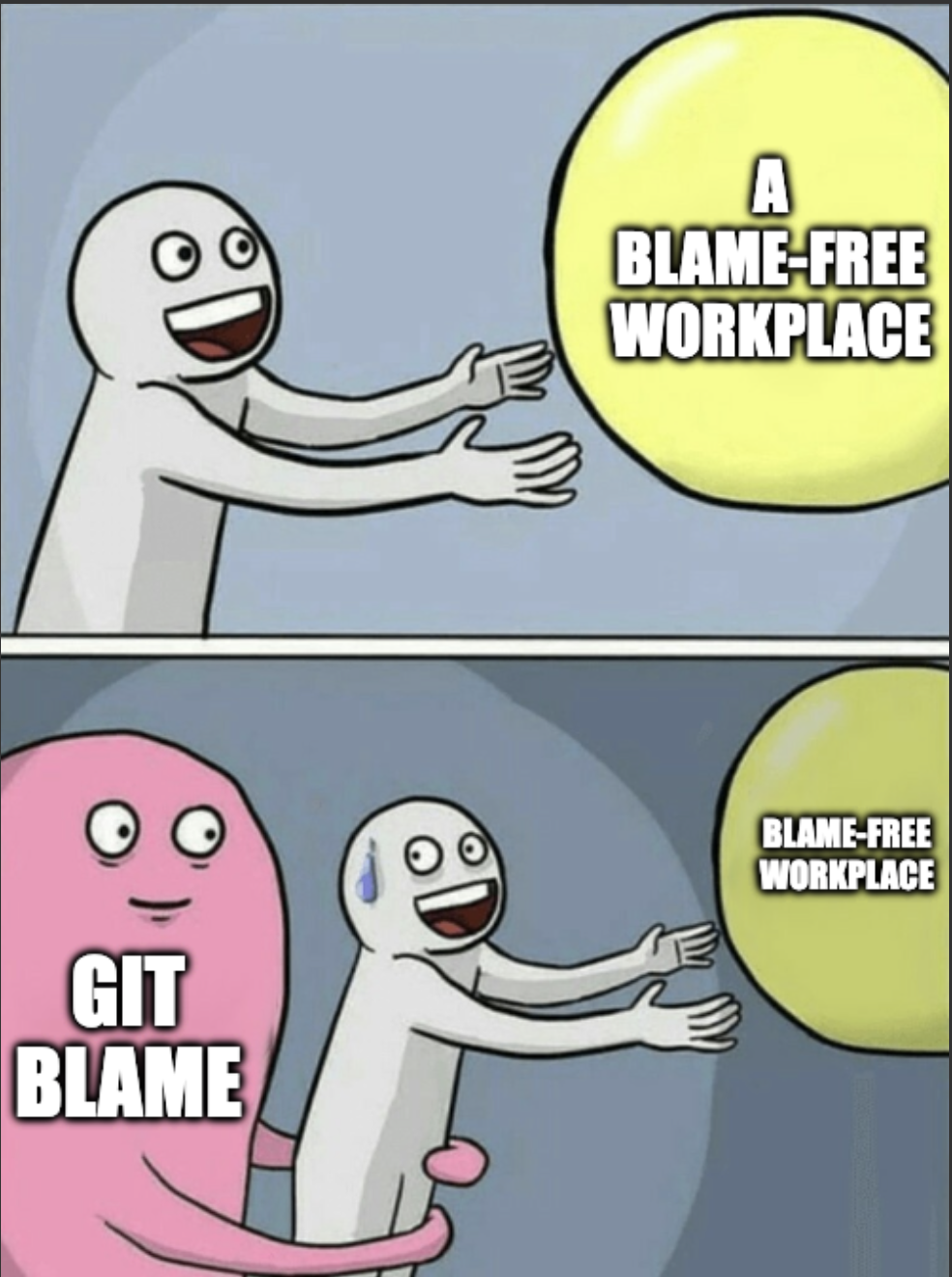
You want a blame-free workplace? Sure, until someone pushes broken code to production at 4:59 PM on Friday. Then suddenly git blame becomes your best friend and detective work begins. The beautiful irony here is that Git literally has a command called "blame" built right into it. It's like the version control system knew from day one that developers would need someone to point fingers at. We say we want psychological safety and blameless postmortems, but the moment the build breaks, we're all running git blame faster than you can say "code review." Fun fact: git blame was almost called git praise in early discussions, but let's be real—nobody runs that command to congratulate someone on their excellent variable naming.

Ultra Casual

Ultra Casual
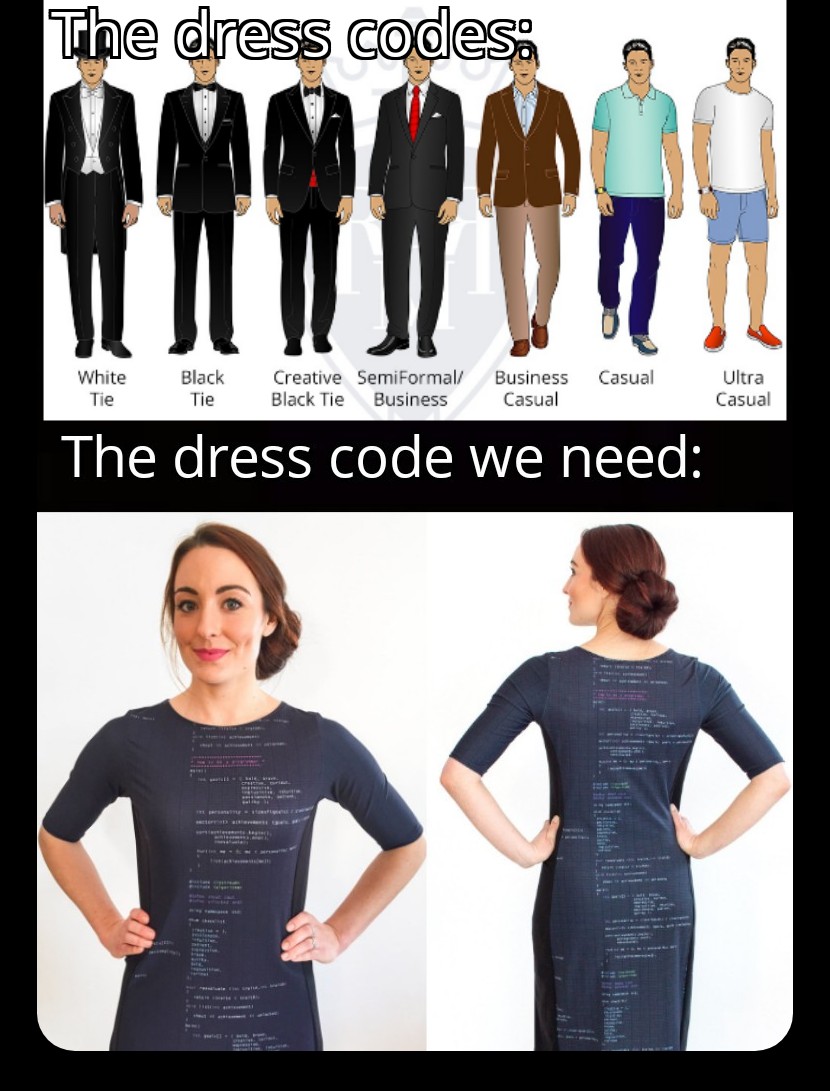
The corporate world has this whole spectrum of dress codes from white tie (basically penguin cosplay) to ultra casual (shorts and a t-shirt). But developers? We've transcended this primitive classification system entirely. Why settle for "ultra casual" when you can literally wear your code ? That dress covered in actual source code is the ultimate power move. You're not just casual—you're so committed to the craft that your clothing IS your work. It's like wearing a conversation starter that says "Yes, I can debug your legacy codebase while looking fabulous." Plus, imagine the efficiency: forgot a syntax? Just look down. Need to reference that regex pattern? It's on your sleeve. This is what peak performance looks like—literally turning yourself into a walking IDE. Business casual could never.

Together We Are Powerful

Together We Are Powerful
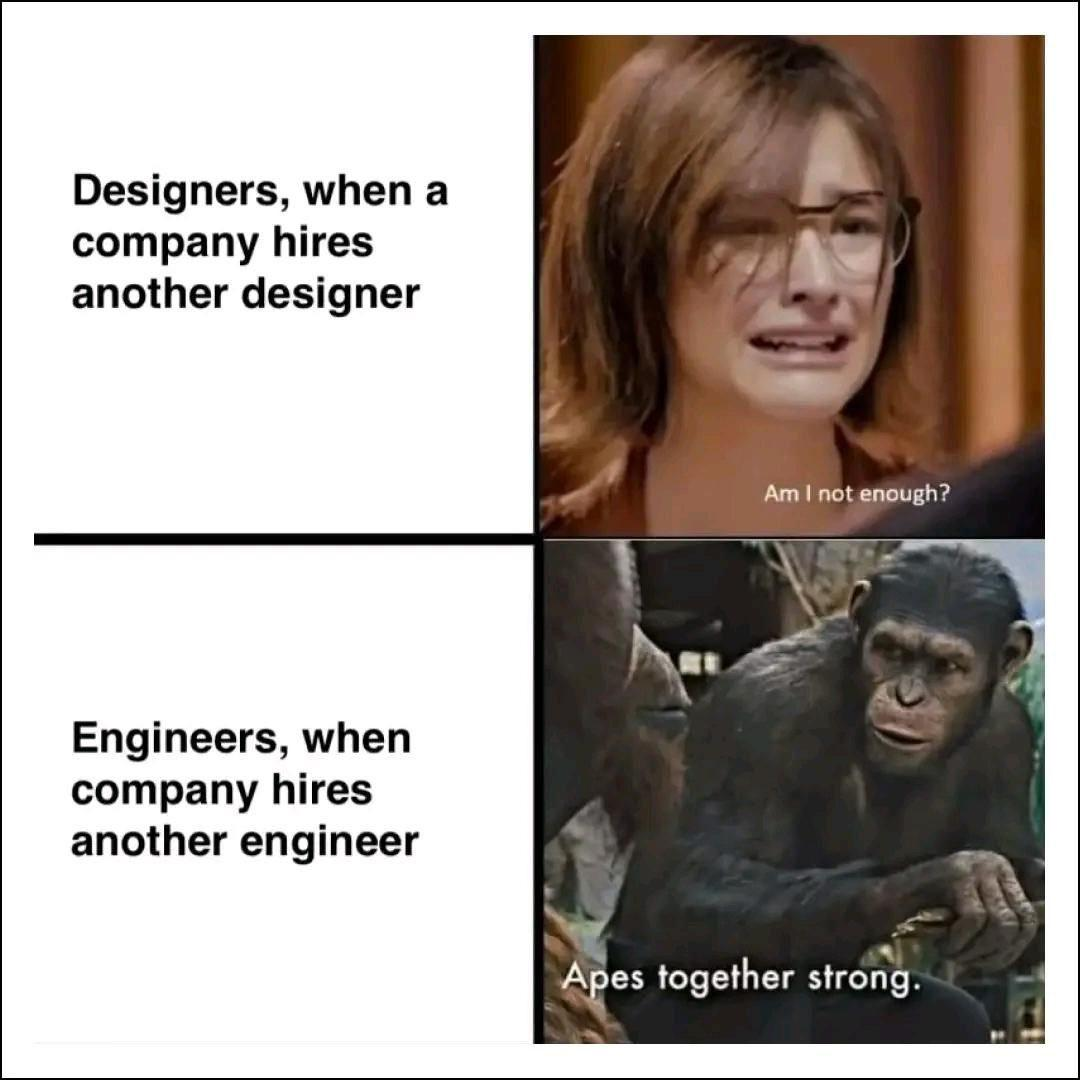
The eternal divide between creative insecurity and engineering solidarity. Designers see a new hire as competition, immediately questioning their worth and value. Meanwhile, engineers? They're just happy to have another warm body who understands what a merge conflict is. There's actually some truth here: design is often subjective and political, where one person's vision can overshadow another's. Engineering is more collaborative by necessity—nobody wants to be the only one on-call when production goes down at 2 AM. Plus, more engineers means less chance you'll be the one debugging that legacy code nobody wants to touch. Designers compete for creative ownership. Engineers unionize against the backlog.

Designers Vs Programmers: The Ownership Paradox

Designers Vs Programmers: The Ownership Paradox
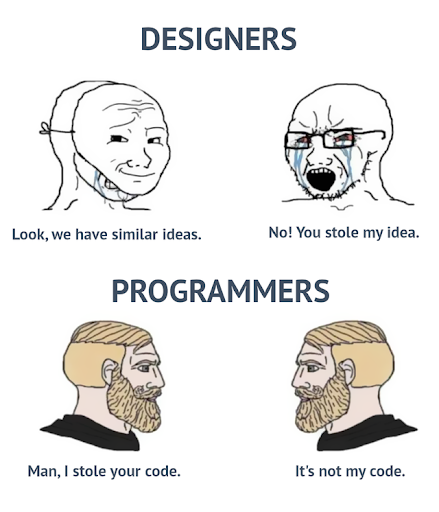
The eternal workplace dichotomy laid bare! Designers will fight to the death over who came up with the rounded corner first, while programmers are basically running a communist utopia of code ownership. Left side: Designer 1 politely suggests they had similar ideas. Designer 2 goes full rage mode, accusing theft like it's the heist of the century. Right side: Programmer 1 openly admits to code theft with zero shame. Programmer 2 responds with the ultimate defense mechanism: "It's not my code" – the programming equivalent of "I don't even want it anyway." Welcome to software development, where nobody wants to own the bugs but everyone wants credit for the pretty buttons.

Cable Matters 20Gbps USB C Switch, 3-in-1-Out, Supports Up to 8K@30Hz on Windows, 4K@60Hz on macOS, 140W PD, for Sharing a USB-C/Thunderbolt 4 Monitor or Dock (Not Work with Captive Cable Docks)

Cable Matters 20Gbps USB C Switch, 3-in-1-Out, Supports Up to 8K@30Hz on Windows, 4K@60Hz on macOS, 140W PD, for Sharing a USB-C/Thunderbolt 4 Monitor or Dock (Not Work with Captive Cable Docks)
Compatibility Warning: Use only the included USB4 20 Gbps cables. Do not use Thunderbolt 3/4/5 cables. The switch works with USB4 and Thunderbolt 4 docks, but its 20 Gbps bandwidth (vs. 40 Gbps for m…

Designers Cry In Figma, Engineers Unite In Git

Designers Cry In Figma, Engineers Unite In Git
The eternal workplace dichotomy exposed! Designers panic when new talent arrives—"Am I not enough?" they sob, fearing their pixel-perfect creations will be outshined. Meanwhile, engineers channel their inner Caesar from Planet of the Apes with "Apes together strong," embracing the reinforcements like it's another node in their distributed system. Why? Because designers fight for creative ownership while engineers know that more hands means someone else can debug that legacy codebase nobody wants to touch. The git commit history doesn't care who wrote it, just that it works!

Will Be Fun They Said

Will Be Fun They Said
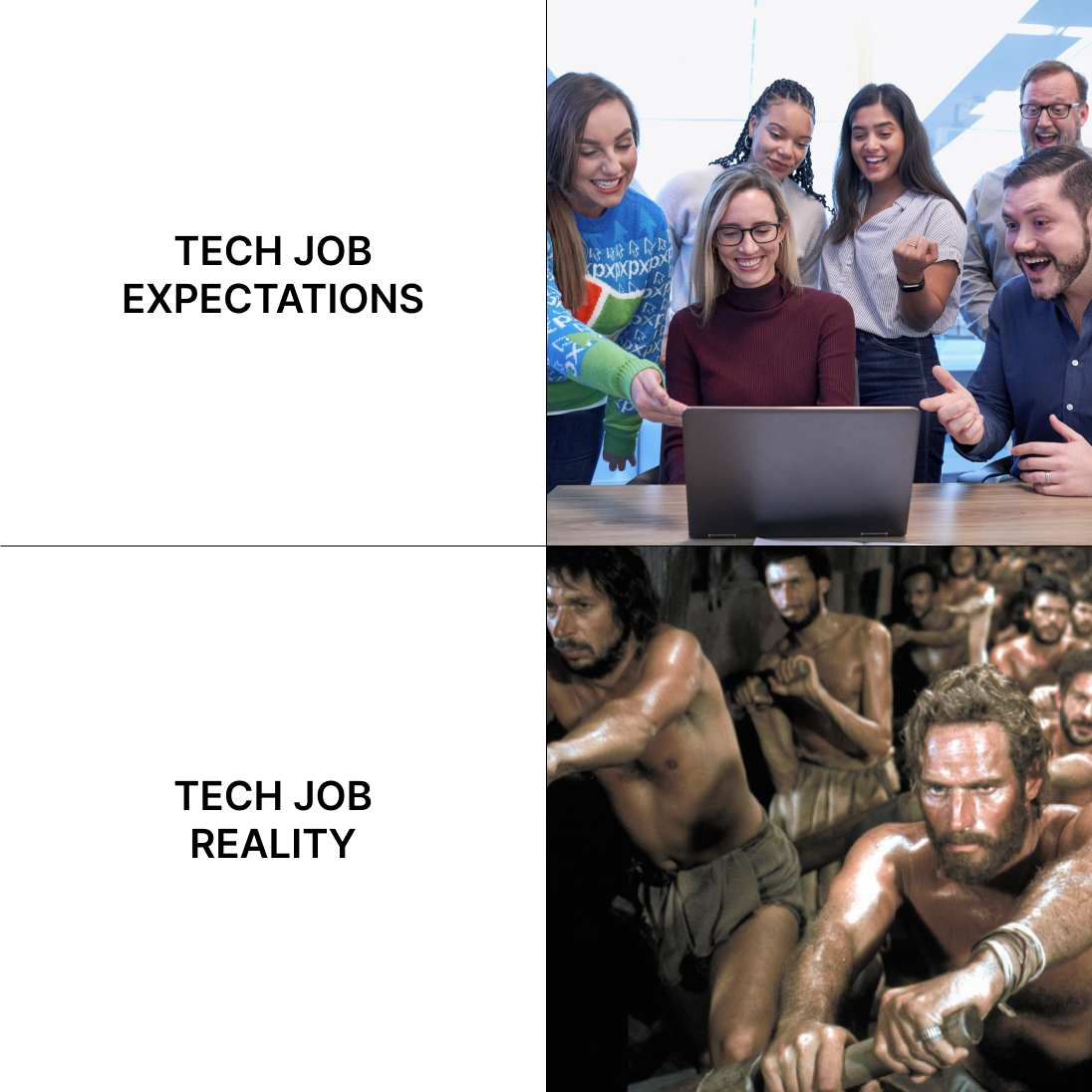
The recruiter's slideshow vs your actual sprint planning meeting. Top image: "Look at our amazing collaborative environment and ping-pong tables!" Bottom image: "Day 3 of trying to fix that legacy codebase with zero documentation while the deadline approaches and management keeps adding features." Nothing prepares you for the moment you realize your shiny new job is actually just rowing in the galley of a sinking ship.

Love Is Blind: Remote Edition

Love Is Blind: Remote Edition
The perfect romance of our time: remote-friendly companies gazing adoringly at talented employees. It's the tech industry's hottest love story since Stack Overflow and copy-paste. Companies are suddenly very interested in your pajama-wearing, coffee-chugging coding skills now that they've realized talent doesn't require a 2-hour commute and fluorescent lighting. The ultimate "swipe right" moment of the digital workplace revolution – except neither side has to pretend they're 6 feet tall.

I Will Refactor It Later Trust Me

I Will Refactor It Later Trust Me
The duality of feedback reception in tech is just *chef's kiss*. Designers will have an existential meltdown if you criticize their perfect shade of #F5F5F5, while programmers casually acknowledge their spaghetti code with a stoic "lol ikr" because deep down they've already accepted that future-them will deal with that nightmare. The "I'll refactor it later" promise is the programming equivalent of "I'll start my diet on Monday" – a beautiful lie we tell ourselves while continuing to nest if-statements 17 levels deep.

New Hiring Technique Just Dropped

New Hiring Technique Just Dropped
Turns out your resume needs a section for "emotional damage sustained in tech." This guy's hiring process is basically "prove you've been traumatized by a startup implosion or don't bother applying." The perfect candidate apparently rage-quits, deletes Slack, and flees the country—all skills apparently crucial for writing good abstractions. The "trauma-oriented development" approach is just corporate Stockholm syndrome with extra steps. Next they'll be measuring developer productivity in therapy bills.