University Memes

Posts tagged with University
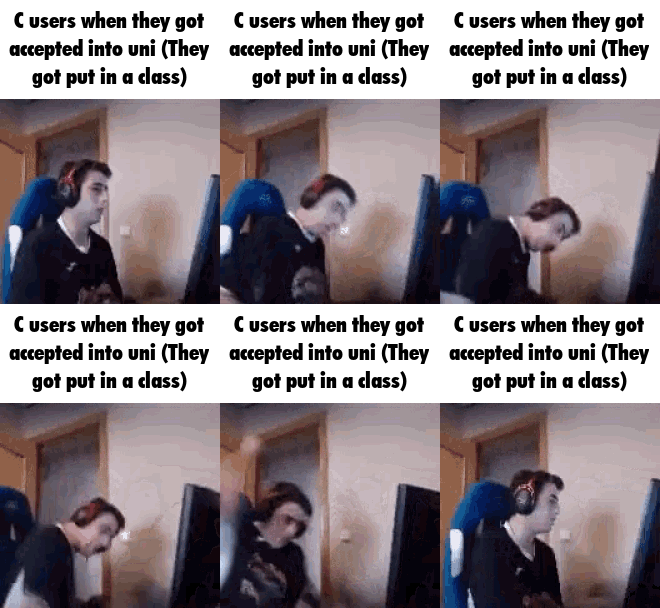
My School Struct

My School Struct
Oh, the absolute DEVASTATION of being forcibly enrolled in a university class like some sort of academic hostage! Someone literally designed a struct where C users are just... *placed* into classes against their will. No constructor with parameters, no consent, just raw memory allocation and BOOM—you're in Data Structures 101 whether you like it or not. The look of pure existential dread in that guy's face? That's the face of someone who just got memcpy'd into a Monday 8 AM lecture. Meanwhile, C++ users are out here with their fancy constructors and destructors, choosing their own destiny, while C programmers are getting struct-slapped into educational obligations like it's 1972. The struct doesn't care about your feelings, buddy. It just stores your data and ships you off to class. 💀

The Deadlock

The Deadlock
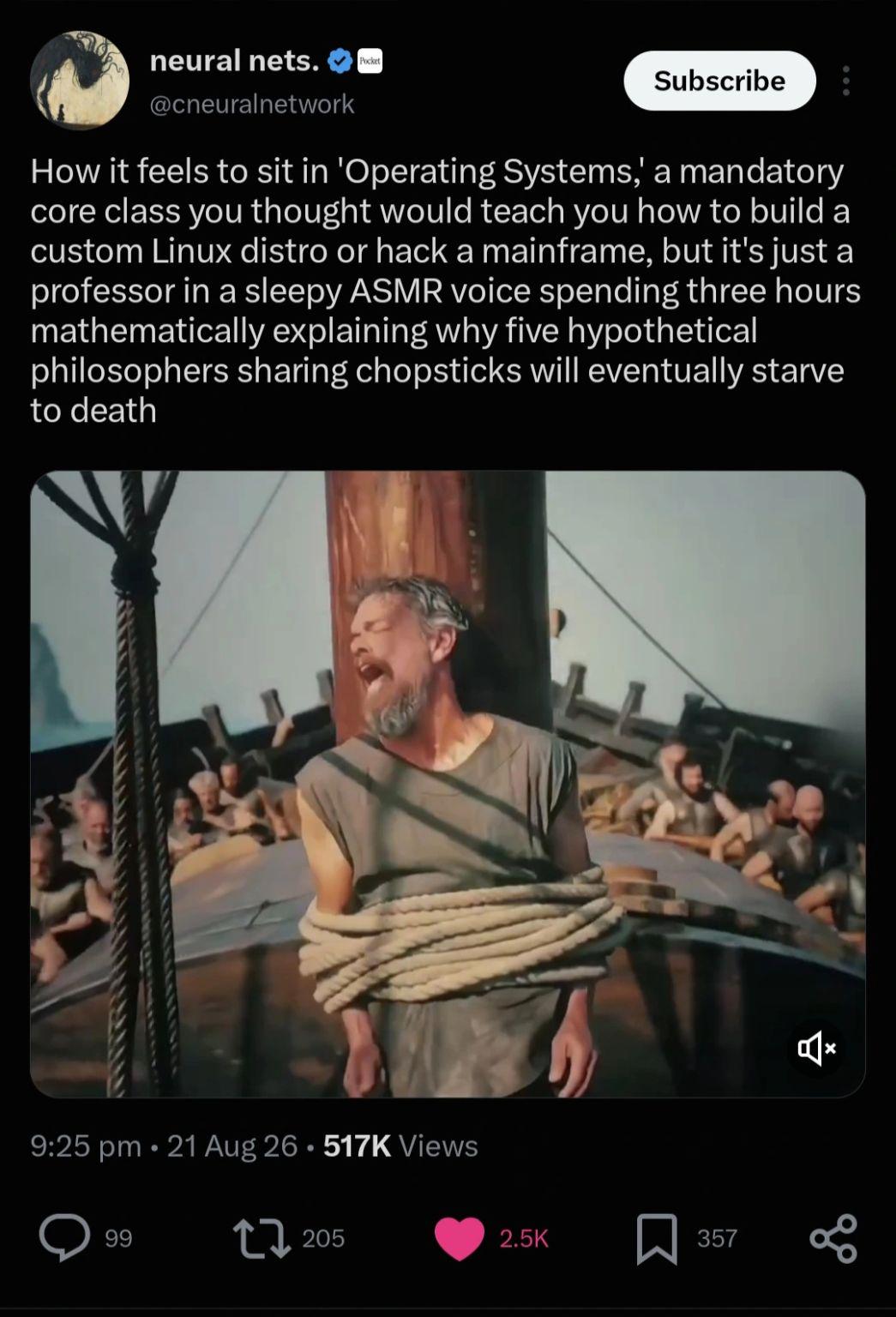
You signed up for Operating Systems expecting to learn kernel development and mainframe hacking, but instead you get a professor monotonously droning on about the Dining Philosophers Problem for three hours straight. The classic deadlock scenario where five philosophers sit at a table, each needing two chopsticks to eat, but there are only five chopsticks total. Each philosopher picks up one chopstick and waits for the other—creating an eternal deadlock where everyone starves. The brutal irony? You're literally experiencing a deadlock yourself—stuck in a mandatory class, unable to proceed with your life, waiting for the professor to finish while the professor waits for you to understand. Meanwhile, your motivation to learn OS concepts is slowly starving to death. Classic mutual exclusion gone wrong, but make it academic torture. Fun fact: The Dining Philosophers Problem was originally formulated by Edsger Dijkstra in 1965 using "dining philosophers" instead of his original "dining savages" for obvious reasons. It's the go-to example for explaining deadlocks, resource contention, and why semaphores exist—even though most students just want to build something cool instead of contemplating philosophical starvation.

Surprise Madafaka

Surprise Madafaka
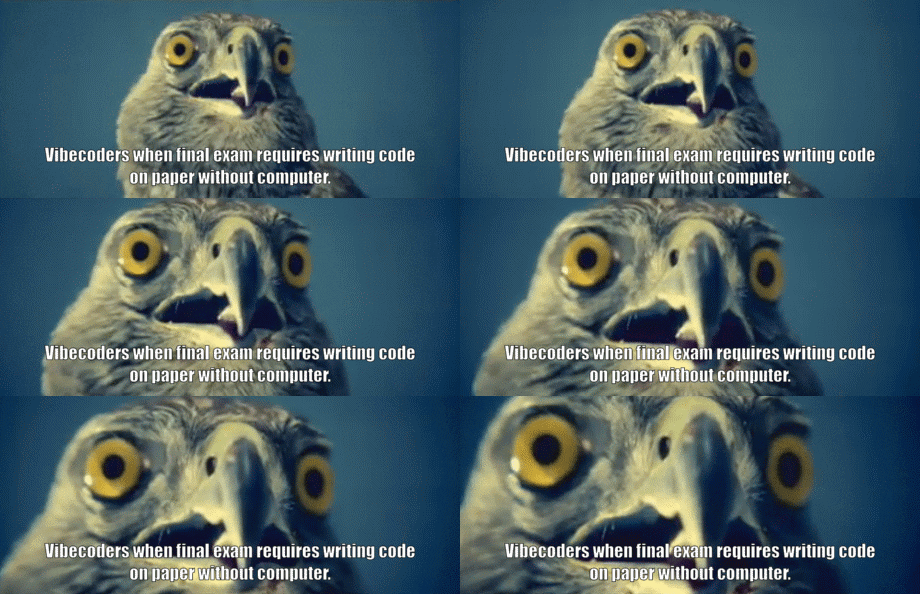
Nothing quite like spending four years learning to copy-paste from Stack Overflow, only to have your final exam demand you write a binary search tree with a pen. On paper. Like some sort of medieval monk transcribing manuscripts. The sheer panic when you realize your muscle memory is "Ctrl+C, Ctrl+V" and "Google how to reverse a linked list" but now you actually have to remember what a pointer is. Without syntax highlighting. Without autocomplete. Without the comforting glow of your IDE telling you that you forgot a semicolon on line 47. Bonus points if you've been using Python for three years and suddenly need to manually manage memory in C++. On paper. Where you can't even compile to see which of the 47 errors you made are actual errors versus just your handwriting looking like a seismograph during an earthquake.

It Wasn't Easy

It Wasn't Easy
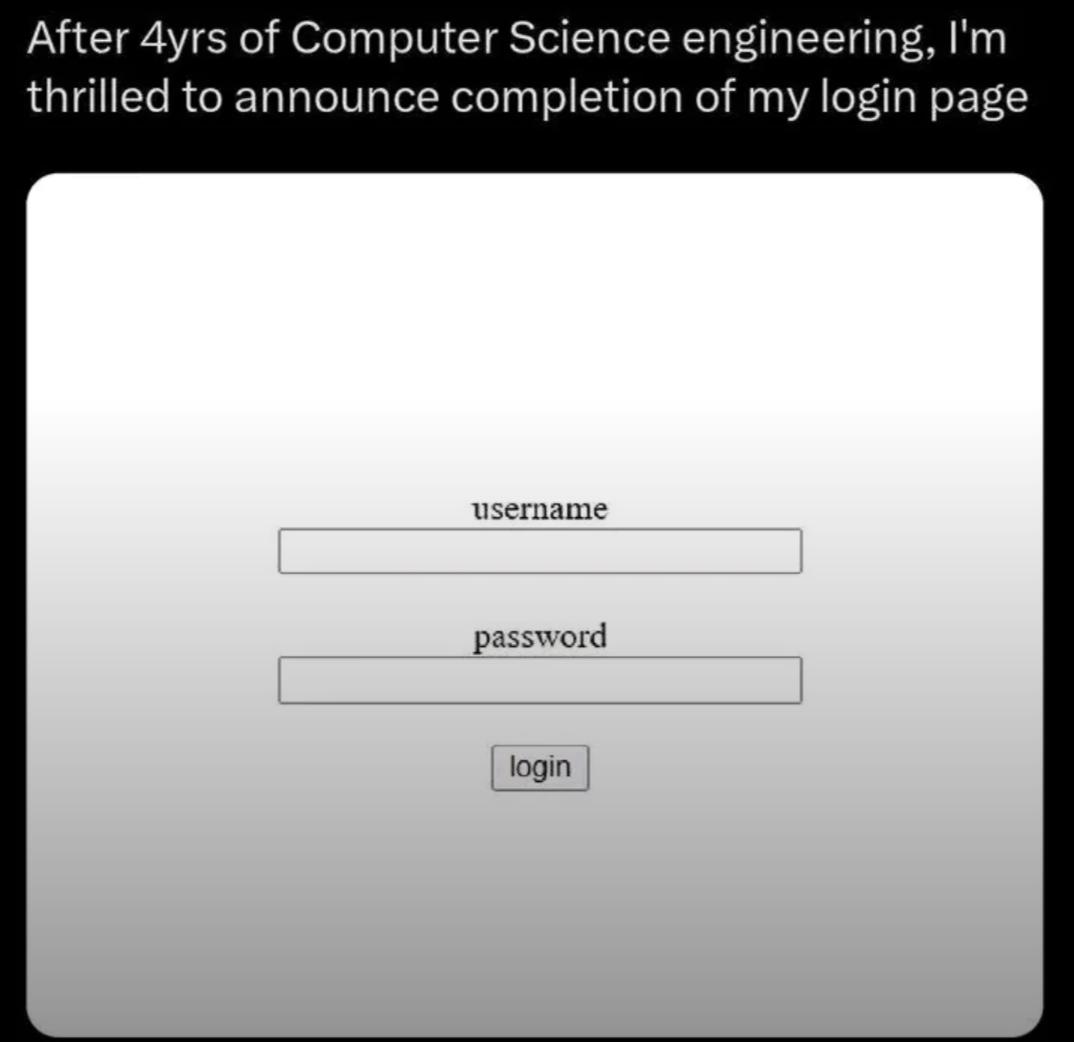
Four years of algorithms, data structures, operating systems, and theoretical computer science just to create... the most basic login form known to humanity. Two input fields and a button. Congratulations, you've basically recreated what a bootcamp grad does in week one. The brutal irony here is that university teaches you how to build compilers and implement red-black trees, but somehow you still end up Googling "how to center a div" when it's time to build actual UI. That CS degree really prepared you to... copy a login template from Bootstrap. But hey, at least you understand the Big O notation of your authentication algorithm, right? That's gotta count for something when you're storing passwords in plaintext because security wasn't covered until senior year.

Either Experience Means Anything Or It Does Not

Either Experience Means Anything Or It Does Not
Recruiters really out here asking senior devs with a decade of battle scars to explain red-black trees they memorized for their CS degree and promptly yeeted into the void. Like, sure Karen, let me just recall the implementation details of a skip list I learned in 2012 while I've been shipping production code using hashmaps and arrays for the past 10 years. The job posting says "5+ years experience building scalable web applications" but the interview is basically a computer science trivia night where you lose points for Googling. Pick a lane: either my years of actually solving real problems matter, or we're all just pretending experience is code for "can recite Knuth from memory."

Absolutely Ridiculous

Absolutely Ridiculous
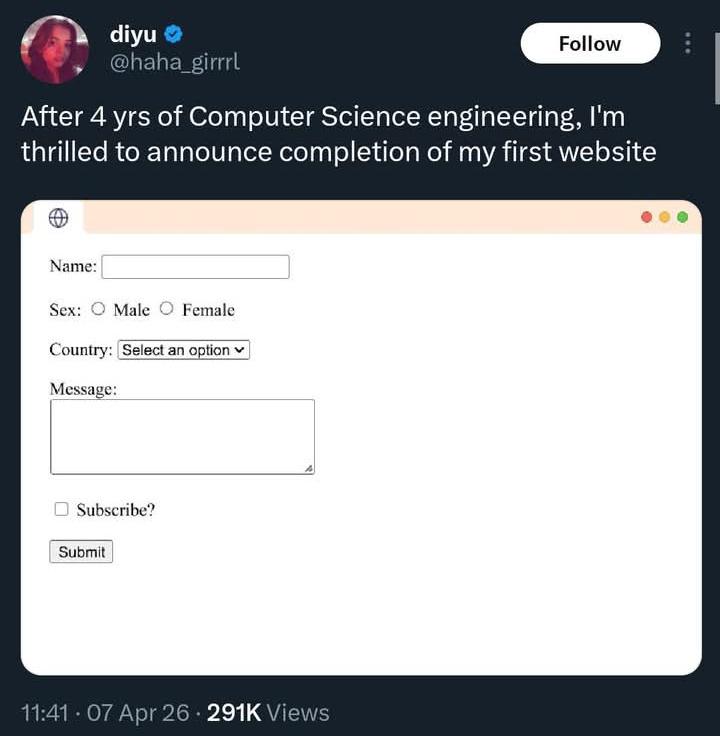
Four years. Four entire years of data structures, algorithms, compiler theory, discrete mathematics, and probably crying over pointer arithmetic at 3 AM. The culmination of this academic journey? A contact form that looks like it was built during a 1998 Geocities tutorial. No CSS styling, default browser fonts, and that beautiful "Select an option" dropdown that screams "I learned HTML in my first week and never looked back." The gap between what CS programs teach and what you actually need to build a basic website has never been more apparent. You can probably explain Big O notation in your sleep and implement a red-black tree from scratch, but centering a div? That's still black magic.

NordVPN

NordVPN
Encrypt your traffic on public Wi-Fi, stream from anywhere, and cover up to ten devices with one plan. 30-day money-back guarantee.

University Assignments Be Like

University Assignments Be Like
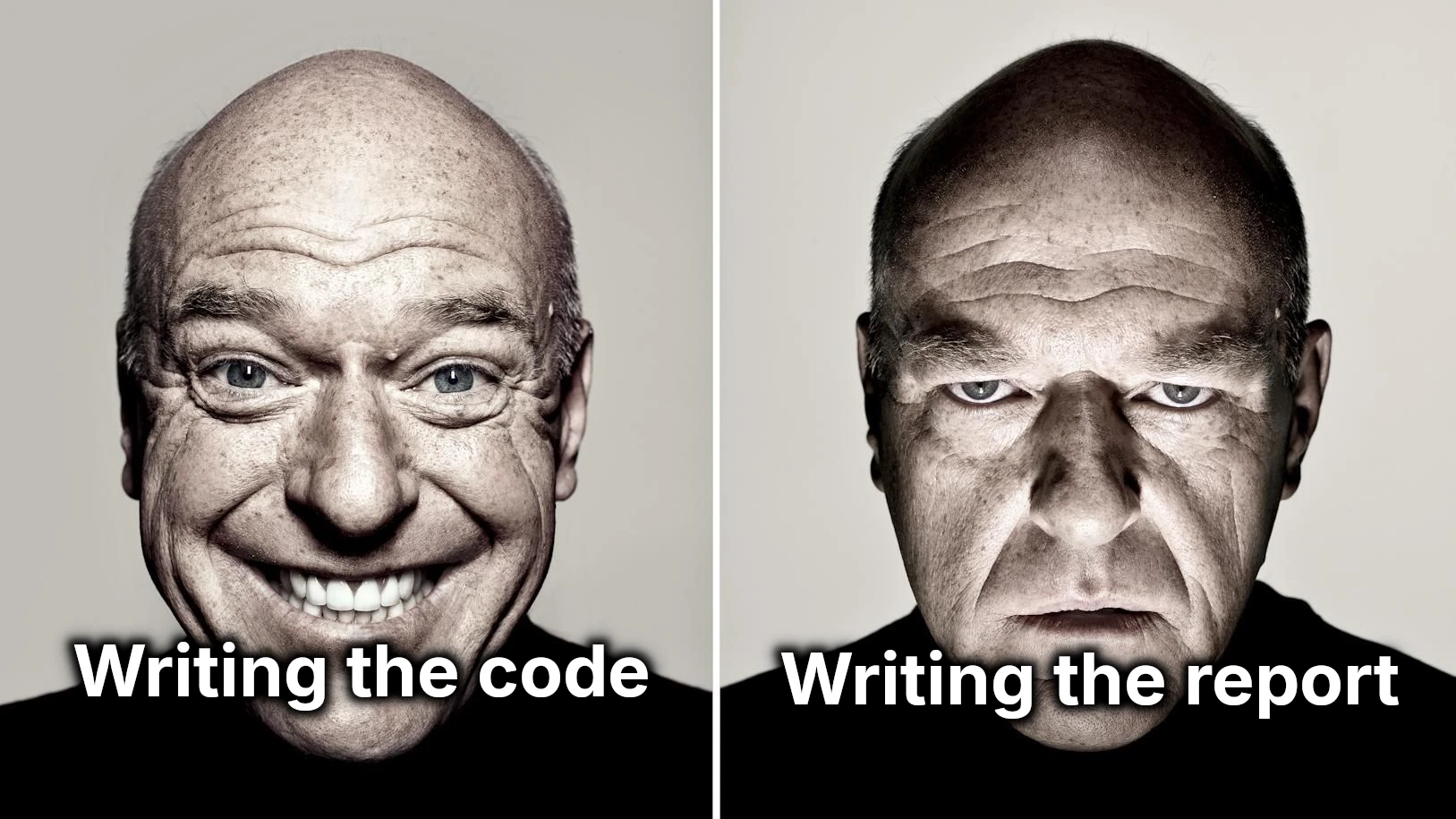
You spend three hours building a working solution, debugging edge cases, and optimizing your algorithm. Then you remember the assignment requires a 15-page report explaining what a for-loop does and citing three academic papers about basic data structures from 1987. The code is 50 lines. The report is due tomorrow and worth 60% of the grade. The TA will skim it for exactly 45 seconds. Nothing quite matches the existential dread of realizing the actual programming was the easy part and now you have to explain why you chose bubble sort in MLA format.

How I Learned About Image Analysis In Uni

How I Learned About Image Analysis In Uni
The history of digital image processing is... interesting. Back in the early days, computer scientists needed test images to develop algorithms for compression, filtering, and analysis. Problem was, they needed something standardized everyone could use. Enter the November 1972 issue of Playboy. Some researchers at USC literally scanned a centerfold (Miss November, Lena Forsén) and it became THE standard test image in computer vision for decades. Every image processing textbook, every research paper, every university lecture - there's Lena. So yeah, you'd be sitting in your serious academic Computer Vision class, professor droning on about convolution kernels and edge detection, and BAM - cropped Playboy centerfold on the projector. Nobody talks about it, everyone just accepts it. Peak academic awkwardness meets "we've always done it this way" energy. The image is still used today, though it's finally getting phased out because, you know, maybe using a Playboy model as the universal standard in a male-dominated field wasn't the best look.

This Absolute Gem In The Mens Toilet Today At Uni

This Absolute Gem In The Mens Toilet Today At Uni
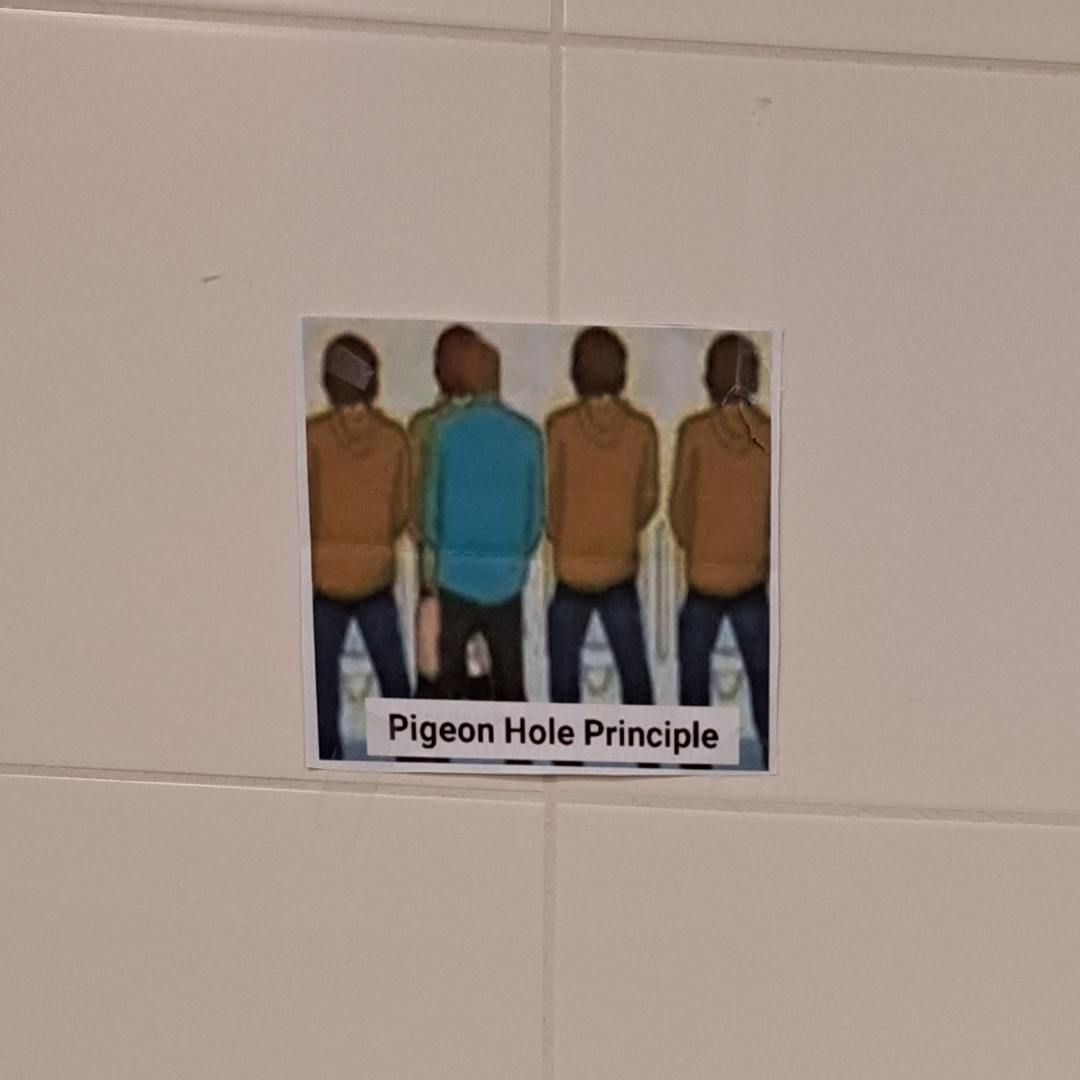
Someone taped a visual guide to urinal etiquette in a CS building bathroom and labeled it "Pigeon Hole Principle." Four urinals, three guys wearing brown shirts, one brave soul in blue who clearly drew the short straw. The Pigeonhole Principle states that if you have n items and m containers where n > m , at least one container must hold more than one item. Applied here: four urinals, but urinal etiquette demands you leave gaps, so really you've only got two usable spots. Guy in blue? He's the overflow. The mathematical proof that bathroom awkwardness is inevitable. Whoever printed this out and stuck it on the wall understands both discrete mathematics and the unspoken social contract of public restrooms. Respect.

Human Compiler: When Professors Make You Render HTML By Hand

Human Compiler: When Professors Make You Render HTML By Hand
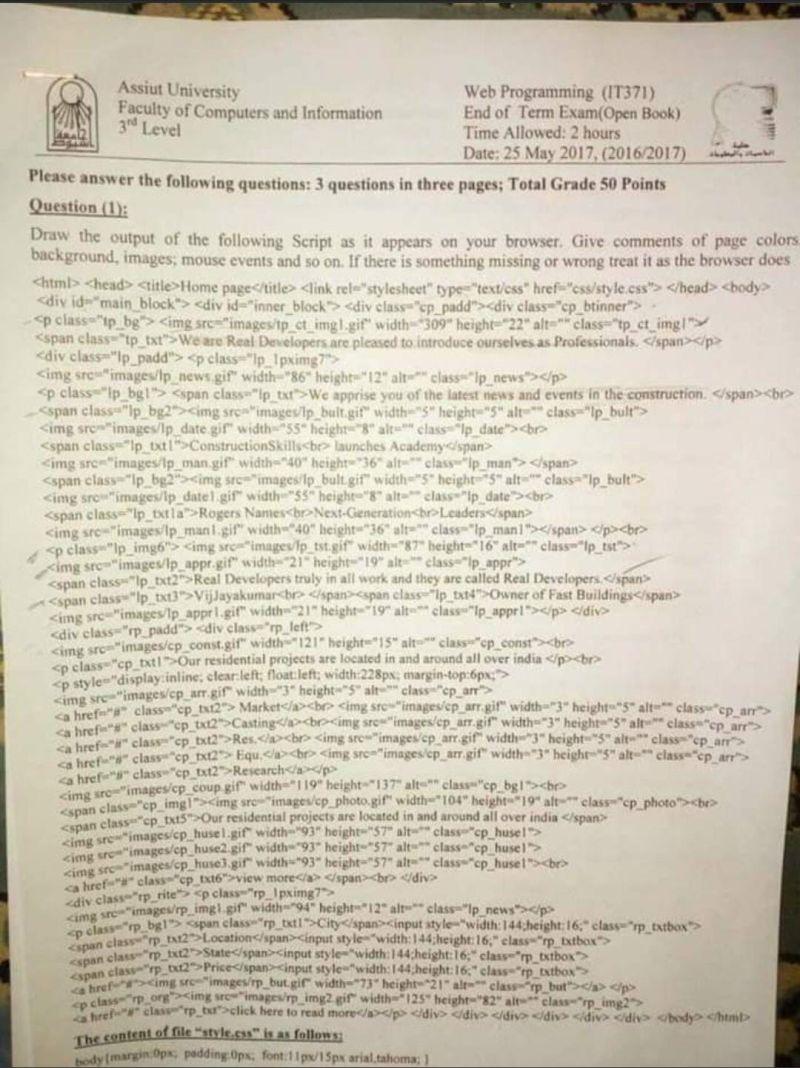
The professor just turned every CS student into a human rendering engine! Instead of asking conceptual questions about web development, this exam literally makes students trace through HTML/CSS code and manually draw what the browser would display—complete with images, colors, and layout. It's like forcing someone to execute a 200-line program with pen and paper when computers were literally invented to do this for us. The ultimate "computers make me obsolete so I'll make you BE the computer" power move. Somewhere, a browser engine developer is crying into their coffee.

monTEK Dual Monitor Stand Mount with USB for Up to 35" Screens,Tall Post Mounted Monitor Arm Holds Max 24.25lbs Per Screen, Full Motion Adjustable Monitor Arm Desk Mount with C-Clamp/Grommet

monTEK Dual Monitor Stand Mount with USB for Up to 35" Screens,Tall Post Mounted Monitor Arm Holds Max 24.25lbs Per Screen, Full Motion Adjustable Monitor Arm Desk Mount with C-Clamp/Grommet
【Universal Compatibility】The heavy-duty dual monitor mount fits up to 35 inch and max 24.25lbs per screen; compatible VESA 75x75 mm and 100x100 mm support ensures seamless setup for most brands, idea…

Dear Universities, Real Programmers Don't Use Paper

Dear Universities, Real Programmers Don't Use Paper
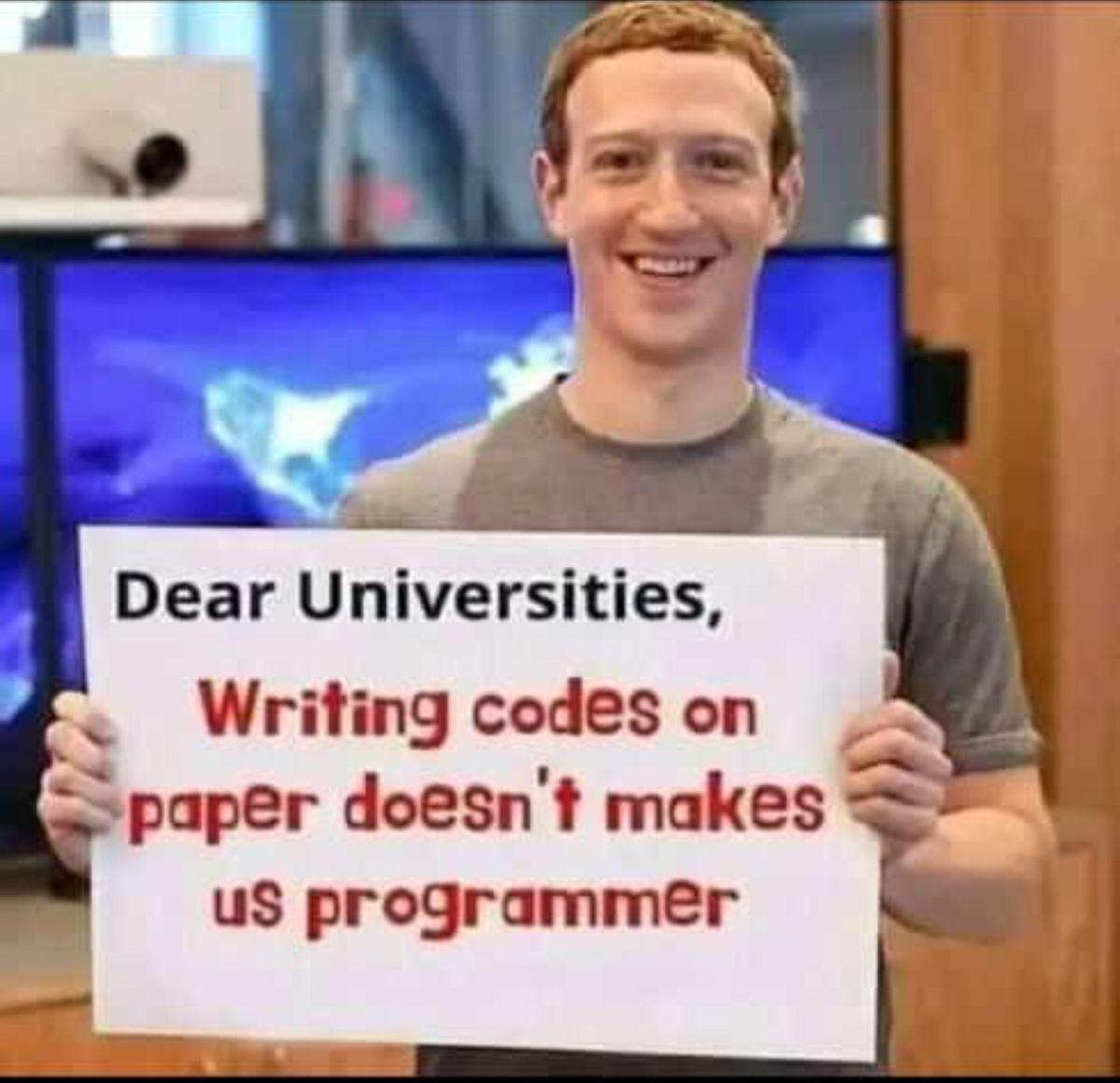
Ah, the classic CS exam paradox! Nothing says "I understand programming" like frantically scribbling syntax on dead trees while praying your indentation looks right without an IDE. Meanwhile, in the real world, we're all just professional Googlers with Stack Overflow PhDs. The irony that the guy holding the sign built a billion-dollar empire without ever having to pass a whiteboard algorithm test on paper is just *chef's kiss*. Next up in university curriculum: "Writing HTML with quill and parchment" and "Debugging without actually running the code because reasons."

We Are Not Beating The Allegations

We Are Not Beating The Allegations
OH. MY. GOD. The computer science department has officially LOST IT! 💀 Some poor university decided that "Introduction to Algorithms" wasn't trendy enough, so they've gone FULL FURRY with "FURRY 101" as an actual course! The academic world is CRUMBLING before our eyes! Next semester they'll probably offer "Advanced UwU Programming" and "Tail-Oriented Development." This is what happens when you let programmers who spend too much time alone with their code finally get control of the curriculum. The stereotype just yeeted itself into reality!