

tcp Memes

Packet Loss

Packet Loss
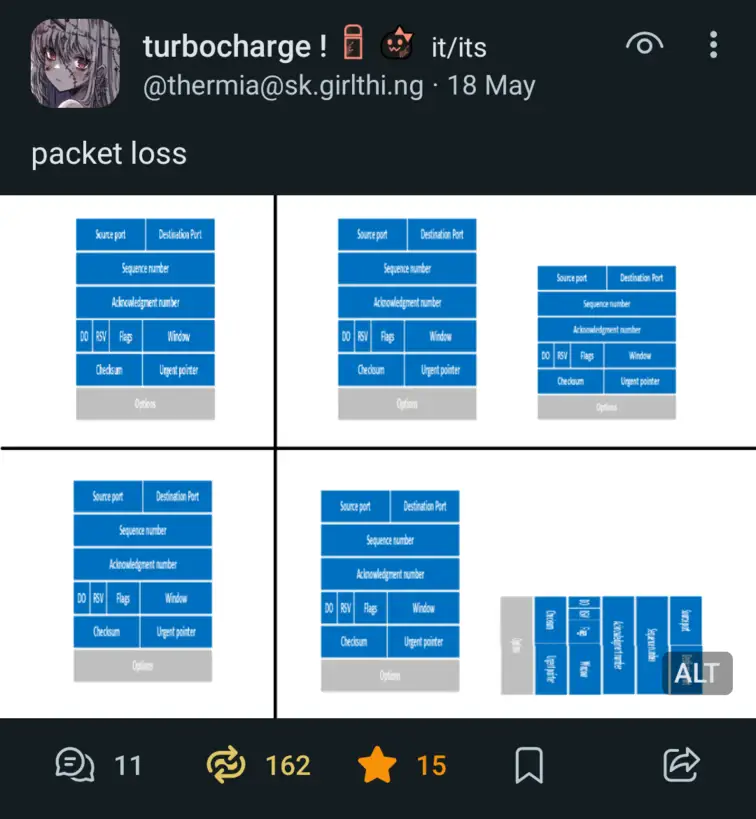
When your network packets start doing their best disappearing act. The joke here is beautifully simple: each frame shows a TCP/UDP packet structure diagram, but with progressively more fields vanishing into the void. First packet is pristine with all its headers intact, then chunks start going missing, until finally you're left with a packet that's basically rotated 90 degrees and screaming "ALT" like it's having an existential crisis. The visual degradation perfectly mimics what happens when your connection decides to cosplay as Swiss cheese. Source port? Gone. Destination port? Adios. Sequence number? In another dimension. By the end, the packet structure has completely lost its architectural integrity and is just... sideways. Because nothing says "network instability" quite like your data packets doing interpretive dance instead of arriving in order. Fun fact: TCP was designed to handle packet loss gracefully with retransmission, but UDP just yeets your data into the network and hopes for the best. No wonder video calls turn you into a pixelated mess when the WiFi acts up.

Meme I Made In College And Rediscovered

Meme I Made In College And Rediscovered
The humble farmer meme format perfectly captures that beautiful moment when you're desperately trying to convince your professor or TA that your TCP assignment deserves partial credit. Sure, it's only 47 lines of spaghetti code held together by prayer and Stack Overflow snippets. Sure, it crashes if you look at it funny. But hey, at least it compiles... sometimes. The real genius here is the brutal honesty. Most students would try to oversell their broken mess with buzzwords like "modular architecture" or "scalable design patterns." But not our farmer friend. He's just keeping it real: "It ain't much and it doesn't work." That's the kind of self-awareness that comes from spending 6 hours debugging only to realize you forgot a semicolon. TCP assignments are particularly notorious for this because networking protocols don't do "sort of working." Your packets either arrive or they don't. Your handshake either completes or it hangs forever. There's no middle ground, which makes this farmer's assessment brutally accurate.

At Least UDP Is Faster

At Least UDP Is Faster
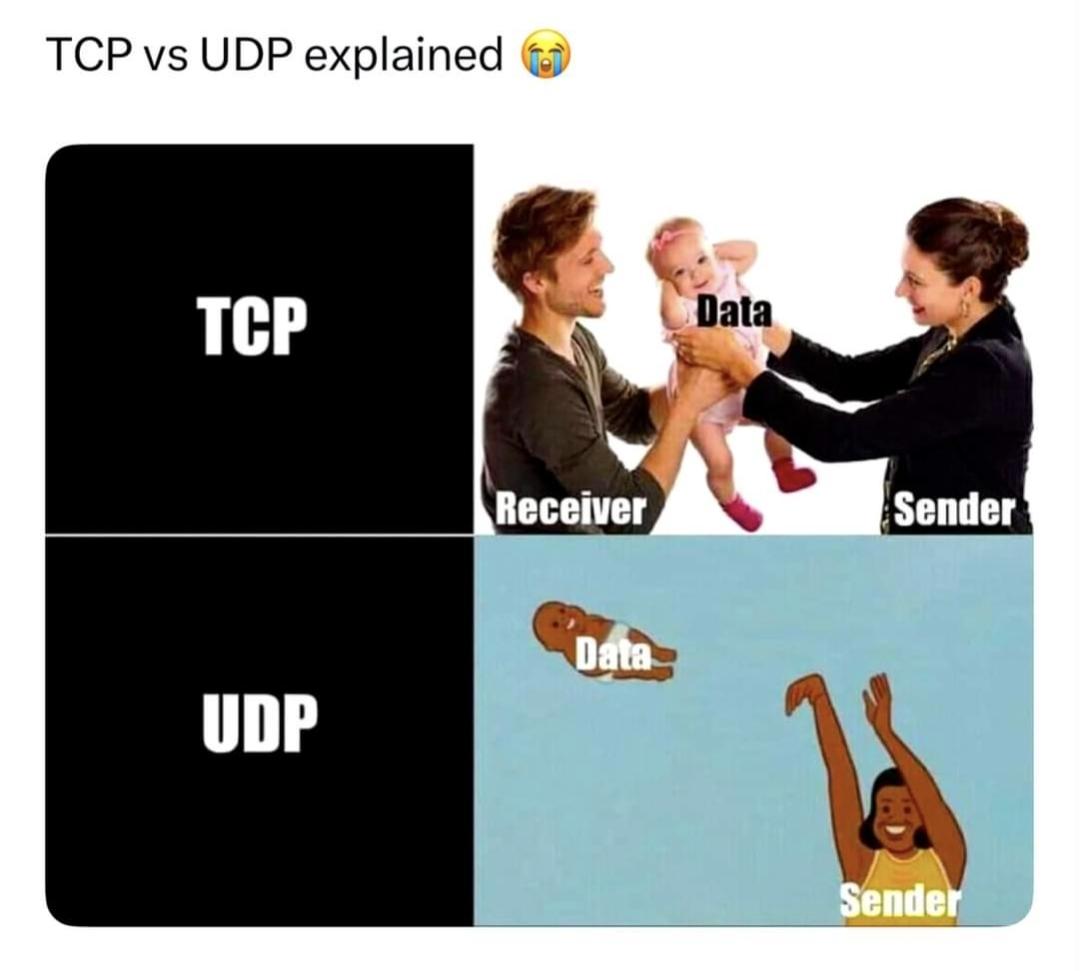
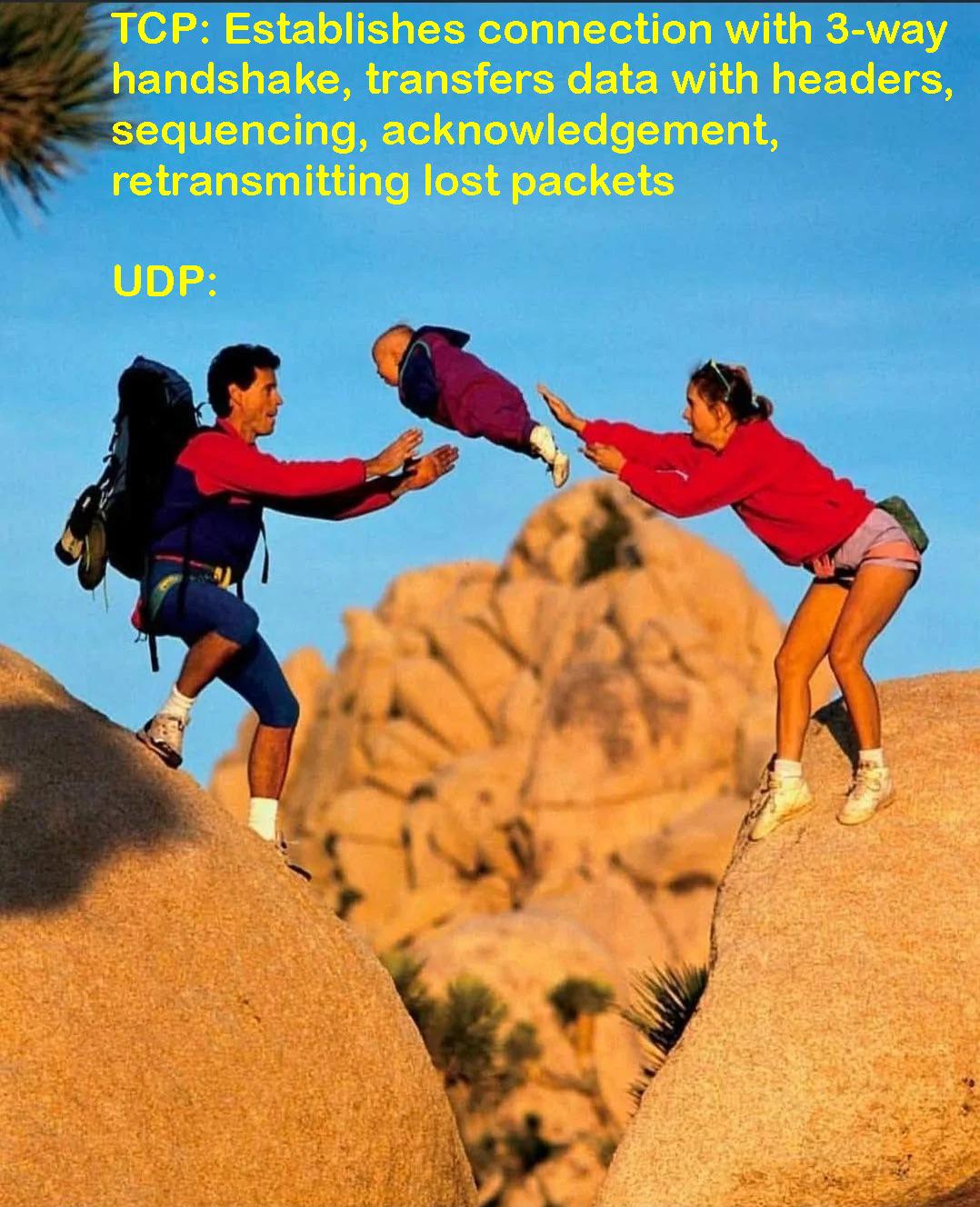
TCP: "Did you get the baby? Confirm receipt. Please acknowledge. Are you there? Baby transfer successful?" UDP: "YEET! ✨ My job here is done." TCP is that overprotective parent carefully handing over the precious cargo with both parties involved, making sure every single packet—err, baby—arrives safely. Meanwhile, UDP just launches data into the void like a trebuchet and goes about its day. Did it arrive? Who knows! Who cares! Speed is life! Perfect for video streaming where losing a frame or two won't kill anyone. Less perfect for, say, banking transactions. Choose your protocol wisely, folks—unless you enjoy explaining to your boss why half the customer data landed in the digital equivalent of a ditch.

Packet Loss Is A State Of Mind

Packet Loss Is A State Of Mind
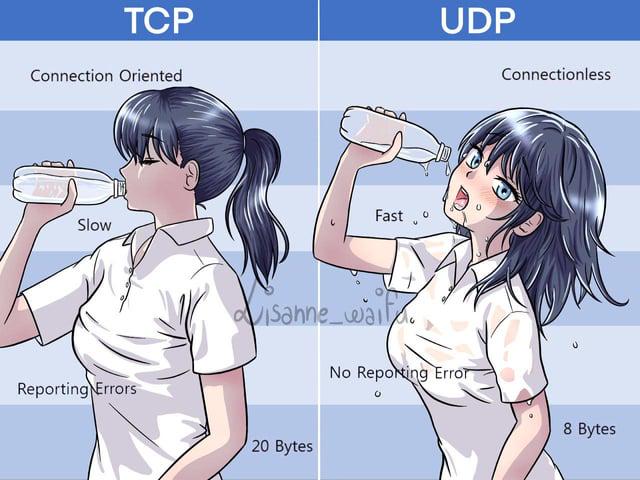
TCP drinks water like a responsible adult at a formal dinner party - slow, deliberate, making sure every drop gets where it's supposed to go. Meanwhile UDP is chugging that bottle like it's the last water on Earth, not caring if half of it ends up on the floor. TCP's over here with its three-way handshake, ACK packets, and error reporting, basically helicopter parenting every single byte. "Did you get that? Let me know you got that. Okay sending the next one." 20 bytes of overhead just to make sure nobody gets lost. UDP? Zero cares given. Fire and forget. 8 bytes, no error reporting, connectionless chaos. Your packets might arrive, they might not, they might show up in the wrong order - UDP's already moved on with its life. Perfect for video streaming where you'd rather have speed than wait for that one pixel from 5 seconds ago to finally show up.

New RFC Was Just Published!!!

New RFC Was Just Published!!!
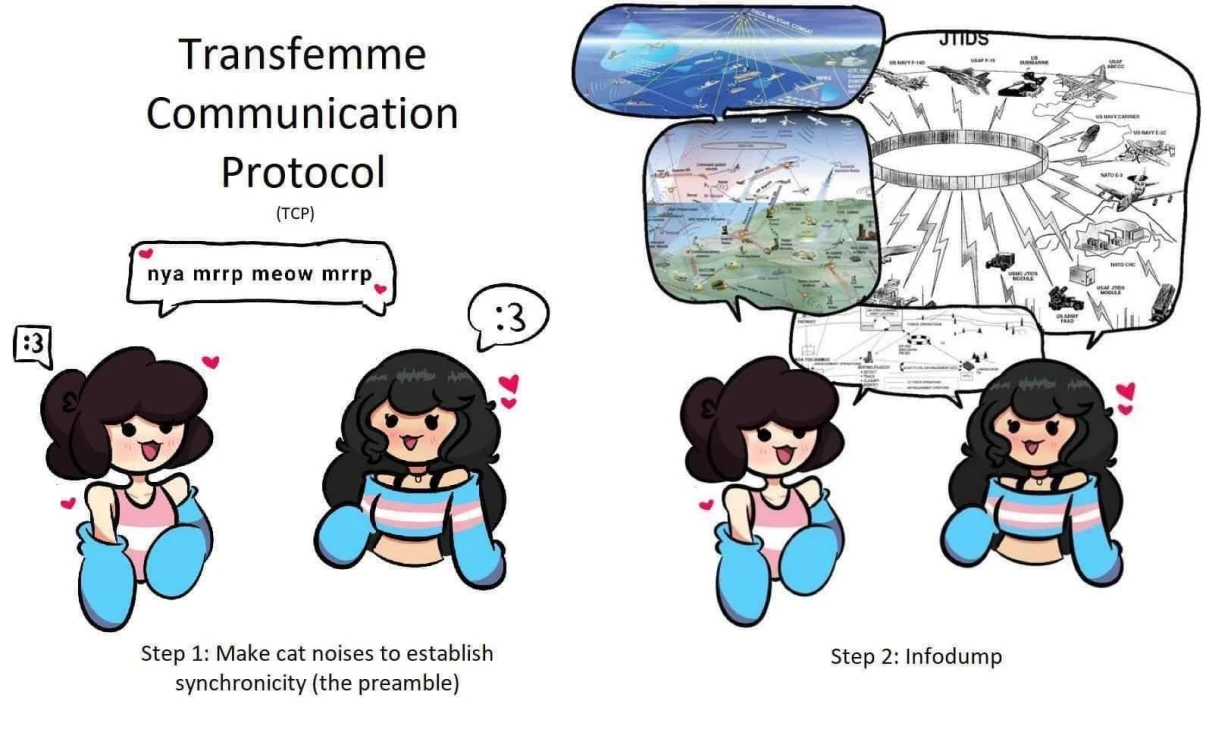
Someone just reinvented the TCP three-way handshake but make it adorable . Step 1 is basically SYN/SYN-ACK but with "nya mrrp meow mrrp" instead of sequence numbers, and Step 2 dumps the entire internet infrastructure diagram on you like a normal ACK packet. The beauty here is how accurately it captures the vibe of reading actual RFCs. You start with simple, cutesy explanations of the preamble and handshake process, then BAM—suddenly you're staring at a diagram that looks like it was designed by someone who thinks "simplicity" means showing every single router, submarine cable, and satellite relay between your laptop and the server. Fun fact: RFC 793 (the actual TCP spec) is 85 pages long and somehow both incredibly detailed and frustratingly vague. The transfemme energy of making cat noises to establish synchronicity before unleashing technical chaos is honestly peak protocol design.

NordVPN

NordVPN
Encrypt your traffic on public Wi-Fi, stream from anywhere, and cover up to ten devices with one plan. 30-day money-back guarantee.

IT Engineers Just Need To Retransmit Drug Dealers Need A Lawyer

IT Engineers Just Need To Retransmit Drug Dealers Need A Lawyer
Drug dealers lose a few packets and they're calling Saul Goodman, while IT engineers just shrug and let TCP handle it. The beauty of network protocols is that packet loss is literally built into the system—just retransmit and move on. No lawyers, no witness protection, just good old reliable error correction doing its thing. The difference in stress levels is astronomical. One profession faces federal charges, the other faces a slightly higher ping. Both deal with "packets," but only one gets to relax by the fireplace with a nice cup of tea while the network sorts itself out automatically. Fun fact: TCP can lose up to 50% of packets and still successfully deliver your data—it'll just take longer. Try telling a drug dealer they can afford to lose half their shipment and see how that conversation goes.

Know Thy Protocol

Know Thy Protocol
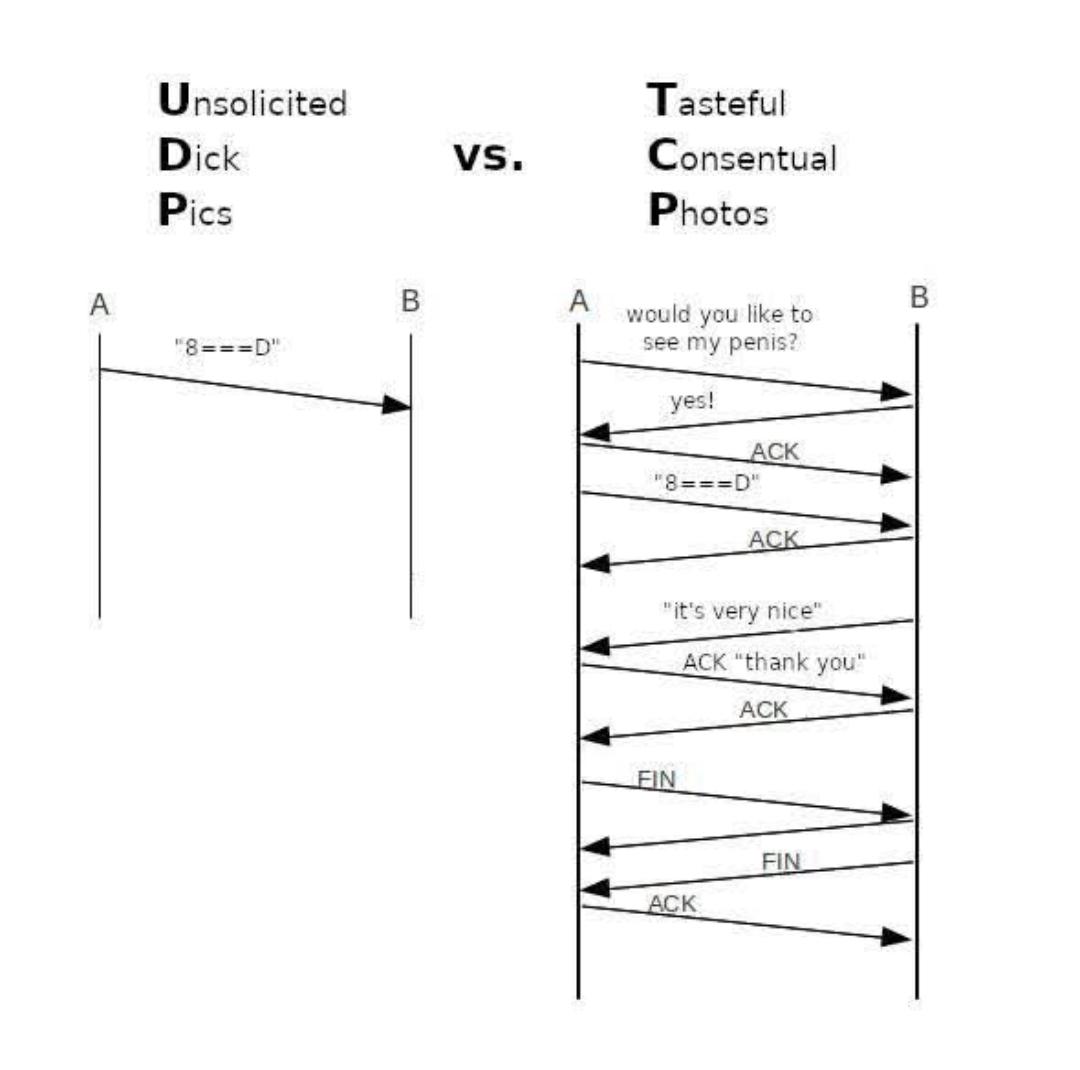
UDP vs TCP but make it wildly inappropriate. The left side shows UDP doing its thing—just yeeting that dick pic into the void with zero confirmation, no handshake, no nothing. Classic fire-and-forget protocol energy. Meanwhile TCP on the right is out here establishing a full three-way handshake before sending anything, complete with consent verification, acknowledgments for every message, and a proper connection termination with FIN packets. It's the networking equivalent of asking "may I?" before every single action. The best part? TCP even acknowledges the compliment AND the thank you. That's some next-level reliable delivery right there. UDP could never—it doesn't even know if its packet arrived, let alone whether anyone appreciated it. This is what they mean when they say "connection-oriented vs connectionless protocols" in your networking textbook, just with significantly more inappropriate metaphors than your professor used.

What If We Yeet The Data

What If We Yeet The Data
TCP is that overprotective parent who walks you through every step, confirms you got the message, and makes sure nothing gets lost. Meanwhile, UDP is out here just launching packets into the void like "good luck, buddy!" and moving on with its life. TCP does all the heavy lifting with its 3-way handshake, sequencing, acknowledgments, and retransmissions—basically the networking equivalent of sending a certified letter with tracking. UDP? Just yeeting data packets across the network with zero regard for whether they arrive or in what order. No handshake, no acknowledgment, no second chances. Fire and forget, baby. This is why video streaming and online gaming use UDP—because who cares if you lose a frame or two? But when you're downloading files or loading web pages, you better believe TCP is there making sure every single byte arrives intact. Choose your protocol based on whether you value reliability or just vibes.

Different Types Of Delivering Packets

Different Types Of Delivering Packets
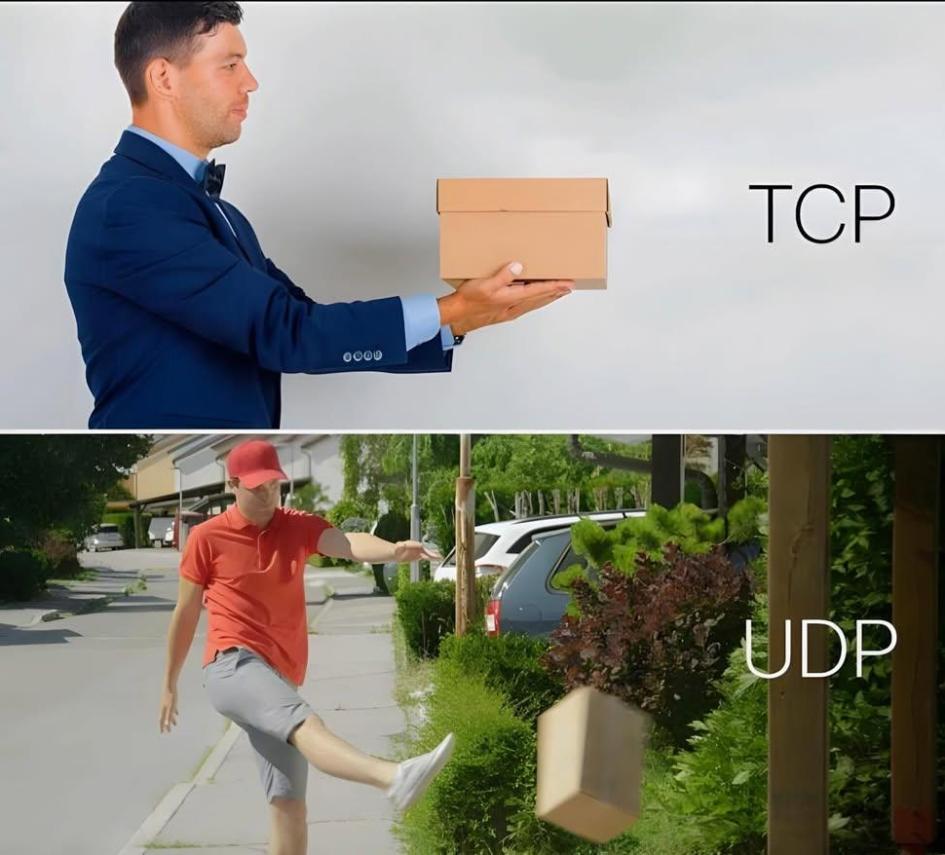
The perfect visualization of network protocols! TCP is that formal gentleman who carefully hands you the package, waits for confirmation, and probably has a spreadsheet tracking delivery times. Meanwhile, UDP is just yeet-and-forget—kicking packages in the general direction of your house and sprinting away before anyone notices. No wonder streaming services love UDP. "Did that packet of your Netflix show not arrive? Too bad, here's the next frame coming at your face anyway!" TCP would never—he's still waiting for you to sign for the last one.

Losing A Few Packets

Losing A Few Packets
OH. MY. GOD. The sheer TRAUMA when your network drops a few packets! 💀 Drug dealers are all panicked like Mr. Krabs when they lose a "packet" - because, you know, that's actual MONEY and possibly JAIL TIME. Meanwhile, IT engineers are sitting there like fancy Mr. Krabs, sipping tea with their pinky out, utterly UNBOTHERED when network packets disappear into the void. TCP will literally resend that data faster than you can say "packet loss," darling! It's the ultimate networking flex - "Oh no! Anyway..." 💅

Spaghetti Codebase: The HTTP Server Nightmare

Spaghetti Codebase: The HTTP Server Nightmare
The AUDACITY of this meme! It's literally the same text twice but the EMOTIONAL JOURNEY is CATASTROPHIC! 😱 First you're all excited about making an HTTP server from scratch, dreaming of glory and internet fame. Then reality SLAPS YOU IN THE FACE when you realize what unholy nightmare you've unleashed upon yourself! One minute you're like "I'm a coding genius" and the next you're questioning every life decision that led to this moment of pure socket-programming HELL! The duality of developer hubris - a tale as old as TCP/IP itself!

Concepts We Need To Know: Networking Protocols And Consent

Concepts We Need To Know: Networking Protocols And Consent
Ah, the TCP handshake explained through the lens of human decency! On the left, we have UDP (Unsolicited Dick Pics) - a fire-and-forget protocol where data is just hurled into the void with zero confirmation. On the right, TCP (Tasteful Consensual Photos) demonstrates the proper three-way handshake with acknowledgments at every step. This is networking explained in a way that even HR would understand. The TCP side even properly terminates the connection with FIN packets! Meanwhile, UDP is just shouting into the void like that guy who still doesn't understand why he's single. Remember folks: always implement proper handshakes in both your protocols AND your dating life.

UGREEN NAS DH2300 2-Bay Desktop NAS, Support Capacity 64TB (Diskless)

UGREEN NAS DH2300 2-Bay Desktop NAS, Support Capacity 64TB (Diskless)
Entry-level NAS Personal Storage:UGREEN NAS DH2300 is your first and best NAS made easy. It is designed for beginners who want a simple, private way to store videos, photos and personal files, which …