Security vulnerabilities Memes

Posts tagged with Security vulnerabilities

Un Preventable

Un Preventable
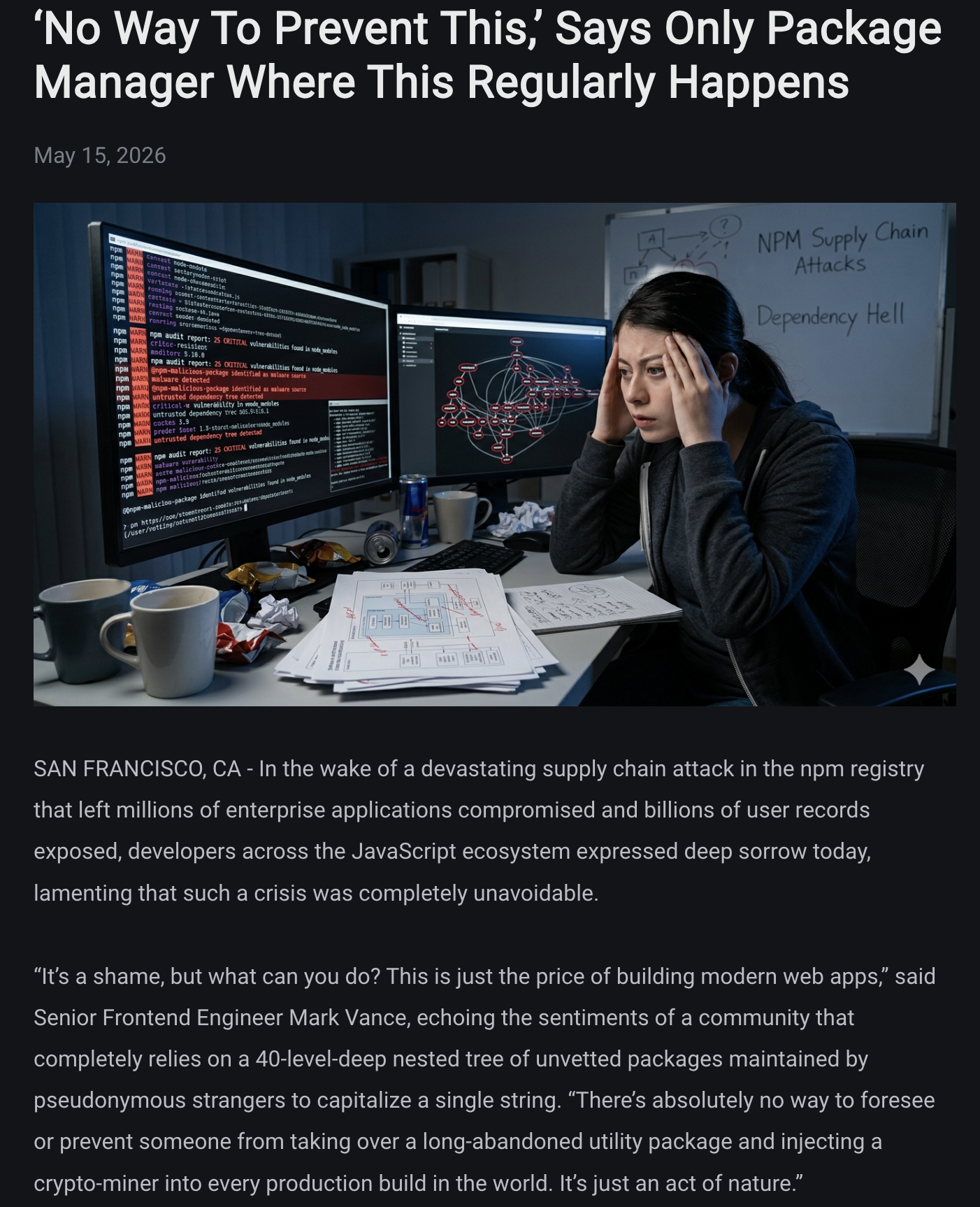
The JavaScript ecosystem in a nutshell: we've built our entire infrastructure on a house of cards made by random strangers on the internet, and we're shocked—SHOCKED—when it occasionally collapses. "No way to prevent this," says the only ecosystem where installing a package to check if a number is odd pulls in 47 dependencies. The satire here is chef's kiss. We literally trust pseudonymous maintainers with packages that have 10 million weekly downloads, then act surprised when supply chain attacks happen. "It's just the price of building modern web apps" is the developer equivalent of "thoughts and prayers." Maybe—just maybe—we shouldn't need 500MB of node_modules to display a button. Fun fact: The average JavaScript project has more dependencies than a soap opera character has relationship drama. And about the same level of stability.

He Actually Said This

He Actually Said This
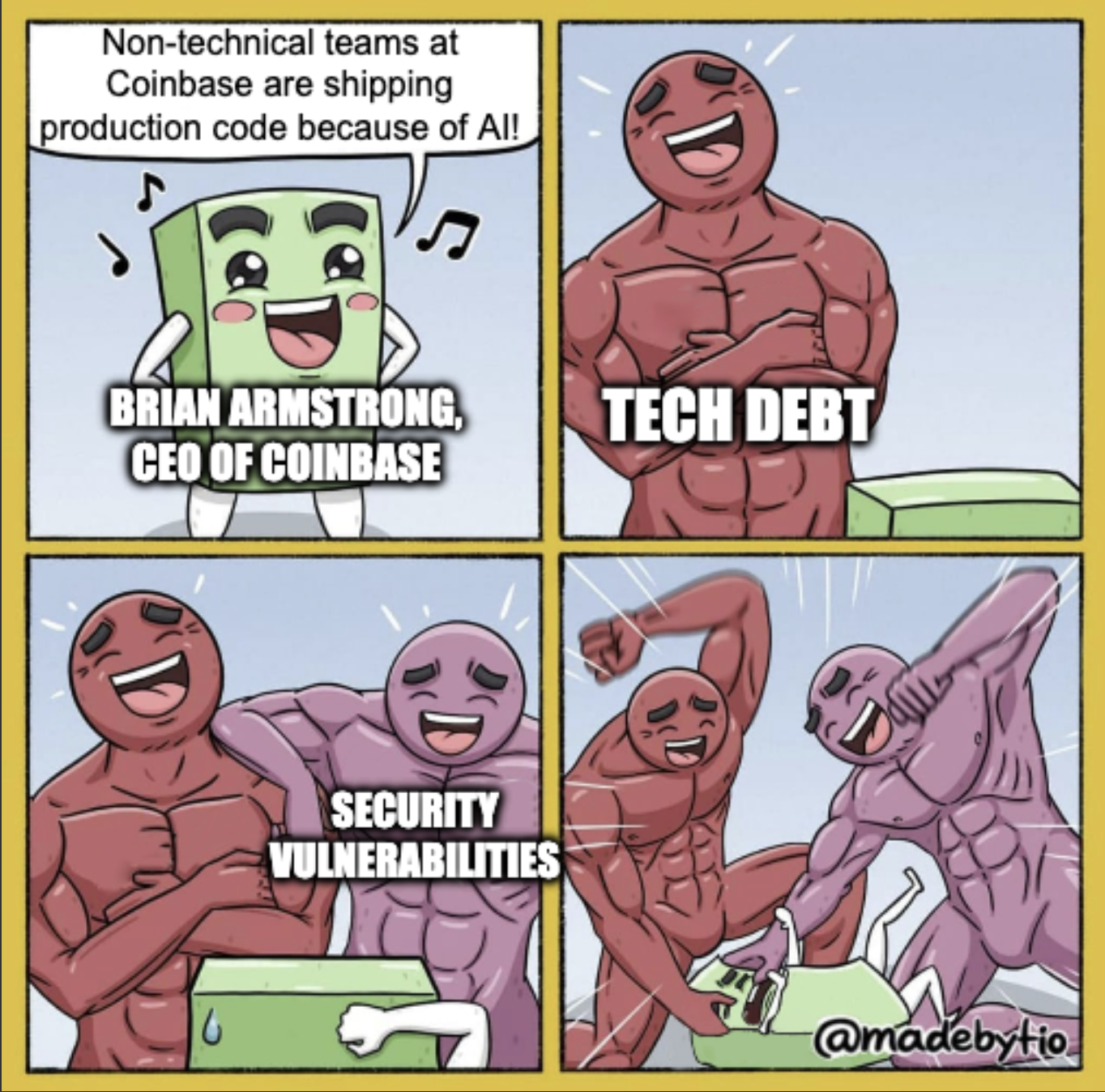
When the CEO of Coinbase proudly announced that non-technical teams are shipping production code thanks to AI, the entire engineering department collectively felt their blood pressure spike. Sure, let's just hand the keys to production to people who think "merge conflict" is a corporate HR issue. Tech debt is already doing backflips of joy knowing it's about to get three new best friends. Security vulnerabilities are literally high-fiving each other in anticipation. And somewhere, a senior engineer just added "AI-generated code reviewer" to their resume out of pure survival instinct. Nothing says "sustainable software development" quite like letting AI write production code for people who can't tell the difference between a stack trace and a pancake recipe. But hey, at least when the inevitable security breach happens, they can blame the AI. Modern problems require modern scapegoats.

Choose Your Drug

Choose Your Drug
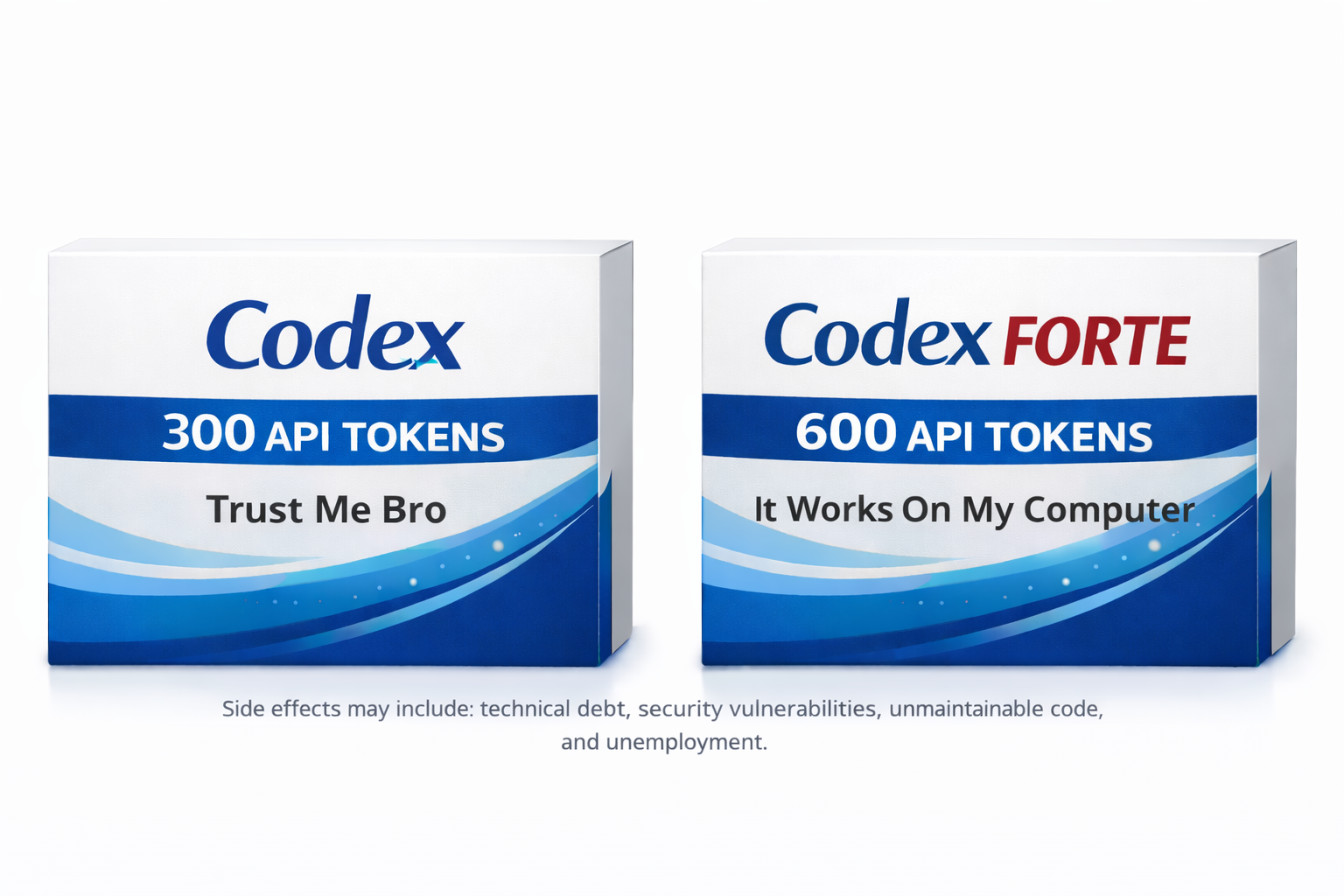
Pick your poison: the light dose of "Trust Me Bro" with 300 API tokens, or go full nuclear with Codex FORTE's 600 tokens of "It Works On My Computer" energy. Both come with the same delightful side effects—technical debt that'll haunt your dreams, security holes big enough to drive a truck through, code so unmaintainable your future self will curse your name, and the cherry on top: unemployment. The pharmaceutical parody nails that feeling when you're shipping code on blind faith versus slightly more blind faith with double the confidence. Either way, you're playing Russian roulette with production, but hey, at least the FORTE version has twice the tokens to generate twice the problems. The best part? Neither option includes "actually tested and documented" as an ingredient.

I Must Be A Genius

I Must Be A Genius
Rolling your own JWT authentication is basically the security equivalent of performing brain surgery on yourself because you watched a YouTube tutorial. Sure, you technically implemented authentication, but you've also probably introduced 47 different attack vectors that a security researcher will gleefully document in a CVE someday. There's a reason why battle-tested libraries like Passport, Auth0, or even Firebase Auth exist. JWT has so many gotchas—algorithm confusion attacks, token expiration handling, refresh token rotation, secure storage, XSS vulnerabilities—that even experienced devs mess it up. But hey, at least you can brag about it at parties while the security team quietly adds your endpoints to their watchlist. Pro tip: If your JWT implementation doesn't make you question your life choices at least three times, you're probably missing something important.

I Even Made A Gradient Library Just For This Bot

I Even Made A Gradient Library Just For This Bot
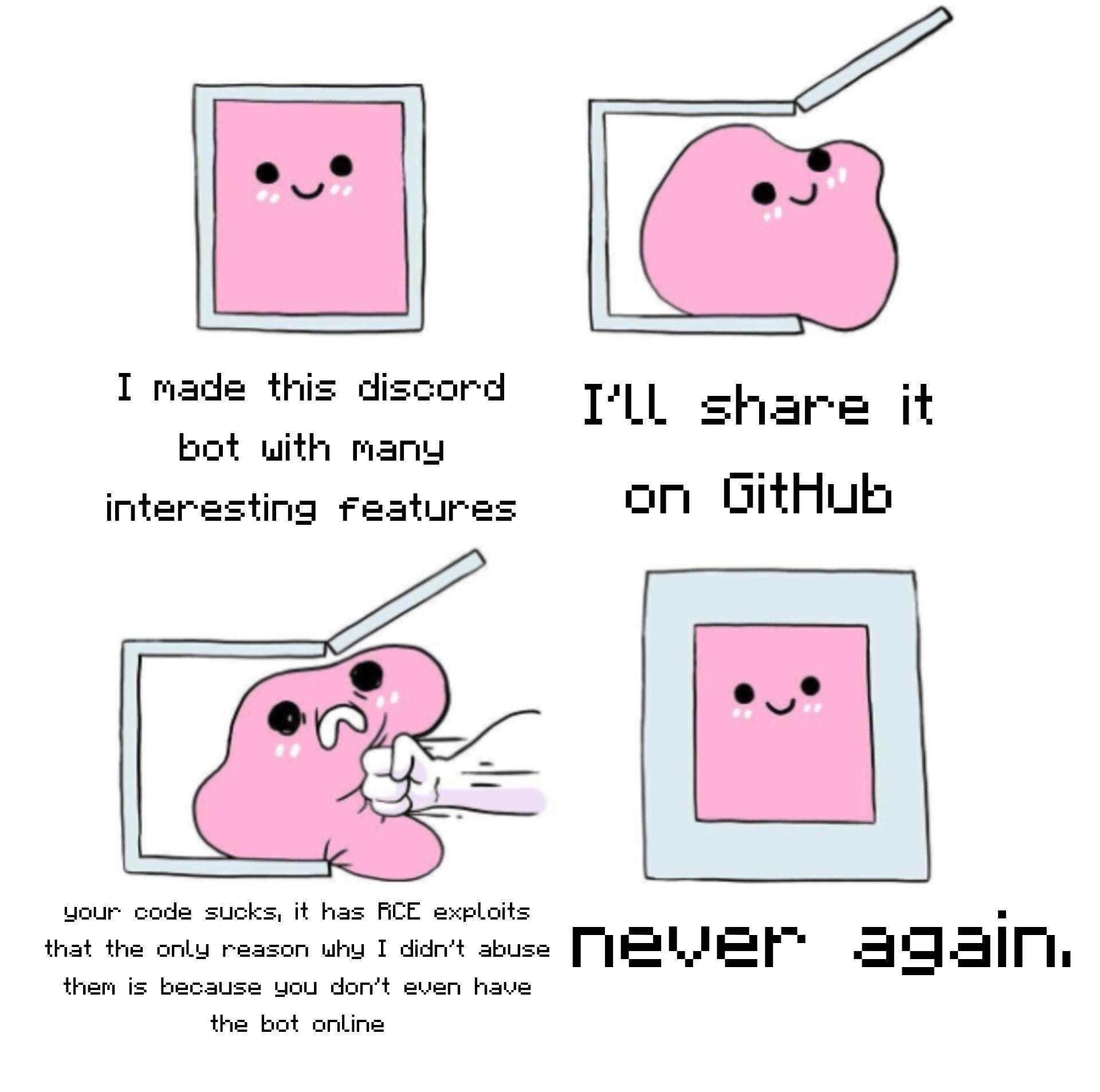
Ah, the classic GitHub reality check! You spend weeks crafting your Discord bot masterpiece, complete with that custom gradient library you're secretly more proud of than your actual résumé. You're feeling all warm and fuzzy about sharing your "many interesting features" with the world... Then some random security expert with an anime avatar and 3 GitHub followers demolishes your entire existence with a single comment. Not only does your precious code have RCE exploits (Remote Code Execution - the digital equivalent of leaving your front door wide open with a "Please rob me" sign), but they also twist the knife by pointing out your bot isn't even online. The final panel's "never again" is the silent vow every developer makes before inevitably repeating this cycle of trauma next weekend with a new project. Because nothing says "I'm a developer" like emotional damage wrapped in pink blobs.

When Vibes Meet Technical Requirements

When Vibes Meet Technical Requirements
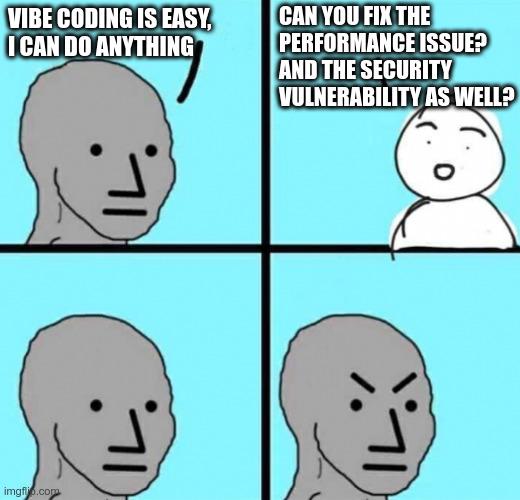
The classic tale of confidence meeting reality. First panel: Developer riding high on vibes, claiming they can do anything. Second panel: Someone asks about fixing actual technical issues. Third and fourth panels: Developer's face transitions from "I'm a genius" to "I want to murder you for exposing my incompetence." This is the programming equivalent of saying you're fluent in French until someone actually speaks French to you. The "vibe coder" is that person who copies Stack Overflow solutions without understanding them, then gets defensive when asked to explain why their code works (or more likely, why it doesn't).

SQL Injection With A Side Of Lasagna

SQL Injection With A Side Of Lasagna
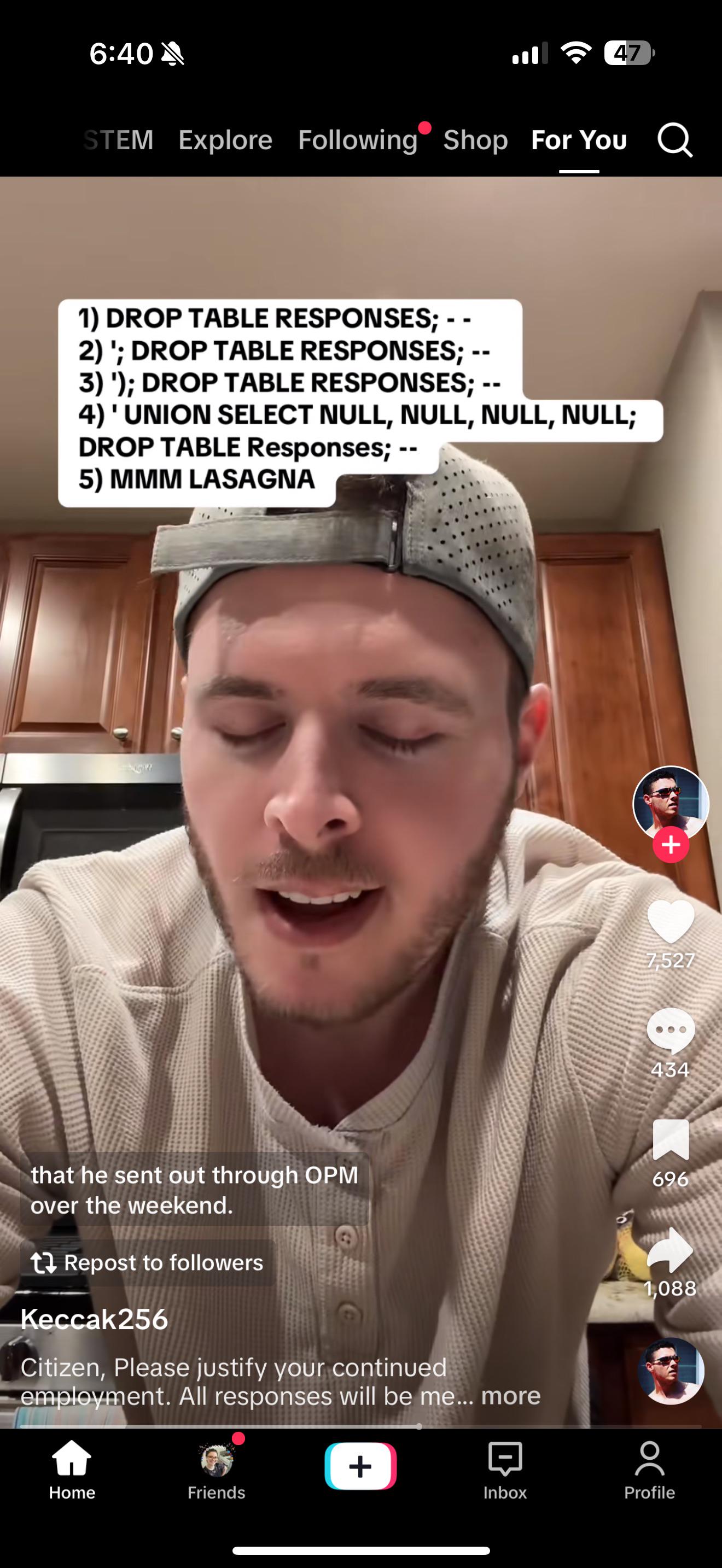
The meme shows a list of SQL injection attacks disguised as normal responses, and then suddenly "MMM LASAGNA" at the end. This is peak database security humor! The first four items are actually malicious SQL commands trying to drop tables and use UNION SELECT with NULL values—classic techniques to compromise databases through poorly sanitized inputs. Then item #5 just throws in random food appreciation, as if the hacker got distracted mid-attack by hunger. It's basically what happens when you're trying to breach security but your brain suddenly reminds you it's lunchtime. Every database admin's nightmare followed by... Italian cuisine?

FIFINE Studio Monitor Headphones for Recording, Wired Headphones with 50mm Driver, Over Ear Headset with Detachable Cables 3.5mm or 6.35mm Jack, Black, on PC/Mixer/Amplifier-H8

FIFINE Studio Monitor Headphones for Recording, Wired Headphones with 50mm Driver, Over Ear Headset with Detachable Cables 3.5mm or 6.35mm Jack, Black, on PC/Mixer/Amplifier-H8
[WELL-BALANCED SOUND] Large 50mm unit drivers featured on the wired headphones deliver dynamic bass, stable mids and accurate treble. Worked with 20Hz~20kHz frequency range, the FIFINE studio headpho…

PHP's Accidental Hash Collision Feature

PHP's Accidental Hash Collision Feature
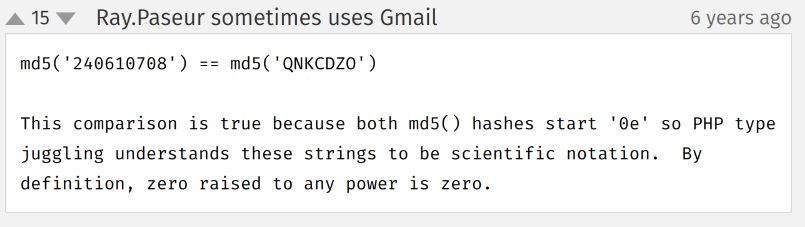
Behold, PHP's infamous type juggling strikes again! The meme shows how md5('240610708') == md5('QNKCDZO') evaluates to true despite being completely different strings. What's happening? Both MD5 hashes begin with '0e' followed by digits, which PHP helpfully interprets as scientific notation (0×10^something). And since 0 raised to any power equals 0, PHP thinks both hashes equal zero. It's basically comparing 0==0. This is why strict comparison ( === ) exists in PHP. Without it, you might accidentally authenticate someone with the wrong password! Security nightmare fuel for any developer who values their sanity.

Cybersecurity Professionals' Job Security Plan

Cybersecurity Professionals' Job Security Plan
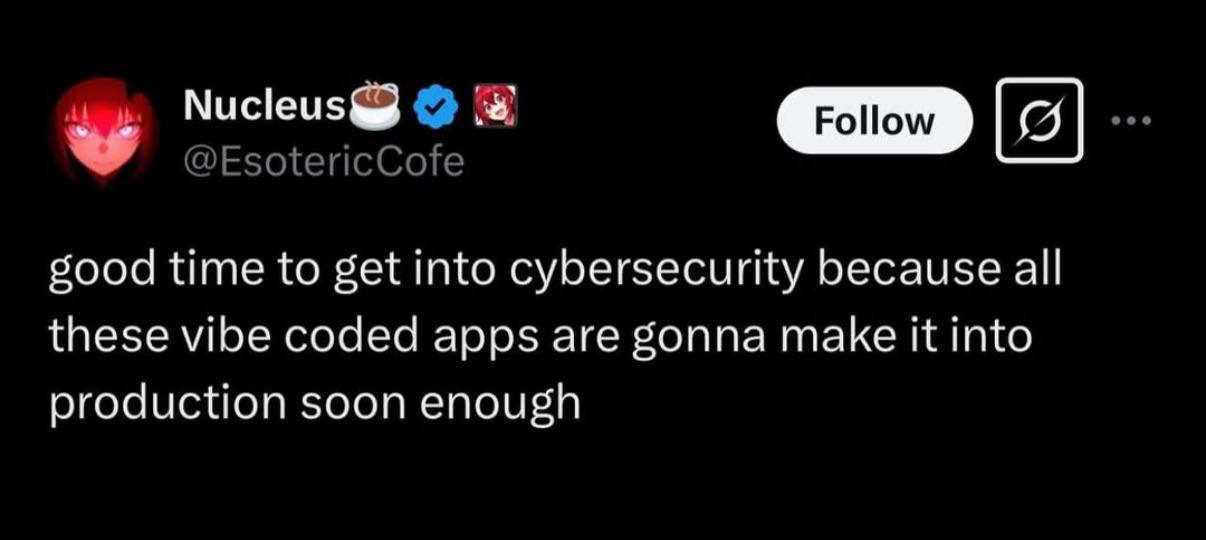
Ah, "vibe coded" – the spiritual successor to "works on my machine." When your code review consists of vibing with it instead of actual testing. Security professionals are salivating at the job security these startups are creating. Nothing says "future CVE entry" quite like an app built on good feelings and zero documentation. The cybersecurity industry thanks you for your service.

URL Parameters: The Ultimate Security Protocol

URL Parameters: The Ultimate Security Protocol
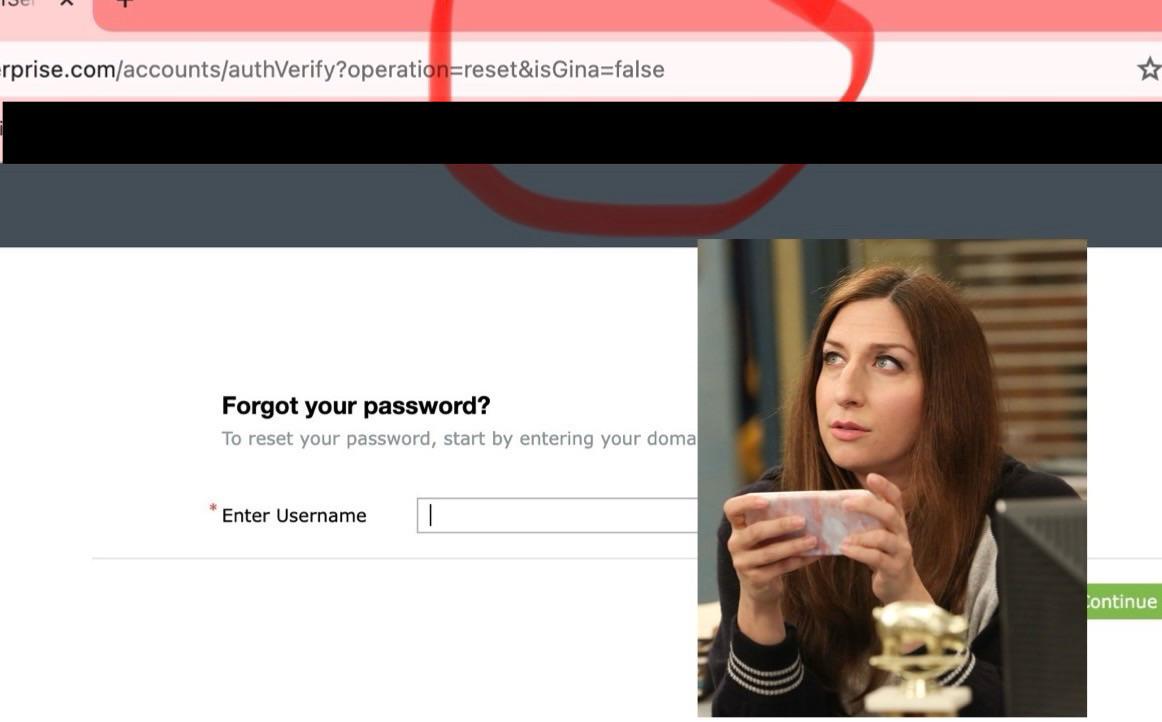
Look at that URL parameter: isGina=false . Some developer really said "let's just hardcode user identity in the query string" and called it a day. Security through obscurity at its finest! Next time Gina forgets her password, she just needs to hack the URL to isGina=true and boom—instant access. Who needs authentication when you can just tell the system who you are? Somewhere a security engineer is having a panic attack while the intern who wrote this is proudly adding "implemented user authentication system" to their resume.