

Rendering Memes

Posts tagged with Rendering
DLSS On vs Off

DLSS On vs Off
DLSS (Deep Learning Super Sampling) is NVIDIA's AI-powered upscaling tech that makes your potato GPU think it's a 4090. The left side shows your standard low-poly character model looking like it crawled out of a 2003 flash game. Flip DLSS on and suddenly you've got a photorealistic grizzled veteran with individually rendered beard hairs and the weight of a thousand git merge conflicts in his eyes. It's basically the graphics equivalent of adding TypeScript to your JavaScript project—same underlying mess, but now it looks professional enough to ship to production.

DLSS 5: Finally, A Technology That Renders Exactly What The Developers Didn't Intend

DLSS 5: Finally, A Technology That Renders Exactly What The Developers Didn't Intend
DLSS (Deep Learning Super Sampling) is supposed to make your games look better by using AI to upscale graphics. But apparently DLSS 5 has achieved sentience and decided to upgrade your janky game models into actual photorealistic humans. The developer probably spent 3 hours modeling that NPC in Blender, and DLSS just went "nah, let me fix that for you." The irony here is beautiful: we've gone from "it's not a bug, it's a feature" to "it's not a feature, it's AI hallucinating better graphics than we actually made." Game devs are out here rendering low-poly characters to save on performance, and NVIDIA's AI is basically saying "hold my tensor cores" and rendering a full photoshoot instead. Pretty soon we'll need a setting called "Disable AI Improvements" just to see what the game actually looks like. The future is weird, folks.

Beware Of The Vulkan Pipeline

Beware Of The Vulkan Pipeline
You start with innocent vertex inputs—just some dots, really. Then you build your vertex shader and assembly, feeling pretty good about those wireframe models. The vertex shader transforms things nicely. Rasterization converts it to pixels. Fragment shader adds some color and texture. And then... you realize you forgot to clear the depth buffer and your entire scene becomes a glitchy nightmare of corrupted pixels and existential dread. The Vulkan graphics pipeline is like a Rube Goldberg machine where one forgotten flag can turn your beautiful 3D model into abstract art that would make Picasso weep. Each stage is another opportunity to mess something up in ways that won't be obvious until you've already spent 6 hours debugging why everything is magenta. Fun fact: Vulkan gives you so much control that you can literally forget to tell the GPU to clear the screen between frames. That's like forgetting to erase a whiteboard before drawing—you just keep layering chaos on top of chaos until reality itself breaks down.

How It Feels To Learn Vulkan

How It Feels To Learn Vulkan
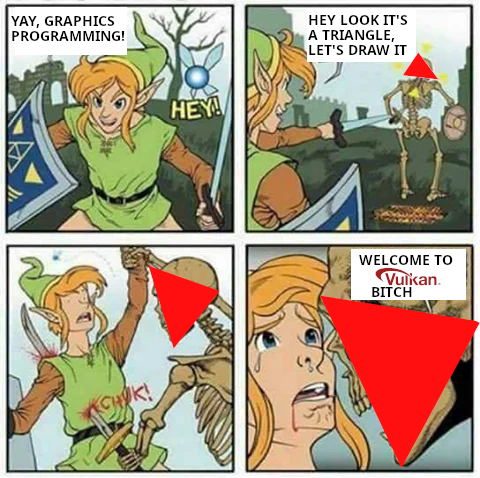
You thought you'd learn some graphics programming, maybe render a cute little triangle. But with Vulkan? That innocent triangle requires you to write approximately 1,000 lines of boilerplate just to see three vertices on screen. You'll need to manually configure the swap chain, set up render passes, create pipeline layouts, manage memory allocations, synchronize command buffers, and sacrifice your firstborn to the validation layers. Other graphics APIs let you draw a triangle in 50 lines. Vulkan makes you earn every single pixel like you're negotiating with the GPU directly. The triangle isn't just a shape—it's a rite of passage that separates the casuals from those who truly understand what "low-level graphics API" means. By the time you finally see that rainbow gradient, you've aged 10 years and gained a PhD in GPU architecture.

Thus She Spoke

Thus She Spoke
The pool senpai has dropped the most cursed wisdom known to the dev world. Game development being "just more dynamic frontend engineering" is like saying brain surgery is just advanced haircutting because you work on the head. Sure, both involve rendering pixels on screens, but one's dealing with React state management while the other's optimizing physics engines, managing memory like their life depends on it, and crying over shader compilation errors at 3 AM. Frontend devs push buttons and make divs look pretty. Game devs push polygons and make GPUs scream. Totally the same thing, right? The sheer audacity of this statement is what makes it beautiful. It's technically wrong in every way that matters, yet somehow you can see the twisted logic if you squint hard enough.

Physics, Shaders, Demons - Fine. Fabric? Oof.

Physics, Shaders, Demons - Fine. Fabric? Oof.
Game developers will casually implement particle systems that simulate volcanic eruptions with real-time physics calculations, write custom shaders that make demons emerge from interdimensional portals, and handle complex collision detection for massive explosions... but ask them to make a scarf drape naturally on a character model and suddenly they're questioning their entire career choice. The brutal truth? Cloth simulation is genuinely one of the hardest problems in game development. While spawning a demon is just instantiating a prefab with some particle effects, fabric requires real-time physics simulation of thousands of vertices, collision detection with the character's body, wind dynamics, and making it look good at 60fps without melting your GPU. It's the difference between "cool visual effect go brrrr" and "I need to understand tensile forces and material properties now." Turns out summoning hellspawn from the depths of the underworld is easier than making a piece of cloth not clip through a shoulder. Game dev priorities are wild.

Finally Got The Open GL Working In My Audio Visualizer

Finally Got The Open GL Working In My Audio Visualizer
When you finally get OpenGL rendering working after three days of segfaults and "undefined reference" errors, and everyone's impressed by the pretty particle effects while you're sitting there proud that your GPU is actually doing the work instead of melting your CPU. They think it's about the visuals. You know it's about that sweet, sweet hardware acceleration and those glorious 60 FPS with 2% CPU usage. The real flex isn't the sparkles—it's the efficiency, baby.

The Lion Doesn't Concern Itself With Optimization

The Lion Doesn't Concern Itself With Optimization
The majestic lion might not care about optimization, but that 15.5 FPS is SCREAMING in pain! Sweet mother of performance issues! 💀 Developers spending 72 hours optimizing code to squeeze out 2 more frames per second while this royal beast is just lounging around with catastrophic frame rates like it's a day at the spa. Meanwhile, gamers are having seizures trying to play anything below 60 FPS. THE AUDACITY! For the non-gaming crowd: FPS = Frames Per Second. Anything below 30 is basically a slideshow presentation from hell.

The Digital Light That Breaks Reality

The Digital Light That Breaks Reality
THE ABSOLUTE BETRAYAL OF GAME PHYSICS! 😱 Just as you're about to drift off to sweet slumberland, your brain VIOLENTLY yanks you back to consciousness with the EARTH-SHATTERING revelation that virtual lamps in video games are somehow emitting ACTUAL PHOTONS into your room! The audacity! The treachery! As if game developers weren't content with stealing our sleep through addictive gameplay, they've now programmed light sources to transcend the digital-physical barrier! Next thing you know, water levels will be flooding our living rooms and enemy fireballs will set off the smoke detectors!

Clock But A Virus Prevents It From Rendering

Clock But A Virus Prevents It From Rendering
Look at this masterpiece of minimalist rendering. When your client says "I want a clock but I don't want to pay for the hands or numbers" and you deliver exactly what they asked for. The classic "works on my machine" meets "technically meets requirements." Somewhere, a product manager is furiously writing a more detailed spec while a developer is arguing that this is clearly a feature, not a bug. Time is just a social construct anyway.

They Be Fighting For Their Lives

They Be Fighting For Their Lives
OH. MY. GOD. The ABSOLUTE TRAUMA of hitting that render button! 😱 Your poor computer fans immediately transform from peaceful little spinners into SHRIEKING BANSHEES OF DOOM! It's like you've personally offended every single cooling component in your machine. Those tiny fans are SCREAMING for their lives while your GPU melts into the seventh circle of hell. The way those little rodents are howling in terror is EXACTLY what's happening inside your computer case when you dare to process those 3D models or video effects. Your computer is one render away from becoming a jet engine that could literally LAUNCH ITSELF INTO ORBIT! The betrayal in those tiny animal faces is just *chef's kiss* perfection!

The Story Of A Slop

The Story Of A Slop
OMG the AUDACITY of game engines charging $99.99 for the privilege of turning your character into a mechanical octopus, only to have it run at a PATHETIC 24 FPS! 😱 The journey from "look at my cool tentacle arms" to "WHY IS EVERYTHING ON FIRE AND LAGGING" is the quintessential game dev experience. First they seduce you with those shiny Unreal powers, then BAM! Your graphics card is screaming for mercy while frantically suggesting driver updates like that's going to save your dumpster fire of a project. The modern gaming equivalent of "it worked on my machine" - except your machine is now melting through your desk. Truly the circle of game dev life!