

Quantum computing Memes

Posts tagged with Quantum computing
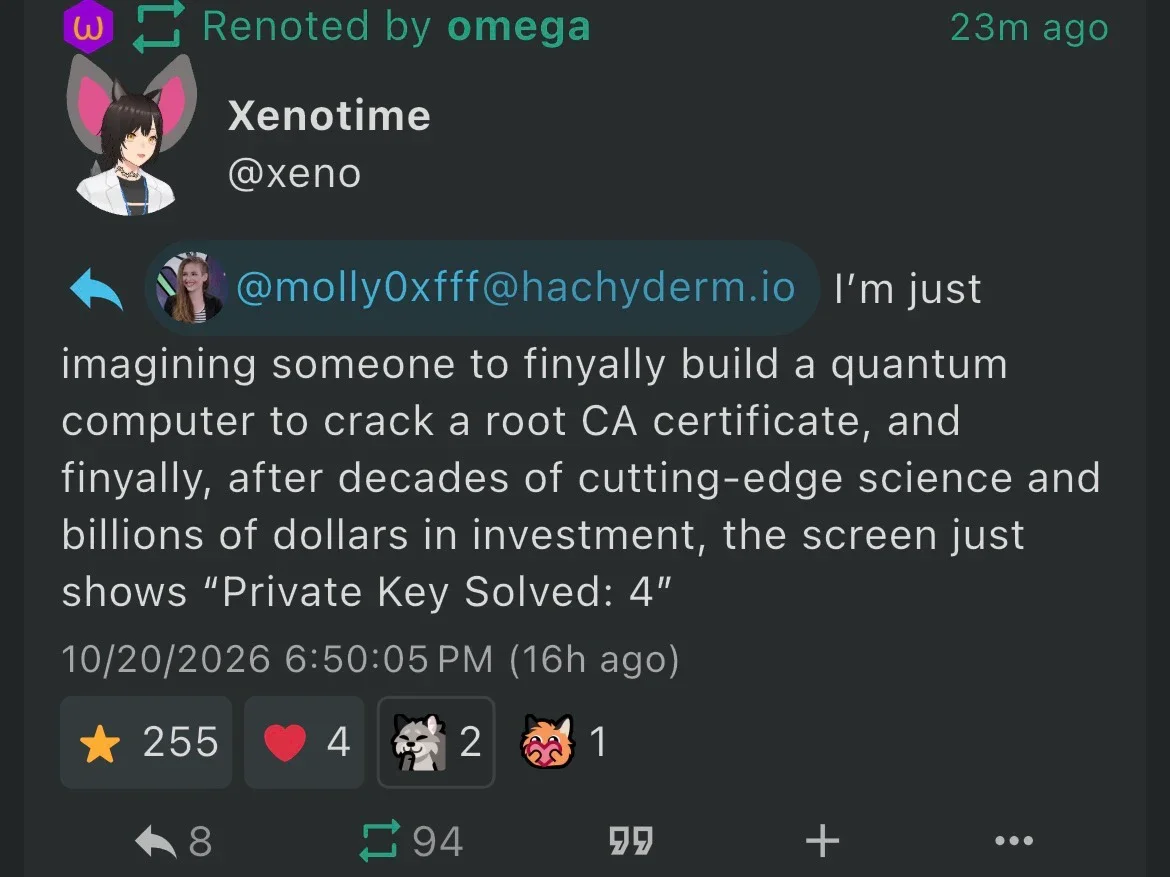
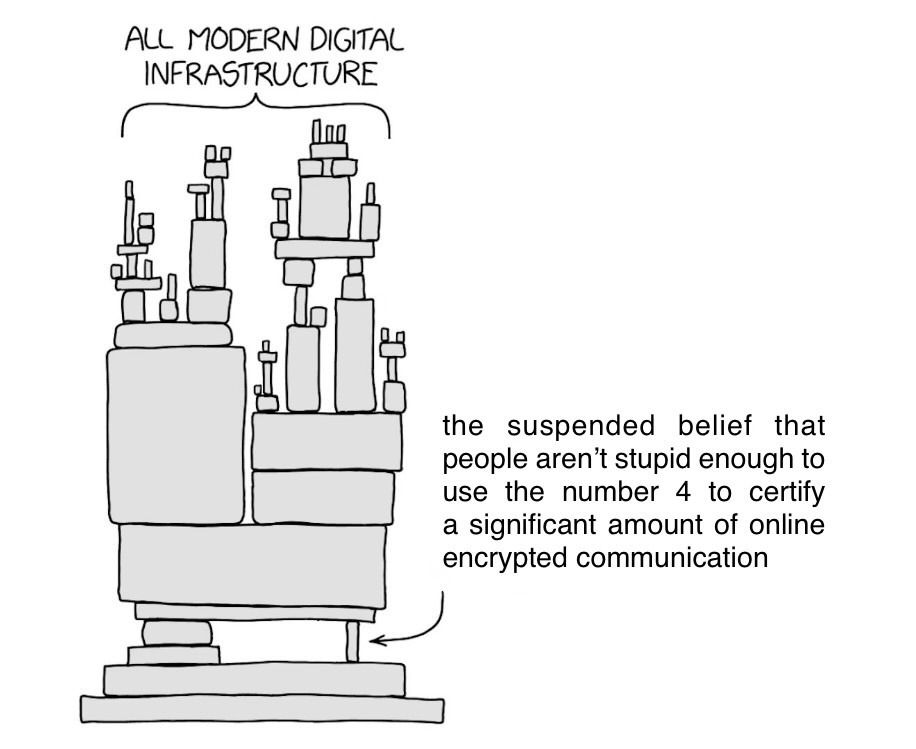
When Quantum Computing Finally Cracks Encryption

When Quantum Computing Finally Cracks Encryption
So we're out here building quantum computers powerful enough to break the entire internet's security infrastructure, and the grand finale is... "Private Key Solved: 4". Not some 2048-bit RSA key, not an elliptic curve masterpiece—just the number 4. Someone's root CA certificate was protected by the cryptographic equivalent of a screen door. Decades of research, billions in funding, and the most sophisticated computing technology humanity has ever created, all to discover that someone's critical infrastructure was secured with a private key that a toddler could guess. The real quantum leap here is the sheer audacity of that security choice. Plot twist: The password was probably "password" too.

Am I Late For This Meme

Am I Late For This Meme
So apparently our entire digital civilization—cloud services, banking systems, streaming platforms, social media—is built on a rickety tower of legacy code held together by the collective delusion that RSA-4096 is uncrackable. The foundation? Just trusting that factoring really large numbers is hard enough that nobody will bother. It's like securing Fort Knox with a really complicated Sudoku puzzle and hoping nobody brings a quantum computer to the party. Sleep tight knowing your encrypted messages are protected by mathematicians playing the longest game of "I bet you can't solve this" in history.

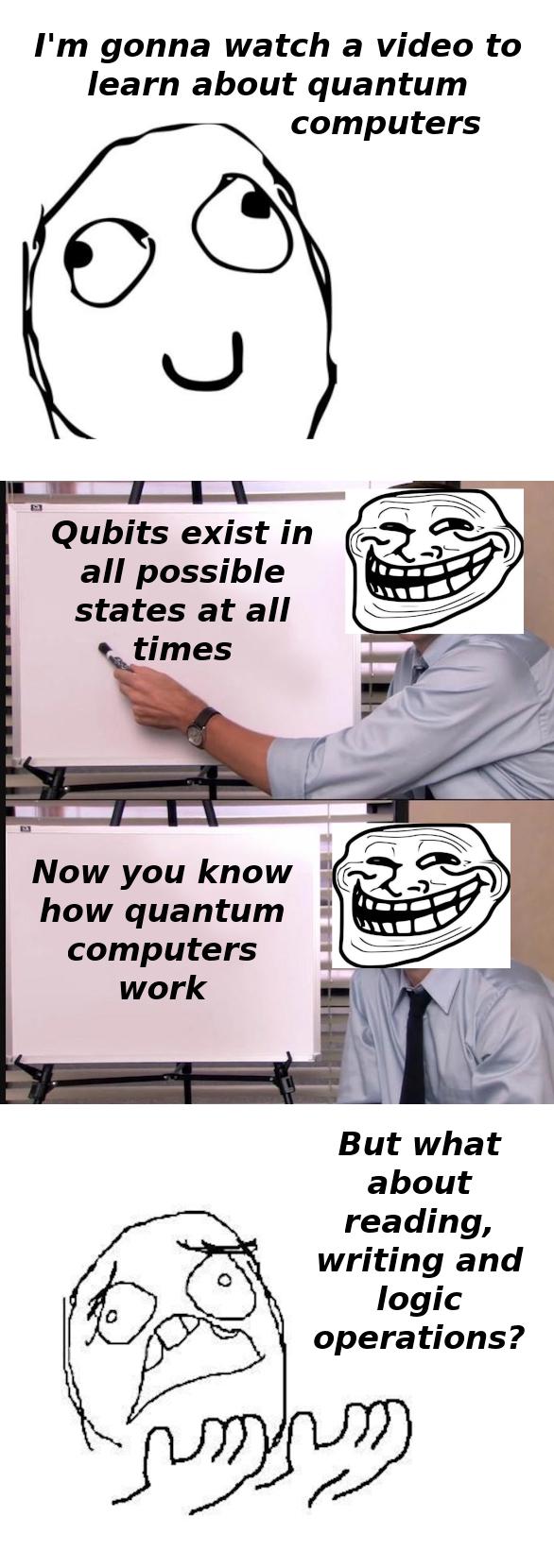
Every Quantum Computer Video Ever

Every Quantum Computer Video Ever
You go in wanting to understand quantum computing. They hit you with "qubits exist in all possible states at all times" and you nod along like you've achieved enlightenment. Then they smugly declare "now you know how quantum computers work" and you're sitting there like... wait, what about the actual implementation details? How do I read from it? Write to it? Do basic operations? It's the tech equivalent of explaining a car by saying "the engine makes it go vroom" and then walking away. Every quantum computing explainer stops right at superposition and entanglement, acting like they've given you the full picture. Meanwhile, you're left wondering how to actually use the damn thing for anything practical. Spoiler: most of those videos are made by people who also don't fully understand it but watched another video that said "qubits exist in all possible states."

How Do Quantum Computers Work?

How Do Quantum Computers Work?
Normal computers are out here making binary decisions like they're at a restaurant: "Yes, I'll have the 1" or "No, give me the 0." Clean. Deterministic. Boring. Quantum computers? They looked at superposition and said "why choose?" They're simultaneously yes AND no until you observe them, at which point they collapse into... well, perhaps an answer. It's like Schrödinger's cat got a CS degree and now refuses to commit to anything. The best part? Even quantum physicists explain quantum computing with "well, it's complicated" energy. These machines are out here solving problems in polynomial time that would take classical computers until heat death of the universe, but ask anyone how they actually work and you get a nervous laugh and a whiteboard full of Greek letters. Qubits are basically the "it's complicated" relationship status of computing.

Bose QuietComfort Headphones - Wireless Bluetooth Headphones, Active Over Ear Noise Cancelling and Mic, USB-C Charging, Deep Bass, Up to 24 Hours of Playtime, White Smoke

Bose QuietComfort Headphones - Wireless Bluetooth Headphones, Active Over Ear Noise Cancelling and Mic, USB-C Charging, Deep Bass, Up to 24 Hours of Playtime, White Smoke
NOISE CANCELLING HEADPHONES: Effortlessly combines noise cancellation technology with passive features so you can shut off the outside world, quiet distractions, and take music beyond the beat · COMF…

Different Conditions

Different Conditions
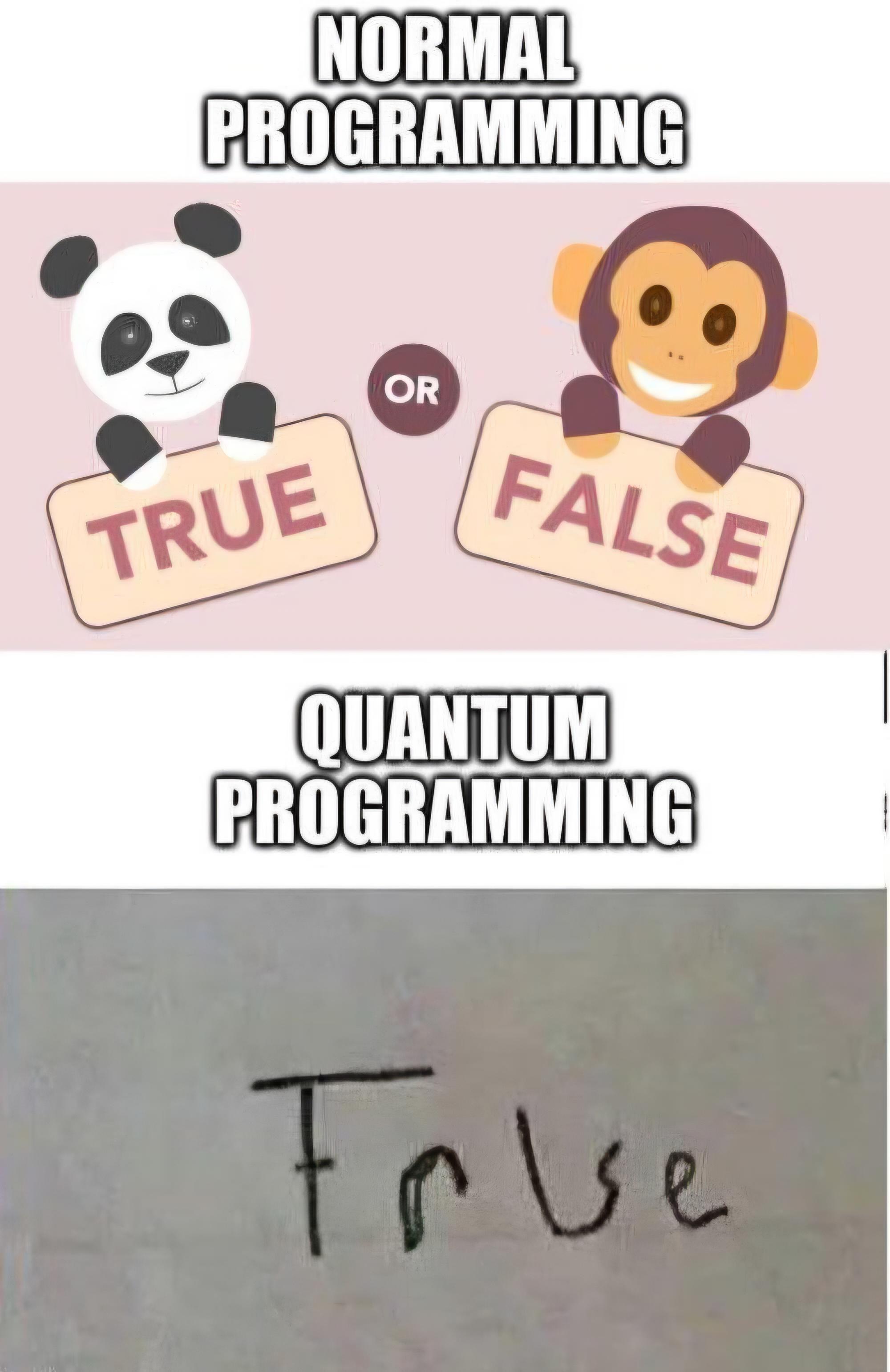
Normal programming: cute binary logic where things are either TRUE or FALSE. Simple. Clean. Predictable. Quantum programming: your boolean exists in superposition and is somehow both TRUE and FALSE simultaneously until you observe it, at which point it collapses into... "Frlse"? "Talse"? Whatever that abomination is supposed to be. It's like Schrödinger's cat decided to become a software engineer and now your conditionals are having an existential crisis. Good luck debugging that with your traditional if-else statements. You'll need a PhD in physics just to understand why your code returns "maybe" as a valid state.

Can Quantum Machines Save Us

Can Quantum Machines Save Us
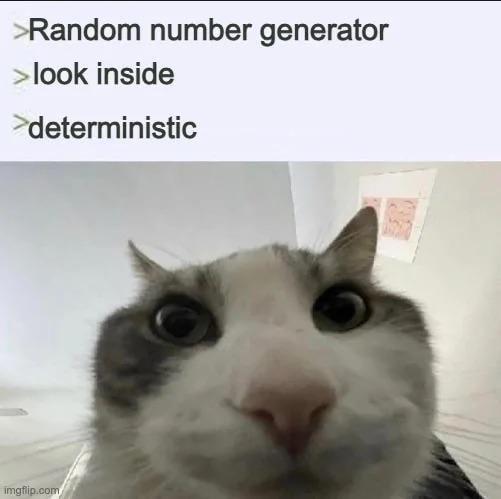
The beautiful irony here is that most "random" number generators in programming are actually pseudorandom—they're deterministic algorithms that just produce sequences that look random. You give them the same seed, you get the same "random" numbers every single time. It's like asking for chaos but getting a very organized spreadsheet instead. The shocked cat's face captures that exact moment when you realize your RNG is basically a fancy calculator cosplaying as entropy. Quantum computers promise true randomness through quantum mechanics shenanigans, but until then, we're all just running Math.random() and pretending we don't know it's using a Linear Congruential Generator from 1958. Fun fact: If you need cryptographically secure randomness, never use your language's basic random function. That's how you end up generating "random" session tokens that a script kiddie can predict faster than you can say "security vulnerability."

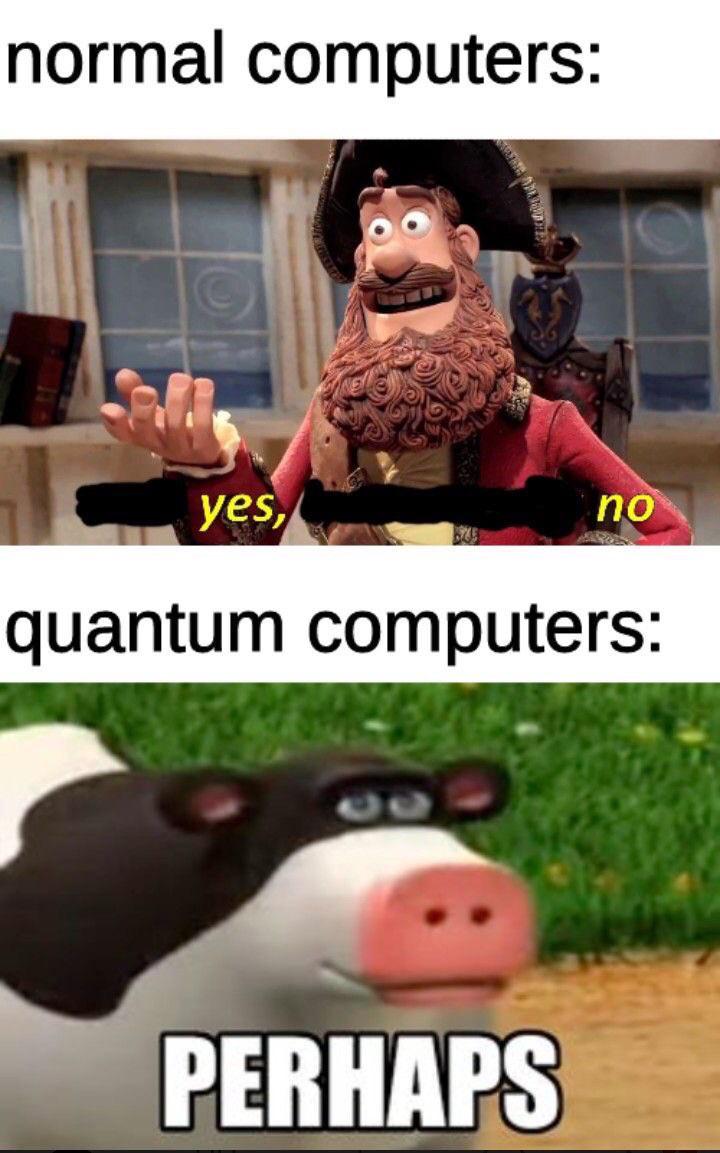
Normal Vs. Quantum Computers: The Ultimate Drama Queens

Normal Vs. Quantum Computers: The Ultimate Drama Queens
OMG, the AUDACITY of quantum computers! While regular computers are over here living their best binary lives with clear "yes" or "no" answers like some kind of digital SAINTS, quantum computers are that one friend who responds to your party invite with "Well yes, but actually no." 🙄 Quantum superposition is LITERALLY the most dramatic thing in computing - existing in multiple states AT THE SAME TIME because picking ONE state would be too mainstream. Like, honey, just make a decision already! The rest of us have code to compile!

Might Have To Study Quantum Physics For Contributing Now

Might Have To Study Quantum Physics For Contributing Now
Schrödinger's bug report just dropped! Someone actually created a GitHub issue requesting quantum uncertainty support for the number 13. According to them, the number should exist in a superposition of being both thirteen and not thirteen simultaneously until .observe() is called. The cherry on top? You get bonus points if the value only collapses to true when nobody's looking at the console. Because that's exactly how I want my production code to behave—completely unpredictable until a customer calls support. Next PR: "Please add support for time travel debugging where errors fix themselves if you stare at them long enough."

The Golden Era Of Software Engineering

The Golden Era Of Software Engineering
The eternal developer's dilemma captured in three painful stages of existence: First, we see Assembly code - a nightmare of register manipulation and syscalls just to print "Hello, World!" - with the crushing realization you missed the era when real programmers had to understand how computers actually work. Then there's quantum computing with its shiny gold hardware that looks like it belongs in a sci-fi movie. Too bad you're stuck in the boring classical computing era while the cool kids will someday manipulate qubits in superposition. But fear not! You were born at the perfect time to experience the true pinnacle of software engineering: begging an AI to center a div because CSS is basically dark magic that nobody actually understands. The circle of programming life is complete. We've gone from writing machine code to having machines write our code.

Bose QuietComfort Headphones - Wireless Bluetooth Headphones, Active Over Ear Noise Cancelling and Mic, USB-C Charging, Deep Bass, Up to 24 Hours of Playtime, Sandstone

Bose QuietComfort Headphones - Wireless Bluetooth Headphones, Active Over Ear Noise Cancelling and Mic, USB-C Charging, Deep Bass, Up to 24 Hours of Playtime, Sandstone
NOISE CANCELLING HEADPHONES: Effortlessly combines noise cancellation technology with passive features so you can shut off the outside world, quiet distractions, and take music beyond the beat · COMF…

Microsoft's Quantum Leap Of Logic

Microsoft's Quantum Leap Of Logic
The classic Drake meme perfectly captures Microsoft's bizarre resource allocation. Top panel: Drake recoils in disgust at "Making a basic Azure linked-service test-connection endpoint working" — you know, something customers actually need daily. Bottom panel: Drake enthusiastically approves of "Building a $50M quantum computing platform that 3 people on Earth actually use." Because why fix mundane connectivity issues when you can pour millions into quantum tech that might be relevant in 2050? Meanwhile, developers everywhere are still waiting for that test connection to stop timing out...

The Quantum Mechanics Of USB Connections

The Quantum Mechanics Of USB Connections
The universal law of USB ports: you'll always try to plug it in wrong twice before getting it right. First attempt? Wrong. Flip it? Still wrong. Flip it back to the original position that somehow magically works now? Success! It's like quantum physics for connectors - the USB exists in a superposition of wrong orientations until observed by the third attempt. After 15 years in tech, I'm convinced USB ports are secretly designed by chaos engineers who feed on our frustration.

I Think I Accidentally Bought A Quantum Computer

I Think I Accidentally Bought A Quantum Computer
Ah, the classic "my CPU is running at half a million MHz" situation. Either this person has discovered the world's fastest processor or their monitoring software is having an existential crisis. For reference, most high-end CPUs run at 3000-5000 MHz, so this is just casually operating at *checks notes* 100x normal speed while using only 14% of its power. Next week: "My RAM downloaded more RAM and now I have infinite memory."