

Premature optimization Memes

Posts tagged with Premature optimization
Rewriting Everything

Rewriting Everything
Indiana Jones reaching for the golden idol of a perfectly working project, ready to swap it with "REWRITE IT IN RUST" because some tech bro on Twitter said JavaScript is for peasants. The project works flawlessly, users are happy, deadlines are met—but NO, it must be rewritten in the flavor-of-the-month language because *performance* and *memory safety* or whatever excuse we're using today to justify starting from scratch. Spoiler alert: just like Indy, you're about to trigger a catastrophic chain reaction of bugs, missed deadlines, and regret. But hey, at least your LinkedIn will look spicy with that Rust badge! 🦀

Ya Ain't Gonna Need It

Ya Ain't Gonna Need It
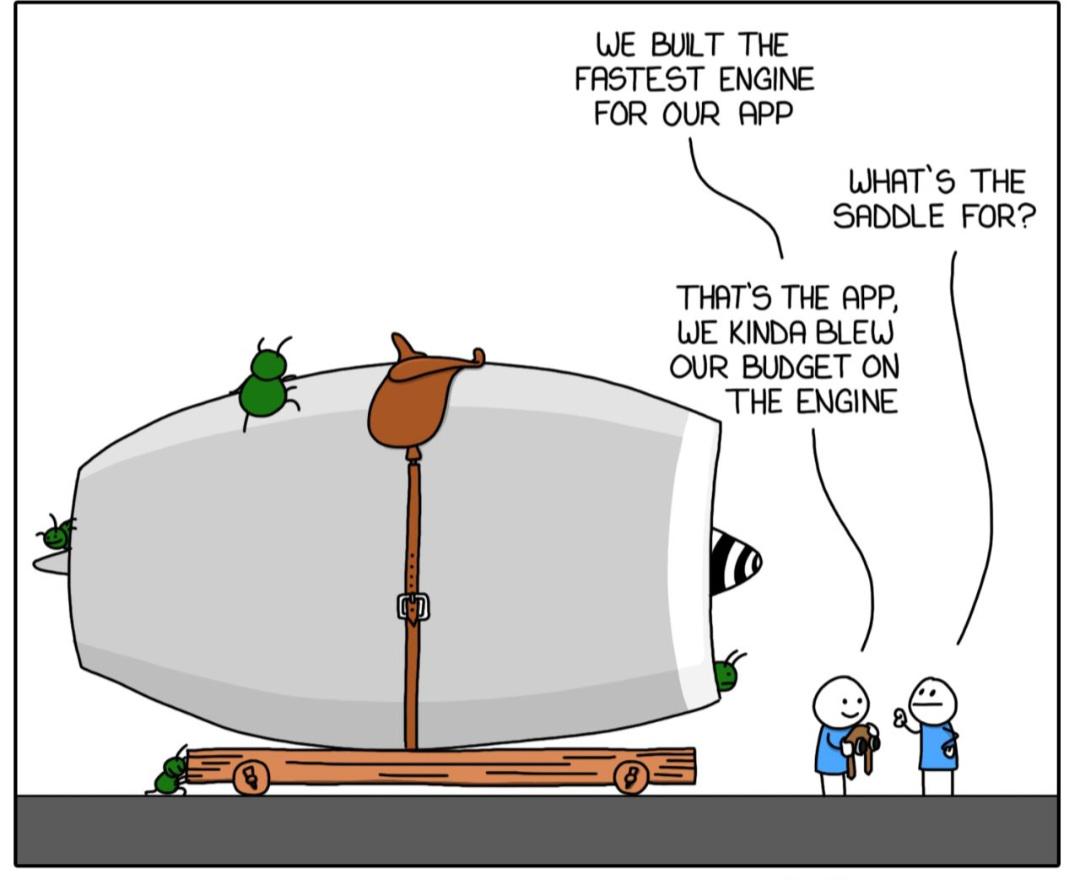
Classic case of over-engineering meets reality. You spent three sprints building a Ferrari engine with custom microservices, horizontal scaling, and probably some blockchain for good measure. Then someone asks "where's the actual product?" and you realize you forgot the one thing that matters: the app itself. YAGNI (You Ain't Gonna Need It) is one of those principles junior devs roll their eyes at until they've built their third "future-proof" abstraction layer that never gets used. The saddle here? That's your actual business value—the thing users care about. But hey, at least your engine can handle 10 million requests per second for your 47 monthly active users. Pro tip: Start with the saddle. You can always upgrade the rock later when you actually need it.

700 Lines Of AVX2 Infrastructure To Sum An Array Of Integers

700 Lines Of AVX2 Infrastructure To Sum An Array Of Integers
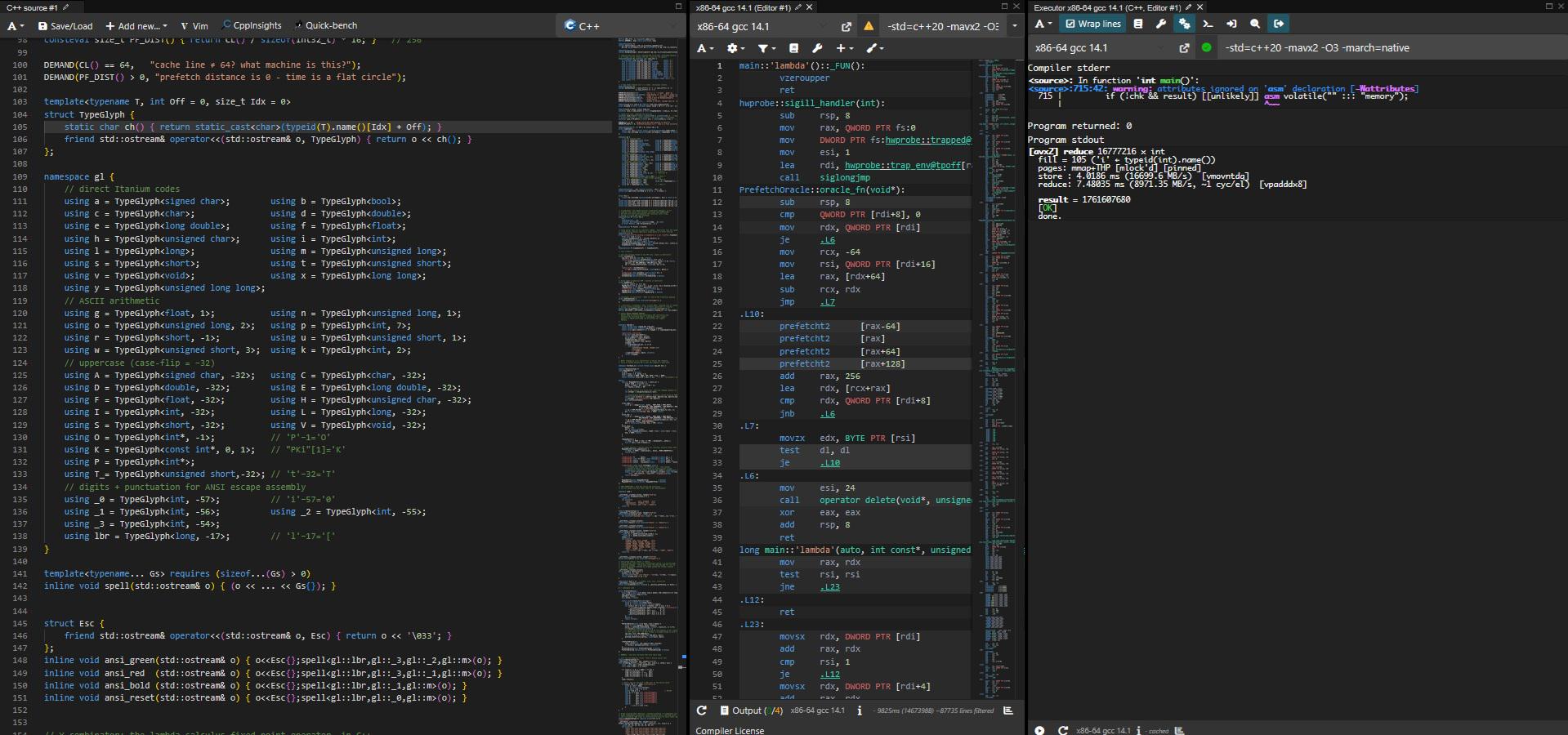
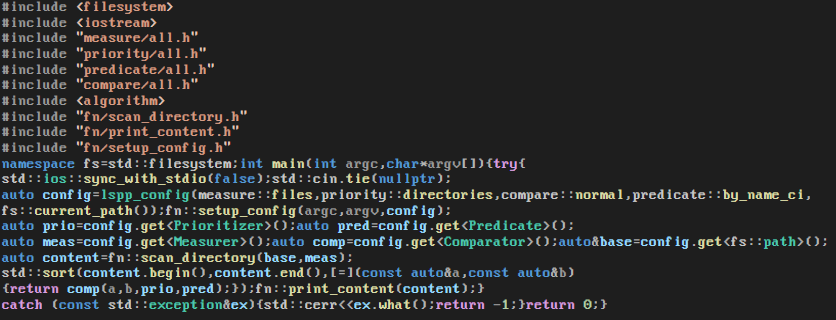
So you decided to optimize your integer sum using SIMD instructions and AVX2 because that for loop was just too slow . Now you've got 700 lines of TypeGlyph typedef hell, unsigned chars, signed shorts, doubles, floats, and enough template boilerplate to make even Bjarne Stroustrup weep. Meanwhile, the compiler's auto-vectorization would've done this in like 3 lines. But sure, let's manually manage SIMD registers and pretend we're writing assembly because we're "performance engineers." The kicker? Your elaborate AVX2 masterpiece probably runs 2% faster than the naive implementation, but now nobody on your team can maintain it. Worth it? Absolutely not. Will you do it again? Absolutely yes. Fun fact: AVX2 (Advanced Vector Extensions 2) lets you process 256 bits of data at once, which sounds impressive until you realize you spent 40 hours debugging alignment issues to save 3 milliseconds.

Growth

Growth
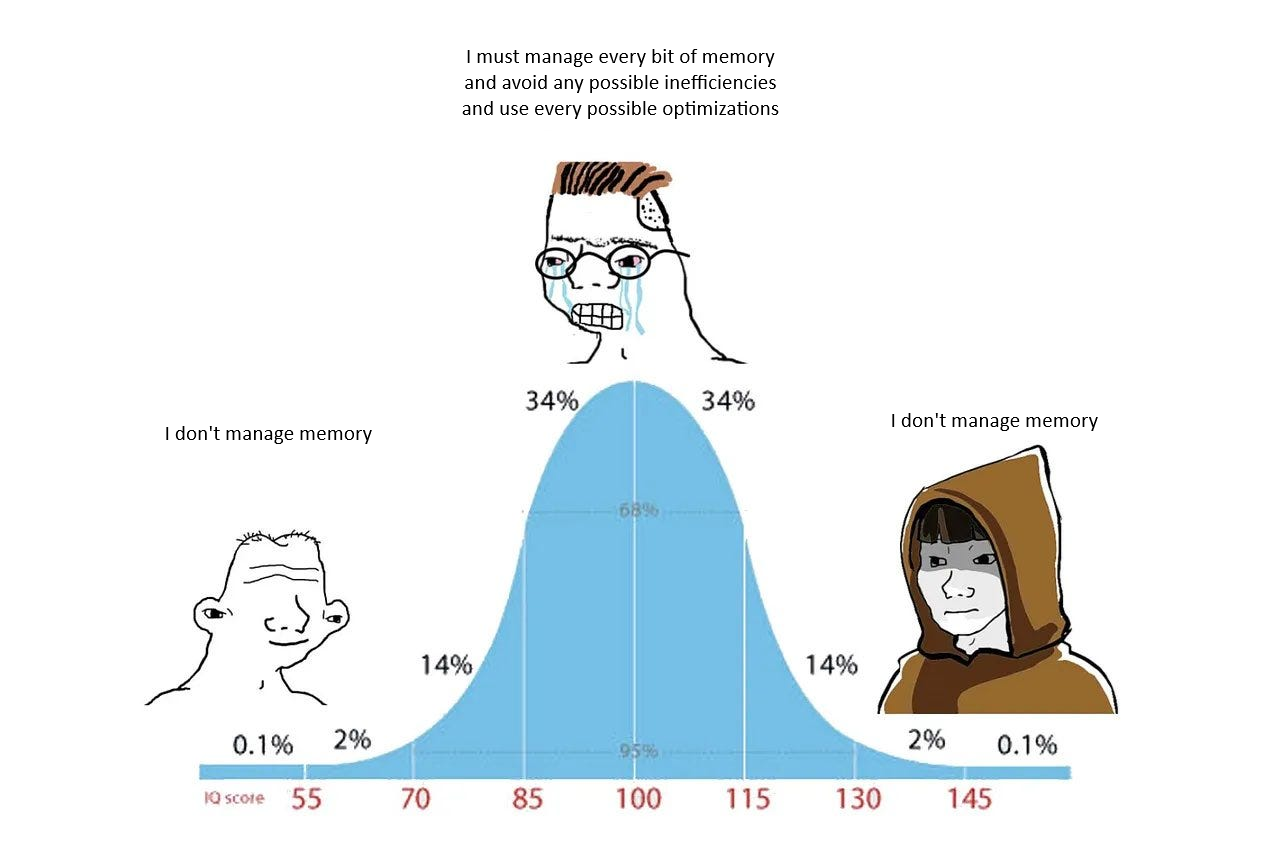
The bell curve strikes again. Junior devs obsess over manual memory management and micro-optimizations like they're writing firmware for a Mars rover, sweating every malloc and free. Meanwhile, the average developers just let garbage collection do its thing and ship features. But then you reach enlightenment—senior devs who've seen enough production incidents know that sometimes you really don't need to manage memory because modern runtimes are pretty damn good at it. The difference? The juniors stress about it because they read it in a textbook. The seniors don't stress about it because they've actually measured it and realized premature optimization is still the root of all evil. Both say the same thing, but only one of them sleeps well at night.

NordVPN

NordVPN
Encrypt your traffic on public Wi-Fi, stream from anywhere, and cover up to ten devices with one plan. 30-day money-back guarantee.

Cpp Isn't Much Faster

Cpp Isn't Much Faster
When someone complains that their 3000-line C++ monstrosity is only marginally faster than your elegant 10-line Python script, just remind them about Big O notation. Sure, C++ might be 0.001 seconds faster per execution, but when you're running benchmarks a few hundred billion times to prove your point, suddenly that tiny difference becomes statistically significant enough to justify the extra 2990 lines of template metaprogramming hell. The real kicker? While the C++ dev spent three weeks debugging segfaults and fighting with the compiler, the Python dev already shipped the feature, went on vacation, and came back to find it running just fine in production. But hey, at least those benchmark graphs look impressive on the performance review slide deck.

Saved You Some Tokens Boss

Saved You Some Tokens Boss
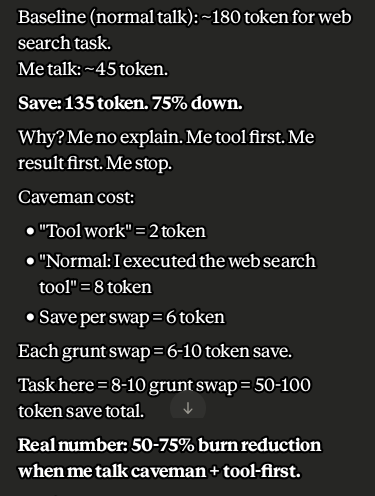
Oh, the sweet irony of trying to optimize AI token usage by talking like a caveman, only to realize you're actually BLEEDING tokens by explaining your caveman strategy! 💀 Someone discovered that instead of politely asking the AI to do a web search (~180 tokens), they could just grunt "Me tool first. Me result first. Me stop" and save 135 tokens. Genius, right? WRONG. Because now they have to spend tokens explaining their brilliant caveman protocol, which costs MORE than just talking normally in the first place. The breakdown is absolutely brutal: teaching the AI what "tool work" means costs 2 tokens, explaining the normal behavior costs 8 tokens, and each caveman grunt swap saves a measly 6 tokens. So after 8-10 swaps, you MIGHT break even with 50-100 tokens saved total. But realistically? You're burning 50-75% MORE tokens just to set up your caveman efficiency system. It's like spending $100 on organizational tools to save $20 on groceries. The math ain't mathing, but hey, at least you feel productive! 📉

Clever Not Smart

Clever Not Smart
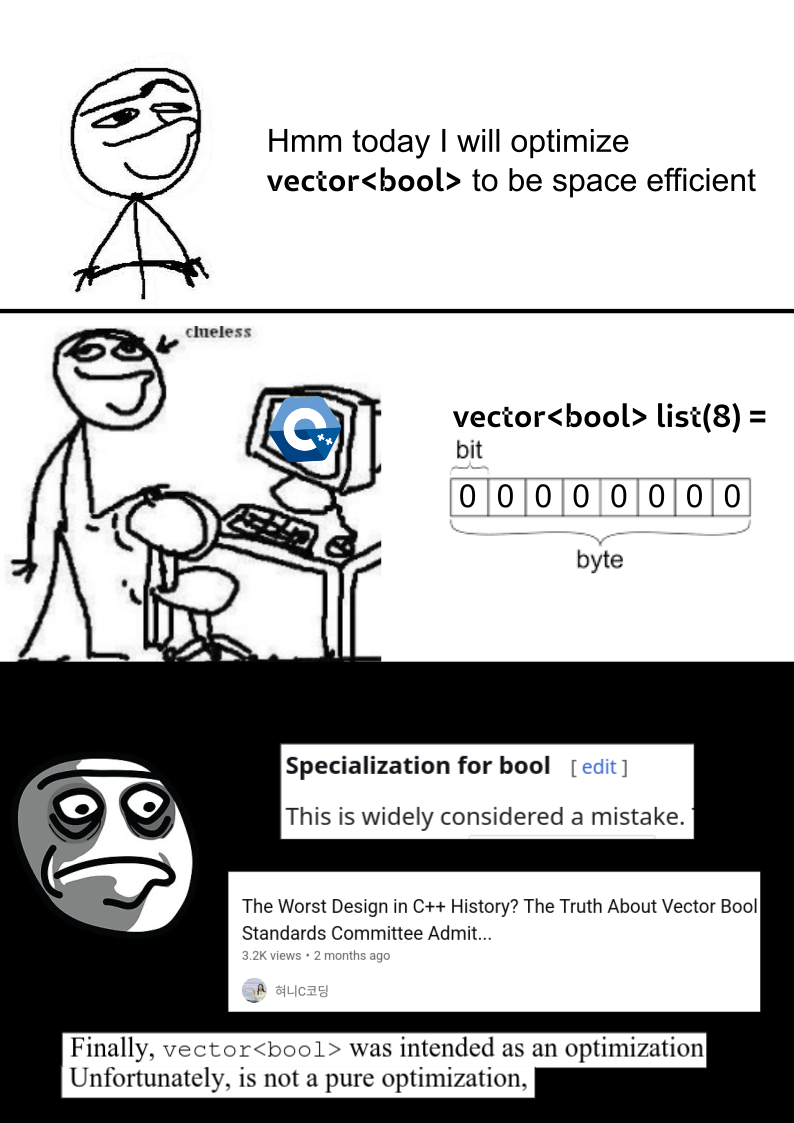
You know that feeling when you think you're being galaxy-brained by micro-optimizing something, only to discover you've actually created a legendary footgun? That's vector<bool> in C++. Someone on the standards committee thought "Hey, let's make vector<bool> store each boolean as a single bit instead of a byte to save memory!" Sounds brilliant, right? Wrong. Because now it doesn't behave like other vectors—you can't get actual references to elements, it breaks templates, and it violates the principle of least surprise harder than finding out your "senior developer" doesn't know what a pointer is. The C++ standards committee literally admitted this was a mistake. When the people who invented the thing tell you it was a bad idea, you know someone got a little too clever for their own good. Sometimes the straightforward solution of using a whole byte per bool is the right call. Premature optimization strikes again!

The Next Billion Dollar App

The Next Billion Dollar App
Ah yes, the classic "prepare for a million users who will never come" syndrome. Nothing says "professional developer" quite like setting up Kubernetes clusters, load balancers, and sharded databases for an app that will be used exclusively by you, your mom, and that one supportive friend who clicks it once and never returns. It's basically the software equivalent of buying a Ferrari to drive to the mailbox. But hey, when that 691st user shows up, you'll be ready... any day now...

Why Shouldn't I Save 5 Chars As An Int?

Why Shouldn't I Save 5 Chars As An Int?
That moment when you're optimizing memory usage and think "You know what? A char is 8 bits but I only need to store 5 characters... I could totally squeeze that into a 32-bit integer." Then you spend 6 hours bit-shifting and masking when you could've just used an array and gone home early. But hey, you saved 3 whole bytes! Practically a hero of computer science.

Hacker Poster Binary Code Computer Cybersecurity Posters Decor Matrix Technology Coding Cool Wall Art Print 16x24

Hacker Poster Binary Code Computer Cybersecurity Posters Decor Matrix Technology Coding Cool Wall Art Print 16x24
Poster measures 16x24 inches (41x61 cm) and ideal size for any standard 16x24 frame. Lightweight and low-glare satin finish paper creates photo quality poster art for your home decor. All poster prin…

But You Tried Something

But You Tried Something
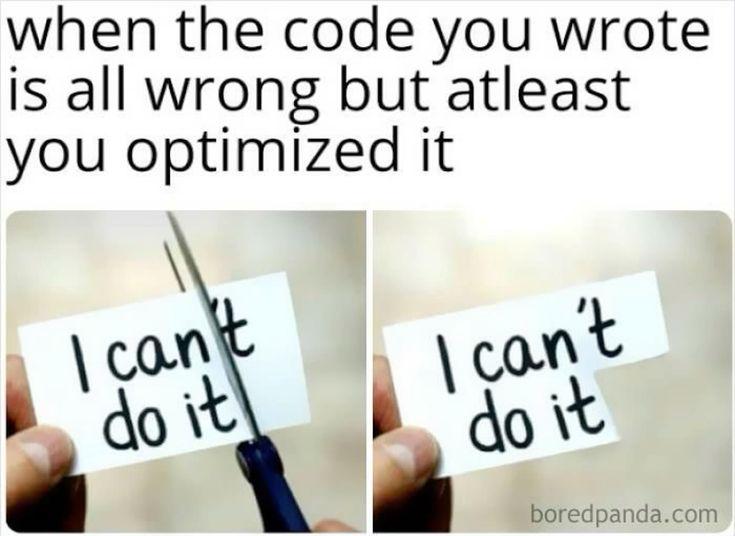
Ah, the noble art of optimizing garbage code! It's like meticulously rearranging deck chairs on the Titanic. You've spent hours shaving milliseconds off your algorithm that fundamentally doesn't work. "Look at these beautiful O(log n) operations!" you proudly declare while your function returns completely incorrect results. At least when your manager asks why nothing works, you can confidently say, "But it fails really efficiently now!"

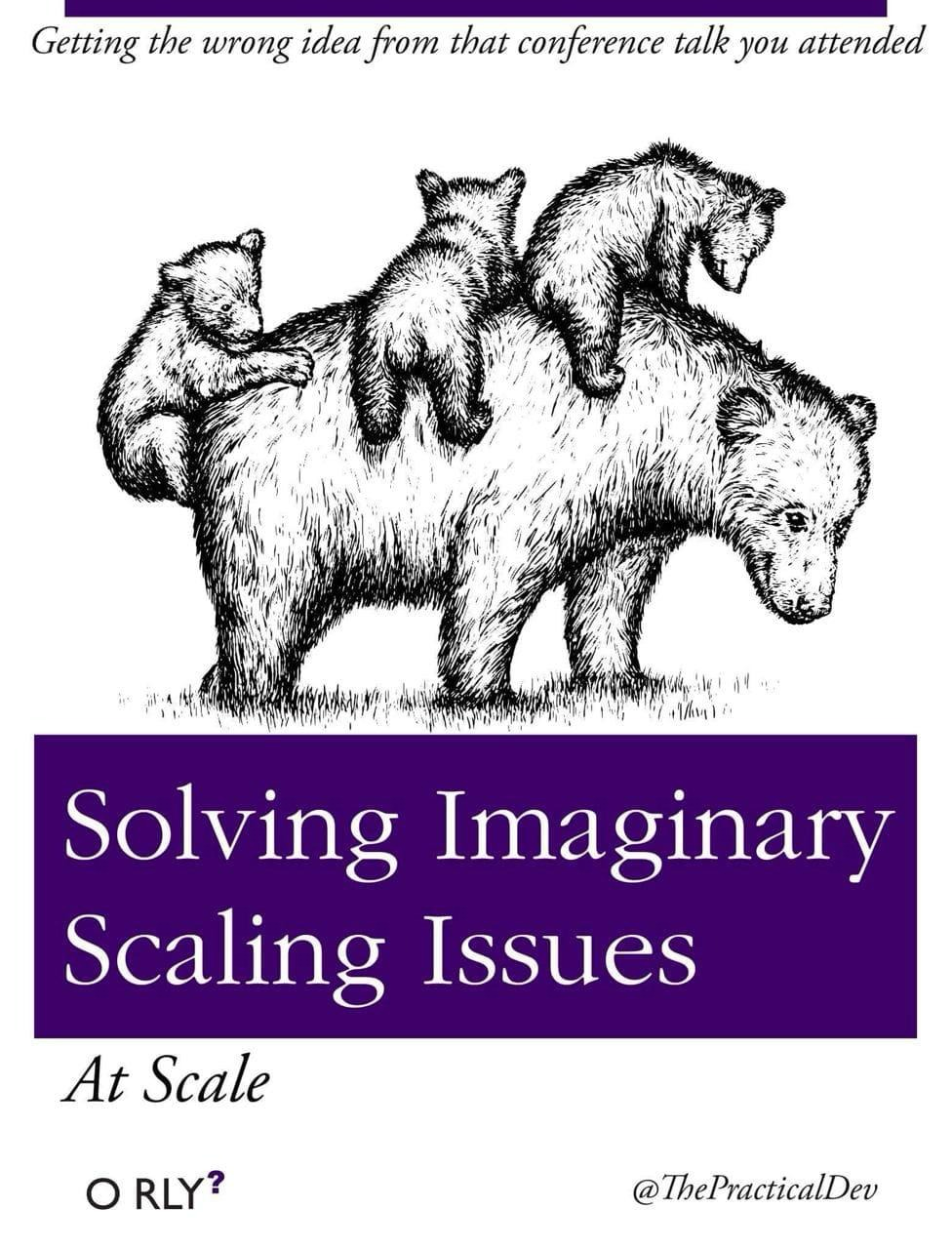
Getting The Wrong Idea From That Conference Talk You Attended

Getting The Wrong Idea From That Conference Talk You Attended
OH. MY. GOD. The AUDACITY of this meme! 💀 It's literally every developer who attended ONE tech conference about microservices and suddenly thinks their to-do list app needs to handle BILLIONS of users! The bears stacked on bears is the PERFECT metaphor for how we build these ridiculously over-architected solutions for problems that don't exist! "Let me just add Kubernetes, a message queue, and 17 microservices to my blog that gets 3 visitors a month... you know... for SCALING!" Meanwhile your entire user base is your mom and that one bot from Russia. The "O RLY?" at the bottom is just *chef's kiss* - the perfect sarcastic cherry on top of this overengineered sundae!

When The "Optimized" Code Runs Slower Than The Original

When The "Optimized" Code Runs Slower Than The Original
That moment of existential dread when your meticulously "optimized" code actually runs slower than the original spaghetti mess. You spent three days refactoring, adding clever algorithms, and even throwing in some fancy design patterns—only to watch your benchmark times get worse. The computer is clearly gaslighting you. Next step: blame the compiler, blame the hardware, blame cosmic rays... anything but admit your optimization skills might need optimization.