

Operators Memes

Posts tagged with Operators
Pre Decrement Fixes The Exploit

Pre Decrement Fixes The Exploit
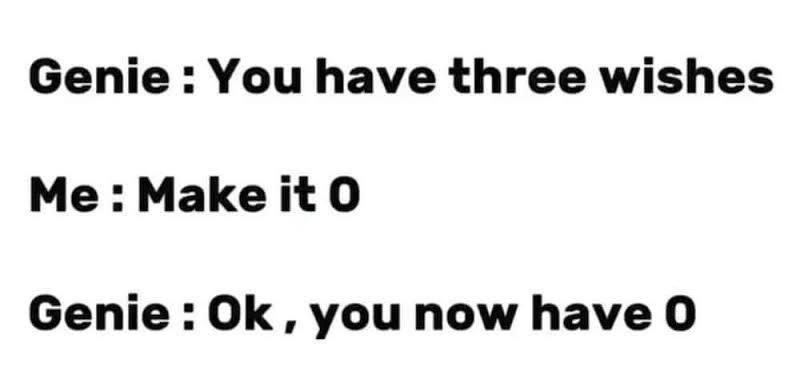
When you're dealing with a critical security vulnerability and someone suggests using pre-decrement (--i) instead of post-decrement (i--) as the "fix," you're basically asking a genie to reduce your problem count to zero... and getting exactly what you asked for. The joke here is that the programmer wants to make their problem count "0" (meaning no problems), but the genie interprets this literally and just sets their wish count to 0 instead. It's like changing i-- to --i in your code and calling it a security patch when you've fundamentally changed nothing about the actual vulnerability. You've just shifted when the decrement happens—before or after the expression evaluation—but the exploit is still there, laughing at your PR. Classic "technically correct but completely useless" energy that every code reviewer has seen at 3 AM.

Left Shift Vs Right Shift

Left Shift Vs Right Shift
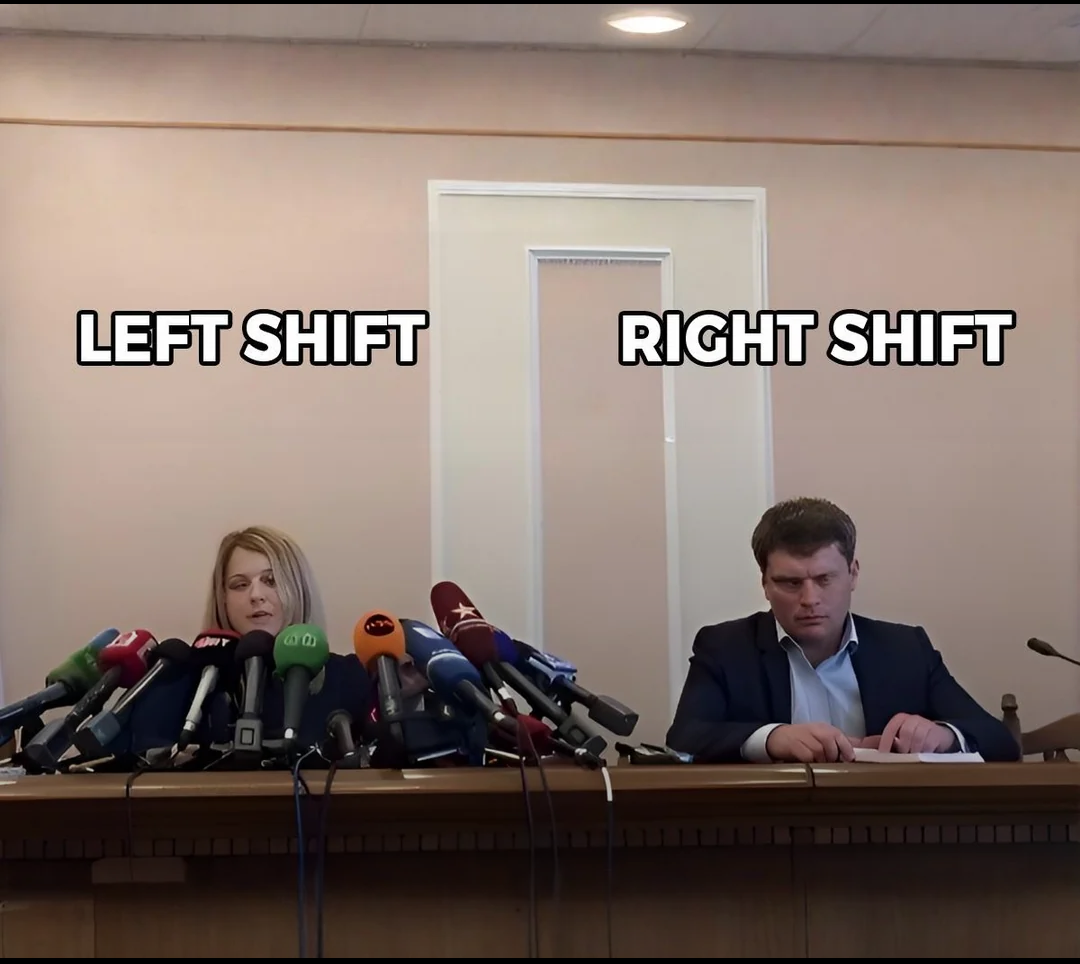
Left shift operator ( ) really said "I'm the main character" and showed up with an ENTIRE press conference worth of microphones, while right shift ( >> ) is just sitting there in corporate silence like it got demoted to intern status. The visual representation is chef's kiss—left shift literally multiplies your number by powers of 2 and apparently also multiplies your media attention by infinity. Meanwhile, right shift is over there dividing numbers and its relevance simultaneously. The energy difference is absolutely sending me—one's out here making BOLD MOVES and the other is just... existing in the corner, quietly doing integer division like a forgotten middle child.

We Love Sloperators

We Love Sloperators
Microsoft really said "Prompt Engineer" and the entire tech industry collectively cringed. Like, we get it, you're trying to make talking to ChatGPT sound like a legitimate career path. But then someone coined "Microslop Sloperator" and suddenly everything makes sense again. The "sloperator" is that beautiful C/C++ operator ( --> ) that technically doesn't exist but works because it's actually -- (decrement) and > (greater than) smooshed together. It's the kind of cursed syntax that makes code reviewers weep. Combining this with "Microslop" (the affectionate term for Microsoft when things go sideways) is *chef's kiss* perfection. So yeah, reject corporate buzzwords, embrace chaos. Why be a "Prompt Engineer" when you can be a Microslop Sloperator, decrementing your sanity one AI hallucination at a time?

This Is Javascript

This Is Javascript
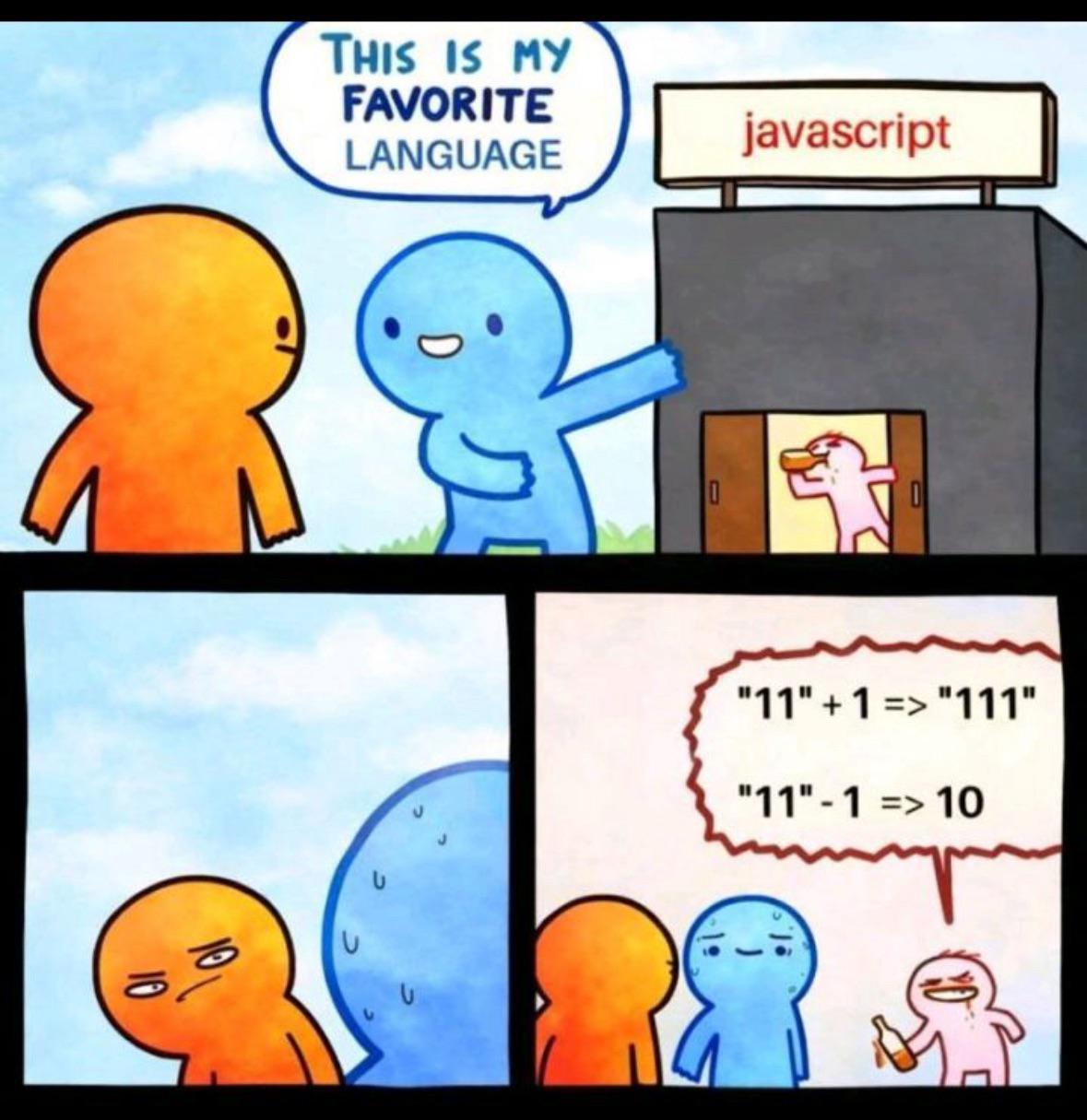
Someone enthusiastically introduces their favorite language, and JavaScript immediately demonstrates why it's both loved and mocked in equal measure. The plus operator does string concatenation ("11" + 1 = "111"), while the minus operator coerces to numbers ("11" - 1 = 10). Totally logical and not confusing at all. JavaScript's type coercion is like that friend who tries to be helpful but just makes everything worse. The language sees a plus sign and thinks "maybe they want strings?" but sees a minus sign and goes "definitely numbers here." It's the programming equivalent of a chaotic neutral alignment.

When You Accidentally Write Elegant Code

When You Accidentally Write Elegant Code
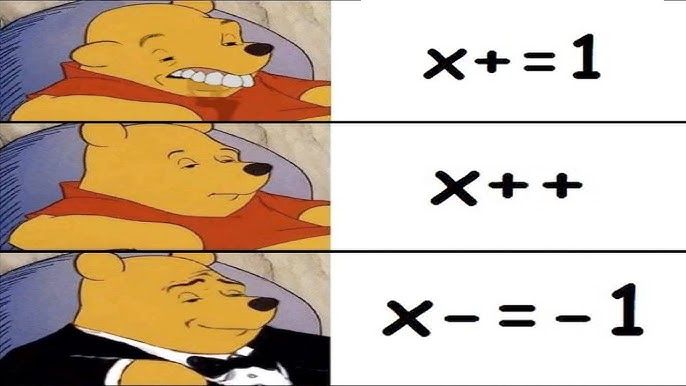
The progression from x += 1 (normal, acceptable) to x++ (meh, whatever) to x -= -1 (suddenly sophisticated) is the programming equivalent of putting on a tuxedo to take out the trash. Sure, you're technically subtracting a negative to increment, but you're also the kind of person who probably writes if (condition == true) unironically. It's mathematically correct, unnecessarily complex, and absolutely nobody asked for it—which makes it perfect code review material. Your teammates will either think you're a genius or question your life choices. Probably both.

NordVPN

NordVPN
Encrypt your traffic on public Wi-Fi, stream from anywhere, and cover up to ten devices with one plan. 30-day money-back guarantee.

Or Or Oror

Or Or Oror
When you're trying to explain the logical OR operator to someone but they keep saying it wrong, so you just give up and embrace the chaos. Left side: developers losing their minds trying to correct pronunciation. Right side: the zen master who's transcended caring and just calls it "oror" like it's a Pokémon evolution. The beauty here is that no matter how you pronounce it—whether it's "or operator or or," "double pipe," "logical or," or just mashing your keyboard—the compiler doesn't care about your feelings. It evaluates to true either way. The real operator overload is the emotional baggage we carry trying to verbalize symbolic logic. Fun fact: Some languages have both || (logical OR) and | (bitwise OR), which makes this pronunciation nightmare even worse. Good luck explaining "pipe pipe" vs "pipe" in a code review without sounding unhinged.

When You Post Increment Too Early

When You Post Increment Too Early
Someone updated that drowning counter with count++ instead of ++count and now zero people have drowned wearing lifejackets. Technically correct is the best kind of correct, right? The sign maker probably tested it once, saw it worked, shipped it to production, and went home early. Meanwhile, the lifejacket stat is sitting there at zero like "not my problem." Fun fact: The difference between i++ and ++i has caused more bugs than anyone wants to admit. Post-increment returns the value THEN increments it, while pre-increment does it the other way around. It's the programming equivalent of putting your shoes on before your socks—technically you did both things, just in the wrong order.

X -= -1 Gang

X -= -1 Gang
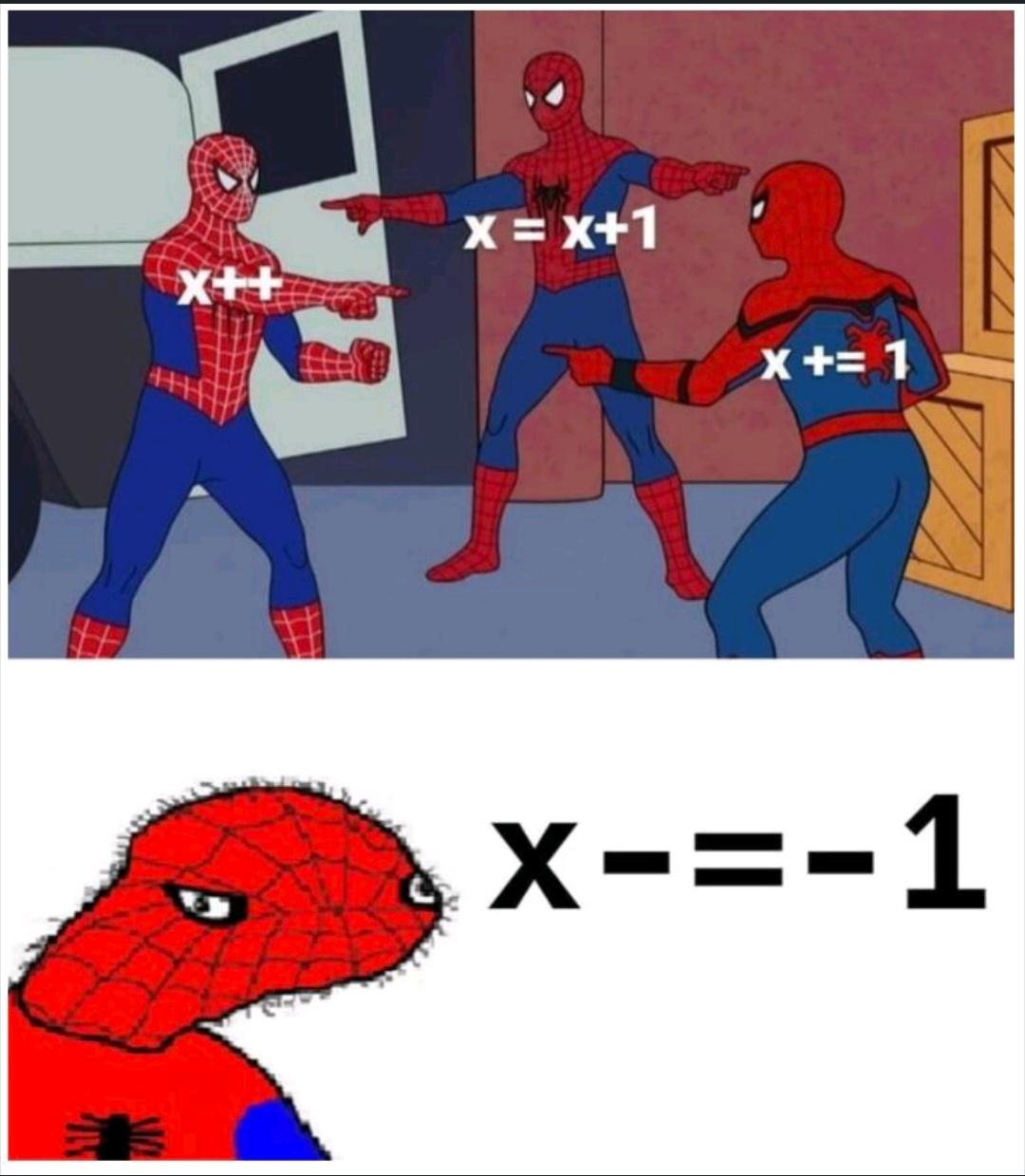
When three Spider-Men argue about incrementing a variable, but then the fourth one shows up with x -= -1 and everyone loses their minds. It's like bringing a quantum physics textbook to a kindergarten math class. The beauty is that all four expressions do exactly the same thing, but the last one is just mathematical perversion wrapped in syntactic sugar. It's what happens when you code at 3 AM after your sixth espresso and think you're being clever. The compiler just sighs in binary.

X Minus Equals Minus One Gang

X Minus Equals Minus One Gang
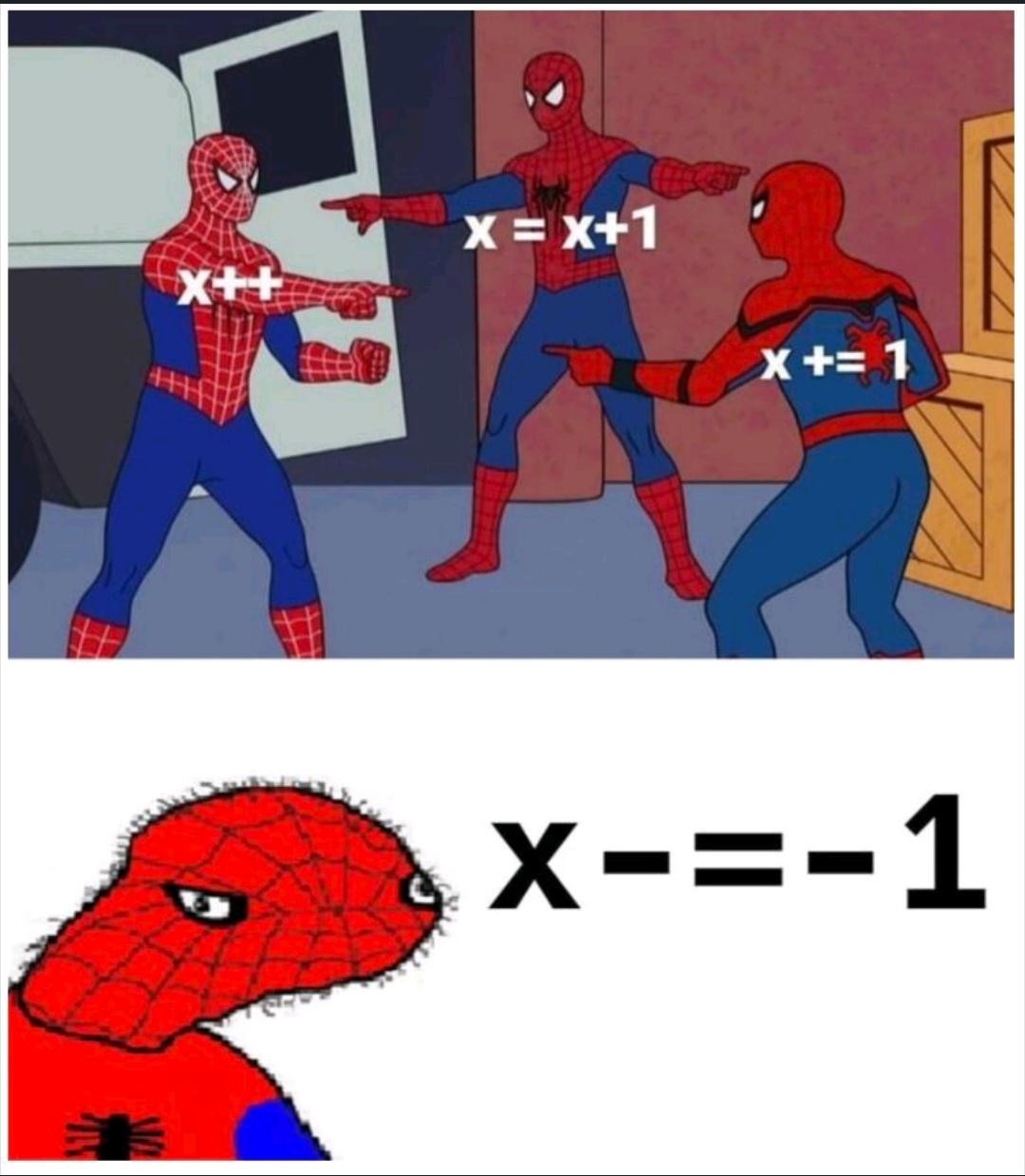
The Spider-Men are fighting over increment operators when suddenly... the enlightened one appears. While these rookies are arguing about x++ , x = x+1 , and x += 1 (which all do the same thing), the true galaxy-brain move is x -= -1 . It's like showing up to a knife fight with quantum physics. Sure, it works exactly the same, but it's the coding equivalent of wearing a monocle while eating fast food. Completely unnecessary, wildly pretentious, and somehow... magnificent. Your code reviewer will either fire you or promote you on the spot.

Mathematicians Vs Programmers

Mathematicians Vs Programmers
Mathematicians lose their minds when you suggest "≠" and "!=" are the same thing. Meanwhile, programmers are just happy their code compiles with either "!=" or "==". The assignment vs. equality operator debate has caused more silent rage than any merge conflict in history. Somewhere right now, a CS student is using "=" instead of "==" and wondering why their if-statement always evaluates to true.

OWC 14-Port Thunderbolt Dock Thunderbolt 40Gb/s Connectivity Solution

OWC 14-Port Thunderbolt Dock Thunderbolt 40Gb/s Connectivity Solution
Power Delivery: Host Thunderbolt (USB Type-C) connection powers and charges notebook computers with up to 85W power; 2 High-Powered USB Type-A ports deliver 5Gb/s speed and up to 7.5W power to additi…

Different Uses

Different Uses
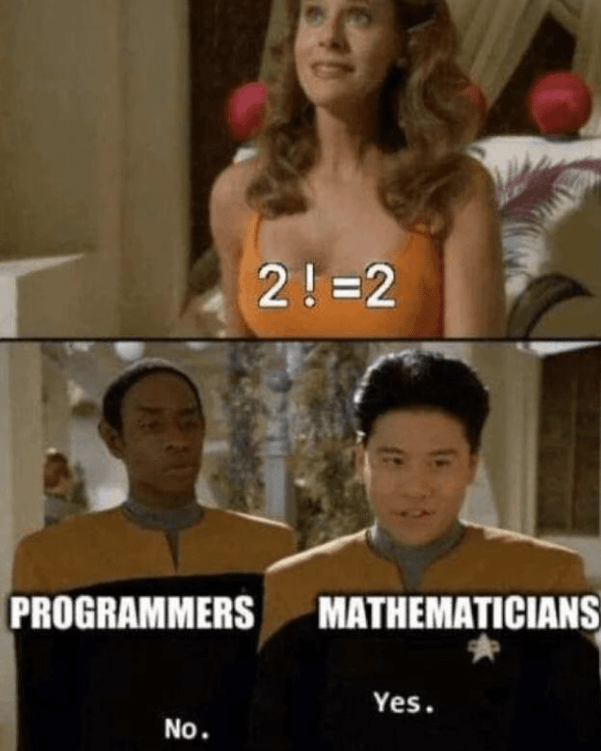
The infamous "2! = 2" equation creates a perfect divide between two worlds. In mathematics, the factorial operator (!) means "multiply by all positive integers less than or equal to this number" - so 2! equals 2×1=2. Correct! Mathematicians nod in agreement. But programmers see something entirely different. In code, "!=" is the inequality operator meaning "not equal to." So "2 != 2" is a blatantly false statement that evaluates to false/0/no. The compiler would laugh if it could. The spacing (or lack thereof) is the silent villain in this syntax tragedy. One tiny space would have prevented this interdisciplinary conflict!

Bow Down To The Increment Master

Bow Down To The Increment Master
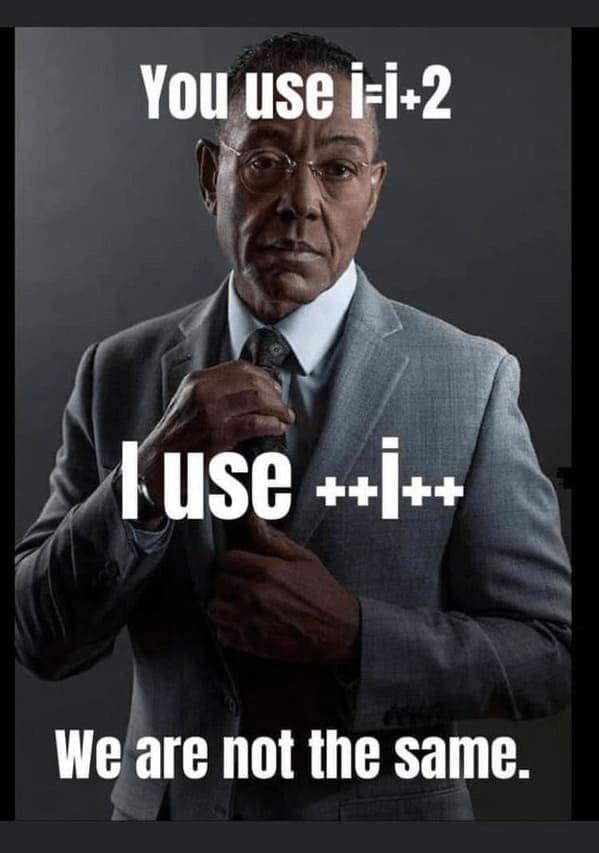
The subtle flex of increment operators. Peasants use i=i+2 like they're still writing BASIC on a Commodore 64. Meanwhile, the distinguished gentleman employs ++i++ , casually breaking compiler rules because he's too important for standards. It's the programming equivalent of drinking scotch neat while everyone else has juice boxes.