

Lisp Memes

Posts tagged with Lisp
Lisp Best Defense

Lisp Best Defense
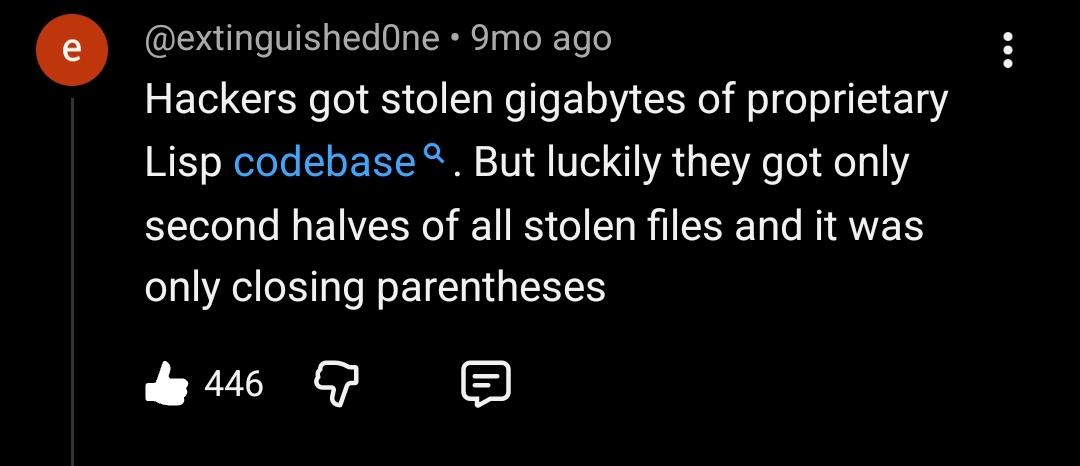
Security through obscurity just got a whole new meaning. Hackers managed to steal gigabytes of proprietary Lisp code, but joke's on them—they only got the second half of the files, which means nothing but closing parentheses. For those blissfully unaware, Lisp is famous (or infamous) for its ((((nested parentheses)))) that go so deep you need a map and a prayer to find your way back. The opening parentheses contain all the actual logic, while the closing ones are just... well, a parade of )))))))) at the end. So the hackers basically stole a file that looks like someone held down the shift+9 key for an hour. This is unintentionally the most effective code protection ever devised. Forget encryption, just write everything in Lisp and let the parentheses do the heavy lifting.

Scheme Is Elegant

Scheme Is Elegant
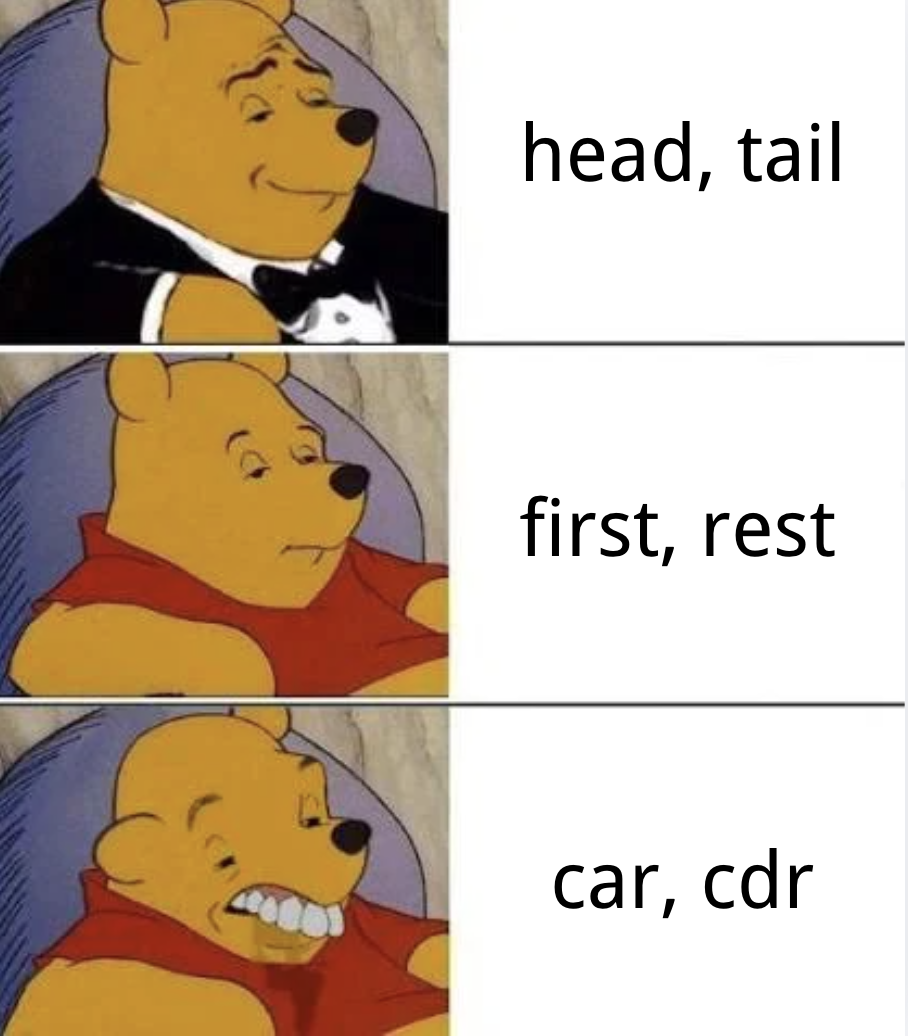
When Lisp/Scheme programmers try to convince you their language is "elegant and minimalist," they show you head and tail for list operations. You nod politely. Then they casually mention first and rest as alternatives. Still reasonable, right? But then they hit you with car and cdr (pronounced "could-er"), which literally stand for "Contents of the Address part of Register" and "Contents of the Decrement part of Register" from a 1950s IBM computer architecture that nobody has used since Eisenhower was president. Nothing says "elegant" quite like naming your fundamental list operations after hardware registers from a machine that required punch cards. It's like if Python decided to call variables "magneticCoreMemorySlot" for historical accuracy. The best part? Scheme purists will defend this with their dying breath while simultaneously lecturing you about code readability.

Lisp

Lisp
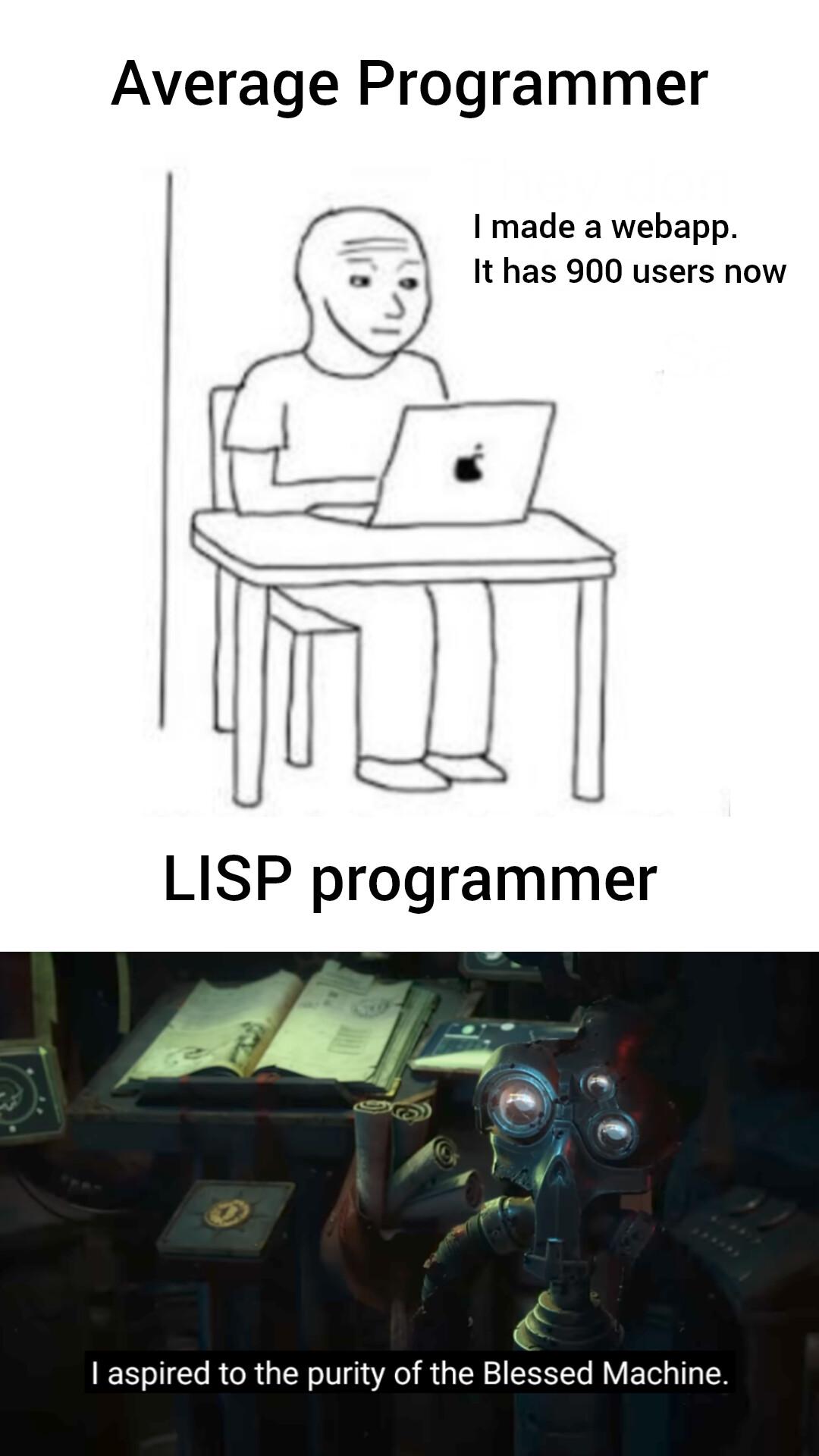
Average programmer: "Hey look, 900 users on my webapp! Time to update my LinkedIn!" Lisp programmer: *transcends mortal concerns* "I have achieved enlightenment through recursive parentheses and have become one with the lambda calculus. My code is a prayer to the Machine God." The contrast is beautiful. One person is happy about basic user metrics while the other has gone full cyberpunk monk, worshipping at the altar of functional programming purity. Lisp devs really do hit different—they're not building apps, they're crafting philosophical treatises in code form. And honestly? After drowning in enough parentheses, you either quit or ascend to a higher plane of existence.

At Least He Closes Brackets Like Lisp

At Least He Closes Brackets Like Lisp
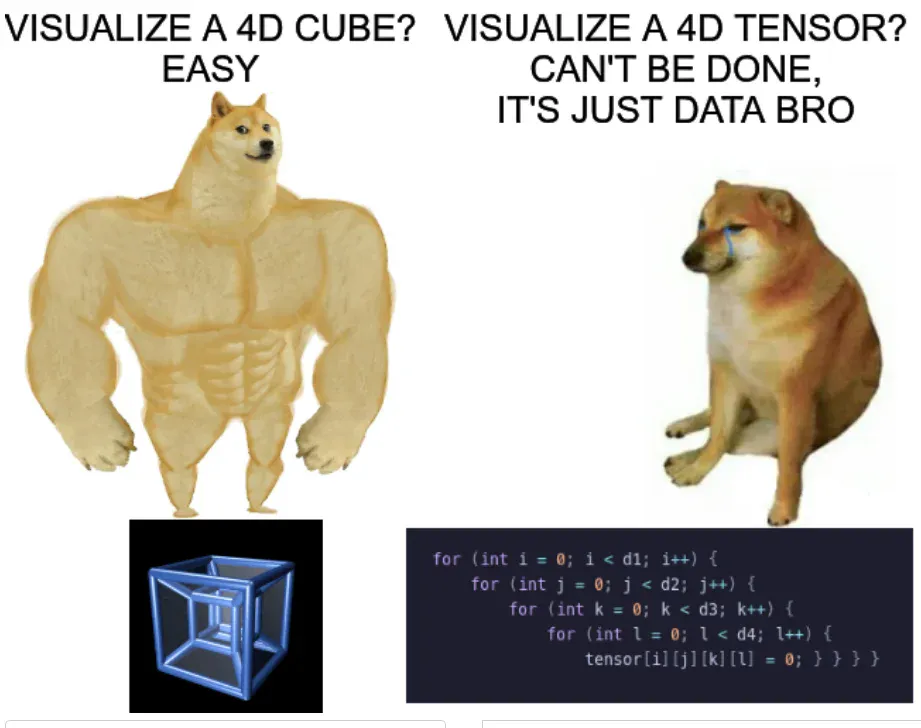
When you can mentally rotate a 4D hypercube in your head but suddenly become illiterate when asked to visualize nested loops. The buff doge confidently shows off his spatial reasoning skills, while the wimpy doge just stares at four nested for-loops like they're written in ancient Sumerian. The punchline? That glorious cascade of closing brackets: } } } } – the telltale sign of someone who either writes machine learning code or has given up on life. It's the programming equivalent of those Russian nesting dolls, except each doll contains existential dread and off-by-one errors. The title references Lisp's infamous parentheses situation, where closing a function looks like )))))))) – except now we've upgraded to curly braces. Progress!

The Emacs Time Paradox

The Emacs Time Paradox
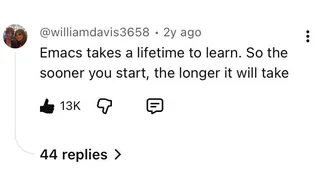
The eternal paradox of Emacs: a text editor so powerful it requires you to grow a beard while learning it. The joke is brilliant because it's painfully true - Emacs has such a steep learning curve that the longer you procrastinate starting, the more of your remaining lifespan it'll consume. It's like telling someone "this workout takes 10 years, so you better start at age 5." Meanwhile, Vim users are smugly nodding while pretending their editor doesn't have the same problem.

When People Encounter Lisp Syntax For The First Time

When People Encounter Lisp Syntax For The First Time
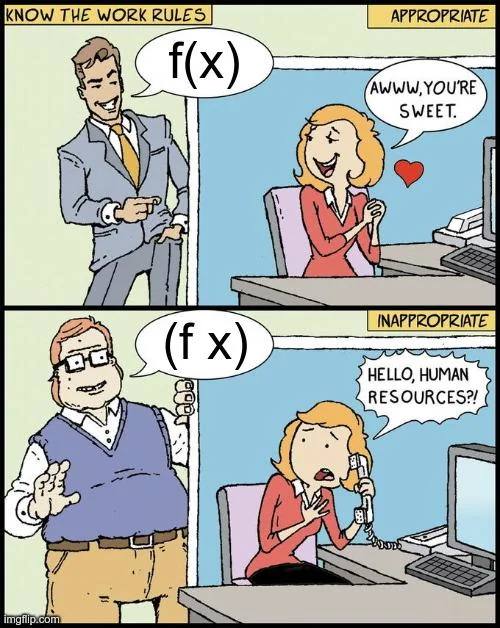
The difference between normal function notation and Lisp's parentheses-everywhere approach is truly office-disrupting material! Top panel: Regular mathematical notation f(x) is perfectly acceptable workplace banter. Bottom panel: Switch to Lisp's (f x) prefix notation and suddenly you're getting reported to HR faster than an unhandled exception. The real tragedy? The poor soul probably just wanted to share their excitement about discovering a language where everything is a list and parentheses are more common than semicolons in JavaScript.

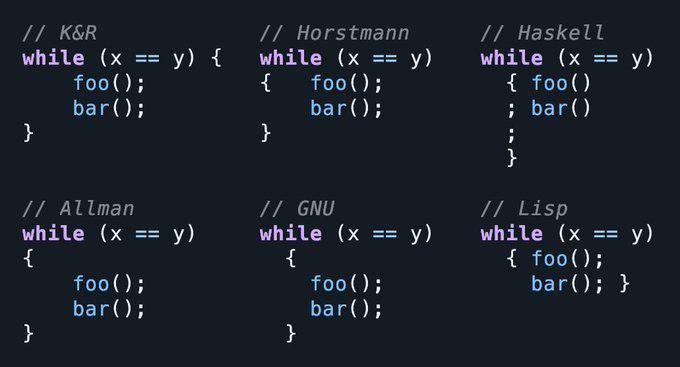
The Great Brace Placement War

The Great Brace Placement War
Ah, the eternal holy war of brace placement. Some programmers lose sleep over whether the opening curly brace belongs on the same line or the next. Meanwhile, Haskell programmers are busy putting semicolons in front of statements like they're driving on the left side of the road, and Lisp is over there doing... whatever Lisp does with those parentheses. The real joke is that we spend hours debating syntax while our actual algorithms still don't work.

ASUS VY27UQ 27 Inch 4K UHD IPS Computer Monitor, HDMI, DisplayPort, Speaker

ASUS VY27UQ 27 Inch 4K UHD IPS Computer Monitor, HDMI, DisplayPort, Speaker
High-Resolution 4K Display: 27-inch UHD (3840 x 2160) resolution display with IPS 178 wide viewing angle for sharp and immersive visuals · HDR-10 Support: Enhances bright and dark areas, delivers lif…

The Programming Language Family Portrait

The Programming Language Family Portrait
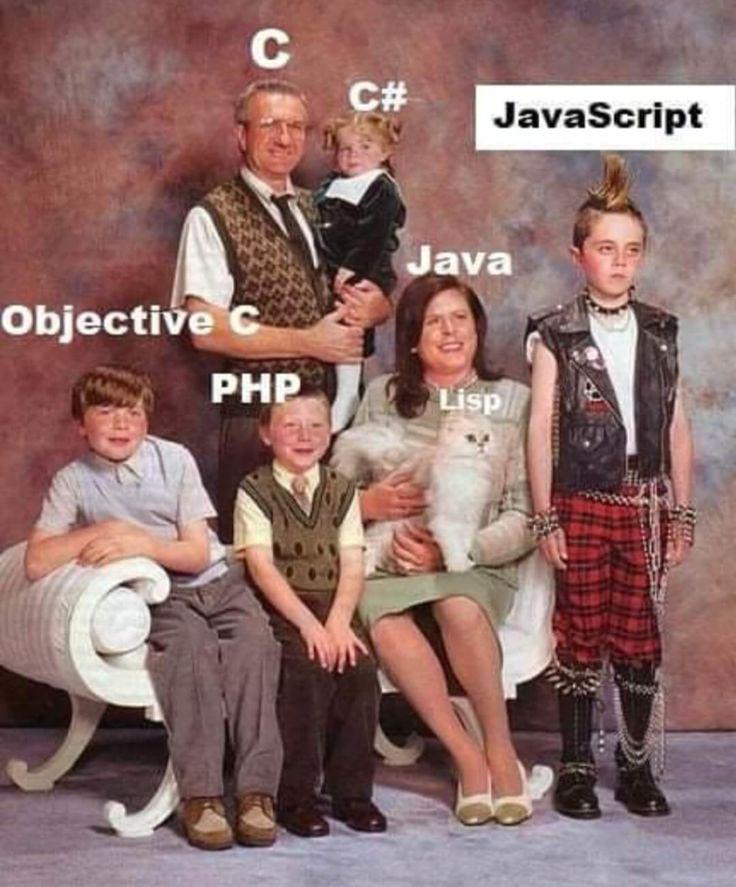
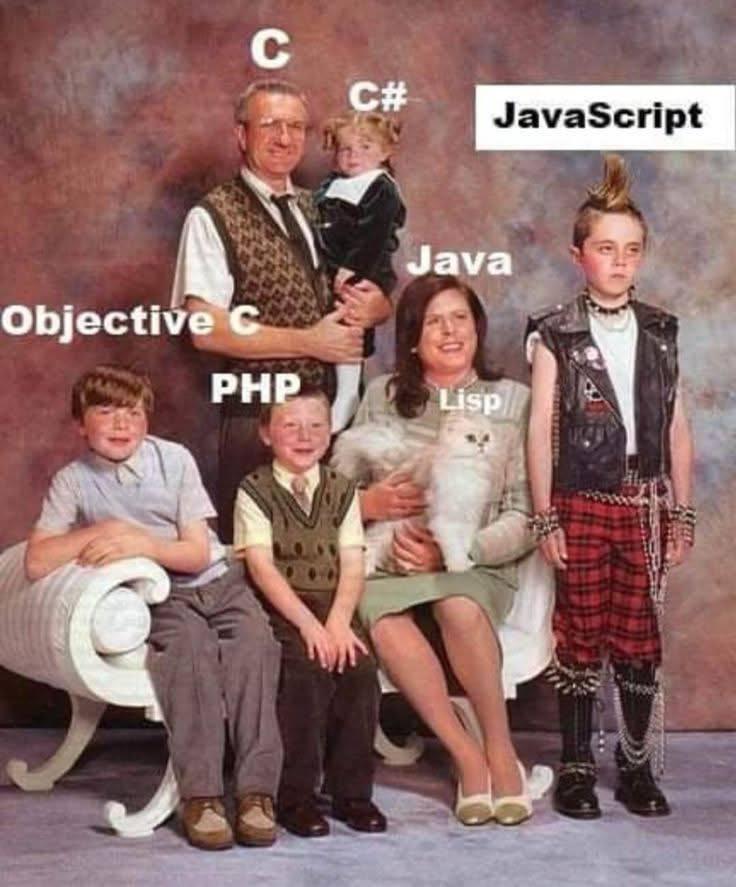
The programming language family portrait is absolute gold! C is clearly the dignified patriarch, while his rebellious son JavaScript is going through that punk phase we all pretend never happened. Meanwhile, C# is the well-behaved child who still gets good grades despite being raised by Microsoft. Java sits there looking completely normal and mainstream (just like its enterprise usage), while PHP awkwardly exists as the kid nobody talks about at family reunions. Objective-C is that cousin who's slowly being forgotten since Swift came along, and Lisp is just happy to be included despite being ancient. The best part? They're all dysfunctional yet somehow related—just like actual programming language inheritance!

The Lisp Enlightenment Trap

The Lisp Enlightenment Trap
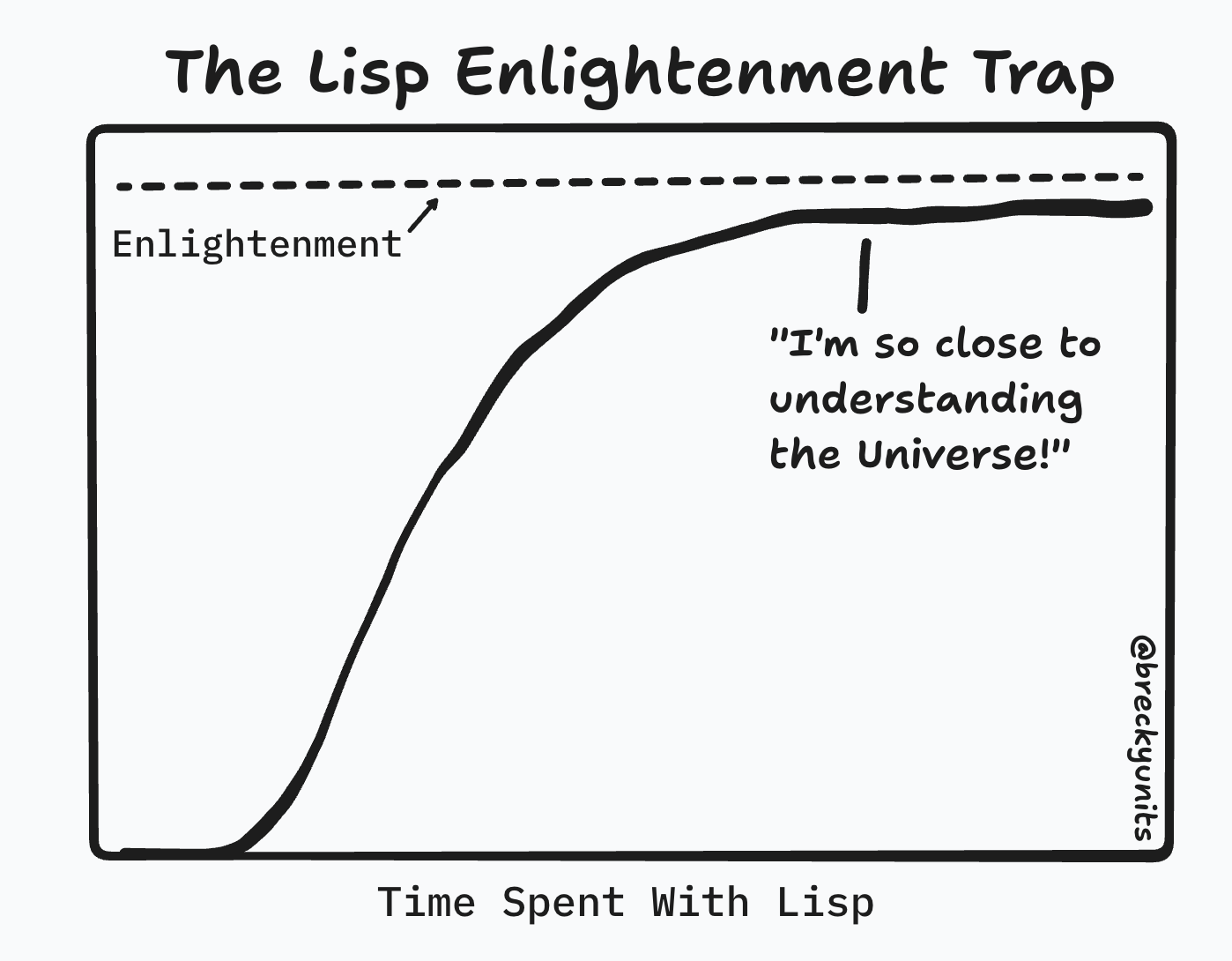
The graph perfectly illustrates the psychological journey of a Lisp programmer who's almost reached enlightenment but remains eternally trapped just below it. Lisp, with its notorious parentheses-heavy syntax ((((like this)))) and powerful functional programming capabilities, creates this weird phenomenon where developers start thinking they're unlocking the secrets of computer science itself. The more time you spend with Lisp, the closer you feel to some grand epiphany—like you're about to crack the cosmic code of programming—but that final breakthrough remains just out of reach. Meanwhile, you're spouting nonsense about understanding the universe while writing code that looks like a keyboard sneezed parentheses everywhere. It's the programming equivalent of climbing Everest, getting 10 feet from the summit, and deciding to set up a philosophy club instead of finishing the climb.

The Programming Language Family Tree

The Programming Language Family Tree
Ah, the perfect programming language genealogy! Dad C is clearly the patriarch who spawned multiple generations of languages. His eldest son Objective C looks so proper, while PHP is that quirky middle child nobody quite understands. Little C# is literally Dad's mini-me, complete with glasses! Mom Java sits proudly with her pet Lisp (functional programming is her hobby, obviously). And then there's JavaScript - the rebellious teenager with the punk mohawk who probably tells everyone "I'm not really related to Java despite my name." The family resemblance is uncanny - syntax inheritance at its finest!

Goose With A Lisp

Goose With A Lisp
The genius of this meme lies in the perfect fusion of programming and ornithology! The expression (HO(HO(HO(HONK)NK)NK)NK) is a brilliant play on nested function calls in LISP programming, where each function wraps around the next in those iconic parentheses. For the uninitiated, LISP (LISt Processing) is one of the oldest programming languages that's famous for its parentheses-heavy syntax. The nested measuring cups shaped like geese create a perfect visual metaphor for nested function calls - each goose (function) contains another goose (function) inside it! The "HONK" at the center represents the innermost value being processed, while each surrounding "HO" and "NK" pair represents a function call that processes the result of the inner expression. It's basically what happens when a goose tries to code in LISP and can only say "HONK" - recursive goose noises!

Python Is A Lisp

Python Is A Lisp
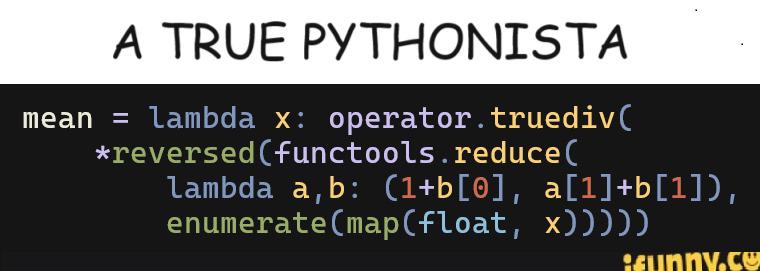
OH. MY. GOD. What unholy abomination have we summoned here?! 😱 Some deranged soul decided to write the most NEEDLESSLY COMPLEX lambda function to calculate a mean when they could've just used sum(x)/len(x) ! The audacity! The DRAMA! This is what happens when a Python developer discovers functional programming and decides to BETRAY EVERYTHING Python stands for. It's like watching someone use a nuclear warhead to kill a spider! Whoever wrote this code deserves to be sentenced to maintaining COBOL applications for all eternity!

Logitech C920e HD 1080p Mic Enabled Webcam Certified Zoom Microsoft Teams

Logitech C920e HD 1080p Mic Enabled Webcam Certified Zoom Microsoft Teams
With a 78° fixed field of view, the C920e webcam displays individual users in a well-balanced frame, while also providing sufficient room to visually share projects and other items of interest. · The…