

Junior vs senior Memes

Posts tagged with Junior vs senior
Why Are You Writing A Library

Why Are You Writing A Library
The bell curve strikes again. On the left, you've got the junior dev who's blissfully unaware that npm exists and thinks every function needs to be handcrafted. In the middle, the sensible majority screaming "just use lodash for god's sake." And on the right? The 10x engineer who's seen the bloat, read the source code of every popular library at 3am, and decided that yes, the world needs yet another date formatting library because moment.js is 2.7MB and they can do it in 8KB. The tiny slice of "public libraries don't have the feature set I need" is the most honest answer here, but let's be real—half of those people just didn't read the docs thoroughly enough. The other half are building something genuinely novel and will either revolutionize the ecosystem or abandon the repo after two commits. The "it might become popular" crowd at 2% is basically buying lottery tickets but with GitHub stars instead of money.

Vibe Vs Skills

Vibe Vs Skills
The duality of software engineering: the friendly "vibe coder" who brings positive energy to standup meetings and writes code that *mostly* works versus the battle-hardened senior dev at 3AM hunting down a production bug with the intensity of someone who's seen things. The transformation is real—you start your career as the cheerful optimist who thinks "it works on my machine" is a valid defense, but after enough midnight pages and production incidents, you evolve into that thousand-yard stare developer who can smell a race condition from three files away. The vibe coder has never met a merge conflict they couldn't ignore; the 3AM debugger has console.log statements in their dreams and trust issues with every async function.

That's Some Other Dev's Problem

That's Some Other Dev's Problem
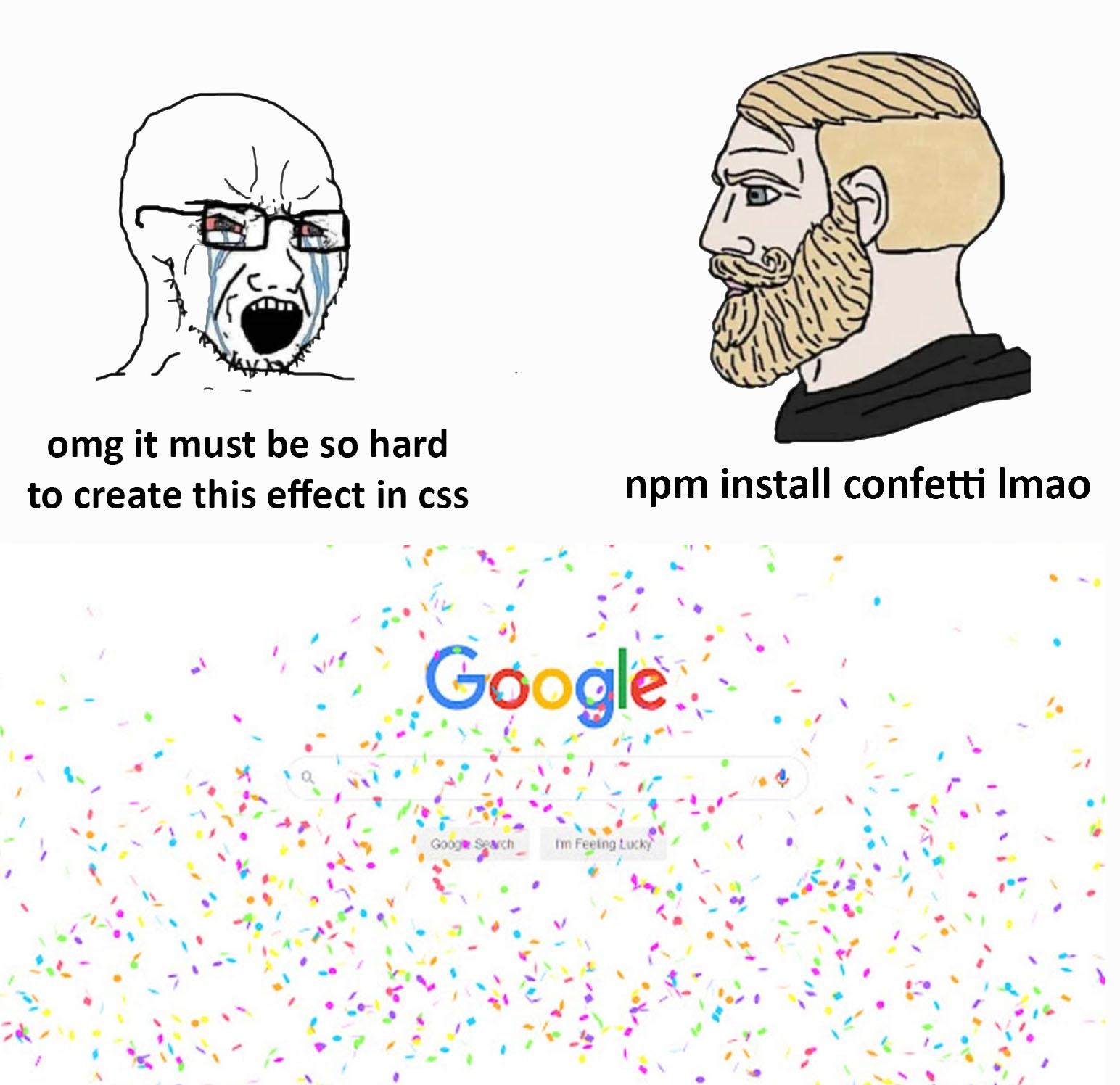
Junior dev sees a confetti effect on a website and thinks it requires some arcane CSS wizardry involving transforms, animations, and probably sacrificing a goat to the browser gods. Meanwhile, senior dev just casually drops npm install confetti and calls it a day. Why reinvent the wheel when someone else already reinvented it, packaged it with 47 dependencies, and uploaded it to npm? The real skill isn't writing code—it's knowing which package to install so you can go back to scrolling Twitter. Fun fact: The npm registry has over 2 million packages. Statistically speaking, whatever you're trying to build, someone has already built it, abandoned it, and left it with 3 years of unpatched security vulnerabilities. Ship it!

Senior Devs

Senior Devs
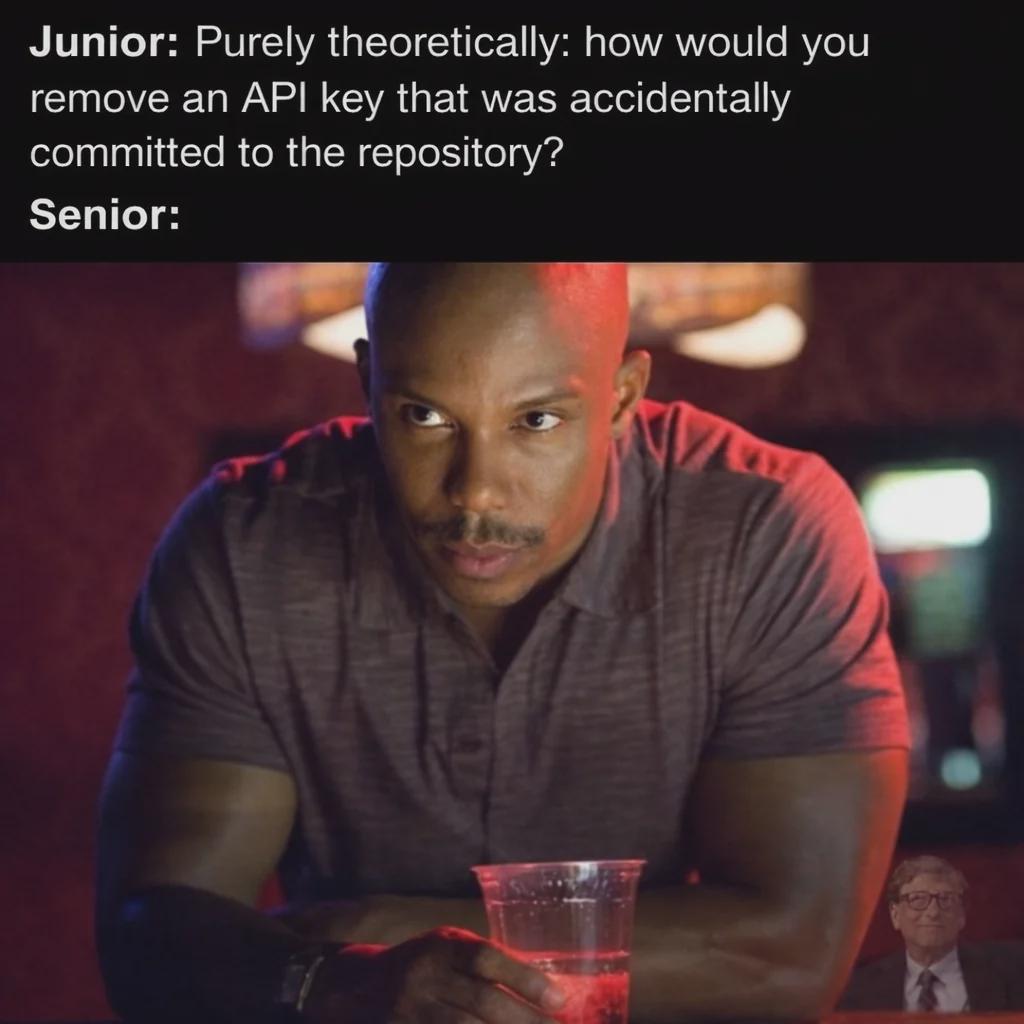
Junior dev asking "theoretically" about removing accidentally committed API keys is like asking your friend "hypothetically" what happens if you total their car. The senior's face says it all—they've already checked the commit history, rotated the keys, and started drafting the incident report before the junior even finished their sentence. That thousand-yard stare comes from years of watching AWS bills skyrocket because someone's credentials got scraped by bots within 3 minutes of pushing to main. The senior knows there's no "theoretical" here—that key is already being used to mine crypto in some Eastern European server farm. Pro tip: git filter-branch and BFG Repo-Cleaner exist, but they won't save you from the post-mortem meeting.

That's Some Other Dev's Problem

That's Some Other Dev's Problem
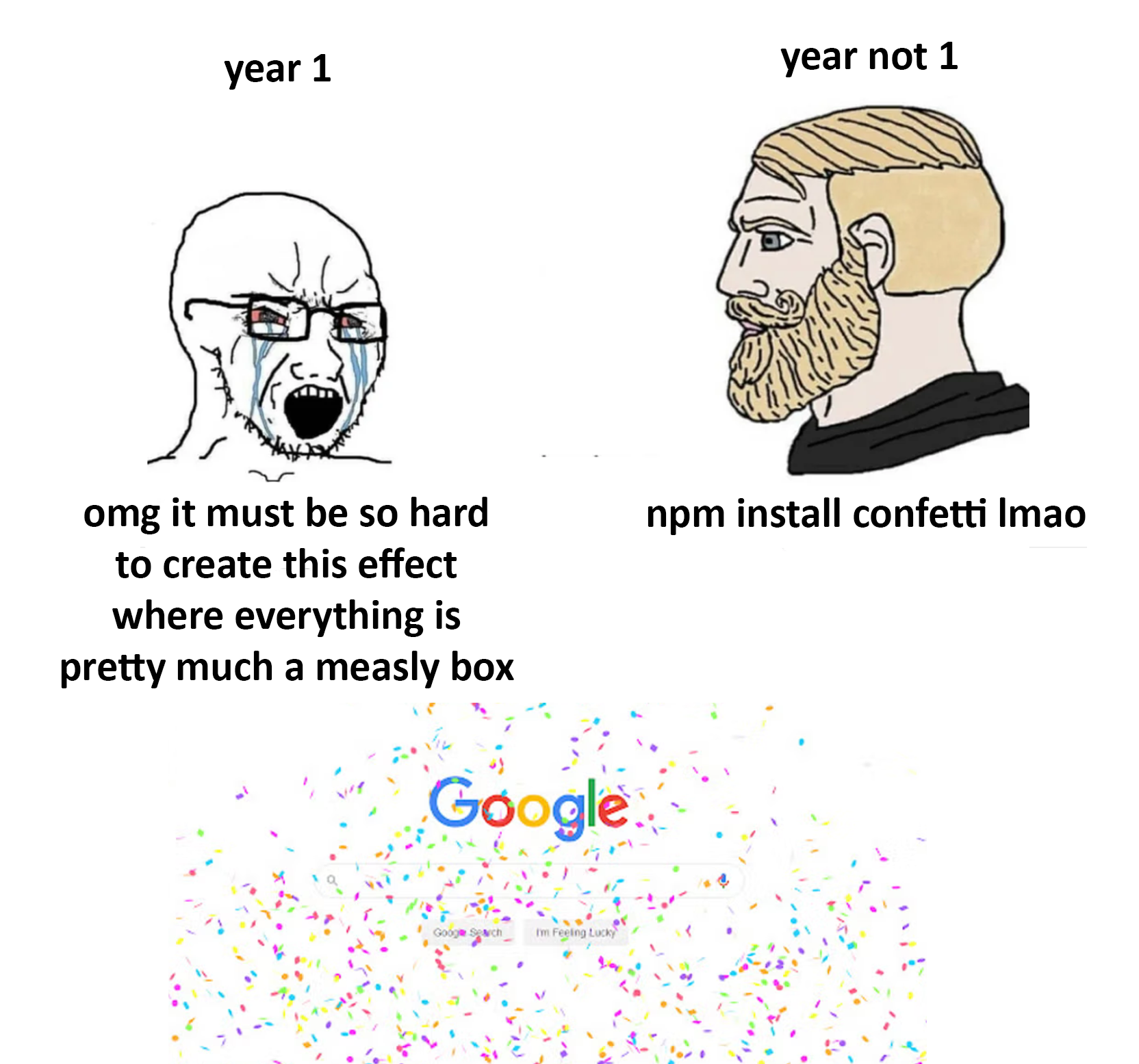
Year 1: Everything is a crisis. Every bug is existential. You're debugging CSS at 2 AM wondering if you're cut out for this career while your tears blur the screen. Year not 1: npm install confetti and call it a day. Someone else will maintain it. Someone else will debug it. Someone else will cry about it. The circle of life continues. Experience teaches you the most valuable skill in software development: strategic apathy. Why reinvent the wheel when there's a package for that? Why stress about implementation details when Google exists and Stack Overflow has already solved your problem 47 times? You've evolved from "I must understand everything" to "does it work? ship it." The real wisdom is knowing that future you is technically "some other dev" too.

More Code = More Better

More Code = More Better
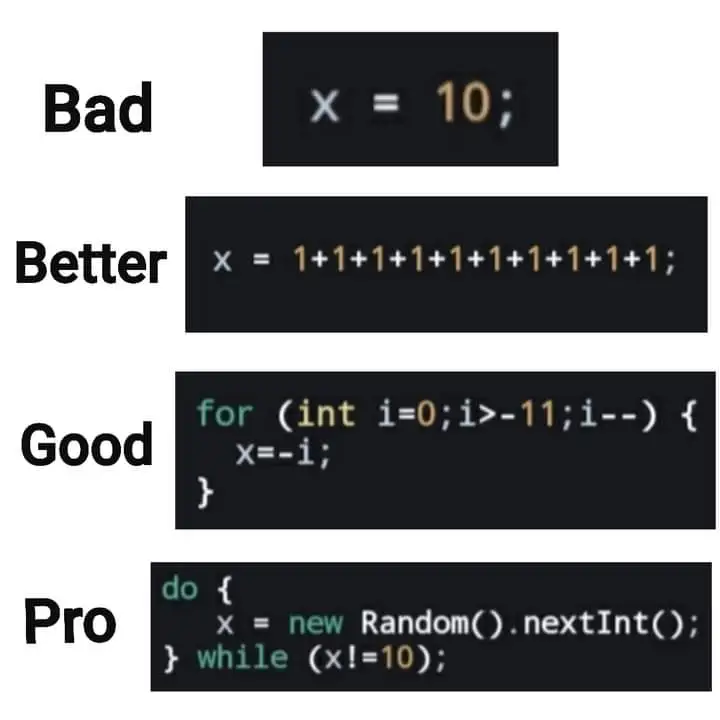
Behold, the evolution of a developer's brain slowly melting into absolute chaos! We start with the innocent x = 10 and somehow end up at a do-while loop that generates random numbers until the universe accidentally spits out 10. Because why use one line when you can gamble with the RNG gods and potentially loop until the heat death of the universe? The "Better" version adding ten ones together is giving strong "I get paid by lines of code" energy. The "Good" version with a backwards for loop that decrements from 0 is just... *chef's kiss* of unnecessary complexity. But the "Pro" move? That's weaponized inefficiency right there. Nothing screams senior developer quite like turning a constant assignment into a probability problem that could theoretically run forever. Your CPU will LOVE you!

When Junior Designer Created A Bad Design

When Junior Designer Created A Bad Design
The senior designer sitting there with the patience of a saint while the junior designer proudly presents their masterpiece that looks like it was made in MS Paint during a power outage. Then reality hits and the senior's internal screaming reaches frequencies only dogs can hear. But here's the plot twist: the senior designer has to FIX IT NOW because the client meeting is in 20 minutes and there's no time for a gentle mentoring session about color theory and proper spacing. So they slap on their professional smile while their soul quietly exits their body, knowing they'll be pulling an all-nighter to salvage whatever unholy abomination just landed on their desk. The "Now" hitting different when you realize YOU'RE the one responsible for cleaning up the CSS nightmare that somehow uses 47 shades of the same color and has div soup deeper than the Mariana Trench.

What Could Go Wrong

What Could Go Wrong
Junior dev: "I designed a database in 3 hours! Give me a medal!" Senior devs: *looking at the schema with User and userId in the same model, nullable fields everywhere, and enums that'll need constant updating* This is why database design takes weeks. The junior's Prisma schema is a ticking time bomb of future migration nightmares, circular dependencies, and queries that'll bring production to its knees when you hit more than 100 users. Six months later, they'll be writing a Medium article titled "How I Survived My First Database Redesign" while the senior devs silently add another gray hair to their collection.

Please Don't Touch

Please Don't Touch
The stack of rocks holding up that fence is basically legacy code in its purest form. Junior devs see it and think, "What an ugly hack! I'll just refactor this real quick." Meanwhile, senior devs know the truth - that "temporary" solution has been supporting the entire system for years, and disturbing it would trigger a cascade of disasters nobody can predict. The fence hasn't fallen yet, so clearly those random rocks are doing something right! It's the programming equivalent of finding duct tape holding together critical infrastructure and slowly backing away.

The Suspicious Success Paradox

The Suspicious Success Paradox
The evolution of developer paranoia in two panels: Junior dev: *code compiles* "WOOHOO! FIRST TRY MAGIC! I'M A CODING GENIUS!" Senior dev: *code compiles* "...suspicious. Very suspicious. What dark sorcery is this? Something's definitely broken somewhere and I just can't see it yet." The true mark of experience isn't celebrating success—it's questioning why the compiler didn't put up more of a fight. Nothing builds healthy paranoia quite like years of mysterious runtime errors that followed suspiciously smooth compilations.

If It Works, It Works

If It Works, It Works
The eternal battle between idealism and pragmatism in code development, perfectly captured in sweat form. Junior devs still believe in the myth of "clean code" while seniors have evolved into battle-hardened pragmatists who've made peace with compiler warnings. That nervous sweat isn't just from stress—it's from suppressing the urge to explain why 147 warnings is actually a feature . Years of debugging nightmares have taught seniors the sacred truth: warnings are just spicy suggestions. Ship it!

Welcome To The Real World Kid

Welcome To The Real World Kid
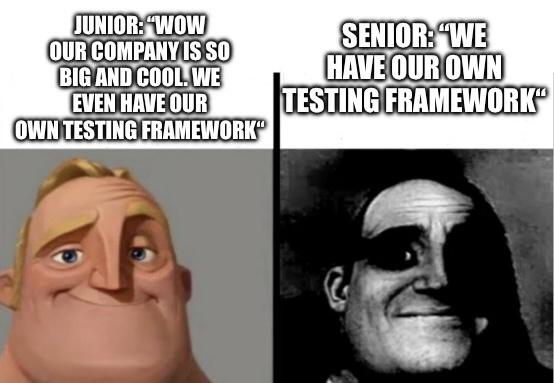
Junior dev: "Is it normal that the codebase is so difficult to work in?" Senior dev: *stares into the void with thousand-yard gaze* "Years of tight deadlines, changing requirements, and revolving door of developers creates this beautiful disaster. Successful software either dies a hero or lives long enough to become legacy code that you'll maintain until retirement." The brutal truth no CS degree prepares you for: technical debt is the REAL company debt. Your inheritance won't be wealth—it'll be 15-year-old spaghetti code with comments like "TODO: fix this before release" from 2009.