html Memes

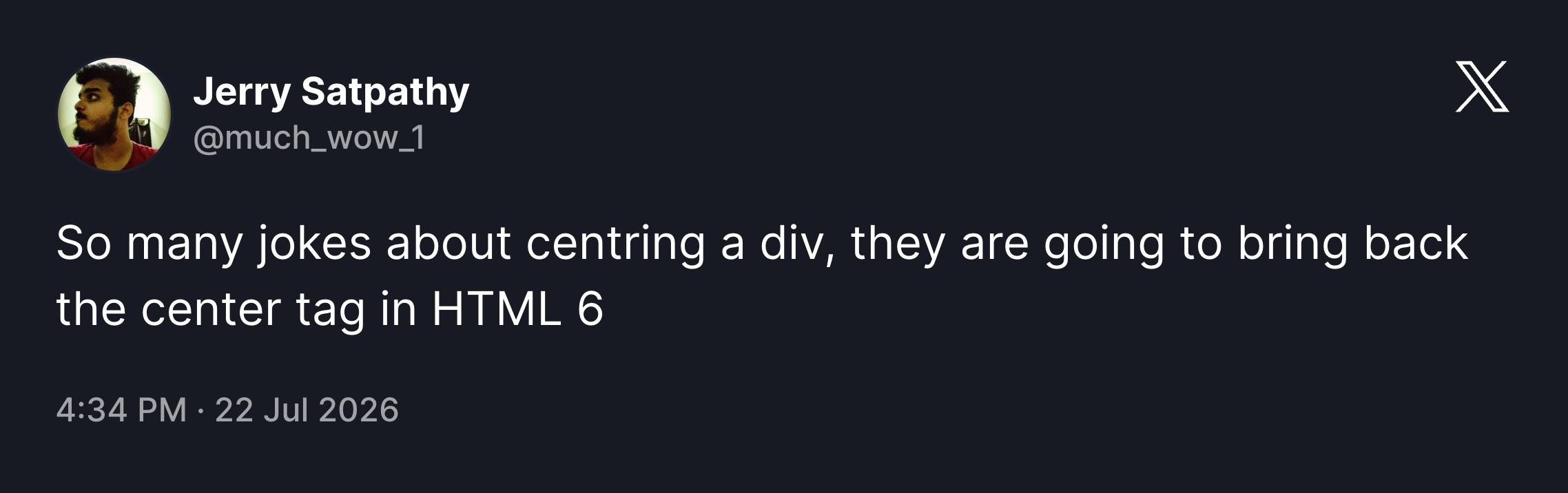
The Universal Developer Search Query

The Universal Developer Search Query
The eternal cycle of web development: whether it's your first day or your ten-thousandth, you're still Googling "how to center a div." Some things never change. CSS flexbox was supposed to save us, yet here we are, senior developers with mortgages and retirement plans, still typing the same query we did as bright-eyed juniors. The only real difference between junior and senior developers? Seniors have memorized which Stack Overflow answer to click on.

The F12 Millionaire Method

The F12 Millionaire Method
The ULTIMATE programmer flex isn't your GitHub stars or Stack Overflow rep—it's hitting F12 and editing HTML to make yourself look like a millionaire! 💸 HONEY, I'm not broke, I'm just one browser developer tool away from being FILTHY RICH! The look of sudden interest when your "bank balance" has more zeros than your production code has bugs is just... *chef's kiss* PRICELESS. Who needs actual money when you can just DOM-manipulate your way into looking like the next tech billionaire? It's basically the same thing! (Except when you try to pay for literally anything.)

Engineering Manager And Fullstack Lead Trying To Center A Div

Engineering Manager And Fullstack Lead Trying To Center A Div
Two cats staring at a laptop screen is the perfect metaphor for what happens when leadership tries to center a div. They'll spend hours looking at the screen, trying different combinations of margin: auto , display: flex , and justify-content: center before eventually giving up and using absolute positioning with negative margins. Because nothing says "I'm a professional" like using CSS hacks that will break the second someone resizes the window. Frontend development: where even the simplest tasks make you question your career choices.

Human Compiler: When Professors Make You Render HTML By Hand

Human Compiler: When Professors Make You Render HTML By Hand
The professor just turned every CS student into a human rendering engine! Instead of asking conceptual questions about web development, this exam literally makes students trace through HTML/CSS code and manually draw what the browser would display—complete with images, colors, and layout. It's like forcing someone to execute a 200-line program with pen and paper when computers were literally invented to do this for us. The ultimate "computers make me obsolete so I'll make you BE the computer" power move. Somewhere, a browser engine developer is crying into their coffee.

Good Old Low Complexity Days

Good Old Low Complexity Days
Oh. My. GOD. Remember when web development was just slapping some HTML, CSS, and jQuery together like a sandwich and calling it a day?! 💅 Now we've got 47 JavaScript frameworks, 23 build tools, and enough npm packages to fill the Grand Canyon! Back then you could actually SLEEP at night without dreaming about webpack configurations! The AUDACITY of modern development expecting us to learn a new framework before we've even finished our morning coffee! Those jQuery days were like taking a bubble bath compared to the FLAMING OBSTACLE COURSE that is frontend development today! *dramatically faints onto keyboard*

The Web Development Food Chain

The Web Development Food Chain
Oh look, it's the classic "my first website" evolution! On the left, we have HTML+CSS – the chunky mango of web development that just sits there looking pretty but doesn't do much. Then there's JavaScript – that smug little parrot with an attitude that thinks it's better than everyone because it can actually do things . Every beginner starts with the big, juicy fruit of static pages before realizing they need that annoying little bird to make anything interactive. The best part? That bird will absolutely bite you when you least expect it with some bizarre type coercion or callback hell. Sure, you could just stick with HTML and CSS, but then your website would just be sitting there... menacingly... like a mango with commitment issues.

The Gold Standard Of Div Alignment

The Gold Standard Of Div Alignment
Ah, the mythical "World's Best CSS Developer" trophy – the only thing more perfectly centered than this award is the existential dread I feel when a client asks for "just a small layout tweak." After 15 years of fighting with floats, flexbox, and grid, I've come to accept that properly aligning divs is basically dark magic. We've all spent hours trying to vertically center something only to end up with a unholy combination of margin: auto , position: absolute , and at least three Stack Overflow solutions duct-taped together. The real winners aren't getting trophies – they're silently weeping into their keyboards at 2am, wondering why display: flex suddenly decided to betray them.

When Regex Meets HTML: A Lovecraftian Horror Story

When Regex Meets HTML: A Lovecraftian Horror Story
What we're witnessing here is the legendary Stack Overflow answer that spawned a thousand nightmares. This unhinged masterpiece isn't just explaining why you can't parse HTML with regex—it's having a complete existential breakdown about it. The answer starts reasonably enough before descending into cosmic horror territory with gems like "HTML and regex go together like love, marriage, and ritual infanticide" and "Z̸̯̀A̸̯̿L̸̯̀G̸̯̿Ò̸̯ IS COMING." It's basically the programming equivalent of "don't feed the Mogwai after midnight" except with more eldritch abominations. And honestly? The answer is technically correct. Using regex for HTML parsing is like performing surgery with a chainsaw—theoretically possible but guaranteed to end in tears and therapy sessions.

.Cat Div Finally Responsive

.Cat Div Finally Responsive
When your CSS finally works and the cat fits purr fectly in the container! That beautiful moment when width: 100% and height: 100% actually do what you want instead of causing overflow chaos. The cat is now fully responsive and contained - unlike most of my elements that either escape their boxes or collapse into weird shapes. No media queries needed for this feline layout! Fun fact: Cats naturally follow the box model better than most browsers. If it fits, they sits - no margin or padding calculations required.

The Great Frontend Amnesia

The Great Frontend Amnesia
Remember when we actually knew how to build websites? Now I've got a decade of experience but can't center a div without asking ChatGPT. The moment those AI servers go down, I'm reduced to a praying mantis in human form, desperately hoping my muscle memory kicks in for basic HTML tags. "What was that flexbox syntax again? Is it justify-content or align-items? LORD HELP ME."

A Hot Take Frontend Devs Hate

A Hot Take Frontend Devs Hate
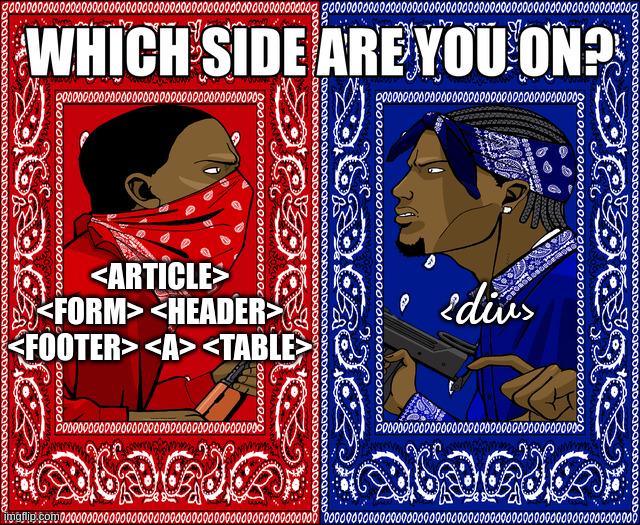
Left side: semantic HTML with proper structure and accessibility elements. Right side: just throw everything in a <div>. Corporate can't see the difference, but every frontend dev just felt a disturbance in the Force. The fullstack dev at the bottom knows both approaches render identically in the browser, but silently judges you for your div soup anyway.

The Web Dev Mountain Of Despair

The Web Dev Mountain Of Despair
The eternal web dev mountain climb in one perfect image. HTML? Sure, manageable. CSS? Getting steeper but still doable. Bootstrap? Sweet relief—premade components to the rescue! But then... the modern framework hellscape hits and suddenly you're scaling El Capitan with dental floss. Nothing says "I've made terrible life choices" quite like staring at a Vue/Angular/React stack error at 2 AM while questioning your career path. The journey from "I can build a website!" to "I have 47 dependencies and none of them work together" happens faster than you can say "npm install".