Dns Memes

Posts tagged with Dns
It's Too Early For Troubleshooting

It's Too Early For Troubleshooting
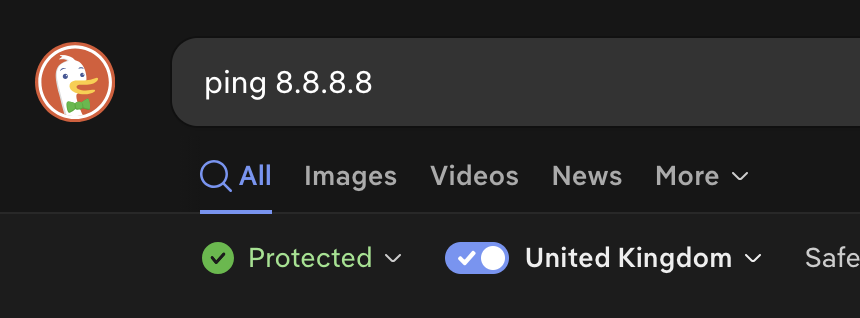
You know you're running on fumes when your troubleshooting strategy is literally "let me check if the internet exists." Pinging 8.8.8.8 (Google's DNS) is the developer equivalent of slapping the side of a TV to see if it works. It's that baseline sanity check before your first coffee kicks in—if this doesn't respond, either your network is toast or you haven't paid the internet bill in three months. The DuckDuckGo browser with "Protected" and "United Kingdom" filters just adds to the vibe. Like yeah, we're privacy-conscious and geographically specific, but also too brain-dead to remember if we're actually connected to WiFi. Classic Monday morning energy.

Dennis

Dennis
You know what? This actually tracks. If we're gonna pronounce SQL as "sequel" instead of the proper S-Q-L, then yeah, DNS should absolutely be "Dennis." And honestly, "Dennis" has been causing me way more problems than any actual person named Dennis ever could. Server not responding? Dennis is down. Website won't load? Dennis propagation issues. Can't reach the internet? Dennis lookup failed. At least now when I'm troubleshooting at 2 AM, I can yell "DENNIS, WHY ARE YOU LIKE THIS?" and it'll feel more personal. The consistency is chef's kiss though—either we pronounce everything as acronyms or we give them all proper names. I'm ready to meet their friends: API (Ay-pee), HTTP (Huh-tup), and my personal favorite, JSON (Jason).

A Perfectly Stable Technology Stack

A Perfectly Stable Technology Stack
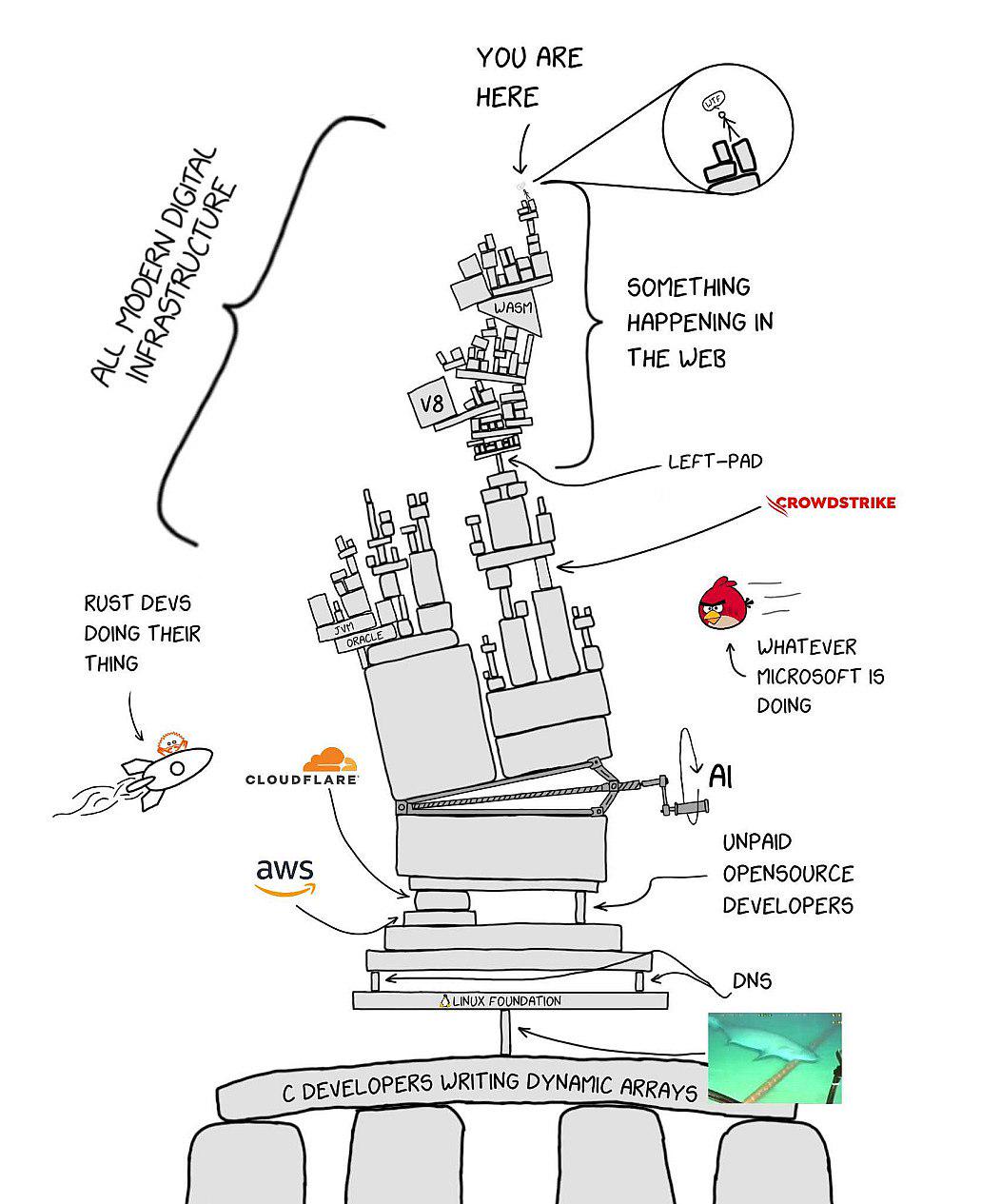
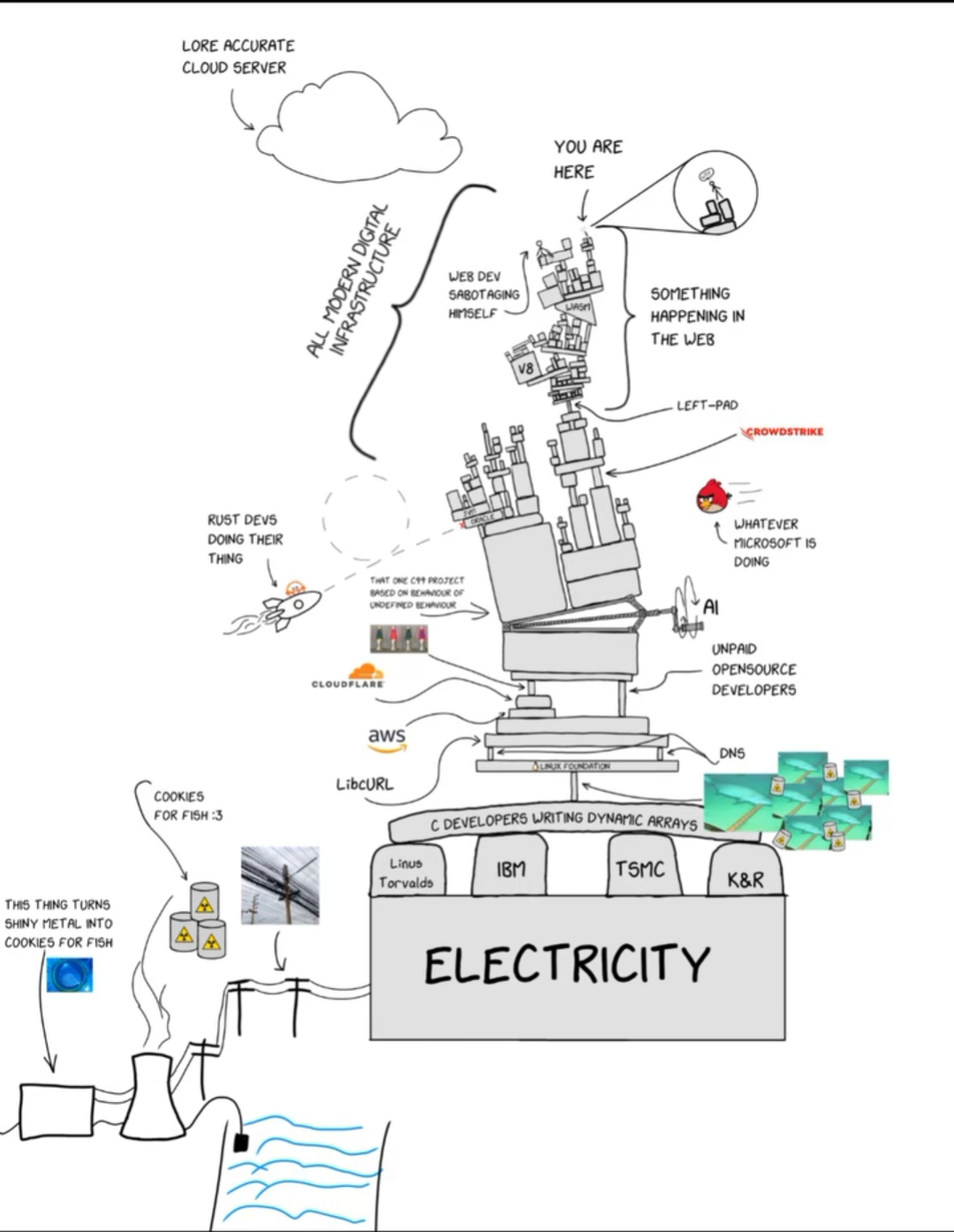
So the entire internet is basically a Jenga tower held together by C developers who still think dynamic arrays are black magic, a Linux foundation that somehow hasn't collapsed yet, unpaid open-source maintainers (bless their souls), AWS charging you $47 for breathing, Cloudflare doing the actual work, and Rust evangelists launching themselves into space. Meanwhile, you're up there at the top with your WASM and V8, blissfully unaware that your entire existence depends on left-pad not getting deleted again, CrowdStrike deciding to push untested updates on a Friday, Microsoft doing... whatever Microsoft does, and DNS being held together by what appears to be an underwater cable and prayers. But sure, your React app is "production-ready." Sleep tight.

When My Website Down

When My Website Down
Every developer's first instinct when their site goes down: blame Cloudflare. DNS issues? Cloudflare. Server timeout? Cloudflare. Forgot to pay your hosting bill? Definitely Cloudflare. Meanwhile, it's usually your own spaghetti code throwing 500 errors or that database migration you ran on production without testing. But sure, let's refresh the Cloudflare status page 47 times and angrily shake our fist at the CDN that's probably the only thing keeping your site from completely melting down under traffic. The real kicker? Nine times out of ten, Cloudflare is actually working fine—it's just proxying your broken backend like the loyal middleman it is.

In Conclusion: Magic DNS

In Conclusion: Magic DNS
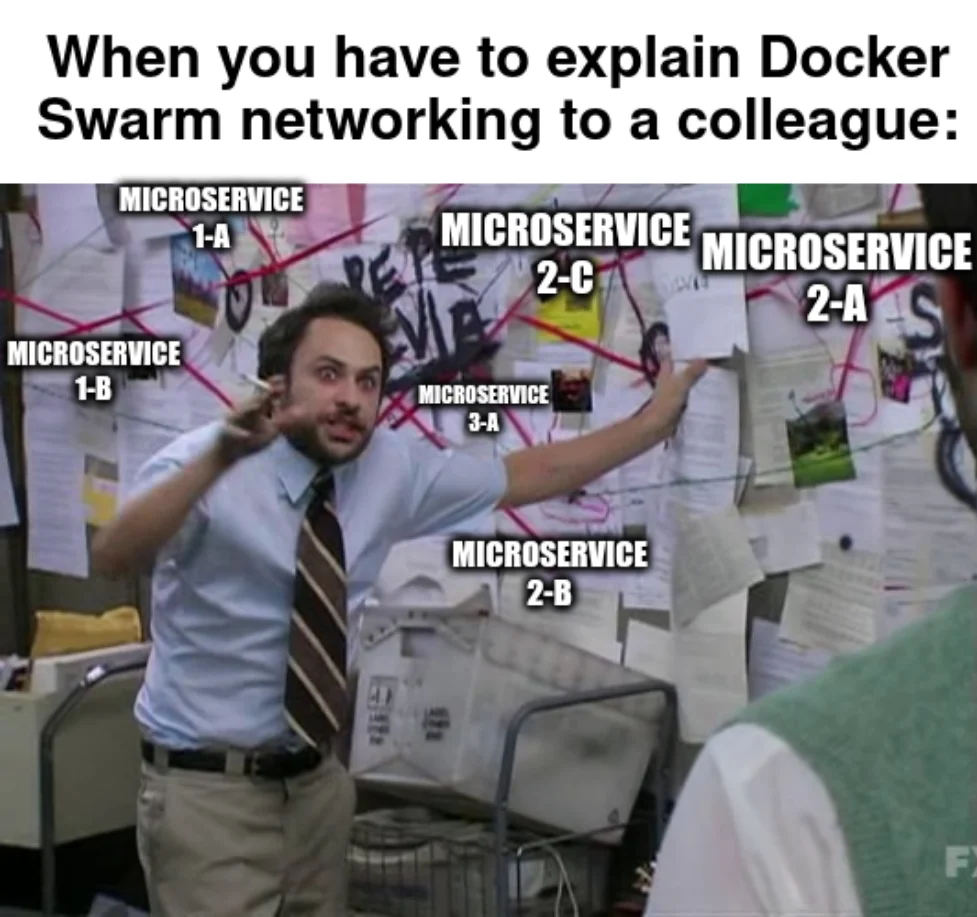
Docker Swarm's overlay networking is one of those beautiful lies we tell ourselves. "Service discovery just works," they said. "DNS resolution is automatic," they promised. Then you're standing in front of a whiteboard trying to explain how microservice 2-C talks to microservice 1-A through an invisible mesh network that somehow resolves names without anyone knowing how. The red strings connecting everything? That's you frantically gesturing about overlay networks, ingress routing mesh, and VIPs while your colleague's eyes glaze over. Eventually you just wave your hands and mutter something about "embedded DNS server on 127.0.0.11" and hope they stop asking questions. Spoiler: They never do. Someone always asks "but how does it ACTUALLY work?" and you're back to the conspiracy board.

Stop Doing DNS

Stop Doing DNS
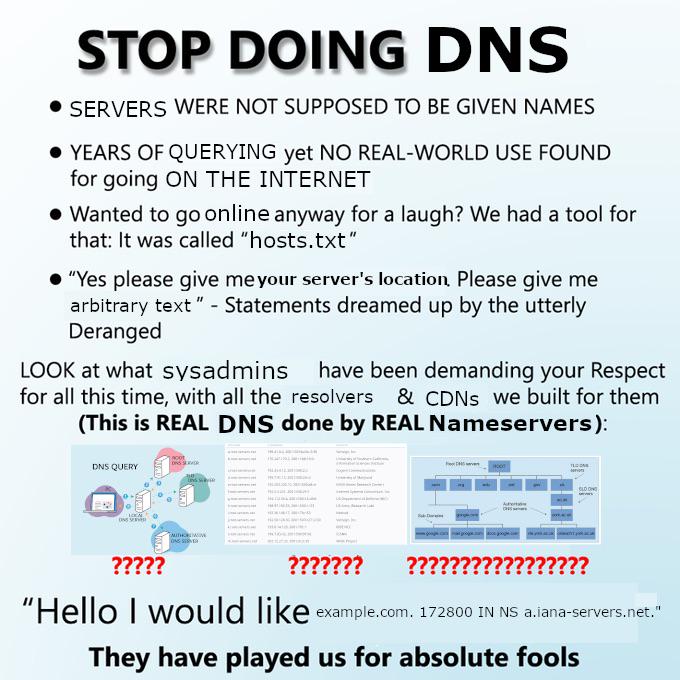
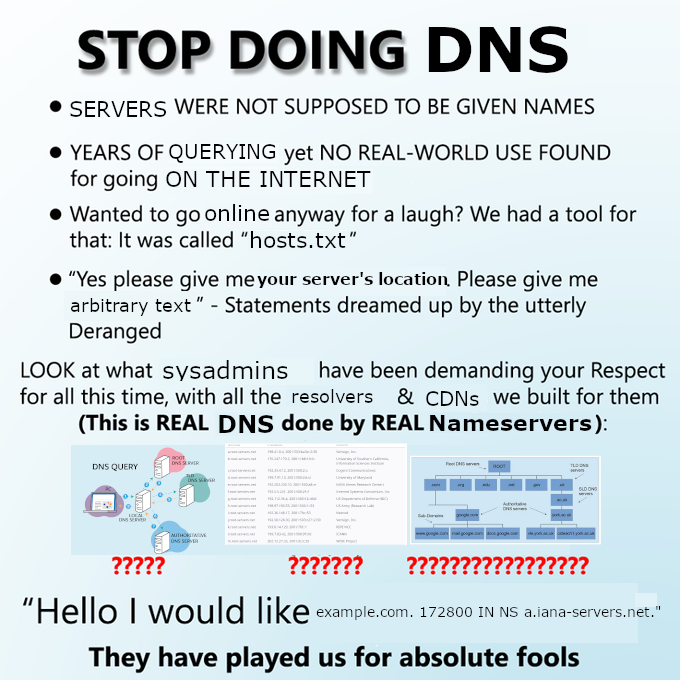
Someone finally said it. DNS is apparently a scam perpetuated by Big Nameserver to sell more resolvers. Servers were perfectly happy being identified by raw IP addresses until sysadmins got greedy and demanded "respect" in the form of complex distributed systems that nobody understands. The argument here is that we had hosts.txt—a single file that every computer could use to map names to IPs. Simple. Elegant. Completely unscalable. But who needs the internet to grow anyway? Instead, sysadmins convinced everyone we needed this elaborate DNS infrastructure with recursive queries, authoritative nameservers, TTLs, and zone files. Now when someone asks for example.com, you get a 17-step journey through multiple servers just to return an IP address. They've been laughing at us this whole time while we troubleshoot NXDOMAIN errors at 3 AM. The three diagrams with increasing question marks perfectly sum up every developer's understanding of DNS: "I think I get it... wait, what?... I have no idea what's happening anymore."

What's A TXT Record

What's A TXT Record
Someone just asked what a TXT record is and now the entire DNS infrastructure is having an existential crisis. The rant starts off strong: naming servers? Pointless. DNS queries? Never needed. The hosts.txt file was RIGHT THERE doing its job perfectly fine before we overengineered everything. Then comes the kicker—sysadmins apparently want to know "your server's location" and "arbitrary text" which sounds like something a "deranged" person would dream up. But wait... that's literally what TXT records do. They store arbitrary text strings in DNS for things like SPF, DKIM, domain verification, and other critical internet infrastructure. The irony is thicker than a poorly configured DNS zone file. The punchline? After this whole tirade about DNS being useless, they show what "REAL DNS" looks like—three increasingly complex diagrams that nobody understands, followed by a simple DNS query example. The response: "They have played us for absolute fools." Translation: DNS is actually incredibly complex and essential, and maybe we shouldn't have been complaining about TXT records in the first place. It's the classic developer move of calling something stupid right before realizing you don't actually understand how it works.

Cloudflare Couldn't Recover At This

Cloudflare Couldn't Recover At This
When your pickup line is literally just recounting global infrastructure failures, you know you've reached peak developer romance. Bringing up that time half the internet went down is apparently the new "Do you come here often?" The girl's reaction says it all—she's either genuinely impressed that someone else was also refreshing their status page every 30 seconds during the outage, or she's plotting her escape route. Either way, this conversation is going better than Cloudflare's uptime that day. Pro tip: If mentioning DNS failures gets you this kind of response, you've found your soulmate. Time to move on to discussing your favorite HTTP status codes on the second date.

The Whole Internet Relies On That One Shark

The Whole Internet Relies On That One Shark
So that's what's holding up the internet - a precarious tower of technology balanced on Linus Torvalds' shoulders with a random shark at the DNS level. Turns out those underwater cables aren't the most concerning part of our infrastructure. The real MVP is that shark guarding the DNS servers while C developers write dynamic arrays, Rust devs do their thing, and some web dev quietly sabotages himself in the corner. Meanwhile, unpaid open source developers and "whatever Microsoft is doing" somehow keep this Jenga tower from collapsing. Sleep well tonight knowing your entire digital existence depends on this absurd tech stack and one very dedicated fish.

End Of All Modern Digital Infrastructure

End Of All Modern Digital Infrastructure
OMG, the AUDACITY of this truth bomb! 💣 The entire digital world—trillion-dollar companies, fancy cloud services, and corporate tech empires—all balancing precariously on the shoulders of sleep-deprived open source developers coding for free while surviving on ramen and energy drinks! That massive pillar labeled "Unpaid Open Source Developers" is literally holding up everything from DNS to AWS while Microsoft is off doing... whatever Microsoft does. The internet would IMPLODE if these caffeine-fueled heroes decided to take a collective vacation day. Fun fact: About 80-90% of all code in modern applications comes from open source components. We're all just one rage-quit away from digital armageddon!

Do Not Unplug: The Internet's Fragile Architecture

Do Not Unplug: The Internet's Fragile Architecture
The internet: a precarious tower of technology held together by duct tape, prayers, and that one guy who maintains a critical npm package from his basement. At the bottom, we've got ISP backbones with a "Do Not Unplug" sign that some intern is definitely eyeing right now. Above that, the Linux Foundation quietly supporting civilization while DNS pretends it's not having an existential crisis. Unpaid open-source developers are literally the load-bearing wall of this structure, while AWS and Cloudflare collect enterprise subscription fees for the privilege of not watching it all collapse. Meanwhile, V8 and WASM are somehow making "things happen in the web" while Microsoft flies around like an Angry Bird, contributing exactly what you'd expect: chaos. If you ever wondered why your app crashed, it's because someone bumped this technological Jenga tower.

The Internet: A Tower Of Questionable Decisions

The Internet: A Tower Of Questionable Decisions
The internet is basically a Jenga tower of questionable engineering decisions. At the very bottom, we've got C developers manually allocating memory for dynamic arrays—because who needs garbage collection when you can have segmentation faults? Above that foundation of tears sits DNS (the system that translates human-readable website names into IP addresses) and the Linux Foundation (keeping the lights on while everyone else has fun). Then we've got the unpaid open-source developers—those magnificent souls whose thankless work powers 90% of the internet while they survive on ramen and GitHub stars. AWS and Cloudflare are the duct tape holding everything together, while AI dangles precariously off the side like an afterthought. Microsoft is apparently doing... something... with Angry Birds energy? Meanwhile, Rust developers are zooming around in their little rocket ship, telling everyone their code is "memory safe" for the 47th time today. And at the tippy-top of this architectural abomination? That's you, my friend, just trying to watch cat videos while the entire digital infrastructure—built on WASM, V8, and whatever "LEFT-PAD" is referring to—teeters beneath you. The miracle isn't that the internet works—it's that it hasn't collapsed under the weight of its own absurdity.